
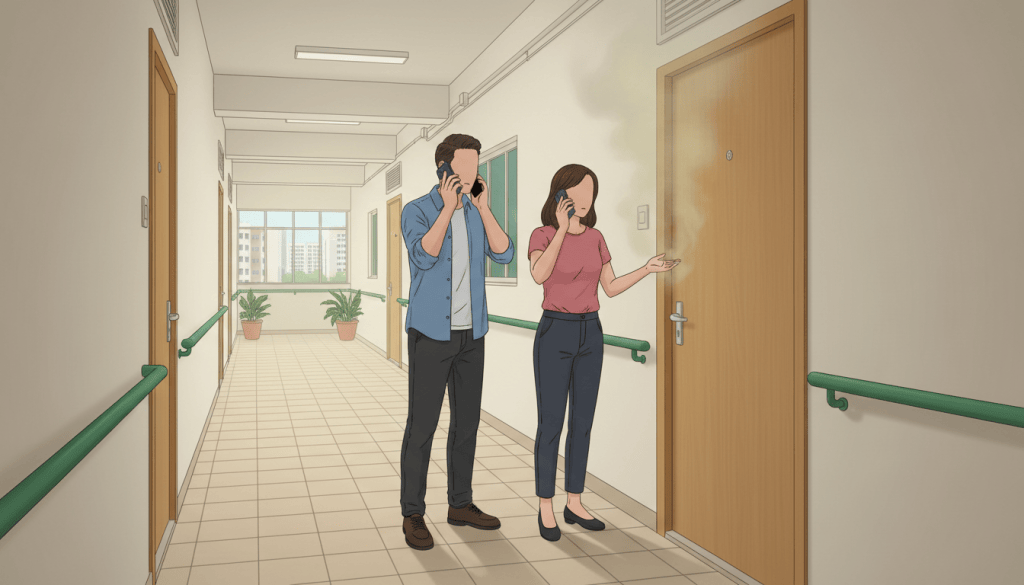
Someone in a Sengkang flat, garage or enclosed room develops an unexplained headache, dizziness, nausea, confusion or collapse near charcoal, an engine, a generator or a fuel-burning appliance? Consider the possibility of carbon monoxide (CO) poisoning. Move to fresh air immediately if you can do so safely and call 995 for an ambulance. Do not go back inside to retrieve belongings, switch equipment off or rescue someone from a suspected toxic atmosphere without proper protection and professional instructions.
Carbon monoxide has no colour or smell. A normal-looking room and the absence of a gas odour do not exclude poisoning. Symptoms can be mistaken for food poisoning or an ordinary viral illness. When more than one occupant becomes unwell in the same enclosed place, or symptoms improve on leaving, tell emergency staff that a possible shared combustion exposure occurred. Medical assessment is important even if the person feels better outdoors.
- Immediate possible CO exposure: leave the affected area safely; call SCDF 995 and report a suspected toxic fume exposure.
- Severe symptoms: confusion, chest pain, severe weakness, seizures, breathing difficulty or collapse are medical emergencies.
- Do not: re-enter a closed room, enclosed car park or service space to investigate or retrieve another person without trained rescue protection.
- Never use: a charcoal grill, portable generator or camping stove indoors or in a garage.
- Gas smell: treat a suspected piped-gas leak separately; from a safe location contact City Energy’s 1800 752 1800 or 995 for immediate danger.
- Professional response: the source must be assessed and made safe before anyone re-enters.
First five minutes: what to do if carbon monoxide is suspected
- Get yourself out of the affected space. Move toward outdoor fresh air using a safe route; do not stay to identify the source.
- Help others leave without entering a dangerous area. A would-be rescuer can be overcome by the same gas.
- Call 995 from safety. Tell the operator ‘possible carbon monoxide or combustion fume exposure’ and describe the source and symptoms.
- State the exact Sengkang address. HDB block, floor, unit, car-park deck or commercial premises, plus access details.
- Check for serious symptoms. Inform SCDF about anyone unconscious, confused, short of breath or complaining of chest pain.
- Do not re-enter. Wait for trained responders to assess the atmosphere and secure the cause.
- Seek medical assessment even after improvement. CO exposure may affect the heart and brain, and an ordinary home pulse-oximeter reading cannot reliably rule it out.
Who to call in Sengkang
- 995 — SCDF fire, rescue and emergency medical services: for suspected serious fume poisoning, collapse, loss of consciousness or a dangerous confined atmosphere. SCDF Emergency Medical Services.
- 1800 752 1800 — City Energy: 24-hour specialist assistance for suspected piped-town-gas leakage; this is not a replacement for a 995 medical emergency call. City Energy gas emergency hotline.
- Building management or MCST: after calling SCDF if needed, report a suspected exhaust-fume incident in a common garage, mechanical area or building.
- Qualified equipment or gas-service professional: inspect any suspected defective combustion appliance after the emergency scene is released.
- Healthcare professionals: assess exposed people even when headache, nausea or dizziness have temporarily eased.
What exactly is carbon monoxide?
Carbon monoxide is produced when carbon-containing fuel burns incompletely. It can arise from charcoal, petrol and diesel engines, natural gas or other burning fuels under certain conditions. It is not the same gas as carbon dioxide, and it is not identical to an ordinary piped-gas leak.
The US CDC’s 2026 carbon-monoxide guidance explains that CO is colourless and odourless. Inhaled CO interferes with the body’s ability to use and transport oxygen and can injure the brain, heart and other organs. High exposure can cause sudden loss of consciousness and death.
CO exposure risk increases when combustion exhaust accumulates rather than disperses, such as in a closed room, basement, garage, enclosed car or a poorly ventilated space. The amount of CO present cannot be reliably estimated from a person’s nose or from how smoky the space looks.
Common symptoms: why it can resemble flu or food poisoning
- Headache, unusual tiredness and weakness.
- Dizziness or difficulty maintaining balance.
- Nausea, stomach upset or vomiting.
- Confusion, poor concentration or an altered mental state.
- Chest discomfort, palpitations or shortness of breath.
- Unusual drowsiness, fainting, seizure or collapse in severe cases.
These symptoms can have many medical causes. The key environmental clue may be that several people become unwell in the same place or feel better when away from a fuel-burning source. The NHS carbon monoxide guidance also explains that symptoms may fluctuate when someone moves in and out of an affected building.
Do not wait for all symptoms to appear. If someone is severely unwell or the source may still be active, move away and get emergency assistance. If you are unsure about the diagnosis, report your actual observations and the possible source.
Carbon monoxide is not the smell of town gas
Singapore’s piped town gas and LPG can be associated with a distinctive warning smell because odorants are added. Carbon monoxide itself has no warning odour. The fact that someone cannot smell a gas leak does not prove the air is safe from combustion fumes.
Conversely, a strong gas smell requires gas-leak precautions: avoid sparks or flames, do not operate electrical switches in the suspected leak area, move away and contact the appropriate emergency number from a safe distance. Refer to the Sengkang gas-leak guide for piped gas versus LPG contacts.
A suspected CO incident warrants urgent medical assessment and investigation of combustion equipment. An ordinary gas hotline cannot diagnose or treat an exposed person.
Why you should never operate a portable generator indoors
A petrol or diesel generator can produce poisonous exhaust while supplying power. During a blackout, it may be tempting to place one in a corridor, service yard or garage. CDC guidance says generators must not be used inside homes or garages, even with windows or doors open, because CO may accumulate or enter buildings.
A generator positioned just outside an open window or ventilation intake can also introduce exhaust into occupied rooms. The safest arrangement follows the equipment manufacturer’s requirements and outdoor safety rules, with exhaust well away from openings and people. Do not treat a balcony or air-conditioned service yard as necessarily suitable.
Most ordinary Sengkang residential power interruptions do not require a household to run a fuel-powered generator. For an actual supply fault, contact SP Group on 1800 778 8888 and follow the Sengkang power-outage guide.
Charcoal and barbecue equipment indoors
Charcoal continues to produce CO even when the flames are no longer obvious. A grill or pot of burning charcoal in a closed room, stairwell or poorly ventilated garage can create a serious poisoning hazard. The CDC explicitly warns against charcoal grills and camp stoves indoors.
Do not bring a charcoal barbecue into an HDB room to keep food warm or to avoid rain. A source that feels small may still create dangerous exposure after sustained combustion. If people begin feeling unwell, leave the space and call 995.
A partially extinguished grill should also be managed using the appropriate fire-safety procedures, not carried through a residential corridor by someone already feeling dizzy.
Engine exhaust in a basement or enclosed car park
Motor-vehicle exhaust can contain CO. A poorly ventilated garage or enclosed space with an idling combustion-engine vehicle may be hazardous, especially if exhaust is accumulating. Do not stay beside a suspected exhaust leak to investigate an unusual engine noise.
If there is a suspected dangerous gas buildup, move people out of the affected area and tell building management and emergency responders. Give the car-park level, vehicle or generator location if known from a safe position, and whether anyone is unconscious or trapped.
Do not assume an open car-park entrance guarantees safe air throughout the structure. Professionals must assess the site and any ventilation problem.
What to do when several family members feel sick together
Two or more people developing headache, nausea and dizziness at the same time in one enclosed room can suggest a shared environmental exposure. That is not proof of CO: foodborne illness, infection and other hazards are possible. But a known fuel-burning appliance, engine or charcoal source makes CO important to mention to 995.
Do not spend an hour comparing symptoms at home to decide whose condition is worse. Move everyone to safe air and get medical guidance. Tell responders about every potentially exposed person, including infants, older adults and household members who were sleeping.
Do not re-enter to rescue an unconscious person
This is one of the most dangerous mistakes. A rescuer who runs into a contaminated room without breathing protection may collapse before reaching the patient. SCDF has specialist equipment and training for hazardous atmospheres.
Call 995, state that a person may be unconscious inside and describe the doorway, unit and source. Let the emergency team manage entry, gas testing and removal. Do not ask a neighbour to try first while waiting for the ambulance.
What happens at hospital after suspected CO exposure?
Medical professionals may assess symptoms, heart function, neurological status and exposure history. Testing can involve measurement of carboxyhaemoglobin rather than relying only on an ordinary finger pulse oximeter. CDC’s clinical guidance warns that conventional two-wavelength pulse oximetry is unreliable in the presence of carboxyhaemoglobin.
A person may require medical oxygen, monitoring or further treatment according to the severity and clinical findings. Do not administer improvised oxygen equipment or a neighbour’s prescribed medicine. An improvement after moving outdoors does not by itself exclude internal injury.
Pregnant people, infants, older adults and people with existing heart or respiratory disease can face additional risk. Tell the healthcare team if pregnancy is involved or if a person has important medical conditions.
What if somebody has a normal oxygen-saturation reading?
A familiar pulse oximeter reading can be misleading during carbon-monoxide poisoning. Some devices cannot distinguish ordinary oxygen-carrying haemoglobin from carbon-monoxide-bound haemoglobin. An apparently normal value should not override a significant exposure history or serious symptoms.
Tell the medical team that CO is suspected and describe the likely source. The clinician decides which tests and treatment are necessary.
How to report the incident clearly to 995
- Where: Sengkang HDB block, street, unit and floor; garage level or named premises.
- Possible source: charcoal, generator, vehicle exhaust, stove, water heater or unknown combustion device.
- People: number exposed and whether anybody remains inside the room.
- Symptoms: headache, confusion, vomiting, breathing trouble, collapse or unconsciousness.
- Timing: when people started feeling unwell and how long the appliance or engine may have operated.
- Hazards: smoke, fire, gas smell or blocked exits, but only report what is known.
- Safe access: where rescuers can enter and where the caller is waiting.
Sengkang scenarios
A family becomes dizzy after using charcoal in a closed room
Leave the room safely, bring other occupants out without risking another exposure and call 995. Tell responders the charcoal source and the symptoms. Do not return to dispose of the charcoal.
A petrol generator is running inside a service area
Stop approaching and move people away. If symptoms or dangerous exposure are suspected, contact 995 and let professionals make the area safe. Do not move the generator while it is running in a hazardous atmosphere.
Someone feels weak in an enclosed car park with exhaust fumes
Move toward safe fresh air and seek urgent medical assessment for suspected poisoning. Call 995 for serious symptoms or any person who is unresponsive or trapped.
A neighbour smells gas but nobody is unwell
This may be a piped-gas or LPG leak rather than CO. Avoid ignition sources, move to safety and use the relevant gas emergency or SCDF contact. Do not use smell to rule out separate toxic-gas exposure.
Prevention for households
- Never operate portable fuel-powered generators in rooms, service yards, garages or other enclosed spaces.
- Never burn charcoal indoors or use an outdoor barbecue as an indoor cooker or heater.
- Have fuel-burning and gas appliances installed and maintained by appropriate licensed professionals.
- Do not run combustion-engine vehicles in enclosed, poorly ventilated locations.
- Follow reliable equipment ventilation requirements and keep exhaust away from doors and windows.
- Consider appropriate certified CO alarms where combustion appliances or sources present a realistic risk, and maintain them as specified.
- Teach household members that CO cannot be detected by smell and that fresh air and emergency help take priority.
Frequently asked questions
Can I smell carbon monoxide?
No. Carbon monoxide is colourless and odourless. The smell of a gas leak is a different signal and needs separate precautions.
Should I open windows and remain in the room?
No. If CO exposure is suspected, leave the area and seek medical assistance. Do not rely on opening windows while remaining in a potentially dangerous atmosphere.
Does a normal pulse oximeter rule out poisoning?
No. Standard pulse oximetry can be misleading because it cannot reliably distinguish carboxyhaemoglobin from oxygenated haemoglobin.
Do I call 995 or the gas supplier?
Call 995 for suspected serious poisoning, collapse or dangerous exposure. For a separate suspected piped-gas leak, City Energy’s 24-hour hotline is 1800 752 1800.
Is a generator safe in a garage with the door open?
No. CDC guidance warns not to operate portable generators inside garages, even with doors or windows open.
Related Sengkang emergency guides
- Piped gas and LPG leaks
- HDB fire, smoke and evacuation
- Power outages and electrical faults
- Medical emergencies and SCDF 995
Explore more Sengkang emergency guides: Suspicious parcels, bomb threats and Police help · Locked-out flats and vulnerable people trapped inside · Discoloured tap water and drinking-water advisories.
Official medical and safety references
- US CDC — Carbon Monoxide Poisoning Basics, 2026
- US CDC — Clinical Guidance for Carbon Monoxide Poisoning, 2026
- NHS — Carbon Monoxide Poisoning Symptoms and Emergency Advice
- Singapore Red Cross — First Aid, Fumes Inhalation
- SCDF — 995 Emergency Medical Services
- City Energy — Piped Gas Emergency Hotline
Reviewed 7 November 2026. This public-safety guide does not diagnose gas poisoning or assess the safety of a specific building. Move to safe air and call 995 when carbon monoxide exposure is suspected. Follow SCDF and clinical advice.
