
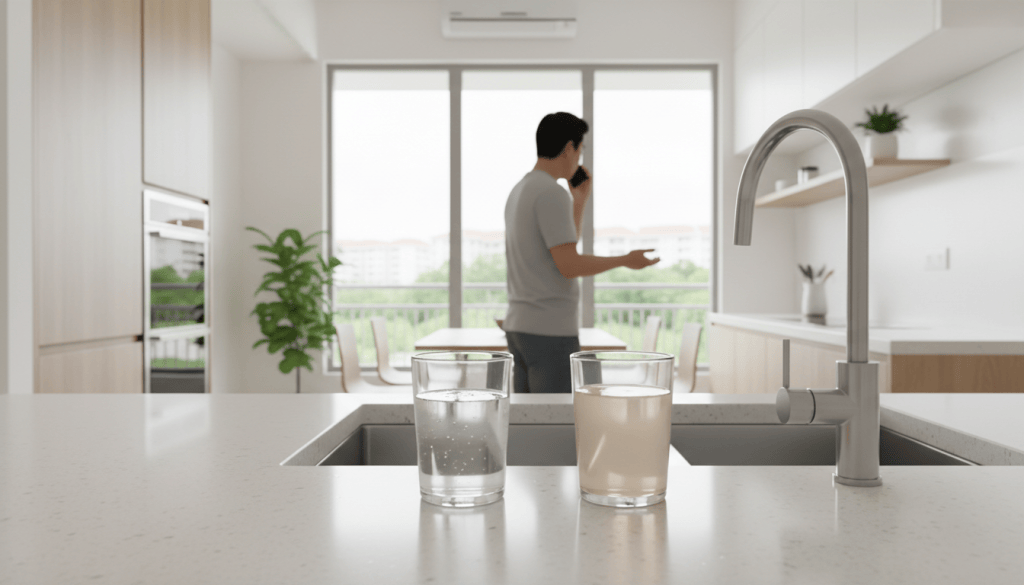
Brown, cloudy or unusual-smelling water coming from your tap in Sengkang? Do not drink or cook with visibly abnormal water until the issue has been resolved or you have appropriate official guidance. For an ordinary discolouration with no other hazard, Singapore’s national water agency, PUB, recommends running the tap until it clears; if it remains discoloured after about 10–15 minutes, contact its 24-hour call centre at 1800 2255 782, or 6521 6470. You can also submit a Water Quality Issue report to PUB.
Suspect a chemical, fuel or toxic contamination? Do not drink, cook, brush teeth or prepare baby formula with that water. Do not attempt to make it safe just by boiling: boiling does not remove many harmful chemicals. Use an unaffected trusted drinking-water source and contact PUB immediately for advice. If someone develops collapse, severe breathing difficulty, seizures or another life-threatening symptom after a suspected exposure, call 995 for SCDF emergency medical help.
- Ordinary brownish tap water: follow PUB’s flushing guidance and avoid using it until clear; call 1800 2255 782 if it persists.
- Strong unexplained chemical or fuel smell: stop use for consumption and contact PUB promptly; do not taste it to identify the substance.
- Only hot water discoloured: consider water-heater or internal plumbing problems; notify the owner or qualified plumber.
- Only one tap affected: check with building management or suitable plumbing services as the cause may be local.
- Official boil-water or do-not-use instruction: follow exactly what PUB or the responsible authority says; these are different advisories.
- Life-threatening illness: SCDF 995, not the routine water-quality feedback form.
The first five minutes: what to check and do
- Check health symptoms first. Serious illness after suspected exposure warrants emergency medical care. Call 995 for life-threatening symptoms.
- Stop consuming suspicious water. Avoid drinking, cooking, making ice or preparing infant formula with water that has an unresolved alarming appearance or smell.
- Observe safely. Note whether the water is brown, cloudy, has particles or smells unusual; do not taste an unknown substance.
- Check which taps are affected. Only hot water, one cold tap, several taps or multiple neighbouring units?
- For ordinary discolouration, follow PUB’s flush advice. Run the tap until it clears; report persistent discolouration after approximately 10–15 minutes.
- Report chemical-looking or unusual water promptly. Use PUB’s 24-hour phone or official Water Quality Issue form.
- Follow any official water advisory. Use safe alternative water for the activities specified, and never assume boiling fixes chemical contamination.
Who to call in Sengkang
- 1800 2255 782 — PUB 24-hour call centre: public water quality issues, suspected contamination, significant discoloration, major pipe bursts and water supply interruptions. Alternative 6521 6470. PUB Contact Us.
- PUB online report: Report Water Quality Issue for problems with water’s smell, taste or appearance.
- 6590 9777 — Sengkang Town Council EMSU: urgent common-area estate maintenance under its management when a shared water tank or installation may be involved. SKTC Essential Maintenance Service Unit.
- Licensed plumber or building manager: problems involving private service pipes, water heaters and internal installations, where professional repair is needed. PUB licensed plumbing guidance.
- 995 — SCDF: collapse, severe poisoning, breathing difficulty or another life-threatening medical emergency. It is not the usual reporting channel for an ordinary cloudy tap.
Singapore’s tap water is normally safe to drink
PUB monitors and treats Singapore’s public drinking-water supply to standards based on World Health Organization guidance and the Food Safety and Security (Non-Packaged Drinking Water) Regulations 2025. It states that water from the national supply is suitable for drinking directly from the tap without additional household filtration under normal conditions.
PUB’s drinking-water quality information explains that the agency tests drinking water through a national monitoring programme and investigates quality reports. A single episode of brown tap water does not establish that the whole Sengkang district’s water is contaminated.
That normal standard should not be used to dismiss a specific local observation. Internal pipes, storage tanks, hot-water heaters, infrequent use and maintenance operations can all affect water appearance at the point of use. Accurate reporting helps locate the actual source.
Why tap water sometimes looks brown
PUB explains that common causes of brownish or discoloured tap water include sediment being stirred in a water main during maintenance or heavy water draw-off, or corrosion and deposits in private pipes or water-heater systems. Mineral particles can become suspended temporarily after the direction or flow of water changes.
For an ordinary brownish-water episode, PUB advises running the tap and allowing the water to clear before drinking or using it. Avoid laundry and other uses while the water is discoloured, because particles may stain fabrics or interfere with household tasks.
If the water does not clear after about 10–15 minutes, report it to PUB. The agency may investigate whether the problem comes from the national main, a building’s distribution system or an internal appliance.
What if the water is milky or cloudy?
PUB says that a milky appearance can sometimes be caused by tiny dissolved-air bubbles, which typically clear after the water is left to stand briefly. This is different from brown sediment or an unusual chemical odour. The appearance alone cannot prove whether every possible issue is harmless.
When water looks cloudy, compare whether it clears over a short period without tasting it. If the condition persists or you observe particles, smell or other unusual changes, contact PUB for a quality report.
Do not rely on home experiments or internet videos to declare the water safe for an infant, pregnant person or vulnerable family member.
Only hot water has changed colour: check the heater
If the cold tap looks normal but hot water from a heater appears brown or rusty, the issue may be inside a storage-type water heater or its pipework. PUB specifically lists corrosion of heater tanks and fittings as possible causes of discoloured water.
Stop using the suspect hot-water supply for drinking or food preparation. Contact the owner, building manager or qualified contractor for an appropriate assessment. Do not dismantle or drain a heater yourself if doing so would involve electrical, high-temperature or pressurised-system hazards.
A whole building’s cold-water issue is different from an isolated appliance fault, so tell PUB exactly which taps are affected.
Does boiling brown water make it safe?
Boiling is not a universal solution. Heating water appropriately can kill many disease-causing microbes, but it does not remove fuel, heavy metals or many toxic chemicals. The US CDC’s emergency water guidance explicitly warns that water contaminated with fuel or toxic chemicals cannot be made drinkable by boiling or disinfection.
If an official boil-water advisory is issued because of a microbiological concern, follow its exact instructions. If authorities issue a do-not-drink or do-not-use advisory, those are different and may require bottled water or other sources rather than boiling.
This article does not claim that any boil-water advisory is currently active in Sengkang. Use current PUB announcements for the specific area, water type and safety instructions.
The difference between three types of water advisories
- Boil-water advisory: typically used when microbial contamination is suspected; authorities specify how and when to boil before relevant uses.
- Do-not-drink advisory: often used when water may contain harmful chemicals or other substances; boiling does not necessarily make it drinkable.
- Do-not-use advisory: potentially applies when even contact with tap water could be unsafe; follow the specific restrictions for washing, bathing or food preparation.
CDC guidance on drinking-water advisories explains these categories. Singapore’s relevant authority determines the exact local instruction if an incident occurs. Do not import another country’s advisory rules as though they have automatically been imposed on Sengkang.
What if several neighbours also have discoloured taps?
A wider pattern may point to building distribution plumbing, storage tanks, recent maintenance or a main-supply issue. Note which blocks and floors are affected, when the change began and whether both hot and cold water show it. Report the findings to PUB and the property manager.
A single neighbour’s experience is useful, but it is not a substitute for official testing. Do not announce on a resident group that all Sengkang tap water is unsafe when you only know about one building. Share the relevant PUB contact and factual details.
If PUB identifies a main-supply issue, it may isolate the relevant water section, conduct flushing and arrange temporary drinking water when required. Specific arrangements depend on the incident.
Water quality after a supply interruption or pipe repair
After a water main has been repaired or flushed, sediment in pipes can sometimes be disturbed. PUB recommends allowing ordinary discoloured tap water to run clear, then contacting its hotline if the issue persists. Follow any incident-specific PUB instructions rather than setting an arbitrary waiting period.
The presence of temporary low pressure or discolouration does not prove a serious contamination event. Equally, it should not be ignored when unusual, persistent or accompanied by a chemical smell.
For a major broken pipe or total water supply interruption, see the Sengkang burst pipe guide.
Chemical odour, fuel-like smell or unusual taste
If water has a strong or unusual smell suggestive of fuel or chemicals, stop using it for consumption and report it promptly to PUB. Do not intentionally taste or sniff closely to identify a substance. In some cases, a smell may come from the sink drain or surrounding room rather than from water itself; describe what you observed without claiming a diagnosis.
Do not attempt to treat unknown chemical contamination using a household filter, extra chlorine, vinegar or boiling. The appropriate response depends on what the substance is, and public utilities or healthcare professionals should advise on safe use.
If several people have become seriously ill after a suspected exposure, call 995 and tell the dispatcher that contaminated water may be involved.
Why ordinary household filters are not a proof of safety
Different filtration devices remove different substances, and the outcome depends on installation and maintenance. A consumer filter cannot be assumed to eliminate every chemical, microbe or dissolved contaminant. PUB notes that poorly maintained filters can themselves become places where bacteria grow.
Explore more Sengkang emergency guides: Suspicious parcels, bomb threats and Police help · Carbon monoxide poisoning and indoor fumes · Locked-out flats and vulnerable people trapped inside.
During an official water advisory, follow the public agency’s approved water sources and restrictions rather than assuming an under-sink filter or a jug will resolve the concern.
Children, baby formula and elderly residents
Infants and young children may be especially vulnerable to some contaminated-water exposures, and caregivers need a reliable source for formula and drinking. If there is a do-not-drink warning or unresolved strong chemical concern, use an unaffected safe water source and consult PUB or medical professionals about the applicable restrictions.
A person with kidney problems or another significant condition may have special fluid needs. If water quality is uncertain, ask the treating healthcare team about the appropriate alternative rather than reducing essential fluid intake without advice.
When is the issue a health emergency?
- Collapse, loss of consciousness or seizures after suspected exposure.
- Severe difficulty breathing or chest pain.
- Serious confusion, inability to swallow safely or rapidly worsening illness.
- Severe dehydration, particularly in a child or older adult.
- Another life-threatening medical condition requiring SCDF assistance.
Call 995 in those circumstances. A change in water colour alone is not an automatic ambulance emergency; report it to PUB and seek appropriate medical advice if symptoms develop.
How to report a water-quality problem to PUB
- Use PUB’s Water Quality Issue form or call 1800 2255 782 for urgent assistance.
- Give the Sengkang block, street, unit, postal code and time the issue started.
- Specify whether cold water, hot water or multiple taps are affected.
- Describe colour, particles or unusual smell without tasting the water.
- Say whether the condition persists after PUB-recommended flushing, when appropriate.
- Share whether neighbouring flats or common water outlets are also affected.
- Retain the report number and follow any instructions for testing, maintenance or safe alternative supply.
Three Sengkang examples
The cold tap becomes brown after a maintenance notice
Avoid drinking or washing laundry with visibly discoloured water. Follow PUB’s ordinary flushing guidance until clear, and report it to 1800 2255 782 if persistent after 10–15 minutes or otherwise concerning.
Only the bathroom hot shower runs rusty
The water heater or internal piping may be involved. Avoid consuming that supply and arrange an inspection by the responsible owner or qualified professional. Tell PUB if the source remains uncertain.
Several flats report an unexplained chemical smell
Do not drink or cook with the suspect water, notify PUB promptly and follow its advice. Do not boil it expecting to remove an unknown chemical. Seek medical care for any significant exposure symptoms.
Household preparation
- Save PUB’s 24-hour water-quality contact 1800 2255 782.
- Maintain water heaters, service pipes and household fixtures through appropriate professionals.
- Follow official building water-tank maintenance notices.
- Check disused taps after extended absences according to PUB guidance.
- Keep a modest reserve of safe drinking water appropriate to household needs.
- Know where to find official PUB advisories rather than relying on forwarded screenshots.
- Never mix cleaning chemicals or use unverified additives to ‘purify’ suspicious tap water.
Frequently asked questions
Is Singapore tap water normally drinkable without boiling?
Yes. PUB says national tap water is normally safe to drink directly under Singapore’s current drinking-water quality regulations.
What should I do if tap water is brown?
PUB advises flushing ordinary discoloured water until clear and calling its 24-hour hotline if it persists after roughly 10–15 minutes. Avoid consuming it while abnormal.
Can I boil water that smells like chemicals?
Do not assume so. Boiling does not remove many harmful chemical contaminants. Use a safe alternative source and seek PUB advice.
Does Sengkang currently have a boil-water advisory?
This is not a live advisory notice. Check PUB’s official announcements for any current instructions rather than inferring an advisory from this guide.
Is a milky appearance always contamination?
No. PUB says tiny air bubbles can cause a temporary cloudy appearance that clears when left standing. Report persistent or concerning changes.
More Sengkang emergency guides
- Burst water pipes, leaks and supply failures
- Sewage backflow and blocked drains
- Food poisoning, vomiting and dehydration
- Medical emergencies and ambulance 995
Official water and health references
- PUB — Water Quality and Discoloured Tap Water
- PUB — Drinking Water Quality and FAQs
- PUB — Contact Us and 24-hour Water Hotline
- PUB — Report Water Quality Issue
- CDC — Making Water Safe During Emergencies
- CDC — Boil Water vs Do Not Drink/Do Not Use Advisories
- SCDF — Emergency Medical Services
Reviewed 7 November 2026. This is practical general guidance, not a live PUB water-quality notice or laboratory result. For current Sengkang water conditions, follow PUB and any specific official advisory. Call 995 for a life-threatening medical emergency.
