
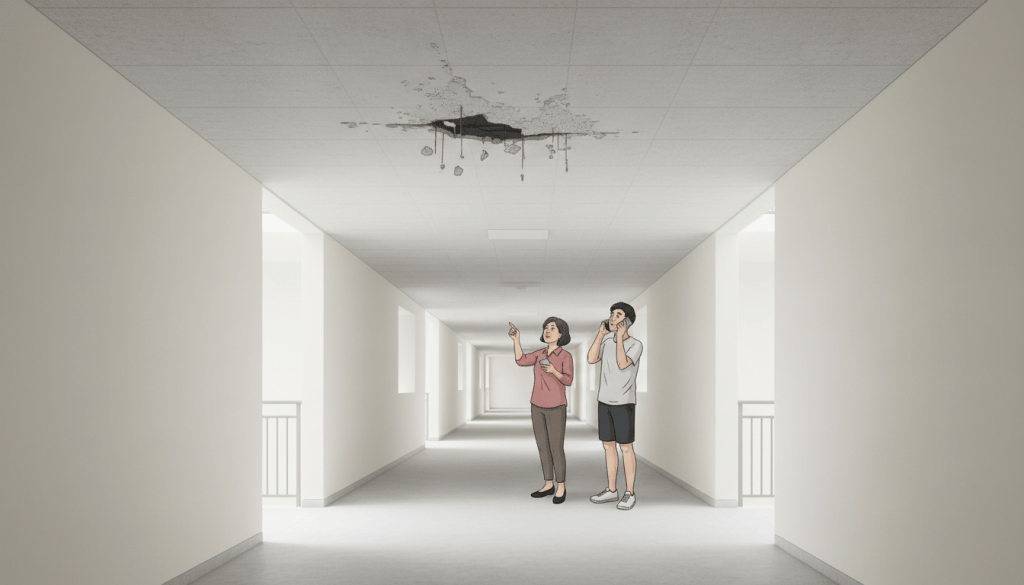
Concrete, ceiling plaster, balcony fragments or building material has fallen in or near a Sengkang HDB block? Move everyone away from the affected area and keep children and pets out. Do not stand beneath a cracked ceiling, leaning exterior panel or hanging fragment to inspect or photograph it. If someone is injured or trapped, or part of a building appears to be collapsing, call 995 immediately for SCDF rescue and medical assistance. For urgent hazards in common HDB areas managed by Sengkang Town Council, call its 24-hour Essential Maintenance Service Unit (EMSU) at 6590 9777.
Cracked paint or ordinary spalling concrete is not automatically proof that an entire building is about to collapse. HDB explains that many ceiling-spalling problems are deterioration of the concrete cover, often in moist rooms, and are generally home-maintenance matters. However, falling pieces can injure someone, and a large or worsening defect needs prompt inspection and repair. For concrete spalling inside your own flat, the flat owner is usually responsible for maintenance and arranging suitable repair; for common corridors, void decks or shared structures, report the issue to the responsible town council or property manager.
- Immediate injury, entrapment or apparent collapse: call 995 and stay away from the danger area.
- Sengkang Town Council common-area hazard: EMSU 6590 9777, 24 hours.
- Concrete falling inside your flat: isolate the room; arrange appropriate contractor inspection or repair; do not let residents stand under loose material.
- Falling exterior feature or facade: keep clear, inform building management and report through BCA’s official feedback channel when appropriate.
- Routine municipal defect: OneService can route reports, but it is not a substitute for an urgent rescue call.
- Water near electrical fittings: avoid touching wet lights, switches or sockets; report both hazards.
The first five minutes: a safe response
- Move people out of the fall area. Choose a safer room or route rather than walking beneath the loose or suspended material.
- Check for injuries without exposing another person. Call 995 if someone is trapped, seriously injured or in immediate life danger.
- Keep other residents back. A neighbour or passer-by may not notice a falling exterior fragment or ceiling hazard.
- Do not try to knock the concrete loose. A pole, broom or hammer is not a safe way to manage a falling ceiling or facade.
- Record the location from a safe place. Block number, road, unit, floor, corridor section, void deck or external wall side.
- Contact the responsible service. SKTC EMSU for common areas it manages; building manager or MCST for private property; contractor for internal flat repairs.
- Keep the area isolated while awaiting advice. Follow any cordons or closures put in place by trained responders.
Who to call for concrete or structural hazards in Sengkang
- 995 — SCDF: urgent rescue and medical response after an apparent collapse, serious injury, entrapment or another immediate danger. SCDF Emergency Medical Services.
- 6590 9777 — Sengkang Town Council EMSU: 24-hour urgent essential maintenance in common areas managed by the town council. SKTC official EMSU page.
- HDB: home-care advice for spalling concrete and ceiling leaks.
- Building and Construction Authority (BCA): official feedback form for building-safety and exterior feature concerns. Its separate statutory incident-reporting process may apply to responsible parties.
- OneService app: municipal feedback and damaged-facility reporting for non-emergency issues.
- Private condominium or commercial building: contact the managing agent, owner or MCST and ask about the urgent maintenance response.
Spalling concrete versus serious structural damage
A flat ceiling may show peeling paint, damp patches, hairline cracks, bulging concrete, exposed reinforcement or a missing chunk of concrete. These signs are not all equivalent. Spalling typically involves deterioration of the protective concrete covering reinforcement, often associated with moisture and carbonation. HDB describes it as a common maintenance issue, especially in older kitchens and bathrooms.
A visibly shifting slab, large falling section, progressive major cracking, serious deformation or unusual noise is a much more concerning situation. Residents should not attempt a structural diagnosis from photographs. When severe active danger is suspected, get away from the area and seek emergency assistance.
Do not automatically reassure occupants that a large crack is harmless because ‘HDB flats are built strong’. Equally, do not circulate an allegation that an entire block is unsafe based on a small patch of flaking paint. The correct response is safety first, then competent assessment.
Who is responsible for concrete inside a flat?
HDB’s spalling concrete guide states that flat owners are responsible for preventing and repairing spalling concrete within their flats. A large patch should be repaired promptly by an appropriate contractor so material does not continue to dislodge. HDB provides information on repairs and a non-exhaustive contractor list.
For a small, stable area, HDB publishes maintenance guidance that may include minor repair approaches. But a guide for an active hazard should not encourage residents to climb a ladder and hack at a ceiling that is dropping pieces. If the defect is large, unstable or difficult to reach, stay out and arrange a suitable professional.
A tenant should tell the landlord or managing agent promptly and follow the tenancy arrangements, while keeping the space safe. A dispute about who pays should not delay removing people from immediate danger.
Who maintains a common corridor, void deck or rooftop?
HDB distinguishes common property from the areas owned and maintained as part of individual flats. A town council typically handles maintenance of shared HDB spaces, including roof and exterior common areas, whereas owners have responsibilities for their own units and certain floor or ceiling components.
If falling debris is from a common corridor ceiling, lift lobby, void deck or roof area within an SKTC-managed estate, call the town council’s EMSU when the issue is urgent. Provide the nearest block, lift letter and floor so the maintenance crew can find it quickly.
Not every building with a Sengkang address is necessarily managed by Sengkang Town Council. Commercial premises, condominiums and some estate management boundaries use separate arrangements. Check the lobby notice or property management contact when uncertain.
Ceiling leaks can worsen concrete and electrical hazards
Water from an upper-floor bathroom, a rooftop leak or a damaged pipe may create damp concrete and falling paint. HDB’s ceiling leak guide explains that leaks between units can be the shared maintenance responsibility of the relevant flat owners, while rooftop leaks generally concern common property maintained by the town council.
Do not reach up to remove a wet ceiling light or touch an electrical switch while standing in water. Water and exposed electricity create a second hazard. Report the problem to the property manager and appropriate utility or emergency services; keep people out of the wet electrical area.
A ceiling stain alone does not prove that the structural slab is failing, but persistent leaks should be addressed promptly to prevent further deterioration and other damage.
If concrete falls from an exterior wall, panel or facade
The risk extends beyond the originating unit. An exterior feature may fall onto a pedestrian walkway or public space below. Keep well away from the projected fall zone, and do not stand directly below for a photograph or attempt to pull a loose feature free.
Notify the building manager or town council urgently. The Building and Construction Authority’s periodic facade inspection guidance explains responsibilities and reporting requirements following incidents involving fallen exterior features.
BCA has a formal safety-incident notification procedure under the Building Control (Reportable Matters) Regulations 2025, with deadlines for those required to report. Those regulatory requirements do not replace calling 995 for immediate rescue or telling the property manager about a dangerous area. Residents can also use BCA’s feedback form for relevant concerns.
Can residents report through OneService?
Yes. OneService supports reporting municipal defects and damaged facilities using location details and photographs. It routes a report to the relevant agency and can provide case updates. This is useful for a stable, non-emergency issue such as a crack in a common facility or a maintenance problem that does not pose immediate danger.
Do not use a routine feedback form as the only action when concrete is actively falling above a crowded area or somebody is trapped. Call emergency responders or the urgent property maintenance service first. Photographs can be taken from a safe distance afterward if helpful.
If a large section falls inside your bathroom
Do not continue bathing or washing directly beneath the damaged ceiling. Move children and other household members away, and avoid handling broken wiring or sharp material. If somebody is injured, trapped or in immediate danger, call 995.
Arrange prompt assessment by a competent contractor and explain whether the ceiling has exposed reinforcement, active leaks or a large missing section. The contractor can determine a safe repair plan, and HDB provides general maintenance reference information.
Do not assume you must be physically present beneath the hazard to show a contractor the exact patch. A safe photograph taken before the area was closed, or a location description, may be enough for initial communication.
If a slab or major structural component appears to move
Movement, widening cracks, severe deformation, unusual noises or falling heavy pieces require a much more cautious response than ordinary spalling. Get people away from the affected space and any directly threatened route, then contact 995 when there is a possible imminent collapse or rescue danger.
Do not gather neighbours inside the suspected danger area to inspect it, and do not send a maintenance worker onto a ladder beneath an unstable component without a proper safety assessment. Qualified structural professionals and emergency responders determine exclusion zones and next steps.
If a piece falls near a playground or school walkway
Keep children and passers-by away from the hazard and notify the responsible manager. If the piece came from an external wall, balcony, window surround or common block facade, give the block number and the side facing the playground or walkway.
A falling fragment near a public access route is more urgent than cosmetic peeling paint in a private room because other people may unknowingly enter the area. Ask the managing body to arrange prompt cordoning and assessment where needed. In case of injury or ongoing immediate danger, use emergency services.
What to say to an EMSU or BCA contact
- Exact site: Sengkang HDB block, street, floor, unit or shared area; for outside the building, the wall facing a named road or entrance.
- What happened: paint flaked, plaster cracked, concrete fell, an exterior panel loosened or a large piece detached.
- Size and frequency: approximate size of the affected patch and whether material is still falling; avoid unsupported claims about structural failure.
- People and access: any injury, blocked corridor, children’s play area or stairway affected.
- Associated hazards: water leakage, exposed reinforcement, electrical equipment or active works nearby.
- Evidence: a safe photograph from outside the fall zone, if available.
- Contact and access: a safe callback number and how authorised workers can enter or view the space.
Avoid unsafe DIY repair during an active hazard
HDB publishes guidance for repair of stable small spalling areas, but the existence of a tutorial does not mean that every crack or piece of falling concrete is suitable for an untrained resident to repair. Cutting or chipping at an unstable ceiling can bring down more material.
Do not break off large portions or climb high to inspect a visibly loose panel. A contractor may need barriers, protective equipment and safe access systems. If you cannot judge the risk, keep the space isolated and seek professional advice.
The priority is not to have the ceiling looking neat by tomorrow. It is to prevent injury, diagnose why deterioration happened and perform a durable repair.
What about the Home Improvement Programme?
HDB’s Home Improvement Programme (HIP) addresses maintenance problems in selected ageing flats, including spalling concrete. In eligible HIP precincts, certain essential improvements may be funded for qualifying households.
A particular Sengkang unit cannot be assumed to be selected, eligible or scheduled merely because the programme exists. Residents should check their block’s official HIP status. If there is active falling concrete, do not wait for a future programme to make the area safe and arrange appropriate repairs.
Four Sengkang scenarios
A kitchen ceiling has a small bulging patch and rust staining
Keep people out from directly beneath, document it safely and arrange prompt inspection. The owner is generally responsible for maintenance inside the flat, unless a specific common-property issue is identified.
A chunk falls into the HDB lift lobby
Keep residents away and call the responsible town council EMSU if the common area is under SKTC. Explain the lift lobby, block and any blocked access. Call 995 if someone is injured or in immediate danger.
Debris falls from the exterior facade into the void deck
Move away from the possible fall zone and alert building management urgently. BCA’s reporting or feedback processes may apply. Do not stand under the affected wall to record a video.
A large crack widens and a heavy component appears unstable
Get everyone away, avoid nearby threatened access paths and call emergency services if a collapse or serious injury is imminent. Do not attempt an amateur structural diagnosis or repair.
Frequently asked questions
Does every crack mean my HDB block will collapse?
No. HDB describes spalling concrete as a common maintenance issue, often affecting surface concrete cover. A professional assessment is needed when damage is extensive, progressive or otherwise concerning.
Who do I call for a dangerous corridor ceiling in Sengkang?
For common HDB areas managed by Sengkang Town Council, call its 24-hour EMSU at 6590 9777. Call 995 if a person is trapped or life is in immediate danger.
Who pays for spalling concrete inside my flat?
HDB says flat owners are generally responsible for maintenance and repair inside their flats, subject to applicable programmes and specific circumstances.
Is BCA’s report form an emergency rescue service?
No. BCA’s reporting and feedback channels address building-safety concerns and regulatory obligations. For an active rescue or life-threatening emergency, call 995.
Can I remove loose concrete with a hammer?
Do not try to remove material from an unstable or actively falling surface. Engage an appropriate contractor and follow HDB guidance only where the defect has been assessed as safe for the proposed repair.
More Sengkang emergency guides
- HDB fire, smoke and evacuation
- Burst pipes and ceiling leaks
- Fallen trees and dangerous branches
- Elderly falls and head injury
Explore the next Sengkang emergency guides: Lost wallets, NRICs and passports · Sengkang MRT and LRT disruptions · Children trapped in locked cars.
Related Sengkang emergency guides: Earthquake tremors, shaking buildings and aftershock safety · Falling windows, broken glass and high-rise fixtures.
Official sources and review date
- HDB — Preventing and Fixing Spalling Concrete
- HDB — Preventing and Fixing Ceiling Leaks
- Sengkang Town Council — Essential Maintenance Service Unit
- BCA — Periodic Facade Inspection and Fallen Exterior Features
- BCA — Feedback on Building Safety
- OneService — App and Chatbot for Municipal Feedback
- HDB — Home Improvement Programme
Reviewed 6 November 2026. This is a resident safety and reporting guide, not a structural engineering diagnosis. If immediate collapse, entrapment or serious injury is suspected, call 995 and keep clear of the affected area.
