
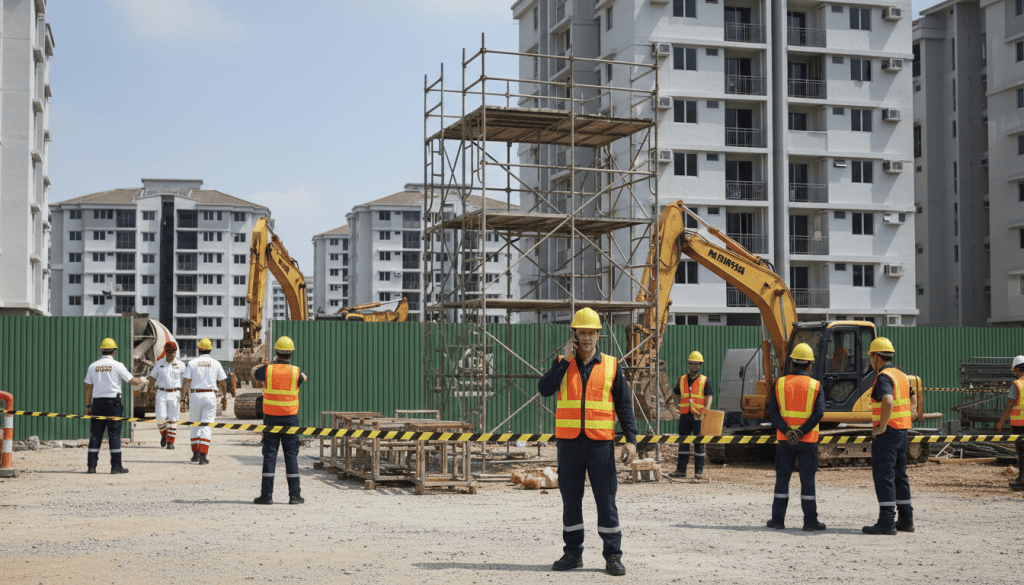
Someone has fallen from height, been struck by an object, suffered a machinery injury or been seriously hurt at a Sengkang worksite? Call 995 immediately for an emergency ambulance or SCDF rescue. Stop nearby work if it can be done safely, keep other people out of the danger zone and alert the site supervisor or workplace safety officer. Do not move a worker with suspected head, spine or fracture injuries unless staying in place presents a greater immediate danger and emergency responders direct you.
The first duty is to save life, not to complete a work-injury form. Give SCDF the exact Sengkang address, worksite entrance, floor or zone, number of people injured and the hazard involved. If there is a suspended load, unstable scaffold, energized equipment or chemical exposure, tell the operator rather than attempting untrained rescue. For an urgent safety issue without an injured person, the worksite occupier must still manage and report the hazard under applicable workplace safety rules.
Singapore’s Ministry of Manpower (MOM) has a separate formal accident-reporting process. Employers generally have to submit an incident report for a work-related injury resulting in medical leave, hospitalisation or light duty, within 10 days from the first notice of the accident. For a work-related fatality, the employer must notify the Commissioner of Workplace Safety and Health as soon as reasonably practicable and also submit a report within 10 days of the accident. Formal reporting does not replace the 995 call, medical treatment or an employer’s responsibility to care for workers.
The first five minutes of a worksite accident
- Make the scene safe for yourself. Do not enter a collapse zone, step under a suspended crane load or touch live equipment to reach a casualty.
- Call 995 for a serious injury or rescue need. Ask another person to make the call if you are providing appropriate first aid.
- Stop the unsafe activity where possible. Ask authorised personnel to isolate machinery or restrict access without endangering themselves.
- Call for a trained first aider. A workplace’s emergency response plan should provide first-aid arrangements and someone to guide paramedics.
- Control serious bleeding only when safe. Apply direct pressure to an accessible wound without pressing on embedded objects; follow dispatcher instructions.
- Do not pull or lift a seriously injured worker. Spinal injury, fracture, crushing or electrical exposure may require a specialist rescue technique.
- Give precise access details. Name the worksite gate, nearest public road, building level, machinery and any gate that needs authorised opening.
Who to call in Sengkang
- 995 — Singapore Civil Defence Force: urgent rescue, fire, serious bleeding, collapse, crush injury, electric shock, fall from height or another medical emergency. SCDF emergency medical services.
- Worksite emergency response team and supervisor: the immediate contact for site isolation, casualty access, welfare and coordinating responders.
- Ministry of Manpower: work accident reporting procedure and iReport for mandatory post-incident reporting by the proper duty holder.
- MOM Work Injury Compensation: employee rights and steps after injury; report work injuries to the employer as soon as possible.
- 999 — Singapore Police: only if an immediate Police or criminal security emergency is occurring in addition to the accident.
- Property or building management: coordinate access or building safety when the accident affects a shared public area, not as a substitute for SCDF rescue.
Why a construction accident may require specialist rescue
Construction, building maintenance, logistics, manufacturing and commercial service work involve different hazards. A fall can leave a worker trapped on a scaffold, inside a hoist or beneath equipment. A heavy object may still be unstable. Electrical wiring, chemical drums, plant machinery and vehicle movement can threaten any person attempting to help.
The bystander’s role is to report the circumstances, stay safe and allow trained rescue personnel to access the injured person. SCDF can dispatch resources suited to entrapment, elevated locations, medical emergencies and hazardous materials. A worker should not risk a second severe injury by climbing equipment or attempting to move an unstable load.
A site supervisor should know the emergency access gates, available site-specific rescue plan and designated first aiders. If no trained helper is present, the 995 operator can give immediate instructions appropriate to what is happening.
If a worker falls from height
Do not automatically sit or stand the person up. Head, neck, spine, hip or internal injuries may be present even when the person is speaking. Ask whether they can breathe normally and remain conscious, and advise SCDF if they have severe pain, loss of normal movement, weakness or heavy bleeding.
If possible, keep the worker supported and still while waiting for responders. If the person is suspended by a harness, do not attempt a makeshift rope rescue without proper training. Inform emergency crews of the height, access route and the worker’s position so specialist rescue can be planned.
Do not remove helmets or other protective equipment without a medical or rescue reason directed by responders. The need to manage an airway or immediate environmental hazard takes precedence over ordinary do-not-move advice, so follow the dispatcher.
If someone is struck by a falling object
Objects falling from a height may cause head injury, fracture, crushing or serious internal injury. A person who remains awake may still have a dangerous injury. Call 995 for serious symptoms and keep everyone away from further falling material or unfinished lifting operations.
Do not move fallen material if another object may still be suspended or unstable. Ask authorised site staff to control the surrounding work zone. Report the type and approximate position of the object to emergency services without walking beneath it to inspect.
If someone is trapped by machinery
Do not use improvised tools to pull a hand, foot or other body part from a moving machine. Ask appropriately authorised staff to activate emergency stop and isolate the equipment according to their training, and call 995. Tell SCDF whether the machinery remains energised and what part of the person appears entrapped.
Do not remove guards, cut cables or attempt to reverse equipment unless instructed by competent personnel. Unplanned movement can worsen crushing injuries. A trained rescue team can determine safe stabilisation and extraction.
If there is a serious electrical or chemical hazard
A worker still in contact with live electricity cannot be safely pulled clear by a barehanded colleague. Stay away, call 995 and have the correct electrical supply isolated only by qualified personnel who can do so safely.
Likewise, do not enter a room with unidentified chemical fumes to retrieve a collapsed colleague. SCDF has hazardous materials response capabilities and must know the suspected substance, container type and whether anyone remains inside.
See the Sengkang electrical-shock safety guide and the dedicated hazardous chemical spill and toxic-fumes guide for more specific safety and reporting distinctions.
What to tell 995 from a construction or worksite location
- Exact site: project or building name, Sengkang road, postal address and nearest accessible site gate.
- Injury: fall, crushing, cut, chemical contact, electric shock, explosion or another event.
- People: number of injured workers or members of the public; conscious or not, breathing normally or not.
- Entrapment: whether a person is suspended, pinned beneath equipment or inside a confined space.
- Danger: unstable structures, energized machinery, traffic, smoke, chemicals or falling loads.
- Access: site security procedures, level, lift, crane or scaffold location and an escort for responders.
- Contact: site supervisor and a safe phone number that dispatch can call back.
The difference between emergency care and MOM reporting
The emergency response is immediate. MOM notification and iReport are legal and administrative procedures after the incident, with different responsibilities and deadlines. An employer cannot claim that a form has been submitted as a substitute for calling an ambulance or arranging treatment.
MOM’s official accident reporting page explains when an employer or workplace occupier must notify the Commissioner as soon as reasonably practicable, and which incidents need an online report. As of November 2026, a work-related fatality requires immediate notification by the employer and a formal report within 10 days. Reporting of employee injuries with medical leave, hospitalisation leave or light duty normally follows a 10-day deadline from the employer’s first notice.
Some dangerous occurrences must be notified even where nobody has been injured. The duty to report may fall on the occupier rather than the employer, especially for relevant public or self-employed-person incidents on the premises. Check the event category and current MOM tables rather than assuming every case uses an identical rule.
What counts as a reportable non-fatal work accident?
MOM’s work injury guidance refers to injuries arising from work resulting in outpatient or hospitalisation medical leave, light duty or certain occupational diseases. Employers should report these through the incident-reporting system as required. The threshold is not simply whether a worker stayed overnight in hospital.
A doctor may provide an MC or light-duty instruction after the first consultation. Workers should promptly provide that information to the employer so any mandatory reporting and compensation processes can proceed.
If a work incident first appears minor but the worker later receives additional leave or requires assessment for permanent injury, update the relevant report and notify the insurer as required. Keeping the facts accurate is important for care and entitlements.
Who must report a death or dangerous occurrence?
Where an employee dies during work or at a workplace because of work, the employer must notify MOM as soon as reasonably practicable and submit an incident report within the specified 10 days. Where a self-employed person or member of the public dies at a workplace as a result of work being carried out, the occupier may have notification and reporting duties.
MOM’s reporting categories also cover dangerous occurrences even when nobody was injured. Do not assume a serious near-miss can be ignored because the crane load or scaffold did not hit anyone.
The worker’s first responsibilities
- Seek necessary medical treatment; call 995 for serious injury or immediate rescue needs.
- Inform the supervisor or employer as soon as possible.
- Explain accurately to the treating doctor that the injury occurred at work.
- Keep copies of medical certificates, medical bills and relevant work accident messages.
- Ask for the appropriate incident report and reference information.
- Attend follow-up clinical appointments and communicate medically approved work restrictions.
- If reporting is not done or entitlements are disputed, consult MOM’s official Work Injury Compensation information and assistance channels.
MOM’s employee WICA guidance describes these steps. Reporting promptly matters, but a seriously injured worker should not delay treatment in order to obtain approval from an employer.
The employer’s medical and compensation duties
Under the Work Injury Compensation Act framework, employers are generally responsible for relevant medical expenses and medical leave wages for eligible work injuries, within applicable rules and limits. They must not simply tell an injured worker to pay everything privately and hide that the incident occurred at work.
MOM’s employer compensation guide explains that employers must continue to pay the required medical expenses and leave wages while an eligible claim is processed, even when reimbursement from an insurer has not yet been received. Entitlements are case-specific and should be checked against the current scheme.
For migrant workers, language and work-pass concerns can complicate communication. The employer and site team should ensure the person understands the medical arrangements and has the necessary support, and keep the next of kin updated where appropriate.
Medical records and photographs: what to preserve
Accurate accident documentation helps care, prevention and compensation. Write down the date, time, location, what the worker was doing, known witnesses, machinery or material involved, and when the employer was informed. Save hospital documents and communications without modifying originals.
If photographs are needed, have an authorised person take them from a safe position after rescue and emergency control. Do not enter an unsafe scaffold, open a machine guard or disturb a collapse scene to improve a photograph. Avoid circulating identifiable injury images in public chats.
If a member of the public is injured at a worksite
An injury to a passer-by caused by work being performed may lead to reporting duties for the workplace occupier, separate from the employer’s duty for employees. Call 995 for serious injury and prevent others from entering the unsafe area. The occupier should examine the relevant MOM notification and reporting category.
Do not assume that a road pedestrian is covered by exactly the same WICA arrangements as an employee. The incident should be investigated, and any compensation or legal questions assessed using the applicable law and evidence.
If the accident happens near a school or HDB estate
Construction and upgrading projects may operate beside active pedestrian paths. A crane, falling material, temporary barrier or vehicle movement could affect residents not working on the site. Keep children away, use authorised detours and alert the site manager to an immediate hazard.
Where a resident is injured, call emergency medical services first. Notify the responsible authority or property manager after life safety has been addressed. Do not enter a gated work area or confront machinery operators while equipment is moving.
Examples from Sengkang workplaces
A worker falls from a ladder during an estate upgrade
Call 995 for serious injury, stop the relevant work area and avoid moving the person if head, neck, spine or hip injury is suspected. Provide the site gate and floor number to paramedics. The employer then handles MOM reporting under the applicable category.
A warehouse employee cuts a hand deeply on machinery
Get the machine made safe by trained personnel, apply appropriate first aid and seek clinical assessment. Severe bleeding requires 995. Medical leave or light duty may trigger mandatory MOM reporting.
A visitor is injured by a falling object near a construction fence
Call 995 if severe, keep people away from more falling material and tell the site occupier. Worksite/public injury reporting duties can differ from an employee’s case.
A lifting operation nearly drops a load but nobody is hurt
Stop unsafe operations, isolate the area and follow the site’s emergency and near-miss response. Check whether the event constitutes a MOM-reportable dangerous occurrence; no injury does not automatically mean no reporting duty.
How to prevent the next incident
- Maintain a site-specific emergency response plan, rescue arrangements and first-aid access.
- Identify a safe gate or location where SCDF can reach an injured worker.
- Use appropriate fall prevention systems and check the condition of access equipment.
- Control lifting operations, exclusion zones and suspended-load hazards.
- Keep machinery guards and emergency-stop systems maintained.
- Isolate hazardous energy by competent workers and never improvise electrical rescue.
- Train workers and supervisors on near misses, incidents and mandatory MOM reporting.
Frequently asked questions
What number should I call for a serious work injury?
Call 995 for an emergency ambulance or SCDF rescue. Provide the site gate, exact location and nature of the danger.
Does the employer need to notify MOM after a fatal work accident?
Yes. MOM requires notification as soon as reasonably practicable and a formal report within 10 days of the accident.
Is a non-fatal work injury reportable after one day of medical leave?
A work injury resulting in an instance of medical leave or light duty can be reportable. The employer should review current MOM requirements and submit within the relevant deadline.
Can an employer wait for the insurer before paying necessary medical costs?
MOM explains that employers must meet their eligible WICA responsibilities even if reimbursement from the insurer is pending.
Should a colleague remove a trapped worker from machinery?
Do not attempt hazardous improvisation. Call 995 and have the machinery made safe by qualified personnel; follow specialist rescue instructions.
More Sengkang emergency guides
- Severe bleeding and deep cuts
- Falling concrete and unsafe structures
- Electric shock and exposed wiring
- Medical emergencies and 995 ambulance
More Sengkang emergency guides, November 2026: Electric vehicle charging fires and car-park evacuation · Hazardous chemical releases and toxic fumes · HFMD in preschool and childcare.
Official sources and information date
- MOM — Report a Work-Related Accident
- MOM — What and When to Report
- MOM — Who Should Report a Work Accident
- MOM — Injured Employees and Work Injury Compensation
- MOM — Employer WICA Responsibilities
- SCDF — Emergency Medical Services
Reviewed 7 November 2026. This is an emergency and workplace reporting guide, not a legal determination of liability. Call 995 for serious injury or rescue and follow the current MOM reporting rules for the specific incident.
