
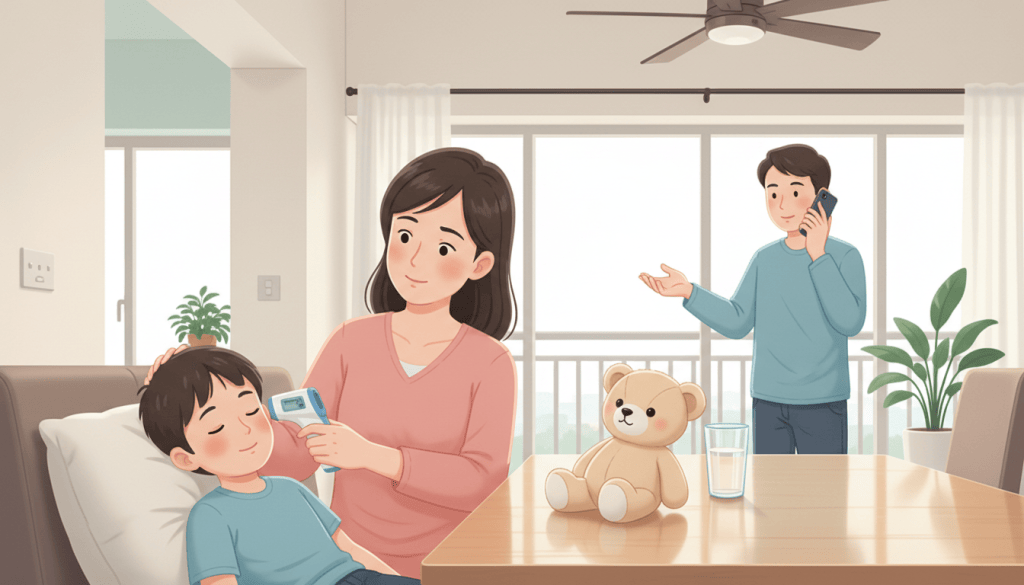
Your child has fever, painful mouth ulcers, and a rash or small blisters on the hands, feet or buttocks in Sengkang? They may have hand, foot and mouth disease (HFMD). Keep the child at home, contact a family doctor or polyclinic for assessment, and tell the preschool, childcare centre or school promptly. Do not send a child with suspected HFMD to a centre, playground, enrichment class or crowded mall while infectious. HFMD is common and often mild, but some children develop dehydration or other serious complications.
Get urgent medical help if your child becomes unusually drowsy, persistently vomits, refuses fluids, develops a severe headache or stiff neck, or otherwise changes behaviour significantly. These are warning signs identified by Singapore’s Communicable Diseases Agency (CDA) and HealthHub. Call 995 for a life-threatening emergency such as collapse, seizure, severe breathing difficulty, loss of consciousness or another serious deterioration. Most uncomplicated HFMD cases do not require an emergency ambulance; they need clinical assessment, fluids, rest and infection-control precautions.
Quick routing: child with suspected HFMD but otherwise stable — GP or polyclinic; serious neurological signs or dehydration — urgent hospital assessment; life-threatening symptoms — SCDF 995; centre attendance or possible exposure — the child’s school or preschool through its verified contact channels. Check CDA’s official HFMD information and HealthHub’s parent guide for public-health instructions.
First five minutes: when HFMD is suspected
- Check how the child is behaving. Can they respond normally, breathe comfortably, drink and pass urine? Severe abnormal signs require urgent medical help.
- Measure the temperature if practical. A thermometer helps establish fever but cannot by itself diagnose HFMD or rule out danger.
- Look without causing pain. Note mouth ulcers and possible small spots or blisters on palms, soles or around the buttocks.
- Keep the child at home. Do not send a sick child to preschool or school while seeking evaluation.
- Contact a doctor promptly. A medical professional can assess whether the symptoms are HFMD or another illness.
- Offer suitable fluids and softer food if the child is fully awake and can swallow; painful ulcers may make eating and drinking difficult.
- Inform the centre or school. Staff may monitor other children and strengthen hygiene measures once notified.
Who to call in Sengkang
- GP or polyclinic: the usual first medical contact for suspected uncomplicated HFMD and a child who remains stable. HealthHub HFMD advice.
- Hospital Emergency Department: for severe headache, neck stiffness, disorientation, persistent vomiting, marked lethargy or concerning dehydration. HealthHub’s serious HFMD warning signs.
- 995 — SCDF Emergency Medical Services: life-threatening collapse, seizure, abnormal breathing, loss of responsiveness or other critical medical danger. SCDF emergency services.
- School, preschool or student-care centre: report a diagnosed HFMD case promptly and clarify return-to-centre requirements without sending the sick child to the premises.
- CDA: official public HFMD disease information and professional clinical guidance for authoritative prevention and medical context.
What is hand, foot and mouth disease?
HFMD is an infectious illness caused by several kinds of enteroviruses. The CDA says it occurs throughout the year in Singapore and can affect people of any age, especially children below five. Common symptoms are fever, sore throat, mouth ulcers, reduced appetite, tiredness and a rash or small blisters on the hands and feet.
The rash may also appear on the buttocks, and not every child has a classic pattern. Some people have mild symptoms or none at all. A clinician may diagnose HFMD through the history and examination without laboratory testing in typical cases.
HFMD is a viral infection. Antibiotics are not a routine treatment for HFMD because they do not treat the virus. A doctor may recommend supportive measures for fever, pain and hydration, or additional assessment if a complication is suspected.
How does HFMD spread?
CDA explains that HFMD can spread through direct contact with saliva, nasal or throat secretions, fluid from blisters and faeces, as well as contaminated objects and surfaces. Shared toys, utensils and close contact in preschool settings can make transmission easier.
Symptoms usually appear after an incubation period of a few days, with individual variation. A child may have been exposed before any obvious rash appears, which means parents should inform the centre when a diagnosis is made rather than trying to determine who caused the outbreak.
Adults can also become infected. A parent with a sore throat and unusual hand rash after a child’s illness should not automatically assume the symptoms are harmless; seek medical advice where appropriate.
When is HFMD a serious medical problem?
- Unusual drowsiness, confusion or disorientation.
- Persistent vomiting, particularly if fluids cannot be retained.
- Severe headache, giddiness or neck stiffness.
- Refusal or inability to drink because mouth ulcers are extremely painful.
- Signs of dehydration: reduced urination, dry mouth, unusual weakness or lethargy.
- Breathlessness, blue or grey skin, seizures or collapse.
HealthHub’s HFMD parent guide and CDA’s public information advise prompt medical attention when a child’s normal behaviour changes, vomiting is persistent or fluids are refused. Serious complications are rare but can involve the nervous system and other organs.
If a child is unresponsive, has a seizure or is severely ill, call 995. For the other significant warning signs, arrange immediate assessment at an appropriate hospital, following professional advice.
Why mouth ulcers can lead to dehydration
Ulcers in the mouth or throat can make swallowing painful. Some children then avoid water, milk or food even when thirsty. Over time, reduced intake and possible fever or vomiting can produce dehydration. The child may have fewer wet diapers, urinate less often, have a dry mouth or seem unusually sleepy.
For an alert child who can swallow safely, offer small frequent drinks and soft foods such as porridge or suitable pureed meals. Follow the doctor’s recommendations for age-appropriate pain relief. Avoid forcing a drink or tablet into an extremely drowsy or confused child.
If the child repeatedly refuses fluids, passes very little urine or appears seriously unwell, seek prompt medical assessment. An online guide cannot tell you whether IV fluids are necessary.
When can a child return to preschool or childcare?
Do not send a child back merely because the fever has stopped. HealthHub advises keeping a diagnosed child at home until blisters have dried, they have fully recovered and the doctor’s medical certificate period has ended, following the applicable centre’s return instructions.
The CDA’s HFMD guidance emphasises early identification, exclusion of unwell children and proper cleaning of shared spaces. The preschool may have additional requirements under its current health policies. Confirm the child’s recovery and medical advice rather than selecting a fixed number of days from an online forum.
Do not take a child who is still recovering from HFMD to another childcare centre or enrichment group simply because their usual centre is closed. That can introduce infection to a new group.
Is a confirmed HFMD case legally notifiable in Singapore?
The CDA’s professional HFMD page, updated 3 August 2026 states that HFMD is not a legally notifiable disease under Singapore’s general infectious disease notification arrangements. This is a specific technical distinction from conditions that require a formal statutory notification.
That does not mean parents should conceal a case from a preschool or school. CDA and HealthHub still direct parents to inform the child’s centre promptly so staff can monitor other pupils, improve infection-control measures and follow current administrative requirements.
A centre may receive sector-specific instructions from ECDA or other authorities during an outbreak. Do not infer that the centre is automatically closing for a particular number of days just because a parent reports one case.
Do all HFMD cases require a hospital?
No. Most cases are mild and self-limiting. A stable child with typical symptoms can usually be assessed first by a GP or polyclinic, then recover at home with fluids, soft food and rest. Emergency departments are for serious warning signs, complications and patients whose condition requires urgent investigation or treatment.
A child with unusual drowsiness, persistent vomiting, severe headache, neck stiffness or dehydration should not be managed solely through home remedies. Call 995 for life-threatening symptoms.
What about fever medicines and antibiotics?
The doctor may recommend paracetamol for fever or pain, using the correct product and dose for the child’s age and weight. Do not guess doses or alternate several medicines without professional advice. No routine antibiotic treats the viruses that cause HFMD.
There is currently no approved vaccine for HFMD in Singapore, according to CDA’s 2026 professional guidance. Claims about a universal HFMD vaccine from another country or an unverified online clinic should not be interpreted as a Singapore-approved prevention option.
Cleaning toys, utensils and shared surfaces
Wash hands thoroughly with soap and water, especially after diaper changes, toilet use and before preparing food. Avoid sharing towels, cups, eating utensils or food when someone is ill. Clean and disinfect shared toys and frequently touched surfaces according to the product’s safe instructions and the centre’s protocols.
A child who continues to touch saliva or blister fluid may contaminate commonly used objects. Parents should keep the ill child’s utensils and towels separate where practical, and clean items before they are used by other family members.
Do not mix household cleaning agents to make them stronger. This can release hazardous chemical fumes and create a new emergency.
What parents should check before the morning school run
- Check the child’s temperature if they appear unwell.
- Ask about mouth pain, sore throat or unusual refusal to eat.
- Look for small spots or blisters on hands and feet when the child can cooperate.
- Check whether the child is behaving and drinking normally.
- Keep the child home when HFMD is suspected rather than hiding a rash with clothing.
- Arrange the appropriate doctor visit and notify the school or centre promptly.
- Follow the medical certificate and recovery requirements before returning.
HealthHub gives this four-part screening approach—temperature, mouth, hands and feet—as a practical parent checklist before sending children to childcare. It is not a replacement for a clinical diagnosis.
If an HFMD case is reported in your child’s preschool
A notice that another child has HFMD is a reason to be watchful and reinforce hygiene; it is not proof that every pupil will become ill. Check whether your child has symptoms, follow the centre’s guidance, and avoid sending an unwell child to classes.
Ask the centre about its cleaning and exclusion procedures rather than demanding the identity of the infected child. Medical privacy matters; other parents do not need a child’s full name, photographs or family details.
Where the authorities instruct a closure or special measures, follow the official notice, date and conditions. Do not circulate an old closure screenshot as if it applies to the current Sengkang centre.
How does HFMD differ from dengue, chickenpox or ordinary rash?
HFMD often features mouth ulcers and blisters or spots on hands and feet. Chickenpox, dengue and several other infections can also cause fever and a rash, but they have different clinical patterns and health risks. The presence of a rash alone does not establish the diagnosis.
If a child has severe symptoms, unusual bruising, bleeding, confusion or concerning dehydration, urgent medical assessment is needed irrespective of the suspected infection. See the Sengkang dengue warning-sign guide for a distinct mosquito-borne illness.
If a younger sibling is still well
A household member without symptoms does not automatically have HFMD, although close contact may have occurred. Monitor for fever, mouth ulcers and rashes, and follow the preschool’s current attendance and exposure policies. Avoid sharing utensils and maintain careful hand hygiene.
Do not start giving a healthy child antibiotics ‘just in case’. HFMD is viral, and clinical assessment is appropriate if symptoms develop.
Sengkang childcare scenarios
A toddler develops mouth ulcers and tiny blisters before morning drop-off
Keep the child home, offer suitable fluids, arrange GP or polyclinic assessment and inform the centre. Do not take the child to an enrichment class while infectious.
The fever resolves but blisters remain wet
Do not assume the child is ready to return. Follow the clinician’s recovery guidance, ensure blisters have dried and the relevant MC period has ended, and check the centre’s policy.
A preschooler with HFMD stops drinking and becomes unusually sleepy
Seek urgent medical assessment; dehydration and neurological warning signs can require hospital care. Call 995 if the child becomes unresponsive or otherwise life-threateningly ill.
A parent receives an unverified message about a cluster at a nearby centre
Verify with the centre or official agency communication. Avoid forwarding names of children or an old closure notice. Reinforce hygiene and monitor your own child’s condition.
Prevention: an education and care routine
- Wash hands with soap before eating and after toilet use or diaper changes.
- Do not share cups, utensils or towels during illness.
- Clean communal toys and touched surfaces safely and regularly.
- Keep unwell children and staff out of group settings according to medical and centre guidance.
- Tell the school or preschool promptly when a child is diagnosed.
- Provide age-appropriate fluids and a softer diet for painful mouth ulcers.
- Teach older children not to pick at blisters and to report new rashes or pain.
- Use updated CDA and HealthHub guidance rather than unverified online treatment claims.
Frequently asked questions
Does every HFMD case need a 995 ambulance?
No. Most cases are mild and require GP assessment and home recovery. Call 995 for life-threatening symptoms such as collapse, severe breathing problems, seizure or loss of consciousness.
Can my child return when the fever goes away?
Not solely because the fever has ended. Follow medical instructions, recovery status, dried blisters and the MC/centre requirements.
Is HFMD a bacterial infection?
No. It is caused by viruses in the enterovirus group; antibiotics do not routinely treat the infection.
Can adults get HFMD?
Yes. HFMD can affect people of any age, although younger children are particularly susceptible.
Is there an approved HFMD vaccine in Singapore?
CDA’s August 2026 professional guidance states that no vaccine against HFMD-causing enteroviruses is currently approved in Singapore.
Should I tell the preschool even though HFMD is not legally notifiable?
Yes. CDA and HealthHub advise notifying the child’s centre so the staff can monitor other children and take preventive measures.
More Sengkang emergency and education guides
- Baby fever and child emergency warning signs
- Dengue fever, warning signs and mosquito control
- Food poisoning, vomiting and dehydration
- Medical emergency and ambulance 995
More Sengkang emergency guides, November 2026: Electric vehicle charging fires and car-park evacuation · Workplace injuries and MOM reporting · Hazardous chemical releases and toxic fumes.
Official sources and information date
- Communicable Diseases Agency — HFMD Public Guidance
- CDA — HFMD Professional Guidance (Updated 3 August 2026)
- HealthHub — Hand, Foot and Mouth Disease
- HealthHub — Keep Germs Away and HFMD Complication Signs
- SCDF — Emergency Medical Services
Reviewed 7 November 2026. This public parent and childcare guide cannot diagnose HFMD or confirm a current Sengkang preschool outbreak. Contact a doctor for suspected cases, follow centre instructions and seek emergency care for severe complications.
