
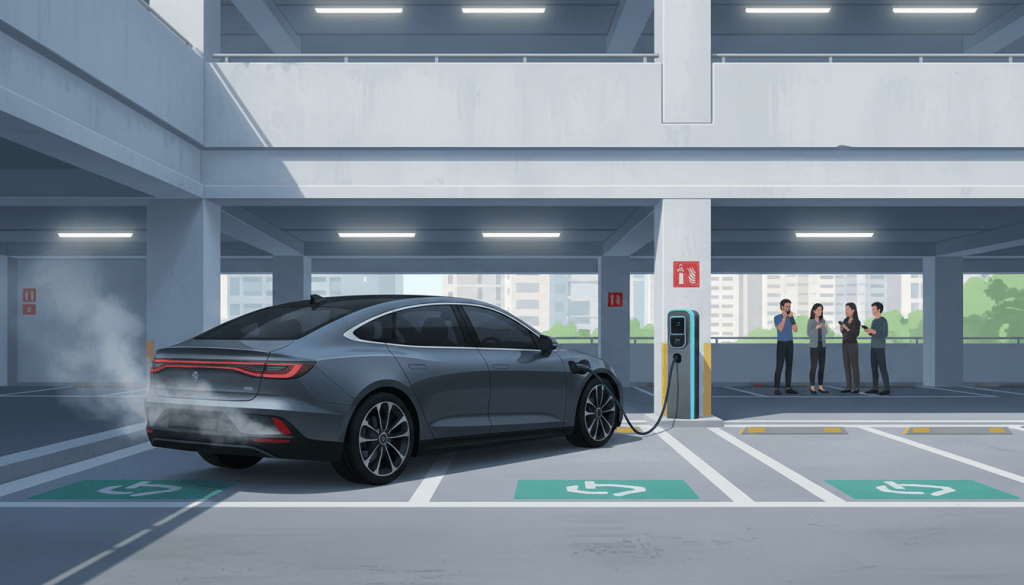
An electric car or EV charger is smoking, hissing, sparking or burning in a Sengkang HDB multi-storey car park, condominium or shopping centre? Move away, keep others clear and call 995 immediately. Singapore’s SCDF and LTA advise people to stay at least 15 metres from an electric vehicle with a battery fire and not to attempt to extinguish it themselves. If in an enclosed car park, move out of the affected area by a safe exit, do not enter smoke and follow SCDF or building management instructions.
Do not reach into a smoking EV to retrieve possessions, try to unplug a hot charging connector or operate electrical equipment near a suspected battery fire. EVs contain high-voltage components and can develop battery thermal runaway. When calling 995, tell SCDF the vehicle registration or make/model, exact car park, level and lot, the charging point if involved, and whether smoke is coming from the undercarriage, bonnet or another visible part. Stay clear while firefighters assess the site.
Quick routing: smoke, flames, hissing, sparking or imminent battery fire — 995; an ordinary faulty charger without fire or injury — contact the charger operator via the number on the station and the car-park managing agent; a damaged electrical installation — keep clear and arrange competent inspection; a normal vehicle breakdown with no hazard — insurer or authorised roadside assistance. A vehicle fire is not a routine EMAS or charging-app complaint.
The first 60 seconds: EV fire at a car park
- Alert nearby people. Tell drivers and pedestrians to move away from the smoking car and not to enter the affected parking bay.
- Leave the immediate area. For an EV battery fire, keep at least 15 metres away; in a basement or enclosed car park, use an appropriate safe exit away from smoke.
- Call 995. State ‘suspected electric vehicle fire’ and identify the car park and exact level.
- Do not attempt to extinguish the battery. SCDF and LTA caution that a normal dry-powder extinguisher may not be effective against battery thermal runaway and may expose the public to danger.
- Do not touch the charger, cable or vehicle. Assume damaged electrical components may be energised.
- Notify car-park security or management from safety. Ask another person to guide responders to the appropriate entrance if it is safe.
- Follow official instructions. Do not re-enter after the smoke appears to stop until responders say the area is safe.
Who to call for an EV charging or vehicle-fire emergency
- 995 — SCDF Fire and Rescue: active electric vehicle or charging-station fire, suspected battery thermal runaway, urgent rescue or life-threatening injury. Official emergency contact.
- Car-park security or building management: help establish access, protect occupants, communicate about affected bays and support responders after SCDF is alerted.
- Charging point operator: use the official support contact on the charger or in its verified app for a normal malfunction; for fire, 995 comes first. SP Mobility’s emergency contact example.
- LTA EV charging framework: official charger registration and safety information for non-emergency compliance questions.
- Insurer or authorised vehicle service provider: after the incident has been made safe; do not arrange an ordinary tow into a still-hazardous vehicle area.
Why an EV battery fire needs specialist firefighting
An electric vehicle’s high-voltage battery may contain many lithium-ion cells. If some cells enter thermal runaway, they can release considerable heat and gas and affect neighbouring cells. Unlike a small ordinary combustible fire, an active high-voltage battery event can involve persistent heat and possible reignition. The public cannot reliably assess from the size of a flame whether the battery is involved.
SCDF and LTA’s joint response on EV safety, 9 March 2026 says EV battery fires differ from normal petrol or diesel vehicle fires, and people without the equipment or training should not fight them. The agencies recommend retreating at least 15 metres and calling 995.
SCDF has specialised equipment for EV fires, including techniques directed at the battery pack. Do not copy a fire-service demonstration at home, pour water onto vehicle high-voltage components or attempt access beneath the car.
Not all smoke from an EV is a battery fire
Smoke may originate from different parts of a car or its charging station. A wiring fault, interior item or nearby fire may produce smoke without the high-voltage battery being the source. However, that uncertainty is not a reason to approach to investigate. Report exactly what you see and keep away until trained responders determine the cause.
SCDF’s 2026 handbook lists possible battery-fire signs such as unusual popping or hissing near the battery compartment, sparks, a sudden release of thick grey or white smoke, and directional jet-like flames. These signs justify avoiding the vehicle and calling 995; an ordinary bystander should not try to reproduce a diagnostic test.
What if the EV is still connected to the charger?
Do not approach a smoking vehicle to release the charging cable or operate the connector. The charger, cable, vehicle and surrounding metalwork may be involved in an electrical fault. Warn nearby users not to start charging or touch the affected equipment.
The Ministry of Home Affairs’ September 2026 car-park safety response describes mandatory emergency main isolation switches for EV charging stations. Such equipment exists to help isolate charging supply during a fire, but a resident must not move closer to flames, smoke or exposed components merely to operate one. Let trained fire or building staff determine safe isolation.
Do not disconnect a charging plug under load in order to test it, cut a charging cable or reset circuit breakers in a smoky service enclosure.
What if the car is in a basement parking level?
Basement car parks can be less intuitive to navigate than open-air parking areas. Smoke can obscure signs, stair entrances and traffic lanes. Move toward the nearest safe escape route away from the affected vehicle and follow the building’s fire-alarm and evacuation instructions. Do not travel through a smoke-filled ramp merely because your own vehicle is parked on another level.
MHA states that Singapore enclosed car parks are designed with fire-rated separations, ventilation and required fire safety systems, including sprinklers in enclosed basement car parks. These protections are important, but occupants should not rely on them as permission to remain near an active fire.
Tell 995 the basement number, parking zone, nearest lift or stairs and which entrance can receive a fire engine. A description such as ‘the EV car park in Sengkang’ is too vague for a multi-storey site.
What to tell the 995 operator
- Location: building name, Sengkang HDB block, car-park deck/basement, zone, lot and nearest vehicle entrance.
- Vehicle: licence plate and EV make/model when already known from a safe distance.
- Observed fire: smoke, visible flames, hissing, sparks, or signs appearing to come from the undercarriage.
- Charger: whether the car is connected to an EV charge point, if observable safely.
- People: injuries, trapped occupants or people still inside the affected area.
- Other hazards: smoke filling corridors, a blocked exit, fire spreading to another vehicle.
- Callback: safe phone number and where the caller is waiting away from danger.
If the vehicle begins smoking while you are inside
If you are driving, slow, signal and stop in a safe place as conditions allow. Switch off the vehicle where safe and get occupants out promptly. Move well away from a suspected EV battery fire and call 995. Do not continue driving a vehicle emitting alarming smoke or heat simply to reach a preferred workshop.
If already parked or charging, leave the vehicle and take children with you. A child safety seat or mobility aid should be managed with priority on getting people clear; belongings can be replaced. Avoid touching a hot battery housing or electrical cabling while exiting.
For an incident on an expressway, remember that moving traffic creates a separate hazard. Keep out of active lanes, seek a safe protected area and inform SCDF of the direction of travel and nearest exit.
When to use LTA EMAS as well
LTA’s EMAS hotline 1800 2255 582 is for expressway assistance and related road incidents. If an EV is on fire along an expressway, SCDF 995 is the primary fire and rescue call; the road authority may assist with traffic control, lanes and recovery after the scene is made safe.
A non-burning EV that has broken down on a highway can be reported to EMAS. That is different from a high-voltage battery fire. The Sengkang expressway breakdown guide explains how to wait safely and find the road authority’s assistance.
A charger that shows an error but no smoke or hazard
A charging session may fail because of a payment, cable handshake, software, network or hardware issue. If there is no smoke, sparks, heat, damage or exposed wire, stop the session using the charger’s normal instructions and contact the charge-point operator through its official app or posted number.
Do not bypass the problem with an unauthorised extension cable, converter or improvised adapter. LTA’s EV charger safety framework requires approved and registered chargers, and warns that improper adapters and extensions in residential installations can breach the law.
If a connector appears physically damaged, unusually hot or wet, do not touch it. Keep the area clear and inform the operator and building management, escalating to 995 if fire or imminent danger develops.
How EV charging differs from PMD and e-bike charging
Electric cars use vehicle-scale high-voltage battery systems and purpose-built charging infrastructure. PMDs and power-assisted bicycles have smaller battery packs and different approved-device requirements. Both can present lithium battery hazards, but their installation, safe shutdown and firefighting considerations are not interchangeable.
The existing Sengkang PMD and e-bike battery fire guide explains household charging hazards. This article focuses instead on passenger cars, designated charging bays and car-park response.
How common are EV fires?
Public risk communication should not imply that every electric car is likely to catch fire. LTA and SCDF reported that EVs made up approximately 6% of Singapore’s vehicle population in 2025 but around 1.8% of vehicle fires. The agencies said this was a lower observed fire rate than for internal-combustion vehicles. Those population-level statistics do not make any individual fire safe.
Whether a particular vehicle has a defect or has been damaged must be assessed through the manufacturer, approved service provider and relevant safety authorities. The correct response to actual smoke or fire remains to move away and call 995.
Sengkang examples
White smoke emerges from a charging EV on a high HDB car-park deck
Warn people away, leave the affected deck by a safe route and call 995. Say that the vehicle is connected to a charger and provide the deck and lot. Do not approach the cable or try to drive the car out.
A basement charging bay begins producing popping sounds and sparks
Treat it as an imminent electrical and potential battery-fire hazard. Keep at least 15 metres away when a battery fire is suspected, move out of smoke and contact SCDF. Let responders manage electrical isolation.
The EV charger shows a payment error but remains cool and intact
Use the charger’s normal stop procedure and verified operator support. This is not automatically a 995 incident. Avoid improvised extension cords or modification.
A vehicle collision damages an electric car’s undercarriage
Keep occupants and bystanders away from an unstable or smoking vehicle and call emergency services if there is injury, sparks or another danger. Tell responders that a high-voltage EV battery may have been affected.
Five prevention habits
- Use approved and properly registered EV charging equipment.
- Follow the vehicle and charger manufacturer’s safe charging instructions.
- Do not use unapproved adapters, extension cables or modified connectors.
- Report damaged or overheating charging components promptly and stop using them.
- Know how to identify the car-park deck, lot and nearest safe exit without relying solely on a navigation app.
Frequently asked questions
How far away should I stay from an EV battery fire?
SCDF and LTA recommend at least 15 metres. Stay farther away when smoke, flames, falling material or building conditions require it, and obey responders.
Can I fight an EV battery fire with a dry-powder extinguisher?
The agencies advise the public not to fight a suspected EV battery fire. Move away and call 995.
Should I unplug a burning car?
No. Do not approach a burning or smoking EV or manipulate the charging cable. Let trained responders isolate the equipment.
Do all EV charger problems require 995?
No. Routine charging or payment faults should go to the charge-point operator. Fire, smoke, sparks and immediate danger require emergency action.
Who handles an EV fire in an HDB car park?
SCDF handles the urgent fire and rescue. The charging operator and property manager assist with equipment and premises after immediate safety is established.
Related Sengkang emergency guides
- PMD, e-bike and lithium battery fires
- HDB fire, smoke and evacuation
- Expressway breakdown and LTA EMAS
- Electric shock and exposed wiring
More Sengkang emergency guides, November 2026: Workplace injuries and MOM reporting · Hazardous chemical releases and toxic fumes · HFMD in preschool and childcare.
Official sources and information date
- SCDF and LTA — Robust Standards and Public EV Fire Safety, 9 March 2026
- MHA — Car-Park Fire Protection and EV Charging Safety, 8 September 2026
- LTA — Regulating Safety of EV Chargers
- SCDF — Civil Defence Emergency Handbook, 10th Edition (2026)
- SP Mobility — What to Do in an EV Charging Emergency
Reviewed 7 November 2026. Public safety information, not a live fire report or EV repair instruction. For suspected EV battery fire, stay at least 15 metres away, call 995 and follow SCDF and building emergency instructions.
