
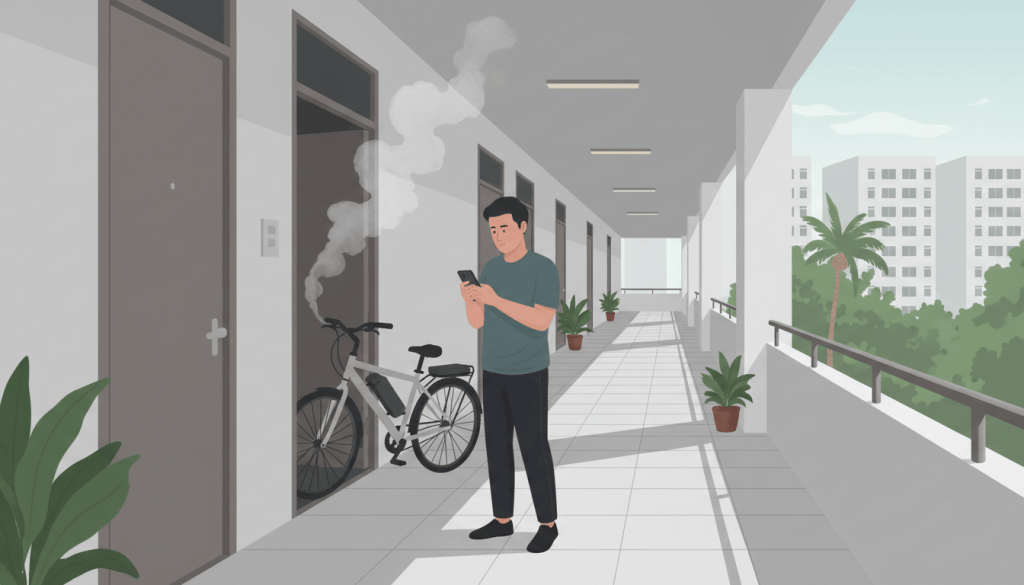
An e-bike, personal mobility device (PMD), power-assisted bicycle (PAB) or battery pack is smoking, hissing, sparking or burning in a Sengkang flat, corridor or workplace? Alert everyone, evacuate immediately, close the door behind you if safe, and call 995. Do not fight a lithium-ion battery fire, carry the smoking device through a corridor or attempt to unplug a device already emitting smoke or flames. SCDF warns that these fires can escalate rapidly, release toxic gases and cause explosions.
If the battery is only visibly swollen or damaged but is not smoking or burning, stop using and charging it. Disconnect a charger only when it is safe to do so without touching an overheated, leaking or dangerous device. Do not test it by turning it on again, puncture it, modify it or continue riding. Obtain advice from the manufacturer or an appropriate authorised service provider; do not leave a suspect device charging or near combustible objects.
Quick decision: smoke, hissing, fire or imminent danger — 995 from a safe place. Damaged battery with no immediate hazard — stop using it and arrange professional advice. In an HDB common corridor managed by Sengkang Town Council, urgent obstruction or estate maintenance may also be reported to 6590 9777, but town council maintenance is not a substitute for calling SCDF about a battery fire.
First minute: the safe response to a smoking lithium-ion battery
- Stop approaching the device. Do not lift the battery pack, squeeze a swollen casing or attempt to carry it outside.
- Alert occupants clearly. A shout of ‘Fire — leave now’ is more useful than silently trying to diagnose the problem.
- Evacuate the unit or area if there is smoke, fire or imminent danger. Bring children, older residents and anyone needing assistance out by a safe route.
- Close the door behind you where safe. SCDF advises this to help slow the spread of a battery fire and smoke.
- Call 995 from a safe place. State that a PMD, PAB, e-bike or lithium-ion battery is involved, and give the exact Sengkang address.
- Do not fight the battery fire. It may rapidly flare, explode or produce toxic gases; let trained SCDF responders handle it.
- Keep others away. Do not go back for belongings or bring bystanders into a smoky corridor.
Who to call in Sengkang
- 995 — SCDF fire and rescue: battery smoke, active fire, explosion risk, persons trapped, serious injury or smoke inhalation. SCDF emergency services.
- 6590 9777 — Sengkang Town Council EMSU: urgent common-area maintenance or obstruction in estates managed by the council, once life safety is addressed. SKTC EMSU.
- Manufacturer or authorised device service provider: technical assessment, replacement or safe disposal advice for a device with a damaged battery when there is no active hazard.
- Land Transport Authority: regulations and compliance for approved PMDs and PABs; not an emergency firefighting service. LTA active mobility information.
- 995 emergency ambulance: severe smoke inhalation, burns, breathing difficulty, collapse or other life-threatening injury.
Why lithium-ion battery fires are different
Lithium-ion cells store substantial energy in a small space. Damage, unsuitable charging, defects, overheating or modifications can lead to thermal runaway: an internal failure in which a cell releases heat that can trigger failures in neighbouring cells. The result may be a sudden burst of heat, flammable gases, smoke and fire.
SCDF’s civil defence emergency handbook warns that fires involving active mobility devices can grow very quickly and emit toxic gases. They can narrow the escape window within seconds. This is why its explicit advice is to evacuate, close the door and call 995 instead of attempting to fight the fire.
Ordinary kitchen fire instructions should not be copied indiscriminately to a device battery fire. Bystanders should not assume that a small visible flame is easy to control or that the battery will remain stable while moved.
Warning signs before a fire starts
- Bloating or swelling of the battery pack or device casing.
- Unusual heat after ordinary use or during charging.
- Hissing, popping or other abnormal sounds from the battery or charger.
- Unusual chemical odour, smoke or vapour.
- Visible corrosion, powdery residue, leakage or deformity.
- Charger defects such as exposed wire, a broken casing, water damage or evidence of impact.
- Repeated abnormal charging behaviour or warning lights contrary to the manufacturer’s guidance.
SCDF’s 2026 safety tips direct users to regularly check batteries for bloating, corrosion or powdery residue and to avoid damaged chargers. Some warnings can be subtle or absent; a battery appearing normal does not prove it is safe if it has been heavily modified or mistreated.
What to do if a battery is swollen but not smoking
Do not continue riding or charging. Keep the device out of use and away from children, and consult the manufacturer or authorised service provider about a safe response. Avoid touching leaking contents or dismantling the battery casing. A swelling pack may be unstable even if the device still switches on.
If the unit becomes hot, begins venting gas, hisses or starts smoking, move away and activate the emergency response rather than trying to carry it outdoors. Do not place the suspect pack in household rubbish or a normal recycling bin without proper waste-handler guidance.
Charging safely in an HDB flat
The SCDF 2026 PMD/PAB fire-safety tips recommend charging on a hard, flat surface to help dissipate heat. Do not charge alongside furniture, curtains, cardboard, solvents or other combustible materials.
Never place the charging device along an escape route. If a battery catches fire near the main door or a narrow corridor, it can cut off the very path occupants need to leave. Choose a suitable well-ventilated location in accordance with the manufacturer’s instructions, away from children and pets.
SCDF also advises against leaving devices charging unattended for extended periods or overnight. Charging immediately after use, while the battery remains hot, is discouraged. Do not rely on a timer or smart plug as permission to ignore a dangerous charging setup.
Use original approved batteries and chargers
An unapproved replacement battery or charger may not match the device’s voltage, protection circuit or charging profile. An attractive low price is not proof of compatibility or safety. SCDF cautions against buying or using non-original batteries and advises using the manufacturer’s recommended adaptor bearing the appropriate Safety Mark.
Do not modify, tamper with or attempt to repair a battery pack yourself. Replacing cells, bypassing protection boards or altering the charging connector can introduce hazards that are difficult to see from the outside.
LTA regulations distinguish different active mobility device types and require relevant approvals. SCDF’s 2026 leaflet refers to UL2272 certification for PMDs and EN15194 certification plus LTA approval for PABs. Check the current rules before purchasing or repairing any device.
A battery catches fire near the main entrance
Treat the escape route as compromised. Avoid moving toward the fire to retrieve shoes, keys or a phone. Use another safe escape route if available, and follow the Sengkang HDB fire and smoke guide and SCDF instructions.
If you cannot leave without passing through dangerous flames or dense smoke, do not force your way through. Seek a safer room away from the fire where possible, close doors, call 995, and state your location and that the exit is blocked. Follow dispatcher instructions.
What if the device is in the common corridor?
Smoke in an HDB corridor can threaten neighbours, particularly children or older people whose nearest exit may be close to the burning device. Alert others from a safe position, avoid entering smoke, and call 995 immediately for a battery fire. Do not attempt to drag the device down the corridor or into a lift.
After the emergency is controlled, a town council may need to inspect or clean damaged common property. In a managed SKTC HDB estate its 24-hour EMSU is 6590 9777. But it is not the primary emergency fire response.
Smoke inhalation and toxic gases
Lithium-ion battery incidents may release irritating or toxic products. A person with significant coughing, breathing difficulty, chest discomfort, confusion or collapse needs medical assessment. Move to fresh air without walking through the hazard, and tell 995 that battery smoke exposure is suspected.
Do not return into a smoky room to collect medication, valuables or the damaged charger. A person who feels less irritated after getting outside may still need professional evaluation depending on exposure and symptoms.
If a child is near the charging device
Tell children not to touch unusual hot objects or attempt to unplug equipment that is smoking. Their first instruction in a battery fire should be to move away and alert an adult. A nearby child should never be asked to carry the battery out of the flat.
For young children, prevention includes keeping chargers and devices out of reach, maintaining a clear exit, and teaching caregivers what a battery warning sound or smell may mean.
Sengkang examples
An e-bike battery begins hissing while charging in the service yard
If it begins venting or smoking, move people away, leave the unit and call 995. Do not approach to unplug it once it appears dangerous.
A replacement battery is swollen but not smoking
Stop use, do not charge it and consult the authorised service provider about safe assessment or disposal. Do not puncture the casing or return it to active service.
Grey smoke emerges from a PMD near the main door
Alert occupants, avoid the dangerous doorway and use a safe alternative escape if possible. Call 995 and explain that the exit may be blocked.
A device is charged overnight next to the sofa
This violates SCDF’s recommended precautions. Stop the unsafe charging arrangement, use approved equipment and keep the charging area away from combustibles and escape paths.
What to report to SCDF
- Location: block, road, floor, unit or shop, and whether the device is in the flat or corridor.
- Device: PMD, PAB, e-bike, battery pack or unknown lithium-ion equipment.
- Condition: swelling, hissing, smoke, active flames or suspected explosion.
- People: anyone trapped, injured or exposed to fumes.
- Escape routes: whether the fire blocks the main door, corridor or stairwell.
- Other hazards: nearby combustible materials or electrical equipment, without approaching to inspect.
- Callback: your safe location and number.
What to do after the emergency
Do not reuse or recharge a damaged device simply because the visible flames have gone. Trained responders and appropriate professionals need to determine whether it is safe to handle or transport. A battery pack may retain hazards after a fire.
Document the event only when safe and follow the official fire, insurance, property management and disposal instructions. Avoid moving remains or batteries yourself before the site has been released and made safe.
Frequently asked questions
Should I pour water on a burning PMD battery?
For an active PMD/PAB lithium-ion battery fire, SCDF’s public advice is to evacuate, close the door if safe, call 995 and not attempt to fight the fire.
Can I pull the plug if the battery is hissing?
Do not approach or touch a battery that is already venting, smoking or otherwise dangerous. Move away and call 995 for an imminent fire hazard.
Is charging on a bed safe?
No. SCDF advises a hard flat charging surface, away from combustible materials and escape routes.
Can I leave a PAB charging overnight?
SCDF advises not leaving devices charging unattended for extended periods or overnight.
Who do I call for smoke from an e-bike inside an HDB corridor?
995 for SCDF fire and rescue. The town council is a follow-up contact for common-property maintenance after life safety is addressed.
More Sengkang emergency guides
- HDB fire, smoke and evacuation
- Electric shock and exposed wiring
- Power outages and electrical faults
- Medical emergencies and ambulance
Continue with this Sengkang emergency series: Escalator injuries and emergency stop · Sewage backflow and blocked toilets · Death at home, doctor and Police procedures.
Official sources and review
- SCDF — 2026 Fire Safety Tips for PMDs and PABs
- SCDF — Civil Defence Emergency Handbook and Active Mobility Fires
- LTA — Active Mobility Rules and Approved Devices
- Sengkang Town Council — Essential Maintenance Service Unit
- SCDF — Emergency Medical Services
Reviewed 6 November 2026. This public guide does not provide battery firefighting or repair instruction. SCDF advises evacuating, closing the door if safe and calling 995 for active mobility battery fires.
