
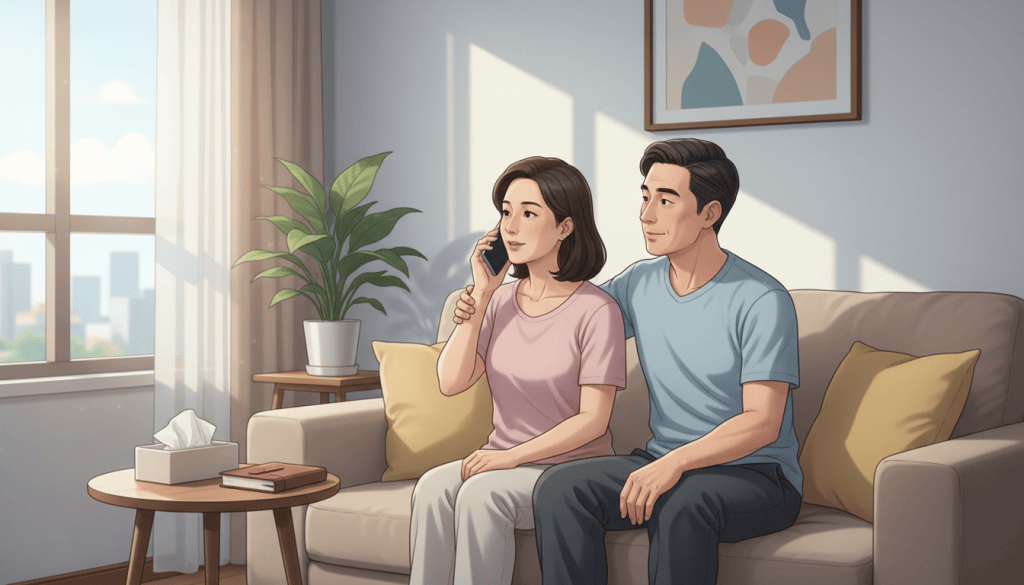
You have found a family member or another person unresponsive at home in Sengkang and do not know whether they are alive? Call 995 immediately. Check responsiveness and normal breathing and follow the SCDF dispatcher’s instructions for CPR or other emergency care. Do not decide that someone has died simply because they are not moving or appear pale. An unresponsive person who is not breathing normally may need immediate resuscitation.
If an expected death has occurred at home under an established end-of-life care plan, contact the regular doctor, home medical team or palliative service according to the instructions already given. Under Singapore’s system, a doctor must certify the death. ICA then automatically registers it online; the next of kin can download a digital death certificate through the official LifeSG/MyLegacy process. You generally do not need to attend a counter to register the death.
If no doctor can certify the death or the death is sudden, unexplained or possibly unnatural, contact the Police for guidance. The National Environment Agency (NEA) states that where no doctor is available, the Police will arrange for the body to be sent to Mortuary@HSA for the relevant processes. Do not move the body or disturb a possibly suspicious scene unless necessary for emergency medical assistance or as directed by Police.
Quick answer: who should you call?
- Person unresponsive or possibly still alive: 995 now. Follow the operator’s resuscitation instructions.
- Expected death under home or palliative care: the person’s regular doctor, home medical provider or palliative team as specified in their care plan.
- Death at home requiring certification: a family doctor or neighbourhood GP willing to make a house call; the doctor certifies the death online.
- No doctor available or death unexplained: contact the Police. For an urgent Police emergency call 999; for a non-immediate enquiry use official Police contact routes and explain the situation.
- Digital death certificate: ICA’s registration and download guide; save the certificate within the 30-day download period.
- Funeral and burial or cremation: a funeral director and the NEA after-death services after appropriate medical and legal procedures.
First five minutes if the person has unexpectedly collapsed
- Check your own safety. If electricity, gas, fire or another hazard is present, avoid becoming a second casualty.
- Call 995 and describe the person. Tell the dispatcher whether they respond when spoken to and whether they are breathing normally.
- Follow resuscitation instructions. If the person is unresponsive and not breathing normally, SCDF may guide CPR and AED use. Do not delay help to search for a pulse you cannot reliably assess.
- Give the exact address. HDB block number, road, unit and floor, and whether someone can meet paramedics at the lift lobby.
- Do not give food, drinks or medicines to a person who is unconscious or cannot swallow safely.
- Do not make assumptions about the cause. Tell responders about medicines, illness or circumstances only if you know them.
- Keep the scene available for responders. Avoid unnecessary moving or cleaning, except when required to save life or follow emergency directions.
Expected death under an advance care or palliative plan
Some people with advanced illness choose home-based end-of-life care. Their regular doctor or home palliative provider may have explained what to do when death occurs, including an after-hours telephone number. In those circumstances, follow the care team’s plan and contact the responsible doctor or service for death certification.
The Ministry of Health’s guidance on death at home explains that such patients are usually already in contact with family doctors, home medical or palliative services that advise families how to obtain assistance outside office hours. This is different from an unexpected collapse in a person who may still be resuscitated.
An advance care plan or advance medical directive, where applicable, should be understood and interpreted by the treating medical team. A general article cannot determine whether CPR, hospital transport or another intervention is appropriate for a particular person’s documented wishes.
Who can certify a death at home?
ICA says that when a death occurs at home, the next of kin should engage a doctor to certify the death. A family doctor who recently attended the person may be able to do so. NEA suggests a neighbourhood GP willing to make a house call when the regular doctor is unavailable.
The doctor must be able to make a professional decision about the cause of death and use the official system. A funeral director, neighbour or family member cannot simply issue the required medical certification. Do not assume a general clinic’s phone number is staffed around the clock or that every doctor will certify every case.
If a doctor cannot establish an acceptable cause or suspects the death is unnatural, the case may need Police and coroner procedures rather than an ordinary medical certificate.
If no doctor can be reached
NEA’s official ‘At Home’ after-death guidance states that if you cannot contact a doctor, you should contact the Police. The Police may arrange for the body to be taken to Mortuary@HSA in a police hearse. The family is normally notified when to attend, often the next day.
Call Police using their official channels and explain calmly that a death has occurred, whether it was expected and why medical certification is unavailable. If a person may still be alive or resuscitation is needed, the correct first contact remains 995.
You do not need to move the person to a hospital yourself to create a death record. Follow directions from Police, the certifying doctor and any relevant care team.
When the death may be unexplained or unnatural
A sudden death with unclear cause, signs of violence, an accident or other unusual circumstances may require an investigation. MyLegacy’s Mortuary@HSA guidance says a doctor may report a death to Police if the cause is unknown or unexplained, or if the death was unnatural or violent. The Police then refer the case to the coroner.
Do not clean an apparent injury scene, discard medicines or move objects unnecessarily. Keep other household members from disturbing the area, while preserving any urgent safety needs and following official instructions. Do not accuse relatives or neighbours based on guesses.
If Police are investigating, an assigned officer can explain the mortuary identification process and the next steps. Families are not expected to conduct their own forensic investigation.
What happens at Mortuary@HSA?
Mortuary@HSA is located at Block 9, Singapore General Hospital, Outram Road, Singapore 169608. For relevant coroner cases, the Police investigating officer contacts the family, and the coroner reviews whether a post-mortem examination is required.
The stated public hours on MyLegacy are weekdays 8am–4.30pm, and weekends or public holidays 8am–12.30pm. These hours do not mean families should attend without instructions. The investigating officer will tell the family when to go, often the day after referral.
Items that may be requested include the deceased person’s identification, the family’s own identification, medical records and a list or packaging of medicines used. Bring documents as directed rather than rushing to the mortuary without an appointment or notification.
How death registration works in Singapore
Under the current ICA process, death registration is automatic after a doctor certifies the death electronically. The next of kin no longer needs to register the death at a Police station, hospital counter or ICA service counter merely to obtain a death certificate. Since 29 May 2022, ICA issues digital rather than physical death certificates.
The certifying doctor or hospital provides the death certificate number, deceased person’s identification number and date of death. Eligible next of kin can use the official digital download process, saving the certificate to a personal device for later use.
ICA says the digital death certificate is available for download for 30 days after certification. After that, a certificate extract application may be needed and fees can apply. It is practical to download and securely save a copy promptly.
Who can download the digital death certificate?
ICA lists categories of eligible relatives including spouse, parents, children, siblings, grandparents, grandchildren, aunts or uncles, nieces or nephews, and persons authorised by an eligible next of kin. The exact authentication steps are set out through the official LifeSG/MyLegacy process.
Do not share the deceased person’s full identification number, certificate number or private medical documents in a public family chat or on social media. Use official accounts and an appropriate secure family record.
ICA states that ordinary death registration and issuance of a digital death certificate carry no fee. An extract obtained later may involve a charge, and funeral services are separate paid arrangements.
What happens to the deceased person’s NRIC?
ICA says the deceased person’s NRIC is automatically invalidated in its system after death registration. The next of kin does not need to surrender it to a Police station or ICA counter for physical invalidation. It can be destroyed or punched through to prevent misuse as described by ICA.
Do not use the card to transact on the deceased person’s behalf. Banking, estates, insurance and account access have their own legal procedures. Seek professional advice where a family is unsure about an estate or financial obligation.
When to engage a funeral director
Families commonly engage a funeral director once medical certification or the Police/coroner process permits release. The funeral director may assist with collection, preparation, wake arrangements, religious or cultural requirements, and burial or cremation bookings.
NEA’s at-home guide explains that a Permit to Bury/Cremate must be obtained before the relevant burial or cremation process. Eligible next of kin can apply through NEA’s e-Services or authorise a funeral director to assist. Do not arrange an immediate collection that conflicts with a Police or coroner hold.
Compare quotes and ask for a written breakdown of the service package, transport, venue arrangements and government fees. A family may wish to involve religious advisers or other trusted relatives, but there is no need to make every non-urgent commercial decision before death certification.
If the family has different religious or cultural needs
Funeral practices vary across families. Some prefer prompt burial, some choose cremation, and others require specific prayers, rites or handling arrangements. Explain the family’s preferences to the funeral director while following Singapore’s legal and medical requirements.
An unusual or investigated death may take longer to release. The Police and coroner process takes priority over the family’s preferred timing. Avoid promising a precise burial or cremation date until the necessary permissions and arrangements are confirmed.
What to tell the family doctor or palliative team
- Person: the patient’s full name, approximate age and the clinic or home-care team that was treating them.
- Location: Sengkang HDB block, unit, floor and a number where the caller can be reached.
- Current condition: whether unresponsive, breathing normally or following an expected end-of-life plan.
- Clinical history: recent illness, last doctor visit, palliative plan and any relevant advance directive known to the care team.
- Timing: when the person was last seen responsive and when the change was noticed.
- Documents: identification and medical records, if they can be gathered without delaying an emergency response.
- Questions: whether a doctor can attend for certification and what to do if that is not possible.
What to tell Police if asked to report the death
Give a concise factual description: where the person was found, when they were last seen alive, any known illness and whether a doctor attended. Avoid guessing the medical cause. Explain whether anyone moved or treated the person before Police were contacted, including CPR or other emergency care.
If family members have already called SCDF and the ambulance crew assessed the situation, tell Police what happened and whether any paperwork or instructions were provided. Keeping a simple timeline can help agencies without requiring relatives to reconstruct every minute immediately.
Sengkang situations
An older person in palliative care passes away as expected
Follow the home palliative team’s written plan and contact their doctor or service. The doctor can arrange appropriate death certification, after which registration and certificate download occur through the official system.
A family member finds someone collapsed and not breathing normally
Call 995 immediately, give the exact address and follow the emergency operator’s CPR instructions. Do not assume death or wait for a funeral provider.
A person dies suddenly at home and no doctor can certify the cause
Contact Police as advised by NEA. An unexplained case may be referred to Mortuary@HSA and the coroner, with an investigating officer guiding the family.
A family has the doctor’s certification but cannot find the paper death certificate
Singapore no longer routinely issues a physical certificate. Use ICA’s digital death certificate download process within the 30-day window, and save it securely.
Frequently asked questions
Should I call 995 whenever an expected palliative death occurs?
For a death expected under an established end-of-life plan, follow the care team’s instructions for contacting the doctor. If the person may still be alive or an unexpected life-threatening collapse occurs, call 995.
Does a family member have to register the death in person?
No. ICA automatically registers a death when a doctor certifies it online. Eligible next of kin then download the digital certificate.
What if the family doctor cannot be reached?
NEA advises contacting the Police if no doctor is available. An investigating officer can explain the next steps, including Mortuary@HSA if required.
Do we have 30 days to obtain a death certificate?
The ordinary digital certificate download window is 30 days after certification. Download it promptly; later retrieval may require a paid certificate extract.
Who handles a death that may be unnatural?
The Police and coroner process applies to reportable or unexplained cases. Follow the assigned investigating officer’s instructions.
Related Sengkang emergency guides
- Medical emergencies and ambulance
- Heart attack, cardiac arrest and chest pain
- Stroke and sudden weakness
- Elderly falls and head injury
Continue with this Sengkang emergency series: Escalator injuries and emergency stop · PMD, PAB and e-bike battery fires · Sewage backflow and blocked toilets.
Official sources and review date
- NEA — When Death Occurs at Home
- ICA — Death Registration and Digital Certificate
- MyLegacy@LifeSG — Coroner’s Case at Mortuary@HSA
- Ministry of Health — Death at Home and Home Medical Providers
- NEA — After-Death Services and Funeral Arrangements
- SCDF — Emergency Medical Services
Reviewed 6 November 2026. This is general Singapore after-death guidance, not a medical certification, legal finding or funeral booking. If a person may still be alive and is unresponsive, call 995. Follow the certifying doctor, Police, ICA and NEA instructions as applicable.
