
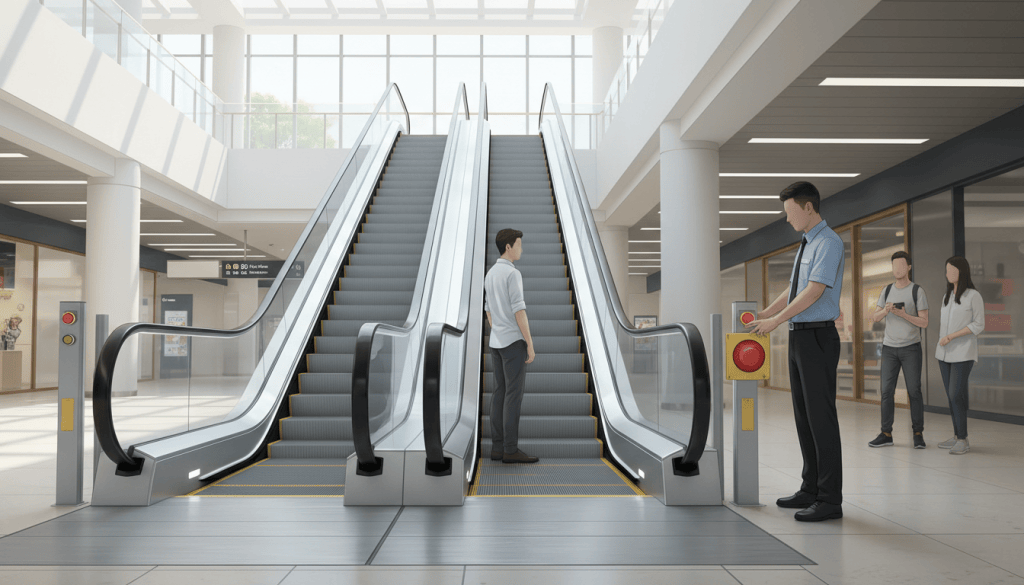
Someone’s shoe, clothing, foot or other body part is trapped in an escalator in Sengkang? Press the escalator’s emergency stop button and call for assistance immediately. This is the Building and Construction Authority’s (BCA) explicit advice for an escalator incident. Alert mall, station or building staff. If someone is seriously injured, trapped in moving machinery, bleeding heavily or otherwise in immediate danger, call 995 for SCDF rescue and ambulance assistance. Do not pull forcefully at an entrapped limb or dismantle machinery.
If the escalator stops after a fall and the person is conscious, keep the surrounding landing clear, check for injuries and allow trained responders to assess whether they can move safely. Do not restart a stopped escalator, open access panels or use tools to free footwear from the side or comb plate. A stopped machine may still contain tensioned components and sharp gaps. The building’s owner or managing agent is responsible for stopping an unsafe escalator and arranging professional inspection.
Fast contacts: severe injury or entrapment — 995; security danger or violence — 999; routine escalator malfunction — the building owner, station operator or managing agent, using the number displayed nearby or staffed information counter. For a mall or private building, the HDB town council is not automatically the correct maintenance contact.
What to do in the first 60 seconds
- Activate the emergency stop if there is a current escalator incident. Press the marked stop button positioned at the escalator landing; follow any posted emergency directions.
- Alert the nearest staff member. Ask one person to tell the mall control room, station counter or managing agent; name the exact escalator and level.
- Call 995 for serious injuries or urgent rescue. Describe whether a foot or clothing is caught and whether the person can breathe and respond.
- Keep other users away. Ask people not to step onto the stopped machine or crowd the landing.
- Do not force an extraction. Do not yank an embedded shoe, clothing or limb, cut into the mechanism or attempt to remove panels.
- Check for additional injuries safely. If someone has fallen, avoid unnecessary lifting where head, back, hip or neck injury is possible.
- Wait for qualified assistance. Follow trained responder directions and preserve the scene for inspection after the patient has been cared for.
Who to call or alert in a Sengkang escalator incident
- 995 — SCDF ambulance and rescue: for a seriously injured person, entrapment requiring rescue, collapse, uncontrolled bleeding or another life-threatening emergency. SCDF emergency medical services.
- Building staff or managing agent: the immediate contact for a malfunction or hazard affecting the escalator they own or manage. BCA escalator incident instructions.
- Rail station personnel: for incidents at an MRT/LRT station; use the staffed counter or emergency communications, and give the station and entrance.
- 999 — Police: if a separate urgent criminal or security threat is occurring, not merely because an escalator stopped.
- BCA building-safety feedback: appropriate for escalator defects and maintenance concerns after immediate safety is addressed. BCA lift and escalator safety page.
When exactly should the emergency stop button be pressed?
The BCA advises members of the public to press the emergency stop button and call for assistance during an escalator incident. Examples include a limb or shoe becoming entrapped, a person falling and being pulled toward the machinery, or an apparent mechanical hazard that may cause injury if movement continues. Stopping the machine may prevent a dangerous situation from worsening.
The button is not a way to shorten a queue, get an escalator’s attention or test whether its safety system works. An unnecessary sudden stop can itself cause a fall, especially for older people, children and users who are carrying items. Use the control for a genuine emergency and alert building staff.
Once the machine has stopped, do not reset it or encourage commuters to continue riding. The owner or maintenance contractor must assess why it stopped and when it can be safely returned to service.
Why shoes and clothing can become trapped
Escalators contain moving steps, side skirting panels, comb plates and landing transitions. Footwear and loose clothing can enter narrow gaps, particularly near the sides of steps. BCA’s 2023 incident review specifically listed entrapment of shoes and body parts among reported incident causes, with young children particularly vulnerable.
Soft shoes, long clothing, straps and untied laces can present problems when they are too close to the sides or the step exit. This does not mean that a particular shoe type always causes an accident. The safest practice is to stand within yellow markings, keep belongings clear of the sides and step off promptly at the landing.
Do not lean down to retrieve a dropped object while riding. The person may lose balance and bring a hand or clothing into the machine.
If a child’s shoe or foot is caught
Press the emergency stop button without delay and request trained assistance. Keep the child still as appropriate and do not tug on the leg or force the shoe apart to free it. Describe whether the child’s foot appears compressed, whether they can move it normally and whether there is bleeding or serious pain.
If the child is seriously hurt or physically entrapped, call 995 and tell responders what part of the body is involved. A parent may want to pull the child immediately, but an unsafe force can worsen a hidden injury.
After release, arrange medical assessment for pain, swelling, numbness, cuts, crushing or difficulty walking. A child who starts crying and then becomes quiet has not necessarily recovered; look at the actual condition.
If someone falls and the escalator stops
Help other commuters move clear of the landing so there is space for responders. Do not automatically pull an older adult into a standing position. A fall can involve head impact, hip injury or limb fracture, especially if the person is unable to move normally.
Call 995 for unconsciousness, severe pain, inability to get up or another emergency warning sign. If the injury is minor and the person can move safely, seek appropriate clinical advice and notify building management so the equipment can be checked.
See the Sengkang elderly-fall and head-injury guide for why an older adult should not be forcibly helped to stand after a serious fall.
What if it stops suddenly but nobody seems injured?
A sudden stop can be triggered by safety devices, an intentional emergency stop or a mechanical problem. Do not decide which occurred solely from the sound or motion of the machine. Step or stand safely where possible and follow staff instructions.
Tell the building manager what happened and whether users lost balance or luggage fell. The escalator should not be restarted casually by a member of the public. The owner has obligations to maintain and inspect the equipment and stop operation if it is likely to be dangerous.
What BCA expects escalator owners to do
BCA’s official escalator safety guidance states that owners and managing agents must maintain escalators in proper working condition, carry out required inspections and immediately shut down equipment that presents an injury risk. Reportable incidents and critical failures must also be handled through the required BCA process.
That regulatory reporting duty is separate from the public’s first action. A bystander should stop the dangerous machine, summon help and contact 995 when a serious injury or rescue need exists. The owner and appointed maintenance contractor can deal with technical examination, repair and official incident notification.
What to tell the 995 operator or building control room
- Place: exact mall, MRT/LRT station or building, plus the nearest entrance.
- Escalator: whether it connects basement to ground floor, direction of travel and which landing is involved.
- Person: child or adult, number of casualties and whether anyone is entrapped.
- Injury: bleeding, pain, loss of consciousness, difficulty breathing or inability to move.
- Machine status: moving or stopped, and whether emergency stop was activated.
- Access: if the machine is behind a barrier or near a staircase that responders may need to avoid.
- Callback: a safe number for staff or the original caller.
Do not pull somebody free with tools
An escalator contains tightly spaced and heavy moving parts. A bystander cannot see where pressure is being applied under a step or skirt panel. Cutting a shoe, prying up a comb plate or attempting to dismantle a side cover can harm the person or create an additional moving-parts hazard.
Specialist maintenance staff and SCDF rescuers have training and equipment for safe release. They may need to isolate the electrical supply and control mechanical movement before extracting the person. The safest ordinary response is to stop the escalator and prevent further movement until professionals arrive.
If smoke or fire is present
An escalator with smoke, visible flames or an associated electrical fire is no longer a routine mechanical breakdown. Move people away, alert the building’s fire and safety team and call 995. Do not attempt to work on panels or restart the machine.
Follow the building’s evacuation instructions and use appropriate safe exits. Do not use an escalator in a hazardous fire or smoke area to attempt a shortcut to another level.
Strollers, luggage and wheelchairs: use lifts instead
BCA specifically advises people with strollers, prams, trolleys, heavy luggage or limited mobility to use lifts instead. Wheels can jam between steps, occupants may topple during a sudden stop, and the person controlling the item may not be able to hold the handrail at the same time.
A wheelchair or mobility aid should not be carried onto an escalator as an improvised accessible route. Ask building staff for a functioning lift or another safe step-free option. If a lift is temporarily out of service, report the access problem rather than making the escalator a risky workaround.
Children and escalator rules
- Hold the child’s hand and supervise them from the moment they step on until they leave the landing.
- Keep footwear and loose clothing within yellow step markings and clear of side panels.
- Do not allow children to sit on steps, climb the handrail or play at the comb plate.
- Avoid using phones while assisting a young child on the machine.
- Step away promptly at the landing rather than stopping to look behind you.
- Use a lift when travelling with a stroller or pram.
Escalator incidents at Sengkang retail centres
Sengkang residents may use escalators at transport interchanges, malls, clinics or commercial premises. The immediate staff contact depends on the actual premises and escalator owner. An escalator inside a mall is generally managed by that building’s owner or agent, rather than a town council.
Give the building name and level accurately. A phrase such as ‘the escalator at Sengkang’ can refer to several different facilities, and a manager may not know which machine requires shutdown.
In a station-connected shopping area, tell responders whether the incident is inside the station’s fare-controlled area or in the neighbouring retail premises; responsibility for access and security may differ.
Three examples
A child’s soft shoe jams at the side of a moving escalator
Activate emergency stop, ask staff for help and call 995 if the foot is trapped or injured. Do not pull the shoe or child’s foot out by force.
An older commuter trips at the escalator exit
Keep others from crowding the landing, alert staff and check the person’s condition. If there is head injury, inability to stand or serious pain, call 995. Do not force the person to walk.
A stroller is being taken onto the escalator
Use the lift instead. If an accident occurs, activate emergency stop and get help; moving a stroller with a child through the escalator mechanism can be extremely dangerous.
Frequently asked questions
Who do I call if a foot is trapped?
Press emergency stop, alert building staff and call 995 for serious injury or a rescue emergency.
Can I restart an escalator after somebody presses stop?
No. Allow the building owner or authorised maintenance staff to assess the cause and determine when it is safe to operate again.
Should a parent use the escalator with a stroller?
BCA advises parents with prams or strollers to use lifts.
Does 6590 9777 maintain every escalator in Sengkang?
No. That is Sengkang Town Council’s EMSU for common estate maintenance under its responsibility. Mall and station escalators have their own owners and managing agents.
What if the person seems fine after getting free?
Pain, swelling, abnormal sensation or difficulty moving warrants clinical review. Significant entrapment or a crush injury should not be dismissed merely because the casualty can speak.
More Sengkang emergency guides
- Stuck in a lift and lift breakdown
- MRT and LRT disruptions and rail safety
- Elderly falls and fractures
- Medical emergency and ambulance 995
Continue with this Sengkang emergency series: PMD, PAB and e-bike battery fires · Sewage backflow and blocked toilets · Death at home, doctor and Police procedures.
Official sources and review date
- Building and Construction Authority — Safe Use of Escalators
- BCA — Public Escalator Safety and Incident Guidance
- BCA — Lift and Escalator Safety
- SCDF — Emergency Medical Services
Reviewed 6 November 2026. Public guidance, not mechanical rescue instructions. Press emergency stop in a genuine incident and call for assistance; use 995 for serious injury or urgent rescue. Follow onsite staff and responders.
