
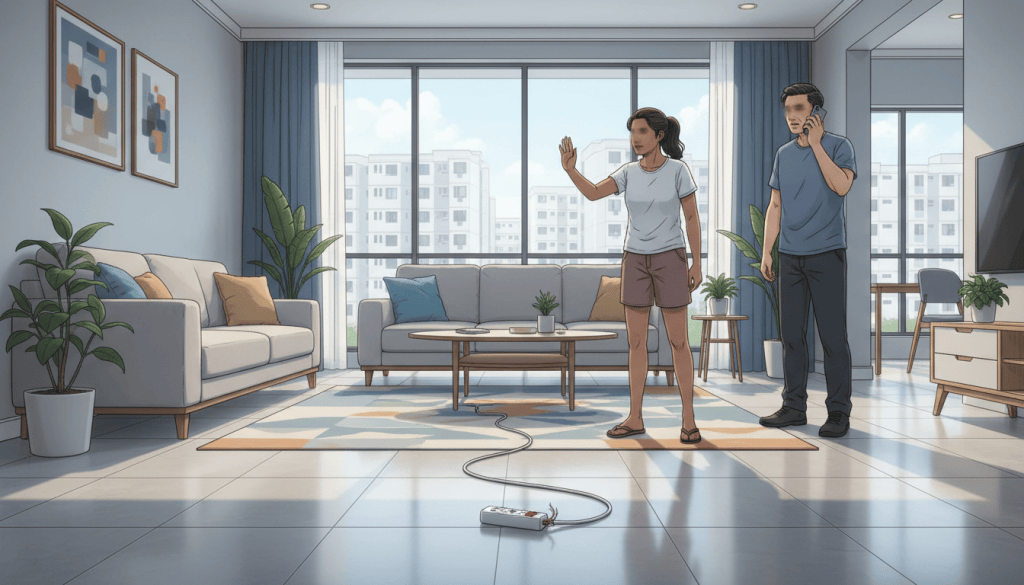
Someone in Sengkang may be receiving an electric shock right now? Do not touch the person, appliance, cable, metal fitting or nearby water while the power source may still be live. Keep everyone back. Call 995 for an unconscious person, collapse, serious injury, burns, breathing difficulty or another immediate electrical rescue emergency. Have the electrical supply isolated only when this can be done safely without approaching an exposed live area; let trained responders manage an uncertain supply.
Once the electrical danger has been made safe, assess the person and follow the emergency operator’s instructions. A shock can cause internal injury or abnormal heart rhythm even when the skin looks relatively normal. Seek prompt medical assessment after a significant electric shock. Do not treat a tripped circuit breaker as proof that every wire is de-energised; multiple supply sources and damaged equipment can be dangerous.
Who to call: 995 for an injury or life-threatening electrical incident; 1800 778 8888 for an SP Group electricity supply interruption; 6590 9777 for urgent HDB common-area maintenance at blocks managed by Sengkang Town Council; and an EMA Licensed Electrical Worker for regulated home electrical inspection and repairs. The correct contact depends on whether a person is injured, a public supply has failed or private wiring is defective.
Immediate checklist: electric shock or exposed live wiring
- Do not become a second casualty. Stay away from anyone or anything that may still be energised. Do not reach into water or grab the person by an arm or clothing.
- Call 995 for a serious incident. Report whether the person is conscious, breathing normally, trapped or visibly burned, and describe the electrical source.
- Keep bystanders away. Ask others not to use nearby sockets, touch cables or step into a wet area.
- Do not improvise a rescue with household objects. A broom, towel or glove is not proof of electrical insulation. Leave uncertain or high-voltage situations to trained responders.
- Isolate the power only if independently and safely possible. An ordinary person should not enter a flooded room, open live equipment or approach sparks to operate a switch.
- After responders confirm it is safe, assess breathing and responsiveness and follow 995 guidance for CPR or other first aid.
- Arrange professional inspection. Do not reuse the faulty equipment or restart the installation until the proper electrical professional has cleared it.
Who is responsible for what in Sengkang?
- 995 — SCDF: urgent rescue, serious shock, burns, collapse, fire or a life-threatening medical emergency. SCDF emergency medical services.
- 1800 778 8888 — SP Group Electricity Service Centre: 24-hour electricity supply interruption hotline. SP Group official contacts.
- 6590 9777 — Sengkang Town Council EMSU: 24-hour essential maintenance for common areas under its management. SKTC Essential Maintenance Service Unit.
- EMA Licensed Electrical Worker (LEW): for repairs, replacement, modifications and technical inspection of regulated installations inside premises. EMA electrical safety advice.
- Building management or MCST: responsible for common electrical installations in a privately managed condominium or commercial property, not necessarily the town council.
Why you must not touch a person still in contact with electricity
Electric current can pass through the injured person and into someone trying to help. Wet floors, metal fixtures and damaged insulation increase the danger. An instinctive attempt to grab a family member or lift them away from an appliance can make the emergency worse.
A bystander does not always know whether a breaker has isolated the circuit, whether the appliance uses a backup supply or whether another exposed conductor remains live. The safest rule is to keep clear of the source and communicate its location to emergency responders. Never experiment by touching a cable to see whether electricity remains.
If a safe, familiar means of isolation exists away from the danger, emergency services may advise the next step. Do not improvise with a wooden stick, broom or rope in an unknown electrical situation: those items may be wet, damaged or insufficient for the voltage involved.
What to tell 995 about an electric-shock emergency
- Exact location: Sengkang HDB block, street, unit and floor; for a public area, the nearest lift, corridor or shop.
- Person: whether responsive, breathing normally or collapsed.
- Source: appliance, power point, water heater, extension cord, downed wire, electrical cabinet or unknown item.
- Current exposure: whether the person appears still in contact with the source; do not approach to check.
- Water and fire: whether the floor is wet, smoke is visible or sparks are occurring.
- Power isolation: whether a qualified person has confirmed the area is safe, not merely whether a switch was flipped.
- Access: which entrance or staircase responders should use and where people are waiting safely.
Why a small skin mark does not mean a small injury
An electrical injury may damage tissues below the skin, disturb the heart’s rhythm or cause an associated fall. A person can be conscious and talking after a shock yet still need medical assessment. NHS Inform’s electric-shock first aid emphasises assessment of the environment before helping, isolation of electricity and urgent assistance when the person is seriously injured.
Do not rely on a burn’s size as a complete measure of severity. The Singapore Ministry of Health’s burns guidance recommends emergency department assessment for electrical burns. Inform the clinician about the source, duration if known and any loss of consciousness or chest symptoms.
A fall caused by an electric shock may also create a head, back or neck injury. Do not move someone with severe trauma unnecessarily once the area is safe. Follow the emergency dispatcher.
Electricity and water: special hazards in bathrooms and kitchens
A water heater, kitchen appliance or extension socket near water requires extra caution. The Energy Market Authority advises never using electrical appliances near water or with wet hands, and never touching an open outlet or switch with wet hands. Water can create conductive paths and make otherwise ordinary movements dangerous.
If a person is in a flooded bathroom or water is dripping over electrical fixtures, do not stand in the water to unplug equipment or operate a switch. Keep others out and tell the emergency or maintenance responder what is wet and where.
Older adults, caregivers and children may not recognise a dangerous socket near a washbasin. Make safe storage and properly installed equipment part of household prevention, not an improvised solution during an emergency.
What if the power trips after someone gets a shock?
A protective circuit breaker or residual-current device may operate during a fault, but the trip alone does not establish that every part of the appliance or wiring is safe. Do not repeatedly reset breakers or restore power when somebody has been injured or sparks, smoke and damage are evident.
Arrange an EMA Licensed Electrical Worker to investigate the installation or damaged circuit. The electrician should identify the root cause and carry out any required tests before supply is restored. For a wider supply interruption affecting neighbours, contact SP Group separately.
Sparks, smoke or burning smell from a socket
A hot socket, visible sparks, crackling noises or insulation smell is not an ordinary inconvenience. Stop using the equipment, keep people away and do not pull a hot or damaged plug while exposed to danger. If there is an active fire or immediate risk to people, call 995.
If there is no fire or injury but the installation appears defective, have a licensed electrician assess it. Do not patch exposed wire with tape and resume use. EMA specifically warns against joining broken cords with insulation tape and against overloading multiple adaptors.
A fallen cable or damaged outdoor electrical equipment
Treat any fallen electrical line as live. Do not touch the cable, nearby metal railing, a fallen tree touching the cable or pooled water. Keep other people away from the hazard. Call emergency services for active danger and inform the responsible electricity operator or property manager.
Do not try to lift a cable with a pole, step over it or photograph it from close range. Professional crews must establish an electrical exclusion zone and isolate the correct supply. See the Sengkang fallen-tree guide for related hazards.
Does a blackout mean the power is safe?
No. A blackout can be caused by a fault, planned interruption or external supply issue, and equipment may have more than one source of power. Never use lack of light as proof that exposed wires are safe to handle. This is especially important for backup batteries, solar systems or facilities with alternative supplies.
SP Group can handle supply interruptions; it is not a substitute for an emergency call when someone is injured or for a Licensed Electrical Worker dealing with damaged private wiring. The Sengkang power-outage guide explains the distinction.
Safe response after the electrical danger is removed
Once trained personnel or responders confirm the electrical hazard is controlled, attend to the injured person according to the emergency dispatcher. If unresponsive and not breathing normally, follow 995 instructions for CPR and AED use. If breathing normally but injured, keep them comfortable and watch for changes while awaiting medical assessment.
If a thermal skin burn is present, appropriate cool-running-water first aid may be advised after the scene is electrically safe; do not use water while an electrical hazard is present. The Sengkang burns and scalds guide gives general non-electrical burn care.
When to arrange a licensed electrician
EMA requires electrical work on consumer installations to be done by licensed electrical workers. That includes rewiring, modification, repair and replacement of electrical installations, followed by the relevant safety inspection and certification.
Use EMA’s official electrical safety page to learn how to verify licence status through ELISE. Avoid hiring someone solely because they advertise a low price in a neighbourhood message. Ask for the scope of work, proper testing and documentation.
An ordinary appliance may be replaced by a consumer when designed for normal plug-and-play use, but internal wiring, new sockets and fixed installation work should not be treated as a casual DIY task.
Examples in Sengkang
A person appears to collapse while handling a defective extension lead
Do not touch them while an electrical source may be live. Keep others away and call 995, describing the extension lead and whether the person is breathing. Let responders advise about safe isolation and access.
Water drips from the ceiling onto a ceiling light
Stay out of the wet area, do not touch the light or nearby switches, and alert the property manager or town council as appropriate. Escalate to 995 if there is fire, a serious shock or immediate rescue danger.
A socket trips whenever a kettle is used
Stop using the defective arrangement and arrange a licensed electrician’s inspection. Do not repeatedly reset the circuit or add adapters to bypass the problem.
A cable is hanging low near an HDB walkway
Keep people away and report an urgent hazard to the appropriate utility and building management; call emergency services if the situation threatens life. Do not touch, lift or step over it.
Prepare before an electrical accident
- Keep the home electrical installation professionally maintained and use EMA-licensed workers for regulated work.
- Do not overload extensions or stack multiple adapters.
- Replace frayed cords rather than covering damage with tape.
- Keep electrical equipment away from sinks, wet floors and baths.
- Keep children away from exposed sockets, damaged chargers and electrical cabinets.
- Know where emergency contacts and the home address are stored.
- Maintain a separate plan for vulnerable household members who depend on powered medical equipment.
Frequently asked questions
Should I pull an electrocuted person away by their clothes?
No. Do not touch the person while the source may still be live. Call 995 and isolate electricity only when it is independently safe to do so.
Can a small shock still need medical care?
Yes. A significant shock may cause internal effects or heart rhythm problems even with little visible skin damage. Seek prompt medical evaluation.
Is 1800 778 8888 the emergency ambulance number?
No. It is the SP Group electricity supply interruption hotline. Dial 995 for life-threatening injury, rescue or fire.
Can I repair the socket myself?
Regulated wiring and installation repairs must be performed by EMA Licensed Electrical Workers. Do not improvise repairs.
Should I pour water on an electrical burn?
Never apply water while a live electrical danger remains. Emergency responders and qualified personnel must make the area safe first; the injured person still needs medical assessment.
More Sengkang emergency guides
- Power outages and electrical faults
- HDB fire, smoke and evacuation
- Burst water pipes and ceiling leaks
- Medical emergency and ambulance
More Sengkang emergency guides (6 November 2026): Asthma attacks and severe breathlessness · Chemical eye splashes and sudden vision loss · Knocked-out teeth and dental injuries.
Official sources and review
- Energy Market Authority — Electrical Safety
- EMA — Engaging Licensed Electrical Workers
- SP Group — Contact Us and Supply Interruptions
- Sengkang Town Council — Essential Maintenance Service Unit
- MOH — Burns and Scalds, Including Electrical Injuries
- SCDF — Emergency Medical Services
- NHS Inform — Electric Shock First Aid (General Safety Reference)
Reviewed 6 November 2026. A public-safety guide, not electrical engineering advice or permission to touch live equipment. Stay away from electricity, call 995 for a serious incident and engage qualified professionals for repairs.
