
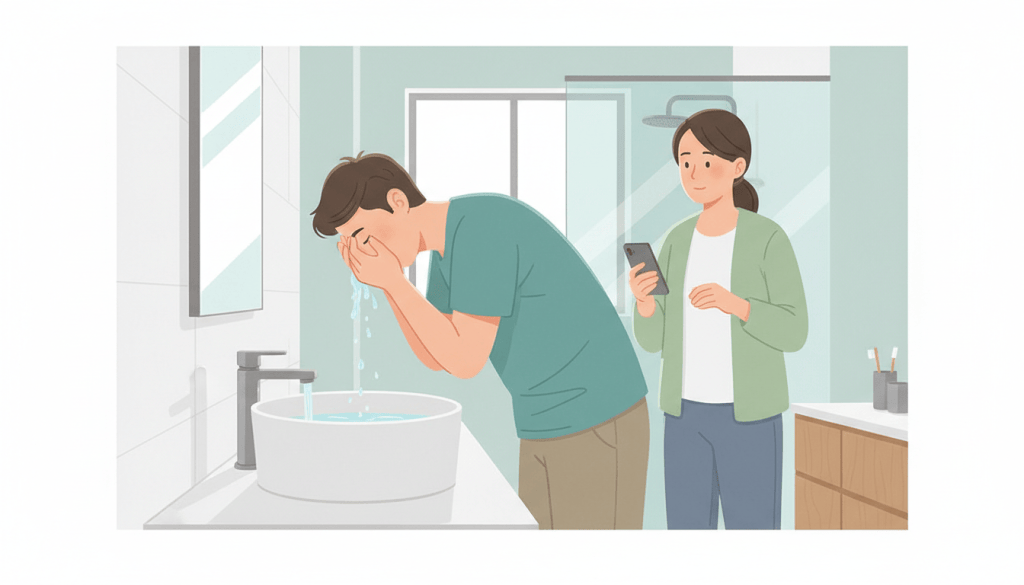
Cleaning chemical, detergent, bleach or another liquid has splashed into someone’s eye in Sengkang? Begin rinsing the affected eye immediately with gently running clean tap water. SingHealth recommends flushing for 10–20 minutes following a chemical splash. Keep the eyelids open gently if the person can tolerate it and let the water run away from the unaffected eye. Seek urgent medical assessment at an emergency department equipped for eye emergencies. Do not wait until the rinsing is finished to arrange help.
Call 995 for a severe eye injury accompanied by life-threatening symptoms, major trauma or another emergency requiring ambulance transport. Important for Sengkang residents: SingHealth states explicitly that Sengkang General Hospital’s Emergency Department does not offer emergency eye services. The outpatient Singapore National Eye Centre (SNEC) clinic at SKH is a different, appointment-based service; it is not the same as emergency eye care. For an urgent sight-threatening eye injury, let the 995 dispatcher or a healthcare professional direct you to an appropriate facility.
Quick distinction: chemical splash — rinse immediately and seek urgent emergency eye assessment; embedded object or penetrating injury — do not press, rub or pull it out, obtain emergency care; sudden vision loss or severe eye pain — urgent specialist emergency assessment. Minor grit without serious symptoms may sometimes be removed with a gentle rinse, but persistent pain, blurred vision or a suspected scratch needs clinical advice.
First steps for a chemical splash in the eye
- Move clear of the chemical source. Protect helpers from additional splashes, fumes or electrical hazards.
- Start irrigation immediately. Use gently running clean tap water, a safe eyewash station or sterile saline where available.
- Continue flushing for 10–20 minutes. SingHealth provides this duration for chemical eye exposure; specialised workplaces may have their own emergency eyewash procedures.
- Aim the flow away from the other eye. If one eye is affected, position the head so contaminated water drains outward rather than across the face.
- Keep eyelids gently open if safe. Encourage blinking; avoid pressing on the eye or forcefully rubbing it.
- Remove contact lenses if easily possible during irrigation. Do not delay the first rinse to find a contact lens case, and never reuse lenses contaminated by chemicals.
- Arrange urgent emergency eye assessment. Bring the product name or a safe label photo; do not carry a leaking hazardous container through public areas.
When to seek emergency care immediately
- Any chemical splash into the eye, even if pain initially improves after rinsing.
- Sudden loss of vision, a large new vision disturbance, double vision or abrupt appearance of many floaters.
- Penetrating injury, suspected embedded metal, glass or another sharp foreign body.
- Severe eye pain, marked sensitivity to light or difficulty keeping the eye open after trauma.
- Eye injury after a fall, collision or high-speed tool use.
- Other severe injuries or life-threatening symptoms that justify 995 emergency ambulance assistance.
SingHealth’s Eye Conditions guidance explicitly lists sudden vision loss, eye pain, chemical splash and injury as reasons for an emergency department with eye services. Do not assume a red but painless eye is always harmless, particularly after exposure to an industrial or concentrated cleaner.
Who to call and where to go from Sengkang
- 995 — SCDF emergency ambulance: for an eye injury with an urgent life-threatening or serious medical emergency, and when emergency services need to determine the safe treatment destination. SCDF emergency medical services.
- Emergency department with emergency eye services: seek specialist-capable urgent care for chemical splashes, penetrating injury, severe pain or sudden vision loss.
- Sengkang General Hospital ED: SingHealth says it does not have emergency eye services. Do not assume its ordinary emergency department includes a dedicated emergency eye service.
- Singapore National Eye Centre (SNEC): its official urgent-care guidance directs medical emergencies to Singapore General Hospital A&E or 995. The SNEC Eye Clinic @ SKH is an outpatient clinic and does not replace these emergency services.
- GP or polyclinic: appropriate for some minor non-traumatic red or gritty eye conditions without warning signs; not a replacement for emergency assessment after a chemical splash.
A particularly important Sengkang hospital distinction
Sengkang General Hospital has a 24-hour emergency department for general emergency care, and the Singapore National Eye Centre operates an outpatient Eye Clinic @ SKH. The outpatient clinic provides specialist evaluation for conditions such as cataracts, glaucoma, corneal disease and retinal conditions. That arrangement is not the same as having a dedicated emergency eye service in the hospital ED.
SingHealth’s current Eye Conditions page explicitly states: ‘SKH ED does not have emergency eye services.’ SNEC’s urgent-care instructions direct medical emergencies to SGH A&E or 995. This can matter when someone in Sengkang is deciding what to do about a chemical injury or sudden serious loss of vision.
Do not delay life-saving medical attention or ignore an ambulance dispatcher because of this page. Describe the injury to 995 or the receiving healthcare professional and follow their triage and destination instructions.
What to tell responders or the receiving hospital
- Exact location: HDB block, unit and floor, or workplace, school or shop entrance.
- What happened: chemical splash, blunt hit, high-speed object, sharp injury, welding exposure or sudden unexplained vision change.
- Substance: product name, concentration or label if known without approaching a hazard.
- Time: when it happened and when irrigation began.
- Vision: blurred, missing, double or normal, with any new floaters or severe pain.
- Eye affected: left, right or both; whether contact lenses are in use.
- Additional injuries: breathing difficulty, skin burns, head injury or other urgent concern.
Why rinsing should begin before a long phone search
Eye chemicals can continue damaging tissue while they remain in contact with it. The faster a safe rinse begins, the sooner the concentration can be reduced. It is more useful for one person to begin rinsing immediately while another arranges medical help than to spend minutes researching the product on a phone.
Use a gentle flow, not a forceful jet directly at the eyeball. If only one eye is exposed, tilt the head and direct the flow so it drains away from the unaffected eye. A safety shower or eyewash station is designed for these situations in some workplaces.
Do not attempt to cancel an acidic cleaner with an alkali or another home chemical. Chemical neutralisation can cause additional reactions. Do not apply unprescribed eye drops, ointment or topical medicine in place of prompt water irrigation and professional care.
If the chemical is a household cleaner
Toilet cleaners, detergent pods, bleach and descaling fluids can have different ingredients and concentrations. Some are especially damaging to the eye. Do not assume that a product sold in an ordinary supermarket is harmless when splashed into the eye.
If safe, record the product label or take a photo after rinsing has begun. A healthcare professional may need to know the exact substance. Do not delay leaving for urgent eye assessment because the packaging is missing or because someone wants to look up its ingredients.
Dust, sand or a loose eyelash versus a penetrating object
Minor loose particles can sometimes be rinsed away with clean water or sterile saline. SingHealth explains that rubbing the eye can scratch the surface and attempts to dig out particles can cause more harm. If discomfort persists, the object seems stuck or vision changes, seek medical examination.
If an object is embedded, penetrating or protruding, do not attempt to remove it and do not apply pressure to the eye. Protect the area from further injury and arrange urgent emergency assessment. A household cotton bud, tweezers or tissue is not safe for removing an embedded eye object.
Sudden loss of vision without an obvious injury
Not every eye emergency follows a visible accident. Sudden vision loss, double vision or a sudden cluster of floaters may signal a serious eye or neurological condition. Seek emergency evaluation promptly, especially when onset is sudden.
Do not assume that a person can wait for the next ordinary optometry appointment because there is no bleeding. If there are associated signs of stroke such as facial drooping, arm weakness or speech changes, call 995 immediately and report both the vision change and other neurological symptoms.
What if the person wears contact lenses?
During a chemical exposure, start water irrigation promptly. Remove contact lenses when it is easy and safe to do so, but never delay the first rinse to find a lens case. A lens can trap contamination, and reinserting it before assessment may aggravate the injury.
If a lens is difficult to remove, do not scrape the eye or force the lens out. Continue irrigation and tell the healthcare professional. Anyone using contact lenses who develops intense pain or sudden visual disturbance should be assessed promptly.
If a child splashes cleaning product in the eye
Keep the child as calm as possible, move them away from the product and gently flush with clean water. An adult may need to help position the face and eyelids, but avoid restraint that could injure the eye. Have another person contact emergency healthcare while rinsing continues.
Seek urgent emergency eye assessment after a chemical exposure. Do not assume the child is safe simply because crying or rubbing has stopped. Tell the receiving clinician the product and time of exposure, if known.
If an eye is injured at work or during home renovation
Grinding, drilling, metal cutting, welding and chemical handling carry distinct eye hazards. An embedded or high-speed fragment must not be treated like a loose eyelash. Stop the activity, prevent further exposure and arrange urgent clinical assessment. Do not return to the work area to retrieve tools until the scene is safe.
Workplace staff should activate their established eyewash, first-aid and incident-reporting procedures without delaying healthcare. The Singapore Workplace Safety and Health Council’s laboratory guidance covers immediate chemical-flushing principles.
What not to do with an injured eye
- Do not rub or press an eye that has been injured or exposed to a chemical.
- Do not apply another chemical or home-made solution to neutralise the substance.
- Do not put unprescribed medicine or ointment into a chemically exposed eye.
- Do not remove an embedded or penetrating object.
- Do not keep wearing contaminated contact lenses.
- Do not delay urgent care because pain has temporarily improved after a splash.
- Do not assume every hospital’s emergency department has emergency ophthalmology services.
Three Sengkang scenarios
A bathroom cleaner splashes into an adult’s eye
Immediately rinse gently with running tap water for 10–20 minutes and obtain urgent emergency eye assessment. Have someone record the product name. Do not wait for pain to worsen.
A child complains of blurred vision after a sports ball hits the eye
Avoid rubbing or pressing the eye. Sudden blurred vision or severe pain after impact warrants urgent assessment at an emergency department with eye services. Call 995 for associated serious injury or another emergency condition.
An adult sees many new floaters and a dark shadow
This can be an urgent eye symptom even without trauma. Seek emergency ophthalmic assessment rather than waiting for a routine clinic appointment.
Prepare for eye safety at home and work
- Keep concentrated household chemicals out of children’s reach and close lids promptly.
- Wear appropriate protective eyewear for drilling, cutting, cleaning or chemical handling.
- Keep an accessible source of clean running water and know where workplace eyewash stations are located.
- Never mix cleaning products to make them stronger.
- Teach children not to rub an injured eye and to report exposure immediately.
- Know that the local SNEC @ SKH clinic is outpatient, not an emergency eye service.
- Use accurate product labels and trained professionals when handling hazardous workplace chemicals.
Frequently asked questions
How long should an eye be rinsed after a chemical splash?
SingHealth advises flushing under running tap water for 10–20 minutes. Begin immediately and follow emergency clinician advice; do not delay healthcare.
Can I go to Sengkang General Hospital ED for a dedicated emergency eye service?
SingHealth explicitly states that SKH ED does not have emergency eye services. For a serious eye emergency, call 995 if appropriate and follow directions to an emergency department equipped to provide eye care.
Is the SNEC Eye Clinic at SKH open as a walk-in emergency service?
No. It is an outpatient specialist clinic, with appointments and published clinic hours. SNEC directs urgent medical emergencies to SGH A&E or 995.
Can I rinse an eye if something sharp is stuck in it?
Do not press, manipulate or attempt to remove a penetrating object. Protect the eye from further injury and obtain emergency care.
Is a chemical splash harmless when it stops hurting?
No. Temporary improvement does not reliably exclude tissue injury. Urgent professional assessment is appropriate after chemical exposure.
More Sengkang emergency guides
- Accidental poisoning and household chemicals
- Burns, scalds and kitchen injuries
- Stroke and sudden neurological changes
- Medical emergencies and ambulance 995
More Sengkang emergency guides (6 November 2026): Asthma attacks and severe breathlessness · Electric shocks and exposed wiring · Knocked-out teeth and dental injuries.
Official sources and review
- SingHealth — Eye Conditions and Emergency Eye Services, Including SKH Note
- Singapore National Eye Centre — Urgent Eye Conditions and Clinic Visits
- Singapore National Eye Centre — Eye Clinic at SKH
- SingHealth — Eye Injuries in Children
- Workplace Safety and Health Council — Laboratories Handling Chemicals
- SCDF — Emergency Medical Services
Reviewed 6 November 2026. This is general first-aid information; do not delay urgent emergency eye evaluation. Specialist eye service availability may change, so follow current SingHealth and SCDF instructions.
