
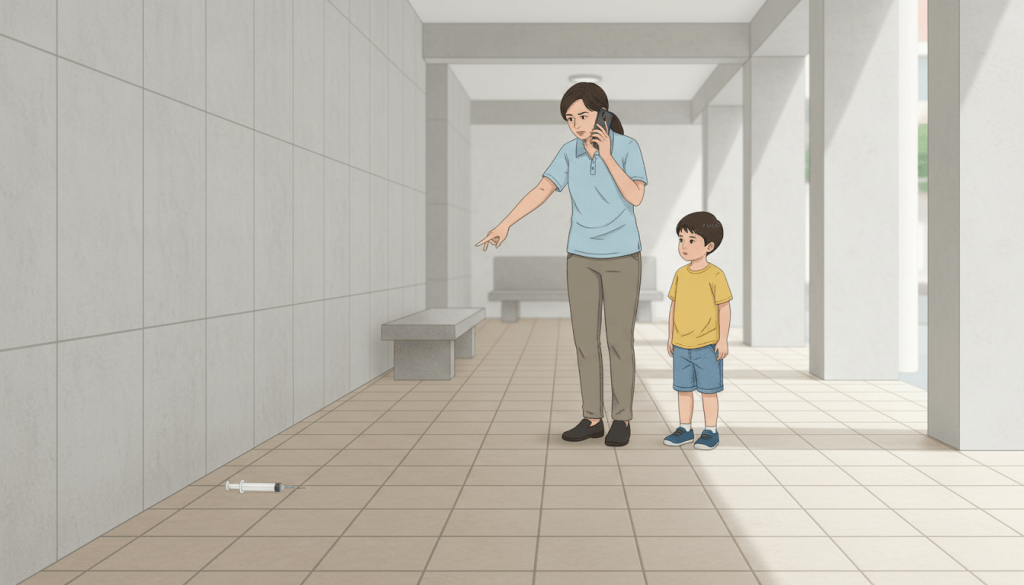
Found a discarded syringe, insulin pen needle or other sharp object at a Sengkang playground, HDB corridor, lift lobby or park connector? Do not touch, pick up, recap or move it yourself. Keep children and pets away and report the exact location to the responsible property manager or municipal authority. For an urgent hazard in an HDB common area managed by Sengkang Town Council, its 24-hour Essential Maintenance Service Unit (EMSU) is 6590 9777. For a routine municipal defect or waste issue, use the official OneService app.
If somebody has already been pricked by a possibly used needle, wash the puncture promptly with running water and soap, cover it appropriately, and seek medical assessment without delay. Tell the doctor when and where the injury occurred and whether the needle was visibly contaminated. Clinicians assess tetanus, hepatitis B, hepatitis C and whether HIV post-exposure prophylaxis (PEP) is appropriate. Singapore’s Communicable Diseases Agency states that HIV PEP, when indicated, must begin within 72 hours of a possible high-risk exposure; earlier assessment is important.
Call 995 for severe bleeding, collapse, unresponsiveness or another life-threatening injury. An abandoned syringe with nobody injured is a hazardous sharp-waste reporting issue, not automatically an ambulance emergency or evidence of criminal activity. A child’s needlestick injury deserves prompt medical attention even if it leaves only a small mark.
- Unattended syringe in HDB common area: stay clear, warn others and contact SKTC EMSU 6590 9777 where it manages the location.
- In a park or municipal route: report through OneService or the responsible park manager using the exact entrance or nearby block.
- Needlestick or cut: wash with water and soap, cover and seek medical evaluation promptly.
- Possible blood exposure: ask the doctor to assess hepatitis and HIV risk; PEP decisions can be time-sensitive.
- No injury: do not touch or attempt to cap a discarded needle.
- Major medical emergency: SCDF 995.
The first five minutes if you find a discarded needle
- Stop and avoid contact. Do not lift, test, bend or put a cover on a syringe lying on the ground.
- Keep children and pets away. Move to another route and warn nearby caregivers without allowing anyone to crowd the object.
- Do not let a child pick it up to show an adult. Ask them to point from a safe distance instead.
- Observe a location marker from safety. HDB block, playground feature, park-connector junction, bus stop or lift lobby.
- Call the responsible maintenance team. For an SKTC-managed common area use its EMSU; otherwise use building management, OneService or park staff.
- Do not imply a crime without evidence. A used needle might originate from legitimate medical treatment as well as other contexts.
- If anyone was pricked, seek healthcare promptly. Medical assessment takes priority over waiting for the sharp to be collected.
Who to call in Sengkang
- 6590 9777 — Sengkang Town Council EMSU: 24-hour urgent essential maintenance for managed HDB common areas. SKTC official EMSU.
- OneService app or chatbot: municipal reporting with a description and safe location reference. Official OneService feedback.
- Building manager or park management: where a sharp is in a privately managed building, school, shop or public park.
- Doctor or hospital Emergency Department: immediate evaluation after a puncture from a possibly contaminated needle. CDA HIV exposure guidance.
- 995 — SCDF: severe bleeding or other life-threatening injury, not ordinary collection of an unused or abandoned syringe.
- 999 — SPF: an immediate Police crime or threat, if independently present; the mere presence of a sharp does not by itself establish one.
Why an abandoned needle should not be picked up by residents
A small needle tip can puncture skin even when the rest of the device looks harmless. An object can also be contaminated with body fluids or other material that is not visible. Trying to cap it or move it to a rubbish bin adds handling steps during which injury can occur.
Public sharps should be collected through appropriate municipal or site-management procedures with trained personnel and suitable protective equipment. An ordinary resident should avoid improvising with tissues, plastic bags or bare hands. A needle inside a soft bag can injure the next person who handles it.
If the item is in a playground, report the exact site and ask others to use an alternative area while maintenance personnel respond. Avoid creating panic or publishing identifiable accusations against nearby residents.
If a child has already touched or been pricked
Move the child away from the object. If the skin is broken, wash gently with soap and running water and cover the puncture. Seek prompt medical assessment rather than assuming it is safe because the injury is tiny or does not bleed visibly.
Tell the healthcare professional exactly what happened, including the type of object, where it was found, approximate injury time and whether the skin was visibly punctured. Do not let the child pick up the syringe again so that the doctor can see it. A safe description is enough for the initial evaluation.
A parent should avoid frightening the child with speculative claims of HIV infection. The clinician will assess the actual risk, review vaccinations and discuss whether any tests or prevention measures are appropriate.
If an adult receives a needlestick injury
- Stop the activity and move away from the needle.
- Wash the puncture with running water and soap; do not aggressively squeeze, cut or suck the wound.
- Apply an appropriate clean dressing when needed.
- Seek medical assessment promptly, especially if the needle may have been used by someone else.
- Give the exposure time, depth, visible contamination and any relevant medical or vaccination history.
- Follow the clinician’s directions for blood tests, hepatitis B prevention and HIV PEP evaluation where indicated.
- Arrange and attend follow-up testing or appointments recommended by the healthcare team.
What is the HIV PEP time window?
The Communicable Diseases Agency’s HIV guidance explains that post-exposure prophylaxis is a short course of medication that can reduce the risk of HIV infection after appropriate higher-risk exposures. It needs to be started within 72 hours if indicated. CDA advises attending a public-hospital Emergency Department to request assessment for emergency PEP.
Not every discarded needle injury needs PEP. The doctor assesses whether the exposure could transmit HIV, considering the type of contact and other evidence. Community exposure from an old abandoned needle may carry a different risk from a fresh injury involving a known source; only a clinician should decide what prevention or tests are justified.
Do not wait until close to the 72-hour limit. The earliest appropriate evaluation provides the best opportunity to decide whether intervention is needed. Do not take someone else’s PEP medicine or attempt to obtain it without medical assessment.
Hepatitis B, hepatitis C and tetanus
Needlesticks can raise several separate infection-prevention questions. Hepatitis B risk may depend on whether the injured person has completed vaccination and has protective immunity. Hepatitis C exposure may require baseline and follow-up testing; a clinician decides what schedule is appropriate.
Tetanus prevention is determined by wound type and vaccination history. HealthHub’s tetanus guide identifies puncture wounds among those requiring assessment. Report any existing medical conditions, immunosuppression or relevant treatment to the clinician.
An initial negative blood test may be only a baseline because infections have different testing windows. Follow the healthcare team’s instructions rather than using one test to declare the incident closed.
If the needle touched intact skin but did not puncture it
Exposure risk depends on whether the skin was broken and whether body fluids reached a mucous membrane. Intact skin contact is different from a puncture, but the person should wash the area and seek clinical advice if there is any uncertainty about a scratch, wound or fluid exposure.
Do not deliberately prick or scratch the skin to ‘check’ how sharp the needle was. Describe what occurred and allow a healthcare professional to assess the need for further care.
If fluid splashes into an eye, mouth or nose
Move away from the source. Rinse an exposed eye, mouth or nose with clean water as appropriate, without applying harsh chemicals, and seek medical assessment promptly after possible body-fluid exposure. Do not use disinfectant or alcohol inside eyes or mucous membranes.
Tell the clinician that the exposure involved a mucous membrane, not a puncture wound. The assessment may differ. If another immediate medical emergency is occurring, call 995.
Household insulin needles are different from public abandoned sharps
Some residents routinely use needles, insulin pens or lancets for legitimate prescribed treatment. NEA provides specific domestic-disposal guidance: used syringes and insulin needles from household use should be placed in a yellow sharps bin where available, or a hard puncture-resistant secure container that is labelled and sealed before disposal according to its instructions.
NEA’s toxic-waste FAQ distinguishes properly contained household sharps from industrial toxic waste. Do not assume that a loose needle can simply go into an ordinary rubbish bag, or that the same disposal rules apply to clinical and laboratory waste.
A person who uses prescribed needles should follow instructions provided by their healthcare facility and any applicable local disposal arrangement. Do not leave used needles uncapped on an open counter within a child’s reach.
What details help the estate maintenance team?
- Exact location: HDB block, floor, playground corner, void deck, lift lobby or park entrance.
- Appearance: syringe, insulin pen needle, lancet or unidentified sharp; do not handle it to confirm the model.
- Number: one or several visible items from a safe distance.
- Access: near a children’s play area, busy footpath, drains or an area maintenance teams may have difficulty locating.
- Injury: whether somebody was pricked and has already been sent for clinical assessment.
- Time: when it was seen, without guessing how long it had been there.
- Photo: only if safely obtainable from a distance; never approach or reposition the item.
What if you find sharps on a park connector?
Stay on the safe walking route and notify the relevant park or municipal authority using the nearest bridge, path junction, park entrance or fixed marker. A broad statement such as ‘needles at Sengkang Riverside’ may not identify the spot sufficiently for collection.
Do not climb down a slope, enter a drainage channel or reach into a bush to retrieve the object. If a sharp is partly concealed, tell the reporting service what you observed so trained personnel can inspect it.
What if you find a needle in a lift lobby?
Move people away from the specific location and report it to the relevant estate manager. If SKTC manages the block’s common area, its EMSU number is 6590 9777. If the item is in a condominium or commercial building, contact that building’s own property team.
A lift lobby may be crowded by children, delivery workers and older residents. Keep the safe route clear while waiting for maintenance staff, without trying to lift or cover the syringe yourself.
Should you call Police about an abandoned needle?
A lone discarded medical needle does not prove illegal drug use or another crime. Report the physical hazard to the responsible maintenance or municipal service. If there is an active crime, threatening behaviour or a separate immediate Police emergency, contact SPF using the appropriate channel.
Avoid photographing or accusing an identifiable person simply because they were near the object. Report factual observations and let agencies handle any necessary investigation.
Three realistic Sengkang scenarios
A parent sees a syringe near a playground slide
Prevent the children from approaching and contact the estate manager or OneService. Give the exact slide or playground position. Do not pick up the item to make it easier to identify.
A child says a needle scratched their hand
Wash promptly, cover and seek medical evaluation without delay. Note the time and area of injury. The doctor can assess whether infection tests, vaccines or PEP are relevant.
A diabetic resident needs to discard used pen needles
Follow NEA’s household sharps instructions, using a suitable sharps bin or secure puncture-resistant labelled and sealed container. Do not put loose needles into a bin or chute.
Prevention and family readiness
- Teach children to identify sharps without touching them, and to alert an adult immediately.
- Keep household needles and medical devices securely out of reach.
- Use the correct sharps container for prescribed medical waste.
- Never recap, snap, bend or play with a discarded needle.
- Report sharps in shared spaces promptly and accurately.
- Keep a record of hepatitis B and tetanus vaccinations for medical review after an exposure.
- Know the nearest appropriate healthcare service and the time sensitivity of some post-exposure treatments.
Frequently asked questions
Should I pick up a used syringe with tissue paper?
No. Avoid handling an abandoned needle. Ask appropriate trained maintenance personnel to collect it.
Is every needle injury an HIV emergency?
Not every exposure transmits HIV or requires PEP. Seek prompt clinical evaluation; the doctor assesses risk and whether time-sensitive prevention is indicated.
What is the PEP time limit?
CDA states that HIV PEP, when indicated, must be started within 72 hours after a possible high-risk exposure. Seek assessment as early as possible.
What should a child do if they find a needle?
Do not touch it. Move away and tell a caregiver or responsible adult, who can report it to the estate or municipal service.
What if the needle is from home diabetes care?
Use a proper puncture-resistant sharps container and follow NEA household sharps disposal guidance, not loose disposal in ordinary rubbish.
More Sengkang emergency guides
- Severe bleeding, deep cuts and wound first aid
- Accidental poisoning and household chemicals
- Medical emergencies and SCDF ambulance
- Dengue fever and mosquito prevention
More Sengkang emergency guides: Dog bites, cat scratches, rabies and tetanus · Bees, wasps, hornet nests and stings · School bus accidents and missing pickups.
Official references and review date
- NEA — Used Syringe and Household Sharps Disposal FAQ
- CDA — HIV, PEP and Needle Exposure Assessment
- HealthHub — Tetanus Vaccination and Puncture Wounds
- HealthHub — Wound Care
- OneService — Municipal Feedback App and Chatbot
- Sengkang Town Council — EMSU
- CDC — Sharps Disposal and Needlestick Prevention
Reviewed 7 November 2026. This is public-safety information, not a personal infection diagnosis or substitute for time-sensitive post-exposure assessment. Seek immediate medical advice after a potentially contaminated needlestick; call 995 for life-threatening injuries.
