
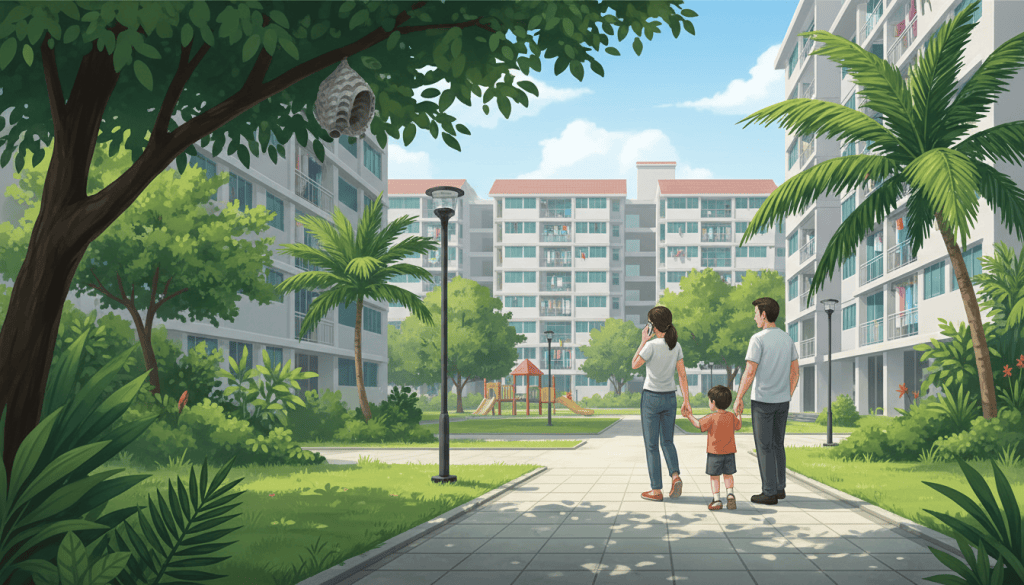
Found a hornet nest, bee hive or aggressive wasp swarm near a Sengkang HDB corridor, playground, park connector or balcony? Keep people away and do not touch, disturb, spray, knock down or attempt to burn the nest. For hives in parks managed by NParks, call its helpline 1800 471 7300. For dangerous insects in HDB common estate areas managed by Sengkang Town Council, call its 24-hour EMSU 6590 9777. In a private home or condominium, contact the property owner or management and an appropriate professional pest-control provider.
If insects are attacking, cover your head, move away toward shelter without tripping, and do not swat them or jump into water. Call 995 if a person has severe breathing difficulty, tongue or throat swelling, collapse, a serious allergic reaction or another life-threatening emergency. Someone stung repeatedly or around the mouth, throat or eyes should seek prompt medical assessment even if they appear initially well.
Quick routing: hive in an NParks park — 1800 471 7300; HDB common-area insect hazard in SKTC-managed estate — 6590 9777; private home or condominium — responsible property team and pest-control professional; severe medical reaction — 995. Bees and wasps are also part of Singapore’s natural ecosystem, so a bee visiting a flower does not automatically require a hive-removal service.
First minute: what to do near an active hive
- Increase distance. Do not move close to inspect the nest, take a photograph or count insects.
- Keep children and pets back. Ask family members to use another entrance or route where safely possible.
- Do not disturb the hive. Throwing objects, smoke, fire or improvised chemical spraying can trigger defensive behaviour.
- If a swarm attacks, cover the head and move toward shelter. NParks advises escaping rather than swatting, and specifically says not to jump into water.
- Check for urgent symptoms after a sting. Breathlessness, tongue swelling, sudden faintness or collapse requires 995.
- Report the location. Identify the Sengkang HDB block, park entrance, tree, corridor or relevant facility.
- Wait for qualified assessment. Use NParks, the relevant town council or a licensed pest-management professional rather than household DIY removal.
Who to call in Sengkang
- 1800 471 7300 — NParks: official helpline for bee or wasp hives in parks; provide the park, entrance, pathway and an identifiable nearby tree or feature. AVS Bees and Wasps.
- 6590 9777 — Sengkang Town Council EMSU: 24-hour urgent essential maintenance for common HDB estate areas under SKTC management. SKTC official EMSU.
- OneService app: a route for routine municipal feedback and identification of the responsible agency; not an emergency rescue replacement. OneService App and Chatbot.
- Property manager or suitable pest-control firm: for a hive affecting private property, after assessing whether removal is necessary and how to do it safely.
- 995 — SCDF: for severe allergic reaction, life-threatening multiple-sting injury, breathing difficulty or collapse. SCDF emergency services.
Bees, wasps and hornets are not all the same
Singapore has numerous bee and wasp species, including honey bees, carpenter bees, stingless bees, paper wasps and hornets. AVS says more than 130 bee species have been documented locally. Species behave differently; a lone bee visiting a flower is usually a very different risk from a hornet colony defending a nest.
Honey bees can defend their hives if threatened. Hornets and many social wasps may sting aggressively when they perceive someone to be too close to the colony. Stingless bees do not possess stings, and solitary bees tend to be less defensive, although a resident should still avoid handling unknown insects.
AVS’s updated August 2026 wildlife guidance explains the different habits. Identification from a distant glance is not always reliable, so respond to the actual nest location and behaviour rather than guessing that a small bee cannot hurt someone.
What if you are being chased by a swarm?
NParks advises covering your head and moving away from the hive toward shelter, while watching your footing. Do not remain near the insects while attempting to swat them individually; that may provoke more defensive stinging.
Do not jump into a canal, pond or swimming pool to escape. AVS says agitated bees may continue the attack when someone emerges, and the water adds a drowning risk. Choose a safe route into a sheltered building when possible.
Once sheltered, assess injuries and whether anyone has breathing problems or widespread allergic symptoms. Call 995 for serious medical danger and explain that bee or hornet stings are involved.
How to recognise a severe allergic reaction
- Swelling of the tongue, lips or throat, particularly if it affects speaking or swallowing.
- Sudden or severe difficulty breathing, wheezing or repeated coughing.
- Dizziness, fainting or collapse.
- Widespread hives or rash accompanied by breathing or circulatory symptoms.
- Vomiting or abdominal pain as part of a larger acute reaction.
- Unusual drowsiness, weakness or confusion after a sting.
HealthHub’s insect stings advice says that allergies may be severe and require immediate medical assessment. For suspected anaphylaxis, call 995; use a person’s prescribed adrenaline auto-injector according to their allergy plan, where available. Do not wait for an antihistamine to solve airway or circulation danger.
What to do for an uncomplicated sting
After moving away from the hive, wash the skin with soap and water and apply a cool compress. If a honey bee has left a stinger visible in the skin, AVS and HealthHub recommend gently scraping it out with a card edge instead of pinching the venom sac with tweezers or fingers.
Some wasps and hornets do not leave a stinger. Avoid repeatedly probing the skin to find one. Watch for swelling, redness, pain and any worsening symptoms. A doctor or pharmacist can advise suitable treatment for mild local discomfort when appropriate.
Do not rub dirt, toothpaste, unapproved oils or unknown chemicals into the wound. Seek medical review if signs of infection develop or the pain and swelling worsen rather than settle.
When medical assessment is needed even without anaphylaxis
HealthHub advises seeking medical attention for multiple stings and stings around the mouth, throat or near the eyes, as well as for a previous serious sting allergy, worsening swelling or other concerning symptoms. The number and site of stings matter, not only whether the person initially seems calm.
Children and older people may find it harder to describe early symptoms. Someone who was stung repeatedly should not be sent alone to walk home or take public transport while feeling faint or unwell.
Where should a nest be reported?
The first distinction is whether the nest is in a public park, an HDB common area or a privately managed building. In a park, NParks explicitly directs callers to 1800 471 7300. In HDB estate common corridors, void decks and shared gardens, NEA’s reporting guidance directs hive issues to the respective town council.
For an SKTC-managed block, its 24-hour EMSU is 6590 9777. A nest inside a private balcony, condo or retail premise should be raised with the property manager or an appropriate pest-control provider. Do not assume SKTC is responsible for every building with a Sengkang postal address.
If in doubt, describe the exact location and hazard to the relevant agency or OneService rather than entering a disputed property boundary to inspect.
Why the nest should not be sprayed by residents
Applying insecticide, pouring hot water or attempting to burn or strike a hive can trigger defensive swarming. It may also expose residents, pets or children to pesticide fumes or falling objects. Removal at height adds a fall hazard, especially from HDB corridors or balconies.
A professional should determine whether a hive poses sufficient risk to require intervention, and what approach avoids unnecessary harm to people and beneficial pollinators. Where bees can be left safely in a natural habitat, there may be no reason to disturb them.
Hives near a playground or childcare centre
A hive near an entrance used by young children may require prompt assessment because children may accidentally approach it. Move the play activity to a safe location, inform the responsible school or childcare staff and report the nest to the relevant town council, park authority or manager.
Do not organise a group of parents to stand beneath the hive to photograph it. A phone call with the playground name, estate block and the tree or wall position is a safer report.
Hives around balconies and service yards
If insects are entering from a nest near a window, avoid opening that window or approaching the nest to inspect it. Keep pets and children away and contact the property manager or suitable pest-control specialist. A suspected nest inside a structural cavity may require additional building expertise.
Do not block a ventilation opening or dismantle facade materials yourself to locate a hive. Those actions may create electrical, structural or falling-object hazards unrelated to the insects.
If you see just one bee on your clothes
AVS says honey bees sometimes land on people to drink perspiration. Do not slap or crush a bee that has landed on you; this may provoke a sting and release alarm pheromones. Move calmly or gently brush it away if needed.
A single bee foraging near flowers is not the same as an aggressive nest. Observing from a safe distance helps protect both residents and Singapore’s pollinators.
How to describe the hive on the phone
- Place: block, road, playground, park-connector section or building entrance.
- Height: low shrub, corridor ceiling, balcony, tree branch or exterior facade, without going closer to measure.
- Activity: a few foraging insects, insects entering a cavity, a visible nest or active swarming.
- Risk: whether the hive is near a childcare entrance, busy walkway or resident’s doorway.
- People: whether anyone has been stung and is seriously unwell.
- Access: safe way for the authorised team to find the location.
- Photographs: only when they can be taken from a safe distance; never climb or approach to obtain them.
Four Sengkang scenarios
A hornet nest appears near the lift lobby
Keep residents away, use another route if safe and notify the relevant town council or building manager. Call 995 if somebody develops a severe reaction after being stung.
A bee hive is seen in a tree at a public park
Keep your distance and contact NParks on 1800 471 7300. Do not shake the branch or spray the hive.
A child is stung once but is breathing normally
Move away from the insects, wash the skin and use a cool compress. Seek medical attention if swelling progresses, a previous serious allergy exists or concerning symptoms develop.
Several insects begin chasing a family along a park connector
Cover heads and move to shelter without tripping. Do not swat or jump into water. Once safe, seek urgent medical advice for multiple stings and call 995 if any person is severely unwell.
Prevention while outdoors
- Keep picnic food covered and dispose of waste appropriately.
- Avoid disturbing nests or throwing objects at tree branches.
- Teach children to move away from a hive rather than investigate it.
- Use normal safe walking routes away from heavily active nest areas.
- Do not apply heavily scented lotions before activities where they may attract insects, when practical.
- Report a hive near a busy residential route promptly through the correct authority.
- Keep a prescribed allergy action plan and auto-injector accessible if a clinician has identified severe sting allergy.
Frequently asked questions
Is every bee sighting an emergency?
No. Bees are pollinators. A foraging insect away from a hive generally calls for distance and calm, not emergency nest removal.
What is NParks’ number for a hive in a park?
AVS lists NParks helpline 1800 471 7300 for a bee or wasp hive in a park.
Who handles a hive in a Sengkang HDB common area?
The responsible town council. For SKTC-managed estates, its 24-hour EMSU is 6590 9777.
Should I jump into a canal to escape swarming bees?
No. AVS explicitly advises against it. Move away toward shelter and avoid swatting.
When should I call 995 for a sting?
Severe allergic symptoms, serious breathing difficulty, collapse or another life-threatening reaction require emergency help. Multiple stings also warrant prompt medical assessment.
More Sengkang emergency guides
- Severe allergy, anaphylaxis and EpiPen
- Snakes and wildlife rescue
- Lost dogs, cats and injured pets
- Medical emergencies and ambulance 995
More Sengkang emergency guides: Dog bites, cat scratches, rabies and tetanus · Discarded needles and needlestick injuries · School bus accidents and missing pickups.
Official sources and review
- AVS — Bees and Wasps in Singapore (3 August 2026)
- HealthHub — Insect Bites and Stings
- NEA — Estate Responsibility for Bees and Hornets Hives
- Sengkang Town Council — 24-Hour EMSU
- SCDF — Emergency Medical Services
Reviewed 7 November 2026. This is wildlife and first-aid information, not a live assessment of a specific hive. Leave hives undisturbed, use the responsible agency and seek emergency medical help for severe reactions.
