
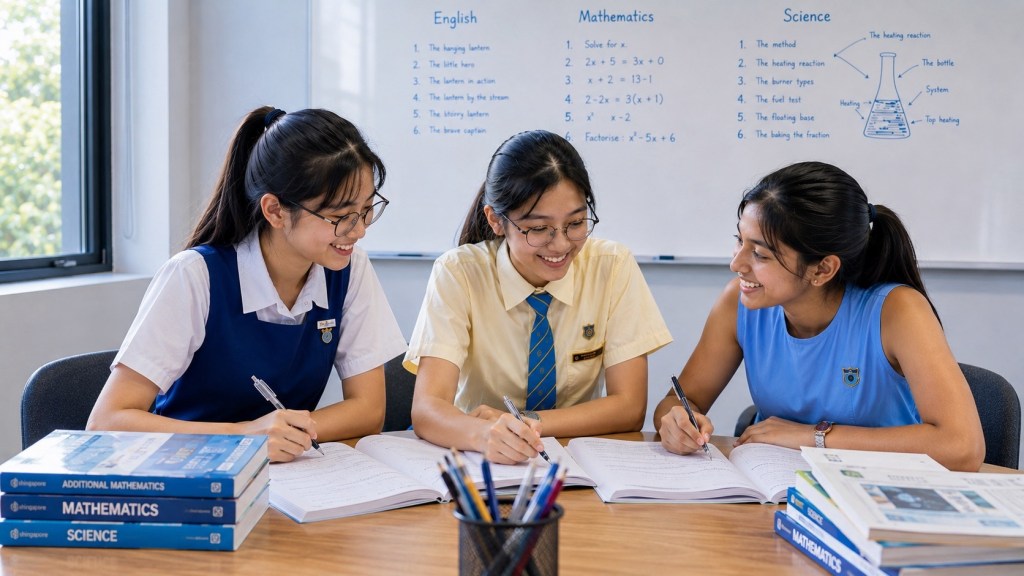
Parents in Anchorvale searching for a Secondary Mathematics tutor in Sengkang now have to compare more than the old Express, Normal (Academic) and Normal (Technical) labels. Under Full Subject-Based Banding, students may take subjects at G1, G2 or G3, and from 2027 graduating students will sit the Singapore-Cambridge Secondary Education Certificate at their respective subject levels. The language has changed, but the tutoring problem remains concrete: what Mathematics is this student taking now, and what must become secure next?
A useful G1, G2 or G3 Mathematics tutor in Sengkang should not teach from the label alone. Two Secondary 2 students taking the same Mathematics level can have completely different bottlenecks. One may have weak fractions and percentage from Primary school. Another may understand number but struggle with algebraic notation. A third may be secure conceptually but lose marks through graphs, signs, working or time control. At eduKateSengkang, the three-student format gives the tutor enough visibility to diagnose these differences.
The search language around Secondary Mathematics reflects the same high-demand clusters seen on major learning platforms: algebra, linear equations, graphs, functions, ratio and percentage, geometry, statistics, probability and exam preparation. Singapore-aligned resources such as IXL Secondary 1 Mathematics connect ratio, fractions, percentage and algebra, while international algebra libraries repeatedly organise learning around equations, functions and graphs. Those are not just keywords. They are the structural spine of secondary mathematical development.
Anchorvale is a local route, not a separate branch claim
This page is for Anchorvale and nearby Sengkang families comparing Secondary Mathematics tuition. eduKateSengkang teaches at a nearby Punggol location; we do not claim a separate Anchorvale branch. The local value is the Sengkang–Punggol catchment, a 90-minute lesson, three students per class and a diagnosis-led teaching system.
The main commercial owner remains Mathematics Tutor Sengkang. This Anchorvale page owns a narrower local intent: helping parents understand Secondary G1, G2 and G3 Mathematics support under Full SBB and the SEC transition.
Full Subject-Based Banding changes pathways, not the need for diagnosis
MOE states that Full Subject-Based Banding has been fully implemented from the 2024 Secondary 1 cohort. Students can offer subjects at G1, G2 and G3, with greater flexibility to adjust subject levels at appropriate junctures according to learning progress and school processes. From 2027, the SEC examination replaces the existing N- and O-Level examination certificates.
Parents can refer to MOE’s current Full SBB information and the official SEAB syllabus lists when checking the student’s examination year and subject level. The tutor’s job is different. The tutor should use that official structure as the boundary, then diagnose the student’s actual Mathematics.
Why G1, G2 and G3 should not become labels about the child
A subject level describes the demand of the subject, not the worth or intelligence of the student. Tutoring becomes less useful when the language turns global: “You are weak,” “You are not a Math person,” or “This level is for smart students.” Those statements hide the mechanism.
Better language is specific. “Your fraction operations are slowing algebra.” “You understand linear graphs but misread scale.” “You can solve the equation but cannot form it from the word problem.” “Your G3 working is correct but too compressed to check.” Specific weaknesses can be repaired.
The Secondary 1 reset: from arithmetic to symbolic relationships
Secondary 1 is not simply Primary 7. Students meet negative numbers, algebraic notation, more formal equations and a wider range of representations. Primary Mathematics allowed many relationships to be solved visually or arithmetically. Secondary Mathematics increasingly asks students to describe those relationships with symbols.
A student can therefore appear to fall suddenly even when Primary 6 marks were acceptable. The problem may be a symbolic-language transition. Variables, coefficients, brackets and negative signs create a new density of notation. The tutor should connect the new symbols to familiar relationships rather than teaching algebra as a set of arbitrary moves.
Secondary 2: the bridge year before upper-secondary demand
Secondary 2 is especially important because algebra, graphs, ratio, geometry and statistics begin to form the prerequisite network for upper-secondary Mathematics. Students who can only perform procedures in isolated chapters may struggle when Secondary 3 requires more mixing and less obvious topic cues.
The tutoring goal should therefore include transfer. Can the student recognise an equation when it is hidden inside a word problem? Can a ratio relationship be expressed algebraically? Can a graph be interpreted rather than merely plotted? These are readiness questions.
Secondary 3: the workload and abstraction both increase
Secondary 3 often feels difficult because several things change at once. The Mathematics becomes more demanding, subject load increases across the timetable and some students begin Additional Mathematics. A weak algebra foundation that was manageable in Secondary 2 can now affect equations, graphs, geometry and A-Math.
A tutor should not respond by simply increasing homework. First identify whether the problem is knowledge, fluency, notation, transfer or workload control. The student who knows the method but needs forty minutes to complete ten lines of algebra needs a different intervention from the student who does not understand the concept.
Secondary 4: knowledge has to survive paper conditions
By Secondary 4, Mathematics preparation becomes an exam-control problem as well as a syllabus problem. The student must choose methods, protect time, show coherent working, use calculators appropriately, check answers and recover after difficult questions.
Past papers and prelim papers are useful here because they expose mixed performance. But the paper should be analysed, not merely scored. Which errors came from concept gaps? Which came from algebra? Which came from calculator input, missing units or time pressure? The revision plan should attack the largest repeated category.
G1 Mathematics: build usable mathematical independence
G1 Mathematics should not be treated as a reduced-expectation zone. Students still need accurate number work, proportional reasoning, measurement, geometry, data interpretation and problem solving at the appropriate level. The teaching should build capability that can be used in school, examinations and everyday contexts.
For many G1 learners, clarity matters more than volume. The tutor should make the mathematical purpose visible, keep notation clean and connect procedures to situations. Practical examples can help, but the learner should still explain why the method works.
G2 Mathematics: strengthen algebra and transfer
G2 students increasingly need to coordinate arithmetic, algebra, graphs and interpretation. The learner may understand each topic in isolation but fail to recognise it inside an unfamiliar question. That is a transfer gap.
A tutor can deliberately vary surface features. Change the wording, representation, number type or context while keeping the same mathematical structure. This teaches the student to recognise relationships rather than memorise question shapes.
G3 Mathematics: precision becomes a major differentiator
At G3, abstraction and multi-step reasoning create more opportunities for small errors to compound. A correct idea can still lose marks through signs, brackets, incomplete working, poor graph interpretation or inefficient method choice.
Strong G3 students may need less re-teaching and more precision training. The tutor should examine the last few marks as carefully as the first few. Plateauing performance often comes from repeated process errors rather than missing chapters.
Algebra is the hidden spine across the secondary years
Algebra has unusually high leverage because it appears directly or indirectly in so many topics. Equations, functions, graphs, coordinate geometry and Additional Mathematics all depend on symbolic control. If algebraic manipulation is slow or unreliable, the student experiences many topics as separate difficulties.
A useful diagnostic checks whether the student understands equality, can combine like terms, handles signs and brackets, solves simple equations, substitutes correctly and can form an equation from a situation. The tutor should then repair the earliest weak step.
Graphs should be read, not only drawn
Secondary students often learn graphing as a plotting procedure. But graphs are representations of relationships. The student should be able to interpret gradient, intercepts, shape, scale and change. A graph can reveal information that is less obvious in an equation or table.
When graph work is weak, the tutor should move among representations: equation → table → graph → verbal interpretation. The goal is not to complete one format but to understand the relationship across formats.
Why fractions and percentage still matter in Secondary Mathematics
Some students arrive in Secondary school believing fractions and percentage are finished Primary topics. They return inside ratio, rates, algebraic fractions, probability, financial Mathematics and formula work. A hidden Primary weakness can therefore become a Secondary algebra problem.
This is why diagnosis sometimes moves backwards. The tutor may need to repair fraction equivalence or percentage reasoning before a current secondary topic becomes stable. That is not restarting the syllabus. It is repairing the smallest prerequisite with the largest downstream effect.
What three students changes in a Secondary Mathematics tutorial
A three-student class allows individual working to stay visible. One learner may be taking G2, another G3, or all may be on the same level but with different bottlenecks. The tutor can ask each student to explain a step, compare methods and assign differentiated follow-up work.
The class should not function like a mini lecture hall. If all three students receive the same worksheet regardless of diagnosis, the numerical ratio is small but the teaching is still generic.
Catch Up, Keep Up and Move Ahead under Full SBB
- Catch Up: repair prerequisites blocking the current subject level.
- Keep Up: consolidate school work and retrieve older topics before they decay.
- Move Ahead: deepen transfer and precision once the current foundation is secure.
This framework is deliberately independent of prestige. A G1 student can Move Ahead within G1. A G3 student can need Catch Up in algebra. The teaching lane describes the current job.
When families are considering a subject-level change
Full SBB provides more flexibility, but subject-level decisions belong within the school’s processes and the student’s broader learning profile. Tuition should not promise a move from one level to another. It can strengthen prerequisites and provide better evidence.
Useful evidence includes independent performance, retention after delay, school results, speed of new learning, error patterns and how much prompting the student needs. A student who appears strong only while examples remain open is not yet showing the same readiness as a student who can transfer independently.
Anchorvale parents comparing local Secondary Mathematics options
Anchorvale has visible tuition competition, and parents searching locally will see options across class sizes, fees, subjects and formats. The useful comparison should include tutor continuity, whether the class matches the student’s subject level, how progress is diagnosed and whether the student is becoming more independent.
eduKateSengkang’s model is a nearby Punggol class with three students and 1.5-hour lessons. Families should compare that against the child’s needs rather than assuming the smallest, largest or nearest option is automatically best.
A Secondary Mathematics parent checklist
- Do we know the student’s current G-level and examination year?
- Is the main bottleneck concept, algebra, representation, transfer or exam control?
- Are older Primary foundations slowing current work?
- Can the child interpret graphs and equations, not only execute procedures?
- Are errors classified and revisited after delay?
- Does the tutor reduce support as the student improves?
- Is any subject-level discussion based on evidence rather than pressure?
The Anchorvale decision
Secondary Mathematics under Full SBB gives parents new labels, but the core learning principle is unchanged. Strong performance comes from secure prerequisites, clear representation, fluency, method selection, checking and transfer.
A Mathematics tutor in Sengkang should make those mechanisms visible. For an Anchorvale family, the value of tuition is not simply local convenience. It is having a tutor who can identify what is failing, repair it at the right level and return the thinking to the student.
Continue: G1, G2 and G3 Mathematics Under Full SBB · Secondary 1 Mathematics · Secondary 4 Mathematics · Mathematics Tutor Sengkang.
The 2027 SEC transition: what changes and what does not
Families preparing for 2027 and beyond will see new subject codes and a common SEC certificate. That administrative change matters, but it should not distract from the continuity in learning. Students still need number sense, algebraic control, graphical interpretation, geometry, statistics, probability and problem solving at the appropriate subject level.
The safest parent habit is to separate official examination information from tuition marketing. Use MOE and SEAB to confirm the current structure, subject level and examination details. Use the tutor to understand the child’s learning evidence.
The seven Secondary Mathematics error families
- Concept errors: the student misunderstands the mathematical relationship.
- Algebra errors: signs, brackets, factorisation or rearrangement fail.
- Representation errors: the equation, graph, table or diagram does not match the situation.
- Calculator errors: input, mode or rounding is wrong.
- Communication errors: working, units or final answer form is incomplete.
- Time errors: a valid method is too slow or the student refuses to leave one question.
- Transfer errors: the topic is known in isolation but not recognised in a mixed context.
When the error family is named, correction becomes more useful. “Wrong answer” becomes “formed the wrong equation from the context”, which points to a representation repair rather than another algebra worksheet.
Why fractions remain a Secondary-school issue
Fractions return in algebraic fractions, rates, ratio, probability, formulae and percentage. Students who never became comfortable with equivalence and operations may experience a surprising Secondary slowdown.
A tutor should test the older prerequisite instead of assuming the current chapter is the problem. Repairing one Primary foundation can improve several Secondary topics at once.
Why algebraic notation needs explicit teaching
Students sometimes learn algebra by imitation: move this term, change the sign, divide by this number. The procedure can work for familiar equations while leaving equality poorly understood.
A stronger approach connects each transformation to an invariant relationship. Whatever operation is applied must preserve equality. Brackets indicate grouping. A coefficient has meaning. Substitution is not only a mechanical replacement; it tests whether a value satisfies a relationship.
How equations should grow from Primary models
Students who used bar models in Primary school already understand many relational structures. Secondary algebra can be introduced as a more compact language for those same relationships. A comparison model can become an equation. A constant-difference relationship can be expressed symbolically. A table can become a functional rule.
This bridge reduces the feeling that Secondary Mathematics starts from zero. The symbols are new, but the relationships are familiar.
Graphs are where algebra becomes visible
Graph work should not end with plotting points. Students need to interpret what changes and what stays fixed. Gradient, intercept, scale, direction and shape all carry meaning. A graph can show a relationship more directly than an equation can.
A tutor should move among table, graph, equation and verbal description. If the student can only work in one representation, transfer is fragile.
Geometry becomes less forgiving when reasoning is compressed
Secondary geometry often requires the student to state or use properties accurately. Visual appearance is not enough. The diagram may not be drawn to scale, and several angle or similarity relationships can coexist.
The tutor should teach a discipline of annotation: mark what is given, state the property, then calculate. This makes the solution easier to inspect and prepares the student for more formal mathematical reasoning.
Statistics and probability require interpretation, not only formulas
Averages, spread, probability and data displays can become calculator exercises if the student focuses only on obtaining a number. The stronger question is what the number means and whether it is appropriate for the situation.
Secondary Mathematics increasingly rewards interpretation. A tutor should ask students to compare representations, explain what a statistic captures and identify what information it leaves out.
Calculator discipline is part of Mathematics, not an afterthought
Calculators increase the importance of estimation. A wrong input can produce a very precise wrong answer. Students should know what magnitude to expect, how brackets are interpreted, when an exact value should be kept and when rounding is appropriate.
The device should support reasoning. It should not replace the student’s judgement about whether the result is plausible.
When G2 students are preparing for more demanding Mathematics
If a family hopes the student may eventually take a more demanding subject level, the best preparation is not always early acceleration. Deepening the current level can be more useful. Secure algebra, independent work habits and strong transfer create a better bridge than superficial exposure to harder chapters.
Tuition can provide evidence about readiness, but it should not promise a school-level change. The school’s processes and the student’s overall profile remain central.
When a G3 student needs Catch Up
Taking G3 Mathematics does not mean every prerequisite is secure. A student can still have a weak fraction foundation, poor algebraic fluency or unstable graph interpretation. The tutor should repair the actual gap without shame.
This is one reason the Catch Up, Keep Up and Move Ahead model is useful. It describes the current instructional job rather than attaching a permanent label to the learner.
How to use school tests as a Secondary Mathematics map
A school test should be read beyond the score. Mark each lost mark by cause. Was the concept missing? Was the equation formed incorrectly? Did a calculator input fail? Was the final answer not stated in context? Did the student run out of time?
When several tests are analysed this way, patterns emerge. Tuition can then target the pattern rather than chase whichever chapter happens to be current.
Mixed practice should begin after the methods are stable enough to discriminate
Mixed problem sets are valuable because students must choose the method. But mixing too early can create random guessing. A tutor should first build enough stability in the individual methods, then remove the topic labels and ask the learner to discriminate.
This sequence is especially important in Secondary 2 to 4, where several algebraic and graphical methods can look superficially similar.
What a 90-minute Secondary Mathematics lesson can contain
- Retrieval: short recall of high-leverage older topics.
- Diagnostic check: one or two questions designed to reveal the current bottleneck.
- Explicit teaching: repair the concept or process directly.
- Guided practice: apply the method with prompts that are gradually reduced.
- Independent transfer: attempt a new question without the method being announced.
- Error review: name the first wrong step and plan the next re-test.
The proportions should change by student. A Secondary 4 learner near an examination may need more mixed paper work. A Secondary 1 learner with a symbolic-language gap may need more explicit explanation.
Why the same worksheet should not be the default for three students
Three students can share one topic and still need different questions. One may need a scaffolded equation. Another may need a word problem with no topic label. A third may need a harder transfer case. The tutor can differentiate the amount of support and difficulty while keeping a common mathematical conversation.
How to tell whether Secondary Mathematics tuition is creating dependence
Warning signs include the student refusing to begin without the tutor, needing the same hint every week, copying worked examples without later reconstruction, and performing well only on tuition-style questions.
Positive signs include fewer prompts, better self-correction, improved school transfer and the ability to explain why a method applies.
Anchorvale parent questions before enrolling
- Which G-level and examination year is the programme aligned to?
- How do you identify hidden Primary prerequisites?
- How do you differentiate algebra, graph and geometry weaknesses?
- How do you reduce prompts over time?
- How do you decide when to use mixed practice?
- How do you read school tests and prelim papers diagnostically?
- What evidence would show that my child needs less support?
Local convenience should protect learning time
Anchorvale families may compare local centres, home tutors and nearby Punggol options. Travel time matters because Secondary students already carry heavier school workloads. A useful class should not only fit geographically; it should reduce the amount of confused, unproductive study at home.
The value of the three-student model is therefore not simply smallness. It is the possibility of faster diagnosis, differentiated work and visible reasoning.
Local route: this Anchorvale page supports the existing G1/G2/G3 parent guide and the year-specific Secondary Mathematics owners without replacing them.
What Secondary Mathematics readiness looks like at each transition
At Secondary 1, readiness means being able to convert familiar numerical relationships into symbols. At Secondary 2, readiness means using algebra and graphs with less prompting. At Secondary 3, readiness means sustaining multi-step work while subject load increases. At Secondary 4, readiness means converting knowledge into reliable examination performance.
These transitions explain why one generic Secondary Mathematics lesson cannot serve every year equally well. The teaching problem changes even when the subject name stays the same.
How parents should interpret a sudden drop in Secondary Mathematics
A sudden drop can come from a genuine concept gap, a new symbolic demand, workload overload, poor retrieval of older topics or examination control. The tutor should ask what changed before assuming ability changed.
For example, a Secondary 3 student may understand new geometry but lose marks because algebraic manipulation has slowed under a heavier timetable. The repair may be fluency and organisation, not re-teaching geometry.
Why Full SBB makes parent language especially important
G1, G2 and G3 give schools useful subject-level flexibility. At home, those labels should remain descriptive. When parents use them as rankings of the child, the conversation becomes less educational. A learner needs to know the next capability to build, not a global judgement about status.
Tuition can help by keeping feedback concrete: cleaner equations, better graph interpretation, stronger retention, fewer prompts, more reliable timing.
Anchorvale summary
For Anchorvale families, Secondary Mathematics tuition should make a complicated system simpler. Know the current G-level. Know the examination year. Identify the first weak link. Repair it at the correct depth. Re-test it after delay. Then mix it with neighbouring topics and paper conditions.
That is the practical value of a nearby three-student Sengkang-facing Mathematics route: fewer assumptions, more evidence and a clearer path toward independent SEC performance.
How to separate school pace from learning pace
School must continue through the syllabus even when one student has a hidden gap. Tuition can create a second pace: not a competing curriculum, but a short repair loop that helps the student rejoin current work. The tutor may spend twenty minutes fixing fraction operations while the school is teaching algebra because those fractions are the real bottleneck.
The key is to return quickly to current school demand. Prerequisite repair should be surgical, not an excuse to restart entire years.
Why Secondary Mathematics needs better note use, not more notes
Students can accumulate formula sheets and model solutions without building retrieval. Notes are useful during learning, but they should gradually disappear during practice. A tutor can mark which parts must be recalled, which can be looked up and which need conceptual explanation.
The objective is not a perfect notebook. It is usable knowledge when the notebook is closed.
How to prepare for mixed-paper switching
Secondary papers require the student to switch among algebra, geometry, data and other topics. That switching has a cost. Students should practise short mixed sets in which the method is not announced, then explain what feature of the question triggered the choice.
This is especially useful for G2 and G3 students because several methods may look plausible. Method selection becomes part of the skill.
One final Anchorvale parent rule
Use G1, G2 and G3 to locate the academic demand, then return immediately to the learner. Ask what is secure, what is fragile and what should be built next. That keeps Full SBB useful without turning subject levels into identity labels.
The SEC preparation stack: concept, fluency, transfer and paper control
Secondary Mathematics preparation is easier to organise when parents separate four layers. Concept asks whether the student understands the mathematics. Fluency asks whether standard procedures can be executed accurately enough to free attention. Transfer asks whether the student can recognise the mathematics when the question changes form. Paper control asks whether all of this survives time, mixed topics and examination pressure.
The lowest unstable layer should usually be repaired first. Timed papers cannot fix a concept gap. More explanations cannot fix a pacing problem if the concepts and procedures are already secure. This stack helps a tutor choose the right intervention.
School method and tuition method should not become competing curricula
Secondary Mathematics sometimes offers several valid methods. Alternative methods can be useful, but the tutor should know what the school is teaching and avoid creating unnecessary conflict. A student who is still learning one method may become less fluent if a second method is introduced only because it looks elegant to the tutor.
When an alternative is taught, the student should know why it is useful: shorter working, lower error risk, clearer reasoning or better transfer. The objective is method flexibility, not method collection.
Why note-taking should shrink as examination readiness grows
Notes are valuable when a student is learning. They become less informative when every practice session is open-book. A tutor can phase note use deliberately. First learn with notes. Then use a short cue sheet. Then close the notes and retrieve. Finally, mix the topic with others and return after a delay.
This progression reveals whether knowledge is accessible without the learning environment that created it. Examination conditions demand retrieval, not recognition.
How to read a plateau in Secondary Mathematics
A plateau can mean different things at different levels. A G1 student may need stronger fluency or interpretation. A G2 student may need better algebraic transfer. A G3 student may already know the syllabus and need precision, method efficiency or mixed-paper control. Repeating the same teaching at higher volume can leave the plateau untouched.
The tutor should compare recent scripts and ask what category of lost marks is growing. That category becomes the next diagnostic target.
What readiness for less tuition looks like
Successful tutoring should create conditions in which support can eventually reduce. The student keeps up with school without emergency rescue, retrieves older topics, begins mixed questions independently, corrects some errors without prompting and plans revision from evidence.
That does not mean the learner never needs help. It means help becomes strategic rather than routine. For Anchorvale families, this is a useful long-term measure of whether the programme is building capability.
Anchorvale families can use one question to simplify the whole decision
Ask: “What will my child be able to do independently after this block of tuition that they cannot do now?” A clear tutor should be able to answer in observable terms—solve linear equations without sign errors, interpret gradients, form equations from contexts, finish a mixed section within time—not vague promises about confidence or improvement.
That question keeps the focus on learning while the surrounding Full SBB and SEC system continues to evolve.
One final SEC readiness check
Before increasing difficulty, ask whether the student can retrieve core methods without notes, explain why the method fits, carry out the algebra cleanly and recognise the same structure when the wording changes. If one of those steps still depends heavily on prompting, more advanced material may hide the gap rather than close it.
For Anchorvale parents, this is a practical way to evaluate progress across G1, G2 or G3: the student should need less help to make the first correct mathematical decision. That is a stronger readiness signal than simply finishing the next chapter earlier.
Mathematics and Sengkang routes: return to the Mathematics Hub or Complete Mathematics Index for the wider Mathematics estate; use What about Sengkang? for the town-wide route.
