
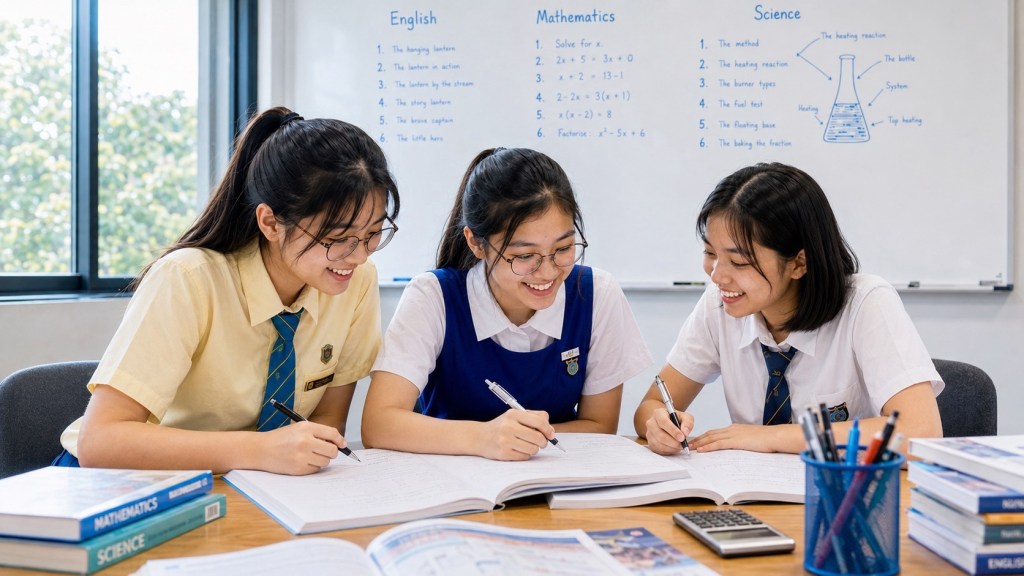
Secondary Mathematics study groups can accelerate learning when students explain, compare and challenge mathematical routes instead of simply copying answers from the strongest person in the room. Parents searching for Secondary Maths study groups, group tuition, G1 Mathematics, G2 Mathematics, G3 Mathematics, peer learning or Mathematics tuition in Sengkang are often asking a practical question: can students learn faster together without allowing one learner to carry the thinking for everyone else?
The answer depends on structure. A group can create useful peer explanation, immediate comparison of methods, more examples of error and a reason to articulate mathematical decisions. It can also create false fluency: the student recognises a classmate’s method, nods along and later discovers that nothing can be reconstructed alone. The key is to turn group activity into individual evidence.
For current Singapore examination scope, families should use the official SEAB pages for G1, G2 and G3 Mathematics. On eduKate Sengkang, the wider local route remains the Secondary Mathematics Sengkang capability map and the Mathematics Tuition Sengkang hub. This article focuses on the study-group mechanism itself.
Quick Read: Group Learning Must End With Individual Proof
A productive Secondary Mathematics group can share explanations, compare methods and expose errors. But every learner must eventually solve a fresh question alone.
The core rule is simple: discuss together, attempt alone, compare after. This protects the benefits of collaboration while preventing supported performance from being mistaken for mastery.
1. A Study Group Is Not Automatically a Learning Group
Three students sitting together does not create useful collaboration. They may divide the work, copy the fastest learner or spend most of the time socialising.
The group needs a mathematical task, a turn structure and an individual check.
2. Peer Explanation Can Reveal Hidden Gaps
A student who says “I know how” may struggle to explain why a step is valid. Explaining an equation, graph or geometry property forces the learner to organise the idea.
The listener also benefits by comparing the explanation with their own model.
3. Explanation Is Not a Performance Competition
Some students speak quickly and confidently. Others think slowly but accurately.
The group should judge explanations by mathematical clarity, not speaking style. A quiet learner may have the strongest structure.
4. Use “Why This Step?” Instead of “What Is the Answer?”
Questions that ask for the next decision are more valuable than answer requests.
Why factorise? Why divide both sides? Why is this gradient negative? Why does this angle relationship apply? These questions expose the route.
5. Rotate the Explainer
If the same student always teaches, the others can become passengers.
Rotate roles. One explains, one questions, one checks. On the next problem, switch.
6. The Checker Needs a Real Job
The checker should not simply say “yes.” They can inspect signs, units, graph labels, algebraic legality or whether the final answer matches the question.
Checking becomes a mathematical role.
7. Use Different Methods on the Same Problem
Secondary Mathematics often permits more than one valid route. One student may use algebra, another a graph, another a geometric relationship.
Comparing routes teaches method choice and helps students understand what is invariant beneath different surface forms.
8. Group Work Can Strengthen Algebraic Language
Students often manipulate algebra without naming the structure. Peer explanation can force vocabulary such as factor, term, coefficient, gradient, intercept, equality, variable and function.
Precise language reduces confusion when questions become denser.
9. G1, G2 and G3 Groups Need Matching Tasks
Subject level matters. A group should not assume that every student has the same syllabus demand.
Use the official syllabus and school programme to select appropriate content. The learning mechanism can be shared even when question complexity differs.
10. Mixed-Level Groups Need Careful Design
A stronger student can benefit from explaining, but the group should not turn that learner into an unpaid tutor.
Each student still needs challenging independent work. Collaboration should support learning, not redistribute the teacher’s role.
11. Similar Errors Can Be Discussed Together
If two students make the same sign error or misread the same graph relationship, the group can compare why.
This makes the error visible as a pattern rather than a personal failure.
12. Different Errors Are Also Useful
Three students may solve the same problem incorrectly for three different reasons.
Comparing causes teaches that the final wrong answer does not identify the underlying weakness. The group learns diagnostic thinking.
13. Use One Shared Example, Then Branch
A tutor can teach one core concept to the group, then give each student a different question matched to their need.
This preserves common discussion while keeping individual learning routes.
14. Do Not Let One Student Supply Every Hint
Peer hints can become as dependency-producing as tutor hints.
Use a rule: the stuck student must first state what is known, what has been tried and where the route fails. Only then can another student offer a cue.
15. Hints Should Shrink Over Time
If a student repeatedly needs the same peer cue, record it. The next attempt should begin with less help.
The goal is independence, not efficient group completion.
16. Whiteboards Make Thinking Visible
A small whiteboard or shared writing surface can make algebraic steps and graph ideas easy to compare.
But every student should also maintain their own working. A shared board cannot substitute for individual evidence.
17. Group Speed Can Hide Individual Slowness
A group may finish a task quickly because one learner drives the route.
After discussion, give each student one parallel question. The difference between group speed and individual speed becomes visible.
18. Use a “No Notes” Minute
After a concept is discussed, close notes and ask each learner to write the key relationship from memory.
This is a fast retrieval check and prevents passive recognition.
19. Compare Error Correction, Not Only Correct Answers
Ask each student to choose one mistake and explain how they repaired it.
This creates a culture where correction is part of mathematical competence.
20. Graph Questions Benefit From Peer Prediction
Before plotting or using a graphing tool, each student predicts shape, direction, intercept or trend.
Then compare predictions. The group sees which assumptions were correct before the software or final graph supplies the answer.
21. Algebra Questions Benefit From Line Audits
Take one solution and audit each line. What changed? Why was it legal? Could a shorter route exist?
This develops algebraic control and exposes hidden “move it across” habits.
22. Geometry Questions Benefit From Property Naming
Students can take turns naming the exact property that justifies each step.
The group should reject “because it looks equal” as insufficient evidence.
23. Statistics Questions Benefit From Interpretation Debate
A group can compare which summary or graph best supports a conclusion.
Students learn that calculations are not enough; interpretation must match the data.
24. Probability Questions Benefit From Sample-Space Comparison
Different students can generate lists, tables or trees for the same probability problem.
The group can decide which representation is most complete and least error-prone.
25. Timed Group Work Needs Individual Timing Too
A group race can be motivating, but it does not show individual readiness.
Include individual timed attempts so each learner sees their own bottleneck.
26. Study Groups Should Not Become Answer-Sharing Networks
Messaging groups can make homework efficient in the wrong way. A photograph of a complete solution removes the learning decision.
If solutions are shared, require a reconstruction from memory followed by a fresh question.
27. Online Study Groups Need Stronger Rules
In online calls, it is easier to disengage or copy from another screen.
Use short tasks, visible working and individual turn-taking. The tutor or group leader should verify that each student can perform after the shared explanation.
28. Group Revision Is Best After Some Individual Preparation
Students contribute more when they have attempted the material first.
A useful sequence is individual attempt → group discussion → individual reattempt. This produces evidence at each stage.
29. The Group Should Track Weak Links, Not Just Topics
“Algebra” is too broad. Record specific difficulties: signed numbers, expansion, factorisation, equation setup, graph interpretation, calculator input or geometric property recall.
This makes the next group session more targeted.
30. Use Peer Questions as Retrieval Practice
Students can write short questions for one another.
The question author has to identify what matters; the responder has to retrieve it. Both roles can be educational.
31. Bad Peer Questions Are Useful Too
If a student writes an ambiguous or trivial question, discuss why.
Question design teaches the group to distinguish surface details from mathematical structure.
32. Group Explanations Need a Time Limit
Long explanations can become mini-lectures.
Ask for a 30-second or one-minute explanation of the key decision, then move to a fresh attempt.
33. Strong Students Need Challenge, Not Permanent Teaching Duty
A student who understands quickly should receive transfer or extension questions.
Explaining can deepen learning, but it should not replace their own advancement.
34. Weaker Students Need Protected Thinking Time
Do not let faster students answer immediately.
Give everyone silent time to attempt the first step. This protects retrieval and prevents social speed from becoming mathematical speed.
35. Use Anonymous Error Examples
A tutor can present an error without naming who made it.
The group diagnoses the cause. This keeps discussion focused on Mathematics rather than embarrassment.
36. A Three-Student Tutorial Can Preserve Diagnostic Resolution
With three learners, the tutor can observe each person’s working, branch questions and still use peer comparison.
This is different from a larger class where the tutor may see only the final answer. The commercial value of the format is visibility plus independent work.
37. What Parents Should Ask About Small-Group Mathematics Tuition
Ask how individual weak links are identified, how much independent work occurs, how hints are faded and how the tutor knows that peer support has not replaced learning.
A group size alone does not guarantee individualisation.
38. Sengkang and Punggol Search Language
Useful searches include “Secondary Math study group,” “group Mathematics tuition Sengkang,” “G1 Mathematics tuition,” “G2 Mathematics tutor,” “G3 Mathematics tuition,” “small group Maths tuition,” and “peer learning Mathematics.”
These searches describe both educational and commercial intent. Parents should still evaluate the actual learning design behind the label.
39. A 60-Minute Student Study-Group Template
Ten minutes: individual retrieval. Fifteen minutes: compare one difficult problem. Ten minutes: one learner explains while others question. Fifteen minutes: individual fresh problems. Ten minutes: review errors and set the next retrieval target.
The timings are adjustable. The essential feature is alternating collaboration with independent evidence.
40. When a Study Group Is Not Working
Warning signs include one student doing most of the explaining, copied homework, little individual writing, constant answer checking before thinking and strong group performance with weak individual tests.
When these appear, change the structure before adding more group time.
FAQ: Are Mathematics Study Groups Effective?
They can be when collaboration produces explanation, comparison and feedback, and when every learner subsequently proves the skill alone.
Is small-group tuition the same as a study group?
No. Tuition includes a teacher or tutor responsible for diagnosis and instruction. A student study group is peer-led. Both can use collaboration, but the accountability and expertise are different.
Can weaker students benefit from stronger peers?
Yes, if they retain thinking time and do not become dependent on explanations or answers.
Can strong students benefit?
Yes, through explanation, comparison and extension, provided they are not permanently assigned the teaching role.
Should G1, G2 and G3 students study together?
Only when the tasks and goals are deliberately matched. Subject levels have different syllabus requirements, so a shared session needs careful design.
How do parents know whether group tuition is working?
Look for stronger independent starts, fewer repeated errors, better explanations, successful fresh questions and improving school evidence.
Where should families continue on eduKate Sengkang?
Use the Secondary Mathematics capability map, the Mathematics Tuition Sengkang hub and the Complete Mathematics Index.
Closing: Discuss Together, Prove Alone
The fastest useful study group does not maximise talking. It maximises mathematical decisions.
Students attempt, explain, question, compare and correct together. Then each learner solves a fresh problem alone. That final step converts collaboration into evidence and keeps group learning from becoming group dependence.
