
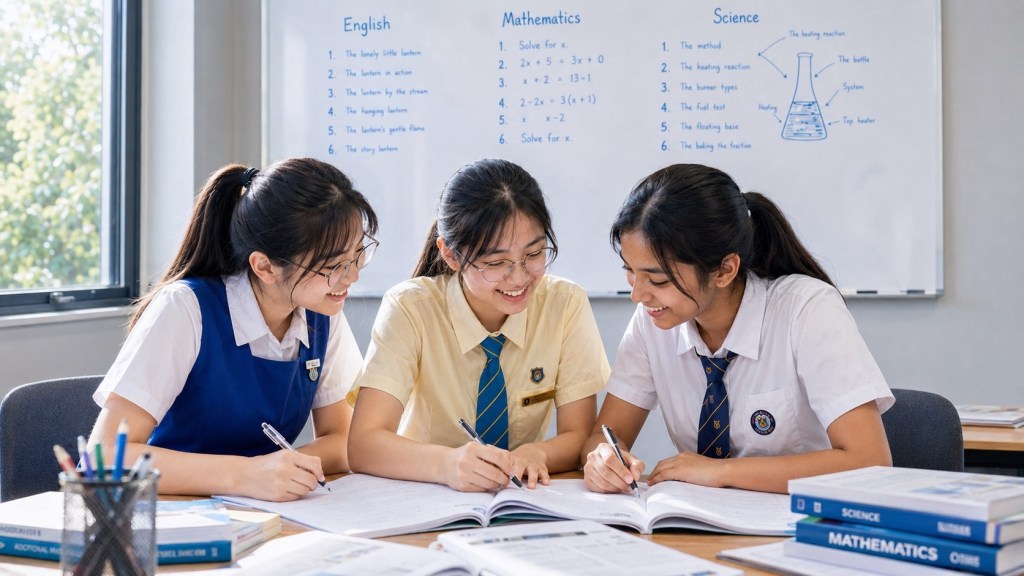
Parents searching for a Secondary Mathematics tutor in Sengkang now have an extra layer to understand: Mathematics is no longer best described only through the old Express, Normal (Academic) and Normal (Technical) stream labels. Full Subject-Based Banding has been fully implemented in secondary schools since 2024, and students can offer subjects at G1, G2 or G3 according to their learning profile and school arrangements. From 2027, graduating students will sit the Singapore-Cambridge Secondary Education Certificate, or SEC, at their respective subject levels.
That changes the language parents use, but it does not change the central tutoring problem. A child can still be weak in number, algebra, geometry, graphs, statistics, probability or mathematical problem solving. A useful G1, G2 or G3 Mathematics tutor in Sengkang should therefore begin with the student’s actual subject level and actual work, not with assumptions attached to an old stream label. At eduKateSengkang, our three-student tutorials use diagnosis to decide what must be repaired, stabilised and extended.
The high-traffic topic language on major mathematics learning platforms is remarkably consistent. Khan Academy Algebra foregrounds equations, inequalities, linear relationships, graphs, functions, exponents, polynomials and quadratics. Singapore-aligned IXL Secondary 1 Mathematics similarly organises learning around number, ratio, algebra, geometry, statistics and problem solving. Those topic clusters matter because secondary Mathematics becomes increasingly relational: students must connect representations rather than execute isolated procedures.
First: what G1, G2 and G3 mean for parents
Under Full Subject-Based Banding, students can offer subjects at different subject levels. MOE explains that Full SBB has been fully implemented since 2024 and that the SEC examination will replace the N- and O-Level examinations from 2027. Students will sit the SEC at their respective G1, G2 or G3 subject levels. Parents can read the current transition details on the MOE Full Subject-Based Banding announcement.
For Mathematics, SEAB currently lists the 2027 subject codes as K110 for G1 Mathematics, K210 for G2 Mathematics and K310 for G3 Mathematics. The official syllabus lists are available directly from SEAB: G1, G2 and G3.
The useful tutoring consequence is not that every learner now follows one standard pathway. It is the opposite. The tutor has to know which level the student is taking, what school work is being attempted, where the student is currently secure and whether a future change in subject level is academically appropriate. The label is information, not a diagnosis.
The transition problem: 2026 and 2027 are not the same examination year
Singapore is in a transition period. Students graduating in 2026 are still under the existing GCE examination structure, while the 2027 graduating cohort moves into the SEC framework. Parents should therefore be careful when searching for notes, tuition pages and examination advice. A resource can be mathematically useful while using an older syllabus code; another resource may use the new SEC language but still cover familiar concepts.
A tutor should make this transition explicit. Students should know the syllabus and examination they are preparing for. Parents should not be made anxious by code changes when the underlying learning issue is, for example, weak linear equations or unstable percentage work.
G1 Mathematics: build usable foundations and mathematical independence
At G1, the tutoring job should not be described as “easier Mathematics”. That description is unhelpful because it encourages low expectations and hides the actual work. The student still needs reliable number skills, interpretation, proportional reasoning, measurement, geometry, data handling and problem solving appropriate to the subject level.
The priority is often usability. Can the student interpret the question? Can the student choose the right operation? Can units be handled? Can a table or graph be read? Can the student show enough working to find and correct an error? Can mathematical knowledge be applied to practical situations?
A G1 tutor should also protect dignity. Students learn poorly when every lesson reminds them that they are “behind”. The more productive language is specific: this ratio skill is unstable; this graph-reading routine is secure; this percentage method needs two more rounds of practice; this word-problem entry process is improving.
G2 Mathematics: strengthen transfer and algebraic control
G2 students increasingly need to coordinate procedures with interpretation. Algebra becomes more important as a language for relationships. Graphs, equations, geometry and statistics demand accuracy across several representations. The child who could once rely on arithmetic intuition may now need formal notation and a clearer sequence of steps.
The tutoring question is often whether a problem comes from knowledge or from transfer. A student may be able to solve an equation when the exercise says “solve the equation” but fail when the same equation has to be constructed from a word problem. That is not a calculation failure. It is a modelling failure.
For some students, G2 can also be a platform for taking certain subjects at a more demanding level when appropriate under school arrangements. A tutor should not promise a subject-level change. The useful contribution is evidence: stronger prerequisite knowledge, consistent school performance, better independence and a clear view of what the next level would demand.
G3 Mathematics: precision, abstraction and examination control
At G3, familiar secondary topics are usually pushed to greater depth and abstraction. Algebraic manipulation, functions and graphs, geometry, trigonometric reasoning, statistics and probability all depend on earlier foundations. Small errors in signs, brackets, substitution or notation can propagate through a multi-step solution.
A G3 Mathematics tutor should therefore work on two layers at once. The first is conceptual: does the student understand the structure? The second is operational: can the student execute the structure accurately and efficiently under examination conditions?
Strong G3 students often plateau not because they need more difficult chapters but because precision becomes the limiting factor. They lose marks through incomplete reasoning, poor checking, careless algebra, calculator input or inefficient method selection. The repair is different from the repair for a student who does not understand the topic at all.
The common spine across G1, G2 and G3
Although the level of demand differs, several mathematical capacities matter across all three levels.
- Number and proportional reasoning: percentages, ratio, rate, scale and estimation.
- Algebraic language: symbols, expressions, equations and relationships.
- Representation: tables, graphs, diagrams, formulae and equations.
- Geometry and measurement: spatial relationships, angle reasoning, length, area and volume.
- Data reasoning: reading, summarising and interpreting information.
- Problem solving: recognising the structure of an unfamiliar task.
- Checking: testing plausibility, units, signs and consistency.
A tutoring system should know how these capacities scale. “Algebra” in a lower-demand context and “algebra” in a higher-demand context are not identical, but the underlying habit of expressing a relationship symbolically remains connected.
Why algebra becomes the secondary-school bottleneck
Primary Mathematics lets students solve many problems arithmetically or visually. Secondary Mathematics increasingly asks them to generalise. Letters stand for quantities. Expressions represent relationships. Equations become objects to transform. Graphs represent how quantities vary together.
For a student who has relied on memorised arithmetic procedures, algebra can feel like the subject suddenly changed language. A tutor needs to make the language explicit: what the symbol represents, why the same operation is applied to both sides, what a coefficient means, why brackets matter, and how an equation connects to a graph or word problem.
International algebra resources repeatedly organise around linear equations, functions, graphs and polynomials because these ideas have high downstream value. Parents do not need to chase every advanced topic early. They need to make sure the algebraic engine is stable.
Linear equations: simple topic, major diagnostic
Linear equations are useful because they reveal several habits at once. Does the student understand equality? Can negative signs be controlled? Are inverse operations understood or merely mimicked? Does the student check by substitution? Can the equation be built from a situation?
A child who can execute ten textbook equations may still not understand equality. A strong tutorial uses variation: missing terms, equations on both sides, fractional coefficients, word problems and graphical interpretations. The goal is to make the structure portable.
Functions and graphs: moving between representations
Graphs are not pictures added after algebra. They are another representation of relationships. Students should learn to move among equation, table and graph, and to read what each representation makes easy to see.
Weak graph work often comes from an earlier habit: plotting points mechanically without thinking about what the axes represent. The tutor should require interpretation. What changes when the gradient changes? What does an intercept mean? What values are possible in the context? Which features can be read directly?
Geometry: from visual confidence to stated reasoning
Secondary geometry can punish students who trust the picture. A diagram may not be drawn to scale. Relationships need to be justified. Similarity, angle properties, Pythagorean reasoning, coordinate methods and trigonometric ideas demand explicit connections.
The tutor can slow students down in a useful way: label what is given, state what is implied, identify the property being used, then calculate. Over time, this produces faster and more defensible solutions.
Statistics and probability: calculation is only half the problem
Students often focus on formulas and neglect interpretation. But data topics ask what a measure means, whether a representation is appropriate, how two groups compare, and what probability describes. A calculator can produce a number without producing understanding.
This is an important secondary-school shift: Mathematics increasingly includes interpretation of information, not only manipulation of symbols.
Why calculators do not remove the need for number sense
Calculator access increases the need for estimation because input errors can produce precise nonsense. Students should know roughly what answer to expect. They should understand brackets, negative signs, mode settings and the difference between exact and rounded values.
A tutor should treat calculator discipline as part of mathematical literacy. The device is a tool, not an authority.
When a student changes subject level
Full SBB creates more flexibility, but flexibility does not mean impulsive movement. A move to a more demanding subject level should be supported by secure prerequisites, learning progress and school guidance. A move to a less demanding level should not be framed as failure; it may allow the student to build a stronger working foundation and allocate effort more effectively.
The tutor’s role is to provide accurate learning evidence. Which topics are stable? Which depend on heavy prompting? How much independent practice is sustainable? Does the student recover from mistakes? How quickly does new material attach to old knowledge? These observations are more useful than prestige language.
Catch Up | Keep Up | Move Ahead in Secondary Mathematics
- Catch Up: repair the prerequisite that blocks current G1, G2 or G3 work.
- Keep Up: consolidate school learning, retrieve older material and prevent cumulative gaps.
- Move Ahead: deepen transfer, unfamiliar problem solving and precision without racing blindly through future chapters.
The same student can move among these lanes. A G3 student may need Catch Up in algebra, Keep Up in geometry and Move Ahead in statistics. Tuition should be granular enough to see that.
Diagnose → Repair → Stabilise → Extend
Diagnose where performance first breaks. Repair that mechanism directly. Stabilise it through spaced and varied practice. Extend it into unfamiliar combinations. Then repeat the cycle.
This is particularly important in secondary Mathematics because the syllabus compounds. A weak manipulation habit can damage equations, functions, coordinate geometry and Additional Mathematics later. Early repair has leverage.
Why three students helps the tutor see level-specific problems
A three-student tutorial can preserve individual diagnosis while still allowing discussion. One student may understand the concept but make sign errors. Another may calculate perfectly but misunderstand the question. A third may need the whole idea retaught. If all three receive the same worksheet and explanation, the class misses the point.
Small-group teaching lets the tutor inspect working, ask each student to justify a step and assign different follow-up tasks while keeping a shared mathematical conversation.
What parents should ask a Secondary Mathematics tutor
- Which G-level and syllabus is my child currently taking?
- What is the present bottleneck: concept, fluency, interpretation, algebra, representation or exam control?
- Which older prerequisite is involved?
- How will the repair be revisited after a delay?
- How much of the lesson is independent work?
- How do you distinguish school support from examination preparation?
- What evidence would suggest my child is ready for more demanding work?
Secondary 1: the reset year
Secondary 1 is not simply Primary 7. The subject becomes more symbolic and formal. Students meet a wider set of teachers, timetables and expectations at the same time. The Secondary 1 Mathematics Tuition Sengkang route focuses on that reset.
Secondary 2: the bridge year
Secondary 2 often reveals whether lower-secondary algebra and geometry are stable enough for upper-secondary choices. The Secondary 2 Mathematics Tuition Sengkang route explains this bridge.
Secondary 3: compounding begins
Secondary 3 typically increases subject depth and workload. Students taking Additional Mathematics face an additional algebraic demand. The Secondary 3 Mathematics Tuition Sengkang page owns the year-specific route.
Secondary 4: convert knowledge into examination performance
Secondary 4 requires consolidation, mixed practice, time control and deliberate recovery from prelim feedback. The Secondary 4 Mathematics Tuition Sengkang route covers the graduating-year job without duplicating this G1/G2/G3 parent guide.
Where Additional Mathematics fits
SEAB’s 2027 lists include Additional Mathematics at G2 as K232 and at G3 as K341. That subject deserves separate treatment because it increases the density of algebra, functions and advanced mathematical relationships. Parents should not treat Additional Mathematics as simply “more Mathematics”. It is a different instructional load.
Use the Additional Mathematics Tuition Sengkang hub for the dedicated A-Math pathway.
Sengkang families and the nearby Punggol teaching location
eduKateSengkang serves Sengkang students through a nearby Punggol teaching location. The commercial proposition is deliberately simple: small groups of three students, 90-minute tutorials and teaching organised around the learner’s actual weak link. We do not claim a separate branch in every neighbourhood. We provide a local Sengkang-facing learning route to a nearby class.
The main commercial owner remains Mathematics Tutor Sengkang | Why Three Students Let Us See the Learning System. This article supports that owner by explaining the new secondary-level landscape.
Frequently asked questions
Has Full Subject-Based Banding replaced streams?
MOE states that Full SBB has been fully implemented in secondary schools since 2024. Students can offer subjects at G1, G2 and G3, and the SEC examination begins from 2027 for graduating students at their respective subject levels.
Are G1, G2 and G3 Mathematics the same syllabus?
No. They are different subject levels with different demands. Parents should use the current school and SEAB information for the student’s specific level rather than assuming one generic “secondary Math” syllabus.
Can tuition move my child from G2 to G3?
Tuition can strengthen the academic prerequisites, but subject-level decisions depend on the student’s learning progress and school processes. A responsible tutor should not promise a level change.
What is the most important Secondary Mathematics foundation?
There is no single foundation, but algebraic language has especially high leverage because it supports equations, graphs, functions and later Additional Mathematics. Number sense and proportional reasoning remain important as well.
Should my child start doing SEC papers immediately?
Only when the paper matches the student’s level and the practice has a purpose. Topic repair, mixed transfer, retrieval and timed work all have different jobs. Practice papers should not replace teaching.
The parent decision
The most useful way to think about G1, G2 and G3 Mathematics is not as a ranking of children. They are subject levels within a more flexible secondary system. The tutoring question remains concrete: what does this student need to understand and perform next?
A Mathematics tutor in Sengkang should make that answer clearer. The tutor should know the current level, diagnose the actual mechanism of failure, repair it without shame, stabilise it through retrieval and variation, then extend the learner only when the foundation is ready. That is how Full SBB becomes a learning system rather than merely a set of new labels.
Next: visit the Mathematics Tuition Sengkang hub, the Mathematics Tutor Sengkang service owner, or the year-specific Secondary 1–4 Mathematics routes linked above.
G1, G2 and G3 should change the teaching demand, not the dignity of the learner
Parents can accidentally turn subject levels into labels about intelligence. That is not useful for tutoring. A tutor needs to describe the mathematical demand concretely: what representations are required, how much abstraction is expected, how many steps must be coordinated, what kind of examination language appears and which prerequisite ideas are assumed.
The student then receives a precise message. “You are weak” becomes “your equation setup is not yet stable”. “This level is too hard” becomes “your fraction and algebra foundations are consuming too much working memory for the current task”. Specific language protects agency because it identifies something that can be trained.
The same core habit can appear differently at G1, G2 and G3
Consider proportional reasoning. At one level, the student may work with direct everyday rates and percentages. At another, the same underlying reasoning can appear inside more formal algebraic or graphical contexts. Consider geometry: the student may move from direct measurement and formula use into more demanding justification and multi-step relationships. Consider data: the task can move from reading a chart into comparing distributions or interpreting statistical measures.
The tutor therefore needs two maps at once: the map of the student’s current subject level and the map of the underlying mathematical idea. This prevents teaching from becoming a collection of disconnected worksheets.
The lower-secondary reset: arithmetic stops being enough
Many students enter Secondary 1 with workable Primary Mathematics but discover that the subject feels different. The reason is not only harder numbers. Secondary Mathematics formalises relationships. Letters represent unknown or variable quantities. Graphs become mathematical objects. Formulae need to be rearranged. Negative numbers and algebraic notation appear everywhere.
A student who solved primary word problems through intuition may now need to express the same relationship symbolically. A student who relied on bar models may need to see how a model can become an equation. A student who was comfortable with numerical patterns may need to generalise the pattern. The transition is from doing arithmetic to describing structure.
A Secondary Mathematics algebra readiness test
Parents do not need a formal diagnostic paper to notice early algebra problems. A tutor can test a small set of behaviours.
- Can the student explain what a variable represents?
- Can like terms be combined without treating unlike terms as interchangeable?
- Are negative signs and brackets handled reliably?
- Does the student understand equality as a relationship?
- Can a simple word relationship be written as an equation?
- Can the solution be checked by substitution?
- Can the student connect an equation with a table or graph?
If several of these are weak, the repair should happen before the class races into harder algebra. The objective is not to keep the student on easy work. It is to make the basic language efficient enough for harder work to become possible.
Why fractions still matter in Secondary Mathematics
Students sometimes believe fractions are a Primary-school topic. Then algebraic fractions, rates, ratios, probability and formulae reveal the gap. A student who is uncomfortable with fraction equivalence or operations may struggle whenever symbols replace numbers.
This is a classic example of a hidden prerequisite. The visible topic may be algebra, but the first weak link is fraction structure. A good tutor is willing to repair the older idea without making the student feel that the entire syllabus must be restarted.
Full SBB makes diagnosis more important because pathways can be more flexible
MOE’s Full SBB framework allows students to offer subjects at different subject levels and, at appropriate junctures, adjust subject levels according to learning progress and school processes. That flexibility increases the value of accurate evidence. Parents need to know whether a student is truly secure, merely coping with heavy support, or ready for a more demanding level.
Tuition should contribute learning evidence, not promises. A tutor can report that algebraic manipulation is now stable, that mixed-topic accuracy has improved, that the student completes work with fewer prompts, or that a higher-demand worksheet remains unsustainable. The school remains central to subject-level decisions.
A subject-level change should not be prepared through acceleration alone
When families hope that a student can eventually take a more demanding Mathematics level, the temptation is to start teaching that level immediately. Sometimes the better strategy is to deepen the current level first. Secure prerequisite knowledge, independent work habits and strong transfer create a more durable bridge than superficial exposure to harder chapters.
The same principle applies in the other direction. If a student is overwhelmed, the answer is not automatically to reduce the level immediately. First diagnose the cause. A small repair may restore performance. If the overall demand remains inappropriate, the family can then discuss options with the school using better evidence.
2026 versus 2027: a parent checklist for the SEC transition
Because 2026 is the final year before the SEC examination begins, families should check five things whenever they use Mathematics resources.
- Examination year: is the student preparing for a 2026 GCE examination or the 2027 SEC?
- Subject level: G1, G2 or G3 for the SEC cohort.
- Official syllabus: use the current SEAB page rather than an old tuition handout as the final authority.
- Resource age: older questions can still be mathematically valuable, but labels and assessment details may differ.
- Teaching purpose: know whether the resource is being used for concept learning, transfer or examination rehearsal.
This prevents families from overreacting to new codes or assuming that every old paper is obsolete. Mathematics knowledge has continuity; examination administration has specific current rules.
What examination preparation should look like at any subject level
Good examination preparation has four layers. First comes concept security: the student understands the underlying mathematics. Second comes procedural fluency: common methods can be executed with reasonable speed and accuracy. Third comes mixed recognition: the student can identify the relevant mathematics when the chapter label disappears. Fourth comes paper control: time, checking, recovery and answer discipline.
The relative difficulty changes by G-level, but the architecture remains useful. A tutor who jumps straight to timed papers may be testing a system that has not yet been built.
Secondary Mathematics error families
Students improve faster when errors are grouped by mechanism.
- Concept errors: the relationship itself is misunderstood.
- Algebra errors: signs, brackets, factorisation or rearrangement fail.
- Representation errors: the equation, graph, diagram or table does not model the problem correctly.
- Calculator errors: input, mode or rounding is wrong.
- Communication errors: working, units or final answer form is incomplete.
- Time errors: a method is valid but too slow or the student refuses to leave a difficult question.
- Transfer errors: the student knows the topic in isolation but fails to recognise it in a mixed context.
A test correction should identify the family, not only the corrected answer. Once students can name their own error families, self-regulation improves.
How G1 tutoring can avoid becoming remedial drill
Students taking G1 Mathematics still need explanation, reasoning and independence. Practical contexts can be powerful, but practical does not mean intellectually empty. A tutor can ask students to estimate, compare methods, justify units, interpret graphs and explain why an answer is reasonable.
The aim is functional mathematical confidence grounded in competence. Repetitive drill may be part of fluency building, but it should not replace understanding.
How G2 tutoring can prepare students for greater symbolic demand
G2 students benefit from strong connections between arithmetic and algebra. Percentage can become an equation. A rate problem can become a formula. A pattern can become a rule. A graph can be connected to an algebraic relationship. These bridges reduce the sense that algebra is an entirely new subject.
Where appropriate, deeper work can also prepare a student for a more demanding subject level without pretending that tuition controls school placement.
How G3 tutoring should handle strong students
Strong G3 students can waste time if extension means only “harder questions”. Their learning may benefit more from method comparison, proof-like reasoning, cleaner algebra, exactness, non-routine transfer and the ability to explain why a shortcut is valid. Precision becomes increasingly important because the final few marks are often lost through small failures rather than missing chapters.
AI, calculators and online worked solutions
Secondary students now have instant access to explanations and solutions. This can improve access to help, but it can also make dependency invisible. If a student repeatedly reads a worked solution before attempting the problem, recognition can be mistaken for mastery.
A better protocol is attempt → mark the sticking point → request a hint or explanation → close the help → complete from a blank page → revisit later. Calculator use should follow the same logic: estimate first where possible, input deliberately, then inspect whether the answer is plausible.
What progress looks like under Full SBB
Progress should be visible in learning behaviour regardless of G-level. The student begins unfamiliar questions more independently. Algebraic work becomes cleaner. Older topics survive longer. Corrections need fewer prompts. The student can explain why a method applies. Time use becomes more deliberate. Confidence becomes less dependent on whether the worksheet looks familiar.
Those indicators help parents make better decisions because they describe the learner, not only the latest grade.
A Sengkang parent’s Secondary Mathematics checklist
- Do we know the student’s current Mathematics subject level and examination year?
- Can the child explain the main algebraic weaknesses?
- Are Primary foundations such as fractions and percentage still causing delay?
- Does tuition differentiate concept repair from paper practice?
- Are old errors re-tested after a delay?
- Is the student becoming less dependent on examples and prompts?
- If a subject-level change is being considered, do we have evidence rather than hope alone?
Full SBB gives families new terminology and greater flexibility. The most useful response is not to chase labels. Build the mathematics that makes the next appropriate step possible.
Continue: Secondary 1 Mathematics · Secondary 2 Mathematics · Secondary 3 Mathematics · Secondary 4 Mathematics · Mathematics Tutor Sengkang.
The most useful Full SBB question is still a learning question
New labels can make families feel that they must master the whole policy architecture before helping their child. They do not. The operational question remains: what Mathematics is the student taking now, and what must become secure next? The official MOE and SEAB pages settle the structure; the school explains the student’s subject arrangements; the tutor works on the learning evidence in front of them.
That division of roles keeps the system clear. Parents do not need tuition to speculate about future pathways. They need it to strengthen number sense, algebra, representation, reasoning, checking and examination control at the appropriate demand level. When those capacities improve, the student has more useful options because the underlying Mathematics is stronger.
For a Sengkang family comparing support, ask whether the tutor can explain the student’s current bottleneck in plain language and show how the next block of work addresses it. That is more meaningful than a generic promise to “cover the syllabus faster”.
That is the operating principle of this lane: use current policy language accurately, but keep the teaching centred on the student’s Mathematics, evidence, independence and next appropriate step.
Mathematics and Sengkang routes: return to the Mathematics Hub or Complete Mathematics Index for the wider Mathematics estate; use What about Sengkang? for the town-wide route.
