
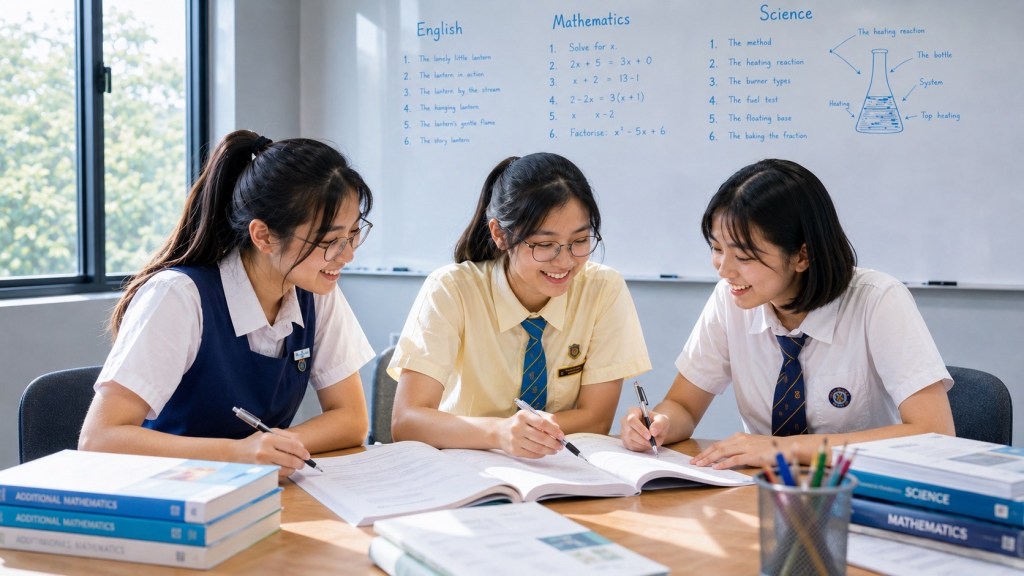
“A-Math tutor near me” is one of the most practical searches a Sengkang parent can make. Families in Compassvale, Rivervale, Anchorvale, Fernvale, Buangkok and the wider Sengkang–Punggol area are not only searching for Additional Mathematics teaching. They are trying to fit that teaching into a real secondary-school week: dismissal times, CCAs, dinner, homework, other subjects, transport and sleep. A tutor can be excellent academically and still be a poor operational fit if the weekly journey makes attendance difficult.
But “near me” should not become the only criterion. Additional Mathematics is cumulative. A student needs accurate diagnosis, careful inspection of working, current syllabus knowledge and a teaching structure that reduces dependence over time. A convenient tutor who repeatedly gives generic worksheets can waste more time than a slightly less convenient programme that identifies the actual bottleneck quickly.
Parents should also check the student’s current Singapore route. For 2027 school candidates, SEAB lists Additional Mathematics at G2 as K232 and G3 as K341. The G1 list includes Mathematics but not Additional Mathematics. The local tutor decision should therefore begin with two questions: is the programme close enough to sustain, and is it teaching the right subject level?
The short answer: “near me” is useful when it improves consistency without lowering teaching fit
Distance matters because learning compounds. Missing one lesson may be recoverable. Repeated lateness, rushed meals, tired arrivals and frequent absences can damage continuity. A local Sengkang tutor or centre can reduce that friction.
At the same time, parents should avoid choosing purely by postal code. The correct comparison is travel time + teaching quality + schedule fit + class format + syllabus fit. The nearest option is not automatically the best value. The best option is the one the student can attend consistently and use effectively.
Why travel time matters more in Secondary 3 and Secondary 4
Upper-secondary students do not have empty afternoons. Schoolwork becomes heavier, CCAs remain demanding and Additional Mathematics itself adds a second layer of Mathematics for many students. A ninety-minute lesson may create a much larger time block once transport, waiting and transition are included.
That extra time has an opportunity cost. It can displace English reading, Science revision, Humanities work, dinner with the family or sleep. If the student is travelling across Singapore several times a week for tuition, the family should ask whether the educational gain justifies the total operating cost.
Local access can therefore be educationally meaningful. A student who arrives less tired may think better. A family that can sustain the routine across an entire year gains continuity.
Search radius should depend on the student’s problem
Parents do not need the same search radius for every A-Math problem. If the student has severe foundation gaps and needs a very specific specialist, travelling farther may be justified. If the learner is already strong and mainly needs weekly mixed-paper challenge, a good local option may provide better overall value.
- Narrow, severe gap: widen the search for specialist diagnosis if necessary.
- Stable but needs structure: prioritise a sustainable nearby programme.
- Strong student: compare challenge level, peer group and travel cost.
- Secondary 4 exam season: reduce unnecessary travel where possible to protect revision time.
- Student with poor attention at home: a nearby physical class may be more useful than online convenience.
What “A-Math tutor near Sengkang” should mean in practice
A local search should lead to practical questions. How long is the door-to-door journey? Can the student reach the lesson directly after school? Is there enough time to eat? What happens if school ends late? Can the family sustain this routine during prelim and examination periods?
Families searching from different parts of Sengkang may use different local terms — Compassvale A-Math tutor, Rivervale A-Math tuition, Anchorvale Additional Mathematics tuition, Fernvale A-Math tutor, Buangkok math tutor or simply “A-Math tuition near me”. These are geographic variations of the same parent need: reduce friction without compromising teaching quality.
Local does not mean the tutor must teach only school homework
One danger of hyper-local tuition is that convenience becomes the entire proposition. Parents should still expect a specialist learning system. The tutor should diagnose prerequisites, connect topics, build retrieval and use mixed questions to test method selection.
A-Math tuition should not become a weekly homework-completion service simply because the programme is nearby. School homework can provide evidence, but the tutor should still ask what underlying skill is causing the difficulty.
Near school, near home or near transport?
“Near me” can mean different things. A centre close to home may be ideal for weekend lessons. A centre near school may be better on weekdays. A programme near a major transport connection may be operationally easier even if the straight-line distance is greater.
Parents should calculate the route the student will actually use, not simply map distance. A ten-minute walk after school may be easier than a theoretically shorter journey requiring several transfers.
Use total weekly time, not lesson duration
Compare programmes using total weekly time.
- Travel to tuition.
- Waiting before the lesson.
- Lesson duration.
- Travel home.
- Transition time before the student can resume other work.
- Required homework or extra practice.
A ninety-minute class can easily consume much more than ninety minutes. A nearby programme may recover enough time each week to make its effective value substantially higher.
Why schedule fit is part of tutor fit
A brilliant tutor at the wrong time can be a weak choice. Students learn poorly when lessons begin immediately after an exhausting CCA, end too late for adequate sleep or consistently conflict with school commitments.
For Additional Mathematics, the student needs enough mental energy to manipulate symbols accurately. Fatigue increases sign errors, careless reading and poor persistence. Parents should therefore treat timetable fit as an academic variable, not merely a convenience variable.
What happens when the timetable changes?
Secondary schedules shift across terms. CCAs intensify, examinations approach and school remedials appear. Ask what happens when the regular slot becomes difficult. Is there another class? A make-up arrangement? Online replacement? Recorded material? A consultation?
Continuity is especially important for A-Math because old and new topics depend on one another. A programme with a sensible absence policy can be more valuable than one that is slightly closer but inflexible.
Near-me searches should still compare class size
Two local options can provide very different learning experiences. One may be one-to-one home tuition. Another may be a class of ten or more. Another may be a small group of three or four. Parents should ask how much individual working the tutor can realistically inspect.
At eduKate, the Sengkang model uses groups of three students. The point is to keep each learner visible while allowing peer comparison and short independent intervals. Families can read our guide on what a 3-student A-Math tutorial should actually do.
Near-me searches should still compare tutor background
Local results may include undergraduates, part-time tutors, full-time tutors, current or former teachers and specialist centres. Do not assume one category is automatically best. Compare relevant teaching experience, subject command, diagnostic process, syllabus knowledge and continuity.
Our guide on undergraduate vs full-time vs MOE/NIE A-Math tutors provides a fuller framework.
Near-me searches should still compare what is included
A nearby programme may include notes, homework support, consultations or mock papers. Another may charge separately. These differences affect both value and time.
Ask what each feature is for. More materials are not automatically better. A good local tuition system should make the next learning task clearer, not bury the student in resources.
Secondary 3: local consistency can prevent compounding gaps
Secondary 3 A-Math often becomes difficult because small gaps accumulate while school keeps moving. A local programme can make weekly attendance easier and allow the student to establish a stable rhythm early.
The tutor should use that continuity to protect foundations: algebraic manipulation, equations, functions, graphs, notation and retrieval. The first months are not only about surviving homework. They are about building the engine for later trigonometry, logarithms and calculus.
Secondary 4: local efficiency can protect revision capacity
By Secondary 4, every hour matters more. Students are balancing prelims, full papers and several subjects. A local A-Math route can reduce travel and preserve revision capacity.
The teaching should also become more performance-focused: mixed papers, method selection, timing, checking and targeted repair. A convenient location is valuable only when the programme changes with the year.
G2 and G3: local tutors must still be current
Location does not excuse outdated syllabus knowledge. For 2027, G2 Additional Mathematics is K232 and G3 Additional Mathematics is K341. Parents should use the official SEAB owner when checking syllabus details.
Older 4051 and 4049 papers may remain useful for practice, but the tutor should explain how they map to the current route. A local tutor who cannot identify the student’s actual syllabus creates avoidable risk.
G1: local Mathematics support may be the right first step
The 2027 G1 list does not include Additional Mathematics. If a G1 student hopes to progress, the immediate need may be strong Mathematics foundations and school-based discussion about subject levels. Parents should not buy A-Math tuition simply because it sounds like the next advanced step.
How to compare three nearby options without getting overwhelmed
Choose three plausible options and compare them across the same variables.
- Door-to-door time.
- Lesson time and weekly schedule.
- Class size.
- Tutor background.
- SEC syllabus fit.
- Diagnostic process.
- What is included in the fee.
- Missed-lesson policy.
- Student independence.
- Four-week progress evidence.
This prevents one attractive feature from dominating the decision.
A parent route test for Compassvale, Rivervale, Anchorvale, Fernvale and Buangkok families
Before enrolling, simulate the weekly journey at the actual lesson time. How tired will the student be? What happens when it rains? Is dinner before or after? Can the learner reach the class directly from school? How much time remains afterwards?
This may sound mundane, but sustainable logistics support academic consistency. A route that works only on ideal weeks will eventually break.
What if the best tutor is farther away?
Sometimes the specialist fit justifies travel. If the student has a severe or unusual gap, or if the farther tutor provides a teaching function unavailable locally, the additional journey may be worthwhile.
Make the trade-off explicit. What educational benefit are you buying with the extra travel? If the answer is vague, reconsider. If the tutor provides clearly superior diagnosis or specialist expertise for a defined problem, the journey may make sense.
What if the nearest option is good enough?
“Good enough” can be a strong decision when the programme is academically sound, the student attends consistently and the saved time protects the rest of the week. Parents do not need to optimise every variable endlessly.
Once the student is progressing, continuity itself becomes valuable. Changing to chase a marginally more impressive programme can reset diagnostic history and routines.
How to tell whether local convenience is actually helping
- The student arrives on time and not exhausted.
- Attendance is consistent.
- There is enough time after tuition for rest or other work.
- The learner completes independent practice between lessons.
- Recurring errors are decreasing.
- The tutor can explain the current bottleneck.
- The student needs fewer prompts on repaired skills.
If travel is easy but none of the learning indicators improve, convenience is not enough.
How eduKate frames “A-Math tutor near me”
For eduKateSengkang, local discovery should lead parents into the existing A-Math spine rather than create a claim that we operate a branch in every Sengkang neighbourhood. The useful destination is the teaching system: three-student tutorials, diagnosis, deliberate practice and SEC-aware preparation.
Start with the Additional Mathematics Tuition Sengkang hub. Then use the Secondary 3 route, Secondary 4 route or the What about Sengkang? guide for the wider town context.
Frequently asked questions
How far should I travel for A-Math tuition?
There is no universal distance. Compare total weekly travel with the educational benefit. The route should be sustainable across busy school terms.
Is the nearest A-Math tutor usually the best choice?
No. Nearness improves convenience, but parents should still compare diagnosis, class size, tutor fit and current SEC knowledge.
Should I choose tuition near school or near home?
Choose the route the student can sustain most easily at the actual lesson time. Weekday and weekend needs may differ.
Does local tuition save enough time to matter?
It can. Small weekly savings accumulate across a school year and can protect sleep, revision or other subjects.
Should Secondary 4 students prioritise a nearby tutor?
Local efficiency can be especially valuable during prelim and exam preparation, provided the teaching is strong enough for the student’s needs.
What should G2 and G3 students check?
For 2027, confirm whether the student is preparing for G2 K232 or G3 K341 Additional Mathematics.
Does G1 have Additional Mathematics in 2027?
The 2027 G1 school-candidate list does not include Additional Mathematics. G1 students should follow their current Mathematics route and discuss progression with their school.
What if a farther tutor is clearly better?
Travel may be justified when the tutor solves a defined specialist need that nearby options cannot. Make the benefit explicit and calculate the total weekly cost.
The parent decision
Use “near me” to reduce friction, not to lower standards. The best local A-Math arrangement is close enough to sustain, rigorous enough to diagnose accurately and structured enough to make the student increasingly independent.
For families searching across Sengkang, Compassvale, Rivervale, Anchorvale, Fernvale or Buangkok, the local question and the academic question belong together: can the student get there reliably, and will the teaching actually change the mathematics?
Continue: Additional Mathematics Tuition Sengkang · Home A-Math Tutor vs Tuition Centre · A-Math Tuition Fees and Value · What about Sengkang?
Micro-location searches are really timetable searches
When a parent types “A-Math tutor Compassvale” or “A-Math tuition Fernvale”, the location word often stands in for a timetable problem. The family wants to know whether the student can reach the lesson without turning one evening into a logistical project.
This is why hyper-local search intent matters even when a tuition provider serves the wider Sengkang area. A family in Rivervale may prioritise a different weekday route from a family in Anchorvale. A student coming from school may use a different starting point from the same student on Saturday morning.
Compassvale families: test the real weekday route
For families searching from Compassvale, the useful comparison is not simply “within Sengkang”. Test the actual journey at lesson time. Can the student arrive directly after school? Is there enough buffer if dismissal runs late? Does the route still work during heavy rain or examination weeks?
A nearby option becomes valuable when it reduces uncertainty. The family knows how long the journey takes and the student can build a repeatable routine.
Rivervale families: compare east-side convenience with teaching fit
Rivervale parents may find several nearby secondary tuition options, but distance should still be combined with class size and A-Math specialisation. A slightly longer trip can be justified if the closer class is too large for the student’s diagnostic needs.
The key question remains: will the tutor see enough written working to identify the first wrong line?
Anchorvale families: protect the after-school transition
For Anchorvale families, weekday timing may interact with CCAs, sports and other activities. A lesson slot that looks perfect on paper can fail if the student consistently arrives mentally exhausted.
Parents should prefer a schedule that leaves enough time to eat, settle and think accurately. A-Math is not a subject where fatigue helps symbolic precision.
Fernvale families: calculate total time, not map distance
Fernvale searches can produce options across different parts of north-east Singapore. Compare door-to-door time and transfer complexity rather than straight-line distance. A route with fewer transitions can be easier even if it looks farther on a map.
The same logic applies when comparing Sengkang and nearby Punggol options. The most sustainable journey is the one the student can repeat every week without disrupting the rest of the academic schedule.
Buangkok families: “near me” may include more than one town label
Buangkok sits within the wider north-east daily movement of many families. Search results may surface Hougang, Sengkang or other nearby options. Parents should not be constrained by website town labels. Use real travel and teaching fit.
A near-me search can accidentally over-prioritise reviews
Local search interfaces often make ratings and reviews very visible. Reviews can help families identify patterns of service, communication and student experience, but they should not replace a trial or direct teaching questions.
One learner’s success does not prove fit for another. Look for evidence relevant to your child: similar year, similar level, similar learning problem and a teaching process you can understand.
A near-me search can accidentally over-prioritise promotional claims
Search results may highlight distinction rates, testimonials or “best tutor” language. These claims can be informative when properly explained, but parents should return to the student’s actual need.
Ask what happens in the lesson when your child cannot start. That question cuts through most marketing differences.
Build a weekly time budget before enrolling
Write down the entire week, not just the tuition slot. Include school end times, CCAs, travel, meals, homework and sleep. Then place the A-Math lesson into the schedule.
- Does the student have time to arrive without rushing?
- Is there enough energy for ninety minutes of symbolic work?
- What work will be displaced?
- What happens during examination weeks?
- Can the family maintain the same routine for six months?
A tuition decision that works in a blank calendar can fail in a real one.
Use attendance reliability as an academic metric
Parents often track marks but not attendance friction. If the student is repeatedly late, misses lessons or arrives exhausted, the local arrangement is not functioning well even before grades fall.
Reliable attendance allows the tutor to build on previous diagnosis. A-Math continuity matters because the tutor needs to know which repairs were attempted and which errors returned.
What a good nearby tutor should know about the student’s school week
A local tutor does not need to know every school’s timetable, but should understand that students arrive with different workloads. The lesson can adapt when a major school examination is approaching or when the student has just completed a heavy test week.
Adaptation does not mean abandoning the programme. It means choosing the right cognitive load for the week while preserving the long-term learning architecture.
Near-me convenience is especially valuable when the student needs consistency rather than intensity
Some A-Math students do not need a dramatic intervention. They need one good lesson every week, careful retrieval and steady correction. For these learners, local convenience can be more valuable than travelling far for a “premium” experience.
Consistency compounds. Small weekly improvements in algebra, method selection and checking can produce large changes by the end of the year.
When intensity justifies a wider search
Other students have severe gaps, repeated failures or unusual syllabus needs. In those cases, a specialist farther away may be worth the time. The important thing is to know what specialist function is being purchased.
“Better reputation” is too vague. “This tutor specialises in rebuilding algebraic foundations for Secondary 4 students who are failing despite understanding concepts” is a defined reason.
The trial should include the route, not only the lesson
When attending a trial, evaluate the entire experience. Did the student arrive rushed? Was the timing sustainable? How long did the trip home take? Did the learner still have energy to complete other necessary work?
A trial that proves the teaching is excellent but the route is unsustainable is still useful evidence.
Near-me search and online tuition can work together
A nearby physical programme may be the main route, while online make-up or consultation preserves continuity when the student cannot attend. Alternatively, a family may choose online tuition precisely because no nearby option provides the needed specialist fit.
The delivery mode should solve a practical problem without weakening diagnostic quality.
Local SEO should not become fake branch SEO
Parents deserve clear location language. An article can help families in Compassvale, Rivervale, Anchorvale, Fernvale or Buangkok think through local tuition without pretending the provider has a physical branch in every neighbourhood.
The useful local page explains routes, timing, teaching fit and where to find the actual programme. That is the approach used here: local discovery routes back into the existing Sengkang Additional Mathematics spine.
A 20-minute parent comparison exercise
Take three nearby options and write one line under each of these headings.
- Door-to-door time.
- Lesson slot.
- Class size.
- Tutor type and experience.
- SEC syllabus.
- Main teaching method.
- Homework and support.
- Missed-lesson arrangement.
- Monthly cost.
- What the student would gain that they do not already have.
The last line is the most important. If you cannot explain what the programme adds, proximity alone is not enough.
The best local route makes the whole week work better
A successful A-Math decision should not improve one subject by damaging the rest of the student’s life. The student should have enough time to sleep, complete other subjects and recover. Tuition belongs inside the education system, not above it.
That is why “A-Math tutor near me” is a legitimate academic search intent. Distance and timetable affect whether good teaching can be used consistently.
How lesson frequency changes the meaning of “near me”
A long journey once a week may be manageable. The same journey twice a week can become exhausting. Families considering extra lessons before examinations should recalculate total travel instead of assuming the original arrangement still works.
Local convenience becomes more valuable as frequency increases. This is one reason a nearby Sengkang option can be especially useful during intensive Secondary 4 periods.
How late-evening lessons change the route decision
A lesson ending late has a different cost from an afternoon lesson. The trip home delays dinner, remaining homework and sleep. Parents should consider the student’s next school morning, not only whether the slot is technically available.
How weekend lessons change the route decision
Weekend travel may be easier because school is not the starting point, but tuition can compete with family time, other classes and recovery. A nearby weekend class may preserve more of the day.
Near me versus home tutor
Some families solve the local-search problem by bringing the tutor to the home. This removes student travel but changes the learning environment and usually the class format. Compare the benefits using the same criteria: visibility of working, independence, schedule reliability and total cost.
Near me versus online tutor
Online tuition can make distance irrelevant. That is useful when no nearby tutor provides the right specialist fit. The trade-off is that working visibility, attention and technology must be managed deliberately.
Our guide on online vs face-to-face A-Math tuition explains that comparison in more detail.
Local convenience can support better sleep
Sleep matters in Mathematics learning. Tired students make more careless errors, persist less effectively and retrieve less reliably. A shorter route that allows the student to finish earlier can improve the quality of the following school day as well as the tuition lesson itself.
Local convenience can support better independent revision
If the student saves forty minutes of travel, decide where that time goes. The best use may be twenty minutes of old-topic retrieval and twenty minutes of rest. Convenience creates value only when the recovered time is used intelligently.
Recommendations from friends still need a fit check
Friend recommendations are useful because they reduce uncertainty, but students have different learning profiles. A class that works for a confident, independent student may not suit someone who needs closer diagnosis and more individual feedback.
A local decision should still include a trial
Nearness reduces friction, but a trial shows whether the teaching process fits. Bring real work, observe how the tutor diagnoses and ask what the first-month plan would be.
The ideal near-me outcome
The ideal arrangement is simple: the student can reach tuition without stress, the tutor knows the correct SEC route, the class format makes working visible, and the learner becomes more independent month by month. When those pieces align, local convenience becomes a genuine academic advantage.
