
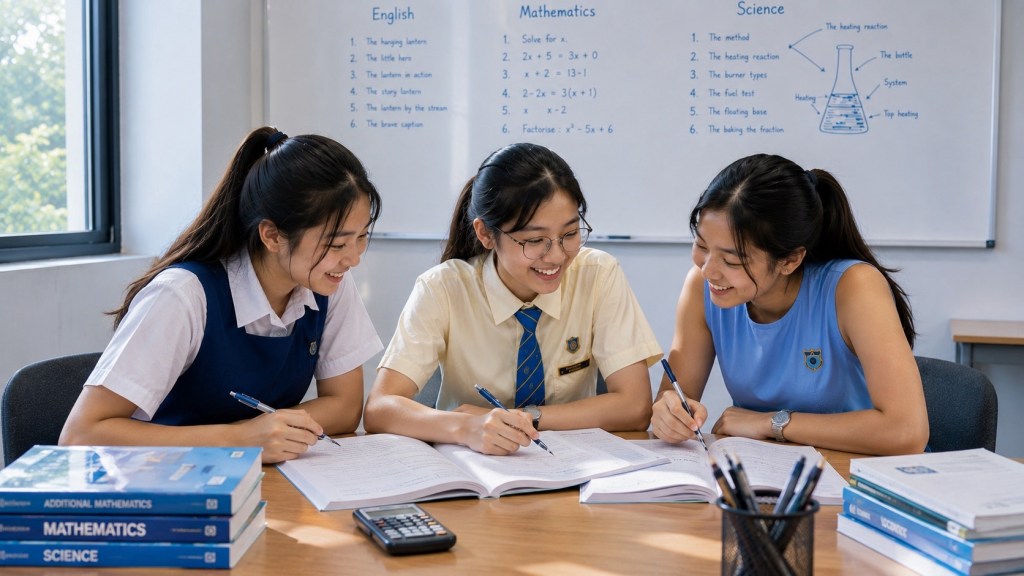
Parents searching for an Additional Mathematics tutor in Sengkang often compare two physical learning models: home tuition and a tuition centre. Both can be effective, and both appear frequently in Singapore A-Math searches because they solve different family problems. Home tuition offers convenience and individual pacing. A tuition centre can offer a dedicated learning environment, specialist resources, stable class routines and peer interaction. The useful decision is not “Which is better in general?” but “Which setup gives this student the right balance of diagnosis, independence and consistency?”
Additional Mathematics makes that decision important because weak learning habits compound. A student who receives too much help at home can become dependent. A student in a centre can disappear inside a class if individual working is not inspected. The physical location matters less than what happens to the student’s thinking when a difficult question appears.
Parents also need the correct syllabus route. For 2027 school candidates, SEAB lists Additional Mathematics at G2 as K232 and G3 as K341. The G1 list includes Mathematics but not Additional Mathematics. Any home tutor or centre should know the student’s actual route before discussing chapter coverage.
The short answer: home tuition maximises convenience; a centre can maximise structure
Home tuition removes travel, gives the tutor direct access to one student’s pace and can fit unusual schedules. A tuition centre creates a separate academic environment, can support regular routines and may offer specialist materials or small-group learning. Neither advantage guarantees better outcomes.
The student’s behaviour determines whether the advantage becomes useful. A highly distracted learner may need the boundary of a centre. A disciplined learner with a heavy school schedule may benefit from the time saved by home tuition. A student who needs intensive diagnosis may benefit from one-to-one teaching. Another may learn more effectively in a small group where different methods are compared.
What home A-Math tuition can do very well
Travel time disappears
For upper-secondary students, the time around the lesson matters. School, CCAs, homework, meals and sleep already compete for space. Home tuition can turn a two-hour travel-and-lesson block into a lesson that begins and ends at the student’s desk.
This is not only convenience. It can protect the student’s energy. A learner who arrives home late from school may have more concentration for A-Math if another commute is removed.
Individual pacing is easy to implement
A home tutor can stop immediately when a prerequisite fails. If the current topic is logarithms but the real weakness is indices, the tutor can move backward. If the student is already strong in a chapter, the lesson can move forward without waiting for a class.
That flexibility can be particularly useful for students with uneven profiles. A child may be strong in calculus, average in functions and weak in trigonometry. One-to-one home tuition can distribute time according to that pattern.
The tutor sees the student’s real study environment
Home tuition can reveal practical problems that are easy to miss elsewhere. The student may have disorganised notes, a cluttered workspace, no consistent error log, or poor calculator habits. The tutor can help build a usable study system around the actual environment.
The hidden risk of home tuition: comfort can become dependence
Home is comfortable, but comfort can reduce productive struggle. The student knows the tutor is beside them and may ask for confirmation after every line. Parents may also be nearby, increasing the tendency to intervene.
A strong home tutor deliberately protects independent thinking. They may set a ten-minute no-help interval, ask the student to mark the exact line where they are stuck or require a full first attempt before feedback. The tutor should become less necessary on repaired skills.
The second home-tuition risk: the lesson can become school-homework rescue
Because the tutor is sitting at the student’s desk, it is easy for every lesson to be consumed by whatever school homework is due tomorrow. That can keep the student afloat while long-term gaps remain untouched.
Homework support is useful when it is diagnostic. A good tutor can use homework to identify the first wrong step, then decide whether a prerequisite needs repair. But the programme should also preserve time for retrieval, old topics and mixed questions. Otherwise the student becomes permanently reactive.
What an A-Math tuition centre can do very well
A dedicated learning environment
Leaving home can create a useful mental boundary. The student arrives at a place associated with Mathematics, opens the required materials and enters a predictable routine. For learners who procrastinate at home, this structure can be powerful.
The environment also reduces some household distractions. Siblings, devices and family routines are less likely to interrupt. The benefit depends on the centre itself being calm enough for independent mathematical work.
Specialist materials and sequencing
A specialist centre may have a developed curriculum, topic sequence, revision archive and error-based practice. That infrastructure can create continuity across Secondary 3 and Secondary 4.
Parents should still ask how materials are differentiated. A strong resource library is useful only when the right questions reach the right student at the right time.
Peer contrast
A small group can create useful mathematical comparison. One student may factorise while another substitutes. One may make a sign error while another chooses a longer method. A skilled tutor can use these differences to teach method selection and checking.
This is one reason our Sengkang model uses groups of three students. The tutor can inspect individual working while still using peer explanation and comparison. The purpose is not simply to reduce class size. It is to create enough visibility for diagnosis.
The hidden centre risk: the student can become anonymous
In a larger class, a student can copy correct work, appear busy and still misunderstand the method. A-Math is particularly vulnerable to this because solutions are long. A page can look productive even when the student would be unable to start from a blank page.
Parents should ask how the centre detects invisible weakness. Does the tutor inspect written working? Are individual questions directed at students? Is independent work checked? Are repeated errors tracked?
Home tuition versus centre by student profile
Profile A: student with severe foundation gaps
One-to-one home tuition can be useful because pacing can move backward quickly. A genuinely small centre group can also work if the tutor has enough time to inspect each learner closely.
Profile B: capable student who procrastinates at home
A centre may be better because it creates a fixed learning environment and removes the student from familiar distractions.
Profile C: highly independent student with a crowded timetable
Home tuition can protect travel time and allow the tutor to focus only on difficult questions. The student already supplies most of the self-regulation.
Profile D: student who relies too much on adult reassurance
A small centre group may create healthy periods of independent work while help remains nearby. One-to-one tuition can still work if the tutor deliberately reduces prompts.
Profile E: Secondary 4 student needing examination control
Either model can work. The important features are timed paper practice, error classification, method selection and delayed re-attempt. Choose the setup that reproduces enough independent examination behaviour.
Travel time should be treated as part of the tuition cost
Parents often compare hourly fees without including transport. For a local Sengkang family, a nearby centre may still be highly efficient. A distant centre can turn one lesson into a long weekly block. Home tuition removes travel but may carry a higher individual hourly rate.
The useful calculation is total weekly cost: money, travel, waiting, energy and the effect on other subjects. A teaching arrangement that saves thirty or forty minutes every week can create many hours of recovered time across a school year.
Home tuition versus centre by learning task
Repairing algebra
Close inspection matters. Home one-to-one or a very small centre group can both work well. The tutor should see signs, brackets, cancellations and line transitions.
Learning functions and graphs
Peer discussion can be useful because students interpret the same graph differently. A centre group may have an advantage if the tutor actively uses comparison rather than simply lecturing.
Trigonometric identities
Method comparison matters. Either format works if the student is allowed to attempt before the tutor demonstrates. The tutor should ask why a transformation was chosen.
Timed examination papers
A centre can provide a stronger examination-like environment. Home tuition can also work if the tutor remains silent and the student follows strict timing. The key is reduced support during the attempt.
Secondary 3: protect foundation-building
Secondary 3 students often need more than chapter coverage. Algebra, equations, functions and graph sense have to stabilise quickly. The tuition format should make it easy for the tutor to move backward when necessary and revisit old material as school moves forward.
Parents should ask whether the home tutor or centre has a plan for retrieval. If every week is only the current school chapter, early material may fade and reappear as a hidden gap months later.
Secondary 4: protect performance
In Secondary 4, the teaching job changes. Students need mixed-topic recognition, time control, method economy and checking. A centre may provide structured timed practices. A home tutor may customise exam repair based on the student’s own papers.
Choose the model that produces better performance evidence, not the one that simply completes more papers.
G2 and G3: the programme should name the syllabus explicitly
Parents should hear more than “we teach A-Math”. For 2027, the tutor or centre should know whether the student is preparing for G2 K232 or G3 K341. Older 4051 or 4049 materials may still be useful, but the current official syllabus should guide preparation.
If the student is currently at G1 Mathematics, remember that 2027 does not list G1 Additional Mathematics. Families considering future progression should discuss actual school pathways rather than assuming an old stream label determines every subject.
Questions to ask a home A-Math tutor
- How do you prevent the lesson becoming only school-homework help?
- How do you diagnose prerequisite gaps?
- How do you create independent work while sitting beside the student?
- What happens when the student repeatedly asks for reassurance?
- How do you revisit old topics?
- How stable is your schedule across the year?
- Which SEC syllabus is the student preparing for?
Questions to ask an A-Math tuition centre
- What is the actual class size?
- How often is each student’s working inspected?
- What happens when one learner is far behind the class?
- Are questions differentiated?
- How are missed lessons handled?
- Are materials included in the fee?
- How is progress reviewed between examinations?
- How do you distinguish Secondary 3 foundation-building from Secondary 4 exam preparation?
What a good home tuition lesson should look like
A strong home lesson is not ninety minutes of tutor explanation. The student should spend significant time generating working. The tutor observes, asks targeted questions, gives the smallest useful hint and returns the problem to the learner.
The lesson may begin with a quick review of an old skill, move into the current weak area, then finish with a mixed or delayed re-attempt. Homework should be selected for a reason rather than simply adding volume.
What a good centre lesson should look like
A strong centre lesson balances shared teaching with individual evidence. The tutor may introduce one concept to the group, then students work independently while the tutor checks different pages. The group comes together again to compare methods or common errors.
At eduKate, our three-student structure is designed for this rhythm. Each learner should be visible enough for diagnosis while still experiencing periods where the tutor is not constantly beside them.
When should a family switch from home tuition to a centre?
Consider a switch if the student has become overly dependent on one-to-one help, needs stronger study boundaries, would benefit from peer comparison or if home scheduling has become unreliable. The switch should solve a defined problem.
When should a family switch from a centre to home tuition?
Consider a switch if recurring errors remain invisible, the class pace is too fast or too slow, the student has an unusual combination of gaps, or travel makes attendance inconsistent. Again, define the problem before changing the format.
Do not confuse home tuition with personalised teaching
One-to-one location creates the opportunity for personalisation; it does not guarantee it. A home tutor can still use the same worksheet every week regardless of need. Personalisation appears when the tutor changes explanation, sequencing, question choice and feedback because of evidence from the student.
Do not confuse a centre with mass tuition
Tuition centres vary widely. Some operate large lecture-style classes. Others use groups small enough for close individual teaching. Parents should inspect the actual class rather than assume the word “centre” tells them how much attention a student receives.
How eduKate positions the Sengkang option
Our Sengkang A-Math route uses three-student tutorials. The commercial proposition is not simply “come to a centre”. The teaching proposition is close inspection of working, diagnostic repair, peer contrast and enough independent time that the student does not receive constant rescue.
Families can begin with the Additional Mathematics Tuition Sengkang hub, the Secondary 3 route or the Secondary 4 route.
A four-week decision audit
Whichever format you choose, review the first month using evidence.
- Is the main bottleneck becoming more specific?
- Are recurring mistakes decreasing?
- Does the student start questions faster?
- Is homework time becoming more predictable?
- Are old topics being revisited?
- Does the student need fewer prompts?
- Is the schedule sustainable?
- Does the tutor know the correct SEC route?
If the answers are mostly yes, the physical setup is probably serving the student well. If the answers are mostly no, ask whether the problem is the format or the teaching design before changing everything at once.
Frequently asked questions
Is home A-Math tuition better than a tuition centre?
Not automatically. Home tuition offers convenience and individual pacing. A centre can offer structure, resources and peer learning. Match the format to the student’s needs.
Is one-to-one home tuition best for weak students?
It can be useful for severe or uneven gaps, but a small group can also work if the tutor has enough diagnostic attention. The quality of teaching matters more than the label.
Can strong students benefit from a tuition centre?
Yes. Strong students can benefit from structured challenge, peer comparison and mixed-question practice, especially if the class is small enough to provide individual feedback.
How important is travel time?
Very important if it affects consistency, sleep or time for other subjects. Include travel in the true weekly cost of tuition.
Does a centre provide better materials?
Some do, but materials alone do not guarantee better teaching. The key question is whether the right material is selected for the student’s current need.
What should G2 and G3 parents check?
Confirm the current syllabus. For 2027, SEAB lists G2 Additional Mathematics K232 and G3 Additional Mathematics K341.
What about G1?
The 2027 G1 list does not include Additional Mathematics. G1 students should follow their current Mathematics route and discuss future subject-level opportunities with their school where relevant.
The parent decision
Choose the environment that makes the student think better, not the one that simply sounds more convenient or more intensive. Home tuition should turn convenience into focused learning. A centre should turn structure into visible individual progress.
For an Additional Mathematics tutor in Sengkang, the practical goal is the same in either setting: accurate diagnosis, correct SEC alignment, deliberate practice and growing independence.
Continue: Private vs Small-Group A-Math Tuition · Online vs Face-to-Face A-Math Tuition · Additional Mathematics Tuition Sengkang.
Home environment checklist: can the student actually learn there?
Home tuition assumes the home is a workable learning environment. That is not always true. Some students have a quiet desk and strong routines. Others share space with siblings, pets, devices and family movement. The convenience advantage disappears if the student cannot focus.
- A stable table large enough for paper, notes and calculator.
- Good lighting so written working is easy to inspect.
- Minimal interruptions during the lesson.
- Devices kept away unless required for learning.
- Parents able to give the tutor and student enough space.
- A predictable place to store corrected work and revision materials.
If these conditions are difficult to create, a centre may offer a stronger academic boundary.
Centre environment checklist: does the space support actual thinking?
A centre can look professional while still being noisy or crowded. Parents should inspect the learning conditions, not only the reception area.
- Can students write comfortably without being cramped?
- Can the tutor move close enough to inspect working?
- Is the room quiet during independent attempts?
- Does one student dominate the tutor’s attention?
- Are resources easy to access without disrupting the lesson?
- Is there enough time for students to attempt rather than only listen?
Parent presence can help or hinder home tuition
Parents naturally want to know whether tuition is working. In home tuition, the temptation to listen, comment or step in can be strong. For older students, too much parental presence may make it harder to reveal confusion honestly.
A useful arrangement is to let the lesson remain tutor-student space, then have a short periodic update. The tutor can explain the current bottleneck and next step without turning every mistake into a family discussion.
Centre learning can teach a student to manage shared attention
In a small group, the tutor is not available every second. That can be educationally useful. The student learns to keep working, formulate a question and wait briefly without giving up.
This resembles examination independence more closely than continuous one-to-one assistance. The benefit depends on the group being small enough that the student still receives timely feedback.
Home tuition can reveal hidden habits a centre never sees
Because the lesson happens in the student’s normal study environment, the tutor can see how school notes are organised, how homework is approached and whether the learner relies excessively on solution apps or answer keys. This can make study-habit repair more concrete.
The tutor should use that access carefully. The objective is not to control every part of the student’s desk. It is to build a simple system the learner can maintain without the tutor.
A centre can make exam simulation easier
For Secondary 4, a dedicated room can support timed papers with fewer home interruptions. Students can practise sitting through a full block, managing time and continuing after a difficult question without receiving immediate help.
This does not mean centres should constantly test. Mock conditions are useful when followed by diagnostic review. The paper should generate an error map, not merely another score.
Compare what happens between lessons
Home tuition and centre tuition may differ significantly between sessions. A home tutor may answer occasional questions by message. A centre may provide a portal, recordings or scheduled consultation. Parents should compare the whole weekly learning system.
The best between-lesson support still requires independent attempt. Students should send working and identify where they are stuck. Immediate full solutions can weaken retrieval in either model.
What if the home tutor cancels?
One-to-one arrangements depend heavily on one person’s availability. Ask what happens during illness, travel or schedule changes. Frequent disruption can undermine the continuity that made home tuition attractive in the first place.
A centre may have more structural backup, but not always. Ask whether students can move to another class, receive materials or arrange a make-up lesson. Reliability should be part of the comparison.
What if the centre timetable changes?
Centre schedules can also create problems when school commitments shift. Before enrolling, ask how much flexibility exists across classes and whether Secondary 4 intensive periods change the timetable.
How to calculate the real financial difference
Home tuition may have a higher hourly fee but no family travel cost. A centre may charge less per student but include material or registration fees. Neither headline number describes the whole arrangement.
- Hourly or monthly tuition fee.
- Material and registration fees.
- Transport cost.
- Travel time.
- Holiday or revision add-ons.
- Make-up policies after missed lessons.
- Between-lesson support.
Our guide on A-Math tuition fees and value provides a fuller cost framework.
When a hybrid model makes sense
Some students can use a centre as the stable weekly base and add short one-to-one intervention when a severe gap appears. Others may use home tuition regularly and attend a centre-style mock examination before major tests.
Hybrid support works when each component has a clear job. It fails when the student receives competing methods, duplicated worksheets and too many teaching hours.
A transition plan from home tuition to small group
A student may begin with home tuition because the foundations are unstable. Once the learner can work independently for longer periods and the main gaps are repaired, a small group can become useful for peer comparison and method discrimination.
This can be an intentional progression rather than a sign that one model failed. The student’s needs changed.
A transition plan from centre to home tuition
A centre student may need temporary one-to-one help after a serious examination failure or when one prerequisite remains persistently unstable. Once repaired, the learner can return to the group.
Use the student’s worst week as the stress test
Ask what happens during the busiest school week. Can the home tutor still attend? Can the student make it to the centre after CCA? Is the journey exhausting? Will the learner skip independent practice because the schedule is overloaded?
The format that survives difficult weeks is often the more sustainable one.
The deeper decision: where will the student become more independent?
Home tuition should not create permanent reliance on one adult. Centre tuition should not create passive dependence on a class pace. The better environment is the one that gradually transfers control to the student.
After several months, the learner should be better able to begin unfamiliar questions, identify the source of an error, retrieve old methods and decide when help is actually needed. That is the outcome to compare.
How to run a fair home-versus-centre trial
If the family is undecided, compare the two environments using similar work. Let the student attempt the same type of A-Math task under each format and observe more than the final score. How quickly does the learner settle? How often do they ask for reassurance? How visible is the working? How much independent thinking occurs?
The better environment is the one in which the student produces better learning behaviour, not simply the one that feels more comfortable.
How siblings and family routines affect home tuition
Home tuition works differently in a quiet household than in a busy one. Younger siblings, shared study space and dinner routines can create interruptions. These are not reasons to reject home tuition automatically, but they should be included in the decision.
A family can often solve the issue with one protected lesson area and clear expectations. If that is impossible, a centre may give the student a more stable learning boundary.
How peer effects can help or hurt in a centre
Peers can create useful comparison, but they can also create distraction or unhealthy pace pressure. A student may rush because another learner finishes first. A strong tutor manages this by keeping the focus on method quality and individual progress rather than speed competition.
When home tuition is likely to be worth the premium
Home tuition can justify a higher hourly rate when the student needs unusual scheduling, intensive one-to-one diagnosis, a temporary repair block or when travel would otherwise consume substantial time. The premium should correspond to a real educational or operational benefit.
When a centre is likely to create better value
A centre can create strong value when the student benefits from a structured environment, stable weekly routine, specialist resources and a small enough group for real feedback. The lower per-student cost of a group can be attractive when the learner does not need continuous individual attention.
The best environment is the one the student can eventually outgrow
Home tuition should build a student who can later work without someone beside them. Centre tuition should build a student who does not need the group to tell them what to do next. The destination is the same: independent mathematical control.
Additional Mathematics and Sengkang routes: return to Additional Mathematics Tuition Sengkang for the A-Math learning system; use What about Sengkang? for the town-wide route.
Home tutor or tuition centre comes after the tutoring job
Location changes convenience, observation, peer interaction and the structure of the lesson, but the educational fit still begins with the learner’s need. Use The Tutor System to connect the A-Math setup to tutor function, class structure, review evidence and eventual independence.
