
Palm View Primary School welcomed its first cohort in January 2013 and was formally opened on 8 October 2015, according to the MOE Heritage Centre. The two dates describe different milestones. Pupils were already part of the institution’s story before its opening ceremony. For a family following Sengkang history, that distinction gives an immediate answer to a common question: the ceremonial opening is not the same thing as the beginning of everyday school operations.
The school’s early identity can be explored through its pioneer leadership, crest and purpose-built learning spaces. Later records add a useful comparison with maker education and a programme launch in 2025. This guide follows those sources, explains how to read the photographs and anniversary labels, and offers original design investigations based on the relationship between space and learning. All invented dimensions, schedules, material quantities and pupil activities below are teaching models. They do not reconstruct Palm View’s actual building plans or classroom results. The original records remain the starting point, with onward links for checking how a young institution developed its own place in the neighbourhood.
eduKateSengkang • Neighbourhood history and learning
Choose your reading route
Read the historical record, follow the worked explanations, or begin with independent practice.
Route 1 · Chapters 1–2: Separate preparation, operations and ceremony
Preparation before a school has a daily routine; First pupils and a later formal opening.
Route 2 · Chapters 3–4: Explore leadership and the crest
Pioneer leadership and the limits of biographical explanation; A torch, a book and a laurel: interpreting the crest.
Route 3 · Chapters 5–6: Understand spaces and experiential learning
School design in the PERI planning context; A garden can connect observation, language and measurement.
Route 4 · Chapters 7–8: Compare anniversary and maker-learning records
A period opening account and the problem of provenance; The 2022 anniversary label and different ways of counting.
Route 5 · Chapters 9–10: Investigate the evidence and test a new case
Maker learning in 2025: test a design before claiming success; Build a history through objects, spaces and dates.
Full chapter index · Independent practice · Sources · Continue exploring
Contents
Chapters 1–2 · Separate preparation, operations and ceremony
Chapters 3–4 · Explore leadership and the crest
3. Pioneer leadership and the limits of biographical explanation
Chapters 5–6 · Understand spaces and experiential learning
5. School design in the PERI planning context
6. A garden can connect observation, language and measurement
Chapters 7–8 · Compare anniversary and maker-learning records
7. A period opening account and the problem of provenance
8. The 2022 anniversary label and different ways of counting
Chapters 9–10 · Investigate the evidence and test a new case
9. Maker learning in 2025: test a design before claiming success
CHAPTER 1 OF 10 • Separate preparation, operations and ceremony
1. Preparation before a school has a daily routine
The MOE release dated 18 June 2012 names Palm View among seven new primary schools preparing to take pupils in 2013. Annex B identifies North Vista Primary as its registration centre and separately lists 150 Compassvale Bow as the intended operating location. This arrangement belongs to the preparation of a new institution. It does not establish that Palm View’s first classes were taught at North Vista or that the two schools shared an institutional identity. Their relationship in this document is specifically administrative.
A school’s preparation can therefore enter neighbourhood history before its first ordinary lesson. Families need a way to register, staff need a framework for organising intake and a planned school must acquire a public identity. The release preserves one part of that process. Its future-tense wording should remain visible even when a later source confirms the school did begin. A researcher gains more by putting plan and outcome beside each other than by rewriting the earlier document as if its author already knew everything that followed.
This also helps identify the correct owner of a history. If one school receives registration paperwork for another, the receiving school becomes part of the administrative story. It does not become a replacement founder or an earlier name for the new institution. Compare a theatre selling advance tickets at a town office: the office is important to the event’s preparation without becoming the performance venue. The analogy explains a relationship; the MOE document supplies the actual roles in Palm View’s case.
For independent practice, imagine an announcement stating that a new museum will open next January while its booking desk operates at a library this October. Which statement is supported: the museum was already operating in October, or bookings were being handled before the opening? The second. If a later museum history confirms a January start, the two sources can build a sequence of preparation followed by operation. Transfer that reasoning to the school. It keeps the registration arrangement informative without converting it into an unsupported holding-campus story, and it prevents historical registration instructions from being mistaken for current application advice.
CHAPTER 2 OF 10 • Separate preparation, operations and ceremony
2. First pupils and a later formal opening
The Heritage Centre’s chronology supplies the January beginning and the October ceremony, while its gallery caption identifies a photograph of pioneer pupils during the 2015 opening. A pioneer pupil appearing at that ceremony belongs to both milestones: entering a new school community and later taking part in a formal occasion. The photograph can document the later moment without depicting the first day. This is why a caption and a timeline should be read together rather than assuming that an image placed near a founding date necessarily shows the founding event.
Month-level precision limits what can be calculated. January 2013 to October 2015 spans thirty-three month markers, but the exact elapsed interval depends on the day in January when operations began. We should not choose a first-day date merely to obtain a precise number of days. For a visual timeline, place one marker labelled January and another labelled 8 October, with the differing precision retained. That is more accurate than making both dates look equally exact when the historical source does not.
An invented pupil-progression model offers another distinction. A child entering Primary One in 2013 would ordinarily be in Primary Three in 2015 under a simple model of one level per year, with no repeating or skipped years. The inference concerns a progression rule. It does not identify every photographed child’s level or establish the composition of the ceremony group. To answer those questions, a researcher needs a caption or roster that actually supplies them. A plausible model should not replace a missing identification.
Try changing the model so the imagined child enters Primary One in 2014 instead. The expected level in 2015 becomes Primary Two. This small adjustment shows why an intake year matters when describing a group. “Pioneer”, “current pupil” and “ceremony participant” are not interchangeable categories, even when some people belong to all three. A useful family history activity is to label what a photograph confirms, what its caption says and what remains an inference. The result can be short while still protecting the distinction between a documented moment and an attractive but unsupported story about it.
| Record | Supported milestone or idea | Boundary |
|---|---|---|
| MOE release, June 2012 | Registration arranged before 2013 intake | Registration host and future campus are separate. |
| Heritage Centre: January 2013 | First cohort begins | Month precision; no invented first school-day date. |
| Heritage Centre: 8 October 2015 | Formal opening | Not the first day of teaching. |
| STAR profile | Clifford Chua identified as pioneer principal | Professional background does not prove a programme’s cause. |
| Heritage Centre: 2022 | Record labels a tenth-anniversary celebration | Retain label; do not move operational start backward. |
| Principal’s message: 2025 | Voyagers programme launch described | Present account does not establish every past activity. |
CHAPTER 3 OF 10 • Explore leadership and the crest
3. Pioneer leadership and the limits of biographical explanation
MOE’s Singapore Teachers’ Academy for the aRts identifies Clifford Chua as Palm View’s pioneer principal. Its professional profile describes experience in arts education, curriculum work and school leadership before the academy role. This provides independent institutional support for the pioneer-principal identification in the Heritage Centre account. It does not establish that every arts space, classroom approach or later programme at Palm View was personally designed by him. A professional background can make a research question interesting without answering it on its own.
There is a common shortcut in institutional history: find a prominent individual, then explain all visible features through that person. The shortcut can hide teachers’ work, national planning, facilities standards and family participation. A stronger account asks what each source actually attributes. A profile can establish a role and experience. A project record can identify responsibility for a particular initiative. A dated policy document can explain the wider design setting. Those records can complement one another without giving one person sole authorship of an institution’s development.
Consider an invented school planning process with a principal, four teachers and an external architect. The principal states an educational aim, the teachers identify activities and the architect develops a spatial arrangement. A photograph of the completed room shows the result, but not every contribution. If a later account says only that the principal led the school, it does not allocate the design work among the six people. The example is fictional, and the number of contributors is not a model of Palm View’s actual project team.
For a transfer check, suppose the principal changes before the room opens. Does the opening date prove that the new principal originated the project? No. Planning and completion can cross leadership periods. The appropriate next source would be a project account, not a guess based on who held office at the ceremony. This approach makes a school history fairer and more informative. Palm View’s pioneer leadership is a useful early anchor; the institution’s later spaces and programmes still deserve evidence specific to their own development, rather than a chain of biographical assumptions.
CHAPTER 4 OF 10 • Explore leadership and the crest
4. A torch, a book and a laurel: interpreting the crest
Palm View’s current institutional identity page explains the crest through a torch, open book, laurel and flame. It connects them with individual potential, learning, holistic excellence and inspiration, and explains orange and green through qualities the school hopes pupils will express. These are published symbolic meanings. They describe an institution’s aspirations, rather than a measurement showing that every person has already achieved them. A crest compresses an educational purpose into a form that can appear across uniforms, documents and other school settings.
The useful first step is to observe before interpreting. Identify the visible elements, then compare your initial reading with the school’s explanation. A viewer may associate a book with study and a torch with light, but the institution’s account tells us how it uses those associations. Personal interpretation remains possible; it should simply be labelled as such. The crest does not become a blank surface onto which a later writer can place any meaning and call it historical fact.
An original symbol-design exercise can make this process concrete. Create a fictional reading-club emblem using a path, a small tree and a circle. Write one sentence explaining each element. Give the emblem to another person before showing the explanation. If they interpret the path as travel while you intended learning progress, discuss which visible feature encouraged each reading. The difference does not make the symbol unusable. It shows why a published explanation is part of the evidence when an institution wants a particular meaning to be understood.
Now change the conditions: remove the tree and keep only the path within the circle. Which part of your explanation no longer has an obvious visual anchor? Revise either the design or the explanation instead of pretending the missing element is still visible. This tests the connection between form and claim. Transfer it to the historical crest by checking each interpretation against the institution’s actual account. Do not infer an unrecorded redesign date or assume that present wording proves identical explanations were used on every earlier document. A stable-looking symbol can have a history that requires more than one image to investigate.
CHAPTER 5 OF 10 • Understand spaces and experiential learning
5. School design in the PERI planning context
Palm View’s campus page describes infrastructure aligned with the Primary Education Review and Implementation recommendations and learning spaces intended to support a broader education. For the wider historical context, MOE’s 25 September 2009 release explains a move toward single-session primary schooling, with greater flexibility in time and space for academic and non-academic learning. The release is a national planning document. It is not Palm View’s construction contract, and its national estimates or targets should not be presented as the school’s final cost or as outcomes already achieved.
The mechanism is worth understanding. A room can support only one activity at a time unless activities share it compatibly. Space and timetable therefore interact. More available rooms can help only if suitable staff, equipment and time also exist. Conversely, unused time in a timetable cannot support an activity that needs a space the school does not have. The policy context explains why infrastructure and the organisation of the school day were discussed together. It does not let us infer the actual weekly timetable of a particular Palm View class.
Use an invented timetable with three activity rooms and four successive sessions. There are three times four, or twelve room-sessions. If each class needs two sessions and no room is unavailable, six classes could be accommodated in this simplified arrangement. The unit is room-sessions, not unique rooms or hours. If a session lasts forty minutes, total scheduled room-time is 480 room-minutes, equivalent to eight room-hours. This represents the combined use of three rooms; it does not make the school day eight hours long.
Change one condition: one room is unavailable during two sessions. Capacity falls to ten room-sessions, so the same two-session requirement supports five classes. If some activities require a particular room, even that aggregate answer may be insufficient. A model based only on totals cannot see a specialist-space bottleneck. The explained answer is to check both total capacity and compatibility. This original exercise makes the relationship between school design and activity understandable while keeping invented schedules separate from the historical institution’s operations.
CHAPTER 6 OF 10 • Understand spaces and experiential learning
6. A garden can connect observation, language and measurement
The current campus page lists an Outdoor Experiential Learning Garden and describes its use for first-hand observation across subjects, including Science and English. This supplies a concrete example of how a learning space can support more than one kind of enquiry. It does not establish the garden’s exact dimensions, every plant species present or a timetable for visits. Those details should remain with sources that actually identify them. The useful historical connection is between the institution’s stated educational purpose and a documented kind of space.
Here is an invented garden-design problem for families to try on paper. A rectangular plot measures six metres by four metres, giving an area of 24 square metres. A one-metre-wide path runs inside all four edges. The remaining central rectangle measures four metres by two metres, with an area of eight square metres. The path occupies 24 minus eight, or sixteen square metres. Calculating the path as four strips without handling the corners carefully can count some areas twice. Subtracting the inner rectangle avoids that overlap.
For a changed-condition check, reduce the path width to half a metre. The inner dimensions become five metres by three metres, giving fifteen square metres of growing area. The path then occupies nine square metres. Halving the width has not halved the path area: sixteen divided by two would be eight, which is not the answer. Corners and changes in both inner dimensions affect the calculation. This is an original geometry model, not a drawing or measurement of Palm View’s actual garden.
The same fictional plot can support a writing task. Describe one observed change in a plant without claiming its cause immediately. A leaf looking wilted might prompt questions about water, heat, roots or recent disturbance. The sentence “the leaf drooped after the pot was moved” records a sequence; “moving the pot caused the droop” makes a stronger causal claim. Ask what observation could distinguish explanations. This connects the garden’s documented cross-subject purpose with a practical lesson in careful description, while avoiding an invented experiment attributed to the school.
CHAPTER 7 OF 10 • Compare anniversary and maker-learning records
7. A period opening account and the problem of provenance
A Weebly site presents itself as Palm View’s 2015 official-opening site and contains an “Our Story” account. It describes the young institution’s aspirations and early development. It is a historical-looking source on an external platform; current institutional endorsement has not been independently established here. For that reason, the central dates in this guide rely on MOE’s Heritage Centre and the archived ministry release. The Weebly account is retained as a separately labelled period perspective, without making it the sole authority for enrolment or staffing figures.
This is a useful real example of provenance: who produced a record, where it is preserved and how we know its relationship to an institution. A page’s title can claim official status, but a researcher still benefits from an institutional link or other corroboration. Conversely, external hosting alone does not prove that content is false. Schools and organisations have used many publishing platforms. The appropriate response is to describe the source accurately and match the strength of the claim to the evidence available.
Imagine a fictional school-history project finds three pages: a current ministry repository, a ceremony site with an old school name in its header and an anonymous directory. The repository directly supports its own institutional account. The ceremony site may preserve useful period material but needs a provenance check. The directory can supply a lead while its claims remain to be verified. Counting all three as independent confirmation would be risky if the directory simply copied the ceremony site. Three web addresses do not necessarily represent three separate bodies of evidence.
For independent practice, suppose the ceremony site includes a number absent from the ministry account. Should the number be copied because the two sources agree on another date? No. Agreement on one claim does not validate every other claim. Record the number as an unresolved lead and seek a suitable source if it matters. In Palm View’s case, the externally hosted account adds context about how the opening was presented. It does not need to supply every missing statistic for the school’s beginning to remain meaningful and well grounded.
CHAPTER 8 OF 10 • Compare anniversary and maker-learning records
8. The 2022 anniversary label and different ways of counting
The Heritage Centre’s milestone table records a tenth-anniversary celebration in 2022 while its main history places the first cohort in January 2013. Both statements should be reported with their original scope. The celebration label does not authorise moving the operational start backward. Nor should a writer silently change the celebration year to force a preferred arithmetic. If the precise institutional basis for the label matters, it requires an anniversary account that explains it; the table alone does not provide that explanation.
There is a possible distinction between counting years of operation inclusively and counting completed elapsed years. The labels 2013 through 2022 comprise ten calendar years, while subtracting the year numbers gives nine. That mathematical distinction can explain how different counts arise, but it is not proof of why Palm View used the recorded label. The historical answer remains the source’s own wording, accompanied by the unresolved question rather than a theory promoted to fact. This is a case where showing uncertainty makes the chronology more accurate.
Try a smaller invented example. A club begins during 2020. The calendar labels 2020, 2021 and 2022 describe three calendar years containing some club activity. Its third anniversary, however, falls in 2023 if measured from the actual start date. A phrase such as “third year” and a phrase such as “third anniversary” can therefore answer different questions. A family can draw three adjacent boxes for calendar years and mark a start point within the first to see why completed intervals do not begin at zero distance from the founding moment.
For a transfer check, suppose an old anniversary invitation calls an event the twentieth celebration, but does not identify whether the first celebration occurred in the founding year. Can subtraction recover the exact founding year? Not reliably. The sequence being counted must first be defined. Apply that habit to Palm View’s record by retaining the confirmed operational beginning, formal opening and recorded celebration as distinct entries. The purpose of the exercise is not to correct an institution from incomplete evidence. It is to help a reader understand what further information would resolve an apparent mismatch.
CHAPTER 9 OF 10 • Investigate the evidence and test a new case
9. Maker learning in 2025: test a design before claiming success
The principal’s current message identifies 2025 as the launch year of Voyagers@PLVPS, developed with the James Dyson Foundation, and describes maker learning involving interdisciplinary projects and digital creation. This is a later institutional development, separate from the early operational and opening milestones. Its appearance in a current message does not establish that the same named programme existed in 2013. The account is evidence of the school’s stated launch and approach; particular claims about pupil outcomes need evidence appropriate to those outcomes.
An original design task helps explain iteration. Imagine making an open rectangular tray with outside dimensions twelve centimetres by eight centimetres and an overall height of three centimetres. Let the base and walls be one centimetre thick. Ignoring rounded corners and other details, the outside cuboid volume is 12 times eight times three, or 288 cubic centimetres. The hollow space measures ten by six by two centimetres, or 120 cubic centimetres. The model material volume is therefore 168 cubic centimetres. These dimensions do not describe a Palm View prototype or actual printing specification.
Change only the wall and base thickness to half a centimetre. The hollow measures eleven by seven by 2.5 centimetres, giving 192.5 cubic centimetres. Material volume becomes 288 minus 192.5, or 95.5 cubic centimetres. The reduction is 72.5 cubic centimetres, approximately 43.2% of the original material volume. This is a geometric comparison, not proof that the thinner design performs adequately. A tray that uses less material might bend or fail under a load; actual performance would need testing, with the same task and conditions for each version.
For independent practice, keep the thinner model’s dimensions but add a divider whose volume is six cubic centimetres, assuming it occupies previously hollow space and does not overlap material already counted. The material volume becomes 101.5 cubic centimetres. The explained answer depends on that non-overlap condition. If part of the divider lies inside an existing wall, simply adding the full volume would count some material twice. This task connects design, mathematics and checking. It makes iteration understandable while preventing a calculated saving from being mistaken for measured educational success or an actual school manufacturing outcome.
Extend the invented task by defining success before comparing designs. Suppose the tray must hold a particular set of stationery for ten minutes without losing its contents. Record the same contents, placement and test duration for each version. A model that passes with two pencils and another tested with a full set have not faced the same requirement. If both pass, material use becomes a useful additional comparison; if the thinner model fails, the geometric saving remains real within the calculation but does not satisfy the design brief. The answer is not simply to prefer the larger number or the smaller volume. It is to explain which version meets the stated function, what was held constant and what evidence would justify a further revision.
CHAPTER 10 OF 10 • Investigate the evidence and test a new case
10. Build a history through objects, spaces and dates
A family can investigate Palm View through three kinds of evidence: a chronology, a symbol and a description of learning space. The chronology distinguishes preparation, operations and ceremony. The crest explains institutional aspirations. The campus account makes the relationship between spaces and possible experiences concrete. None needs to carry the whole history alone. A school is an institution that uses places, symbols and activities; the sources give different routes into that institution without requiring an invented long past before its first cohort.
Begin a notebook with one factual sentence from each type of record, using your own words. Under each sentence, write what the source cannot establish. An opening photograph does not prove the first teaching day. A crest explanation does not measure attainment. A room list does not establish how often every child uses each room. These limits are specific to the questions, rather than reasons to reject the sources. They guide the next enquiry and prevent a polished narrative from acquiring claims that no record actually supports.
Now set a changed-condition challenge for another reader. Remove the dates from the notebook and ask which could be recovered securely from the remaining evidence. A numbered anniversary label may not settle an exact beginning. A dated ceremony heading can identify that occasion but not necessarily the first lesson. Restore the dates with their correct event labels. Then remove a source link and ask which claim needs another route to evidence. This exercise checks understanding of the source relationship, not merely memory of a list of years.
Palm View’s story becomes richer when the differences remain visible: a first cohort before a formal opening, a pioneer leader within a wider planning context, a crest with stated meanings and later programmes with their own dates. The original design tasks offer ways to explore those relationships through geometry, observation and careful comparison. They belong beside the history as learning tools, with their assumptions clear. For further enquiry, follow the institutional sources and ask a precise question about a particular milestone. A useful neighbourhood history gives the reader both an answer and a reliable way to continue investigating.
Frequently asked questions
Did Palm View start in 2013 or 2015?
The records distinguish the first cohort from the formal opening. Both dates belong in the history with their event labels. The later ceremony should not replace the operational beginning, and a photograph from that ceremony should not automatically be described as a first-day image.
What does the school crest tell us?
The school publishes meanings for its torch, book, laurel, flame and colours. They communicate aspirations about learning and character. Read that explanation before assigning your own meaning, and keep symbolism separate from evidence about what every pupil achieved or how a particular programme performed.
Why discuss the 2022 anniversary label separately?
The Heritage Centre records that celebration alongside a January 2013 first-cohort beginning. The table does not explain its counting basis. Retaining both statements is more accurate than silently changing either date. Inclusive calendar-year counting is a useful mathematical comparison, but is not established here as the institution’s reason.
Are the garden and maker calculations school measurements?
No. They are original hypothetical models designed to explain area, volume, overlap and changed conditions. Their dimensions, timetables and material quantities do not come from Palm View plans. A correct geometric calculation answers its stated model question; it does not prove safe capacity, product strength or actual school outcomes.
Which sources should a family begin with?
Start with the MOE Heritage Centre for the early chronology, the school’s own identity and campus pages for their published explanations, and the dated principal’s message for the later programme account. The external opening site is separately labelled because its current institutional endorsement has not been independently established here.
Sources and reading notes
MOE registration release, 18 June 2012, preserved by NAS — Actual release opened. Annex B lists North Vista Primary as Palm View’s registration centre and a separate intended operating address. Not evidence of teaching at the registration host.
MOE infrastructure release, 25 September 2009, preserved by NAS — Actual release opened for PERI and single-session planning context. Does not identify a final Palm View project cost, prove all national targets were achieved, or establish the identity of every unnamed planned school.
Palm View: Vision, Mission and Core Values — Opened current institutional crest explanation, updated 8 June 2026. Symbolic meanings treated as published institutional interpretation, not outcomes measured in pupils.
Palm View: Our Campus — Opened school account of learning spaces and experiential garden uses. No invented dimensions, public access or timetable claims.
Palm View: Principal’s Message — Opened school account identifying Voyagers launch in 2025 and explaining maker learning. Distinguishes launch, aspirations and evidence of outcomes; no current competition ranking reproduced.
Self-described Palm View 2015 opening site: Our Story — Opened historical-looking account hosted by Weebly; current institutional endorsement not independently established. Used as a separately labelled period account, not the sole authority for dates or enrolment figures.
MOE Heritage Centre: Palm View Primary School
MOE STAR: Clifford Chua profile
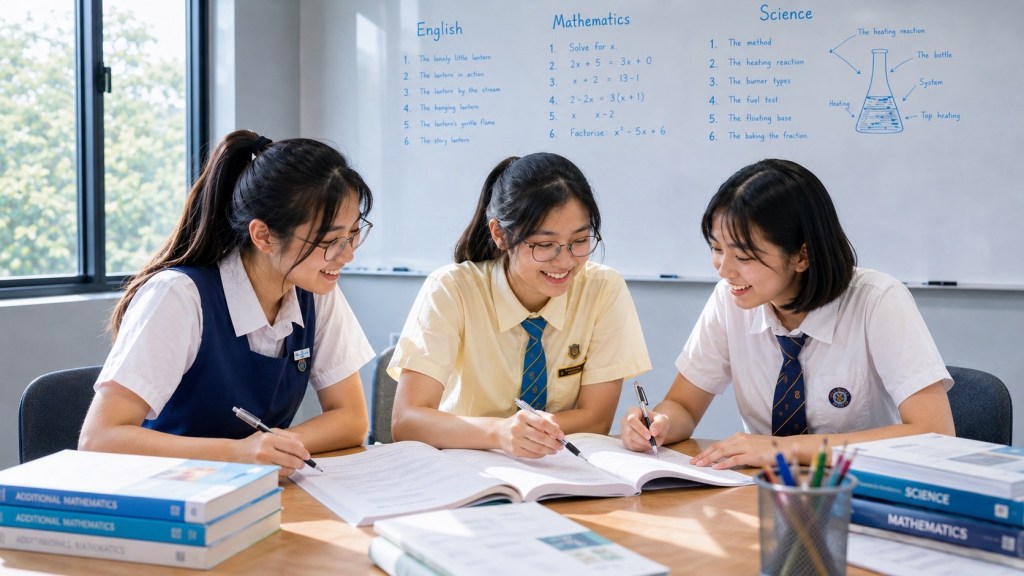
These records describe particular historical milestones and activities. Check official school channels for current arrangements. The featured classroom photograph illustrates eduKate’s learning theme and does not depict the named school.
More Sengkang school stories
Palm View learning and parent guide
North Vista Primary School History: 2008 Beginnings and Campus Milestones
Springdale Primary School History: 2013 Beginnings and First-Year Stories
North Spring Primary School History: The 2024 Silver Jubilee and Family Memories
