
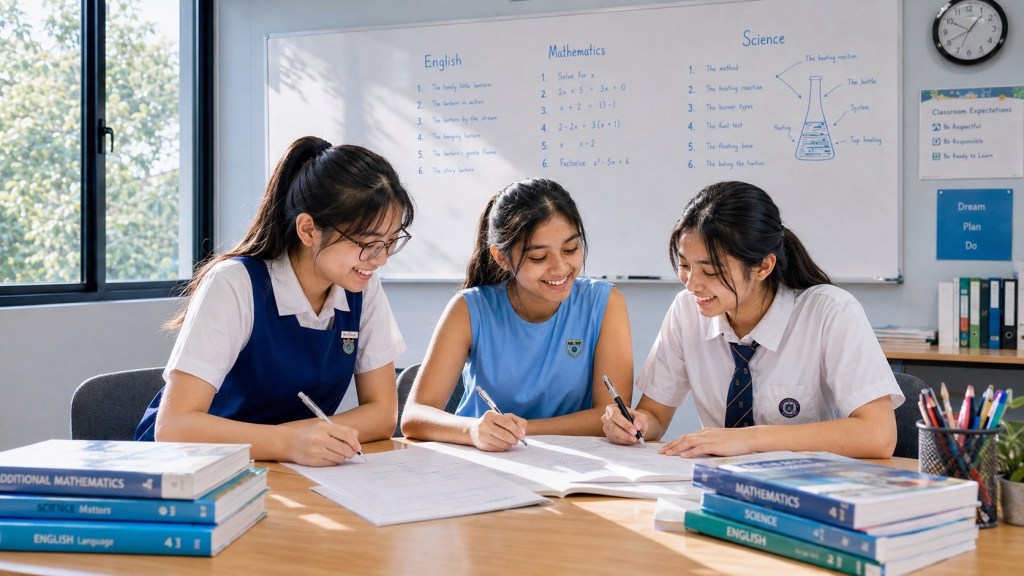
G2 Mathematics for Secondary Schools is the General 2 subject level for Mathematics under Singapore’s Full Subject-Based Banding system. For Secondary 1 learners, G2 Mathematics marks a clear move from primary-school calculation toward more abstract representation, algebraic reasoning, multi-step problem solving, geometry, measurement, data and mathematical communication.
The important change is not simply that the questions become longer. G2 students increasingly have to decide how to represent a problem, which relationship matters, what can be inferred from the information given, and whether an answer is mathematically reasonable.
This guide explains what Secondary 1 G2 Mathematics means, how it differs from G1 and G3 Mathematics, how it relates to Posting Groups, what the 2027 SEC K210 endpoint looks like, and how parents can distinguish genuine mathematical progress from short-term worksheet familiarity.
The Short Answer: What Is G2 Mathematics?
G2 means General 2. Under Full Subject-Based Banding, G1, G2 and G3 are levels for individual subjects. A learner may therefore take Mathematics at G2 while taking English, Science or another subject at a different level.
For 2027 SEC school candidates, SEAB lists G2 Mathematics as syllabus K210. The syllabus includes the broad domains of Number and Algebra, Geometry and Measurement, and Statistics and Probability, with mathematical problem solving running across the content.
See the current SEAB 2027 G2 syllabus listing for official examination-year details.
Why Secondary 1 G2 Mathematics Feels Like a Reset
Primary Mathematics gives learners a strong base in arithmetic, fractions, ratio, percentage, geometry and problem solving. Secondary 1 changes the language of the subject.
- letters represent unknown or variable quantities;
- negative numbers become routine;
- expressions must be manipulated symbolically;
- equations become a central problem-solving tool;
- graphs represent relationships;
- geometry requires more formal reasoning;
- data questions require interpretation as well as calculation;
- multi-step problems demand planning before execution.
A learner who relies on recognising familiar worksheet patterns may therefore struggle. G2 Mathematics rewards students who can identify structure beneath the surface wording.
Read: Secondary 1 Mathematics: Why the Primary 6 to Algebra Transition Feels Hard.
The Core G2 Mathematics Skill: See the Relationship Before the Procedure
Students often ask, “Which formula do I use?” That question is sometimes too early. The better first question is:
What relationship does the problem describe?
Once the relationship is visible, the formula or method usually becomes easier to select.
For example, a problem may be about:
- a fixed total divided in a ratio;
- a quantity changing by a percentage;
- two algebraic expressions representing the same value;
- a geometric property constraining an unknown angle;
- a graph showing how one quantity changes with another;
- data that must be compared rather than merely read.
Method selection follows relationship recognition.
Number and Algebra: The Secondary 1 Engine Room
For many learners, Number and Algebra determines whether the rest of secondary Mathematics feels manageable.
Numbers and Operations
G2 students need dependable control of integers, rational numbers, real numbers, factors, multiples, approximation, estimation and standard form. Calculator use helps with computation, but it does not replace number sense.
A student should be able to recognise when a calculator result is unreasonable. Estimation is therefore not an optional extra; it is a checking tool.
Algebraic Expressions
Algebra asks students to operate on structure rather than only visible numbers. Important early habits include understanding variables, combining like terms, substitution, expansion and recognising equivalent expressions.
The central question is not “Can the student copy the steps?” It is “Does the student understand what remains equivalent after each step?”
Equations
Equations should be understood as statements of equality. Operations performed on one side must preserve the relationship.
- identify the unknown;
- form the equation;
- use inverse operations;
- maintain balance;
- check by substitution;
- interpret the solution in context.
Read: Secondary 1 Algebra After PSLE: Variables, Negative Numbers, Equations and the Symbolic Reset.
Representation Errors Become Algebra Errors
A common Secondary 1 mistake is to treat algebra as manipulation only. But before the algebra comes representation.
The student must decide whether the situation is best represented by:
- an expression;
- an equation;
- a table;
- a graph;
- a number line;
- a labelled diagram;
- a ratio statement.
If the representation is wrong, flawless arithmetic can still produce a wrong answer.
Read: Secondary 1–2 Mathematics: Why Representation Errors Become Algebra Errors.
Geometry and Measurement: Read the Diagram as Information
Geometry questions often look visual, but they are really relationship questions. A diagram contains constraints.
- Which angles are equal?
- Which lines are parallel?
- Which lengths are known?
- Which property applies?
- What is the target quantity?
- What information is irrelevant?
We teach students to annotate before calculating. A well-labelled diagram reduces working-memory load and makes the logic easier to inspect.
Statistics and Probability: Do Not Confuse Data With Conclusion
Data questions require both calculation and interpretation. Students need to read tables, charts and graphs accurately, compare values, recognise patterns and avoid claims that the data does not justify.
This is where mathematical communication matters. A numerical answer may be correct but incomplete if the question asks what the value means.
A G2 Mathematics Problem-Solving Runtime
- Decode: rewrite the problem in simpler mathematical language.
- Target: identify exactly what must be found.
- Inventory: list the useful information.
- Represent: choose an equation, diagram, table, graph or model.
- Plan: decide the order of steps.
- Execute: perform the mathematics accurately.
- Verify: use estimation, substitution, inverse operations or another valid check.
- Communicate: present the result with correct units and sufficient working.
This runtime prevents the student from diving into arithmetic before the problem has been understood.
Why Working Matters
Working is not paperwork for the teacher. It is an external memory system for the learner.
Clear working helps the student:
- see whether a sign changed;
- track where a number came from;
- check one step without restarting everything;
- communicate mathematical reasoning;
- recover partial credit when the final answer is wrong;
- identify the first divergence during review.
A student who writes too little often makes mistakes invisible until the final line.
How G2 Mathematics Differs From G1 and G3
The broad mathematical domains overlap, but complexity and abstraction increase across subject levels.
- G1: emphasises strong fundamentals, practical application and dependable core problem-solving.
- G2: increases algebraic abstraction, multi-step reasoning, representation and independent problem selection.
- G3: pushes symbolic fluency, complexity, mathematical reasoning and transfer further.
The correct level is the level at which challenge produces learning rather than chronic confusion.
Read: Secondary G1, G2 and G3 Mathematics: Algebra, Problem Solving and the Secondary Reset.
G2 Mathematics Is Not the Same as Posting Group 2
Posting Group 2 is an admission grouping. G2 Mathematics is a Mathematics subject level.
A learner entering through PG2 may take Mathematics at G2, may be eligible for Mathematics at a more demanding level, or may require a different level later according to progress and school guidance.
- PG2: admission route.
- G2 Mathematics: Mathematics subject level.
- Actual learner profile: a mix of levels across subjects is possible.
This distinction is central to Full Subject-Based Banding.
Three Secondary 1 G2 Mathematics Pathways
Pathway 1 — Repair the Prerequisite
The student appears weak in algebra, but the actual cause may be fractions, negative numbers, ratio, percentage or arithmetic fluency. New secondary content exposes an older weakness.
We repair the prerequisite while keeping the learner connected to current school topics.
Pathway 2 — Stabilise the Method
The student understands concepts but performance fluctuates. Sign errors, skipped conditions, incomplete working and poor checking create unnecessary losses.
The job is to make correct processes repeatable under time pressure.
Pathway 3 — Extend Through Deeper Reasoning
A secure G2 learner should be challenged through unfamiliar application, alternative methods, justification, reverse problems and stronger algebraic connections. Extension is not merely “do G3 questions”. It is deeper mathematical thinking.
Our First-Principles Method for G2 Mathematics
1. Diagnose the exact failure
We separate conceptual errors, representation errors, arithmetic errors, sign errors, method-selection errors and checking failures.
2. Fence the target skill
Our Fencing Method reduces unrelated difficulty so that the learner can understand the target relationship before complexity is reintroduced.
3. Make representation visible
Students draw, label, tabulate or write equations so that the mathematical structure can be inspected rather than guessed.
4. Explain every transformation
Why can these terms be combined? Why does this operation preserve equality? Why does this angle relationship apply? Explanation converts procedure into understanding.
5. Retrieve after delay
Students revisit important skills after enough time has passed for effortless recognition to fade. This tests whether the method is actually available from memory.
6. Interleave topics
Mixed problem sets require students to identify the problem type rather than applying the method named in the heading.
7. Transfer to unfamiliar contexts
The learner applies the same mathematical relationship in a different surface story, diagram or data context.
8. Verify independently
We teach students to check using a second route where possible: substitution, inverse operation, estimation, alternate method or logical bounds.
What a 90-Minute G2 Mathematics Lesson Can Look Like
- Retrieval: prerequisite skills from earlier topics.
- Concept: one new relationship explained.
- Worked example: representation and reasoning are explicit.
- Guided practice: prompts reduce as competence increases.
- Independent set: the learner chooses the method.
- Error analysis: mistakes are classified, not merely corrected.
- Transfer: the idea appears in a changed context.
- Continuation: targeted work tied to the next learning job.
A three-student class allows the tutor to see how each learner thinks. One student may need representation support, another algebraic precision, another a stronger checking routine. The shared topic stays coherent while the teaching pressure changes.
Common G2 Mathematics Problems
“My child can follow examples but cannot start homework.”
The student may recognise a method after seeing it but cannot independently identify when to use it. Mixed practice and problem classification are needed.
“My child understands algebra but makes sign errors.”
Slow down transformations and make each sign change explicit. Many so-called careless errors are process-compression errors.
“My child gets stuck on word problems.”
The weakness may be representation rather than arithmetic. Teach the learner to identify the target, known information and mathematical relationship before calculating.
“My child depends on the calculator.”
A calculator is useful, but students still need estimation and number sense to detect impossible outputs and input errors.
What Progress Looks Like
- starts by identifying the target;
- chooses a representation deliberately;
- uses algebraic notation more accurately;
- sets out working clearly;
- recognises familiar structures inside unfamiliar wording;
- checks answers using more than one method;
- explains why a method works;
- recovers from errors efficiently;
- uses previous topics inside current problems;
- needs less tutor prompting.
These behaviours are stronger indicators of mathematical independence than a temporary run of familiar worksheets.
G2 Mathematics and the 2027 SEC
From 2027, students sit the Singapore-Cambridge Secondary Education Certificate at their respective subject levels. SEAB lists G2 Mathematics as K210.
The official syllabus includes Number and Algebra, Geometry and Measurement, and Statistics and Probability. Lower-secondary learning should therefore develop the concepts and problem-solving habits that later allow the learner to handle the full syllabus with control.
Secondary 1 should not be reduced to premature examination drilling. Build the engine first: representation, algebraic meaning, reasoning, communication, retrieval and checking.
Frequently Asked Questions
What does G2 Mathematics mean?
It means Mathematics is taken at General 2, one of the subject levels under Full Subject-Based Banding.
Is G2 Mathematics the same as Posting Group 2?
No. PG2 is an admission grouping. G2 Mathematics is an individual subject level.
What is the 2027 SEC code for G2 Mathematics?
SEAB lists G2 Mathematics as K210 for 2027 school candidates.
Can a PG2 student take G3 Mathematics?
Students may take selected subjects at more demanding levels where the relevant eligibility criteria, readiness and school arrangements support it. Parents should check the learner’s actual subject offer.
Should a strong G2 learner start G3 Mathematics immediately?
Not automatically. First make sure current concepts are secure and transferable. Deeper reasoning at the current level may be more valuable than superficial exposure to harder content.
How do I know whether Mathematics tuition is helping?
Look for better method selection, clearer working, fewer repeated errors, stronger checking, improved explanation and greater independence on unfamiliar questions.
Helpful Reading
- What is G1 for Secondary Schools | Sec 1 Mathematics
- G1, G2 and G3 Mathematics Explained for Secondary School Parents
- Secondary G1, G2 and G3 Mathematics: Algebra, Problem Solving and the Secondary Reset
- Secondary 1 Algebra After PSLE
- Why Representation Errors Become Algebra Errors
- SEAB 2027 G2 Syllabuses for School Candidates
- MOE Full Subject-Based Banding
Secondary 1 G2 Mathematics: Build a Method That Survives New Questions
The strongest G2 Mathematics learner is not the student who has seen every possible question. It is the student who can recognise mathematical structure when the surface changes.
At eduKate Sengkang, we diagnose the first failure, make representations visible, explain transformations, retrieve after delay, interleave problem types and require verification. The goal is a mathematical system that remains usable when the question is unfamiliar.
Contact eduKate Sengkang if you want help reading your child’s Secondary 1 G2 Mathematics work and identifying the next skill to strengthen.
