
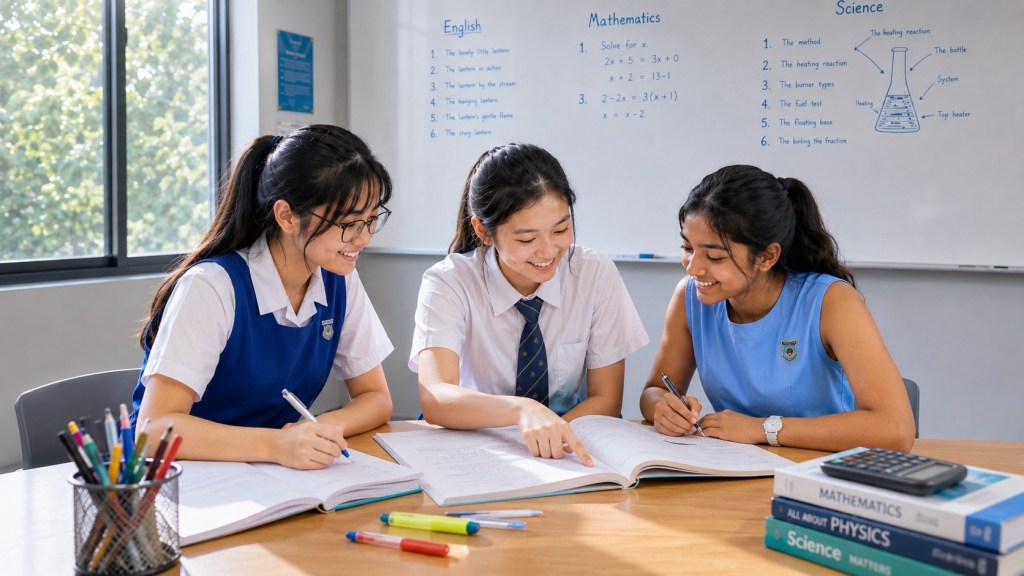
G1 Mathematics for Secondary Schools is the General 1 subject level for Mathematics under Singapore’s Full Subject-Based Banding system. For a Secondary 1 learner, G1 Mathematics is designed to build fundamental mathematical knowledge, practical problem-solving, reasoning, communication and confidence through meaningful applications.
The shift from Primary 6 to Secondary 1 still matters. The learner meets more algebra, more symbolic notation, negative numbers, ratio and proportion in new forms, geometry, measurement, data and practical mathematical reasoning. The challenge is not simply that the numbers become harder. The student is expected to become more independent in deciding what operation, representation or method a problem requires.
This guide explains what Secondary 1 G1 Mathematics means, how it differs from G2 and G3 Mathematics, how it relates to Posting Groups, what the 2027 SEC endpoint looks like, and how parents can recognise real mathematical progress beyond one test score.
The Short Answer: What Is G1 Mathematics?
G1 means General 1. Under Full Subject-Based Banding, G1, G2 and G3 describe the level of an individual subject. A learner can therefore take Mathematics at G1 while taking another subject at G2 or G3.
For Mathematics, G1 is not simply “easy Maths”. It has a distinct purpose: to establish strong fundamentals, practical application and a usable mathematical system that supports daily life, further learning and future vocational or technical pathways.
SEAB lists G1 Mathematics as K110 for the 2027 Singapore-Cambridge Secondary Education Certificate. The official syllabus identifies three broad content strands: Number and Algebra, Geometry and Measurement, and Statistics and Probability, with application of mathematics as an important emphasis.
See the current SEAB 2027 G1 syllabus listing for examination-year details.
What Secondary 1 Changes in Mathematics
Primary Mathematics often allows students to reason through concrete quantities and familiar models. Secondary Mathematics keeps those foundations but increases abstraction.
- Letters begin to stand for quantities.
- Negative numbers become part of ordinary calculation.
- Operations are combined more systematically.
- Equations require inverse operations and balance.
- Geometry becomes more symbolic.
- Graphs and tables carry more information.
- Problem solving depends on selecting a representation before calculating.
Many Secondary 1 difficulties are therefore representation problems before they are calculation problems. A learner may know how to multiply, divide and subtract but still struggle because the situation has not been translated into the correct mathematical form.
Read: Secondary 1 Mathematics: Why the Primary 6 to Algebra Transition Feels Hard.
G1 Mathematics Is a Subject Level, Not a Student Identity
Full Subject-Based Banding is built around the idea that strengths differ by subject. A learner may need G1 Mathematics while taking English or another subject at a different level.
The useful question is not, “Is my child a G1 student?” It is:
What mathematical ideas can my child understand, apply and explain independently now?
That question produces a teaching plan. A label by itself does not.
The Three Main G1 Mathematics Content Strands
1. Number and Algebra
Number and Algebra is where many learners feel the Secondary 1 reset most strongly. Important foundations include number operations, factors and multiples, estimation, approximation, standard form, ratio, percentages, simple algebraic expressions and equations.
The central shift is from computing with known quantities to reasoning with quantities that may be unknown or represented symbolically.
- understand positive and negative numbers;
- use the number line;
- apply the four operations accurately;
- estimate before calculating;
- round appropriately;
- interpret algebraic symbols;
- simplify simple expressions;
- solve basic equations;
- translate a word problem into mathematical operations.
Read: Secondary 1 Algebra After PSLE: Variables, Negative Numbers, Equations and the Symbolic Reset.
2. Geometry and Measurement
Geometry becomes easier when students see shapes as relationships rather than pictures. Angles, lengths, areas and volumes are connected by rules that must be selected and applied in context.
- identify geometric properties;
- use angle relationships;
- calculate perimeter and area;
- work with common units;
- interpret scale and measurement;
- draw or label diagrams carefully;
- decide which measurements are actually needed.
A common error is to choose a formula because the diagram looks familiar. Stronger learners ask what quantity is required, what information is known and what relationship connects them.
3. Statistics and Probability
Statistics and Probability develops the ability to read, organise and reason from data. The learner must distinguish what the data shows from what they merely assume.
- read tables and graphs;
- compare quantities;
- identify trends;
- calculate and interpret simple summary measures;
- understand basic chance;
- avoid conclusions not supported by the data.
This is mathematical literacy: using numbers and representations to make informed decisions.
The Real Secondary 1 Mathematics Skill: Representation
A learner can fail a question before doing any arithmetic if the problem is represented incorrectly.
Representations include:
- a number line;
- a bar model;
- a labelled diagram;
- a table;
- an algebraic expression;
- an equation;
- a graph;
- a ratio statement.
The correct representation compresses the problem. The wrong representation creates extra work.
Read: Secondary 1–2 Mathematics: Why Representation Errors Become Algebra Errors.
A Simple G1 Mathematics Problem-Solving Runtime
We teach students to make the mathematical job visible before rushing into calculation.
- Read: what is happening?
- Target: what exactly must be found?
- Knowns: what information is given?
- Representation: what diagram, equation, table or model makes the relationship clear?
- Method: which operation or rule connects the knowns to the target?
- Execute: calculate carefully.
- Check: is the answer reasonable, correctly labelled and consistent with the question?
This routine is deliberately simple. A reliable simple process is more valuable than a sophisticated method the learner cannot reproduce.
Why Negative Numbers Cause Trouble
Negative numbers expose whether a learner understands meaning or memorises signs. Rules such as “minus times minus gives plus” may produce correct answers temporarily, but they become fragile if the student cannot reason about direction, change and relative position.
We therefore connect negative numbers to:
- temperature;
- elevation;
- money owed;
- movement on the number line;
- changes above and below a reference point.
Once meaning is stable, symbolic rules become easier to remember because they fit a model.
Why Algebra Feels Like a New Language
Primary students mostly calculate with visible numbers. Algebra asks them to accept that a letter can stand for a number, that the same letter represents the same quantity within a context, and that an expression can describe a relationship without immediately producing one numerical answer.
The early algebra sequence should therefore be:
- understand what a variable represents;
- translate phrases into expressions;
- substitute values;
- simplify like terms;
- understand equality as balance;
- solve equations using inverse operations;
- check by substitution.
Skipping meaning and teaching only symbol manipulation often creates students who can copy a method but cannot recognise when it applies.
How G1 Mathematics Differs From G2 and G3
G1, G2 and G3 Mathematics share many broad mathematical domains, but the depth, complexity, abstraction and independence expected increase across the levels.
- G1: builds fundamental concepts, practical application, confidence and dependable problem-solving routines.
- G2: increases abstraction, algebraic manipulation, multi-step reasoning and problem complexity.
- G3: increases abstraction and mathematical demand further, requiring stronger symbolic fluency, reasoning and transfer.
The right level is not the one with the most prestige. It is the one where the learner can be challenged while still learning successfully.
Read: G1, G2 and G3 Mathematics Explained for Secondary School Parents.
G1 Mathematics Is Not the Same as Posting Group 1
Posting Group and subject level must be separated.
- PG1: Secondary 1 admission route.
- G1 Mathematics: Mathematics subject level.
- Actual programme: may contain different levels across subjects.
A learner can enter through PG1 and take Mathematics at a more demanding level where the relevant criteria and school arrangements support it. Likewise, a learner from another Posting Group may take Mathematics at G1 if that is the appropriate level for successful learning.
Full Subject-Based Banding works properly only when parents read the learner’s actual subject profile rather than turning the Posting Group into a fixed identity.
Three Secondary 1 G1 Mathematics Pathways
Pathway 1 — Repair Primary Foundations
The learner may struggle with multiplication facts, fractions, ratio, percentages or interpreting word problems. These gaps become expensive in secondary Mathematics because new algebra is built on old number sense.
Repair means identifying the exact missing prerequisite and rebuilding it while continuing with current school work.
Pathway 2 — Stabilise Secondary 1 Routines
The learner understands most concepts but loses marks through skipped steps, sign errors, weak diagrams, poor checking or failure to identify what a problem is asking.
The job is consistency: make the correct process repeatable.
Pathway 3 — Extend the Learner Who Is Ready
A secure G1 learner should not be trapped in endless repetition. Extension can deepen reasoning, problem representation, explanation and unfamiliar application. Where sustained school evidence supports it, parents can discuss whether a more demanding Mathematics level is appropriate.
Our First-Principles Method for G1 Mathematics
1. Diagnose the first weak link
“Weak at Maths” is too broad. A student may actually have one of several problems: number facts, fraction sense, negative numbers, algebraic translation, equation balance, diagram interpretation or multi-step planning.
2. Fence the target skill
Using our Fencing Method, we reduce unrelated complexity so the learner can see one mathematical relationship clearly before applying it inside harder problems.
3. Make the representation explicit
Students draw the number line, label the diagram, write the equation or build the table. We do not let hidden mental representations remain invisible when they are causing errors.
4. Explain why the method works
A method remembered without meaning disappears quickly. The learner explains what each step does and why it preserves the relationship in the problem.
5. Retrieve after delay
Old skills return after time has passed. Retrieval reveals whether the student can access the method independently.
6. Interleave problem types
Mixed practice forces the learner to decide what kind of problem is present. That recognition step is part of mathematical expertise.
7. Build checking into the solution
Checking can include estimation, substitution, inverse operations, unit checks, boundary checks and asking whether the answer makes sense in context.
What a 90-Minute G1 Mathematics Lesson Can Look Like
- Retrieval: short review of earlier number or algebra skills.
- Concept: one mathematical relationship explained clearly.
- Worked example: the representation and reasoning are made visible.
- Guided practice: students solve with prompts.
- Independent practice: support is reduced.
- Error analysis: mistakes are classified by cause.
- Transfer: the same idea appears in a different context.
- Continuation: focused practice rather than indiscriminate worksheet volume.
Common G1 Mathematics Problems
“My child knows the formula but cannot answer the problem.”
The likely weakness is representation or selection. The learner does not know which relationship the problem requires.
“My child understands in class but forgets at home.”
The method may still depend on recognition and prompting. Delayed retrieval and mixed practice are needed.
“My child keeps making careless mistakes.”
“Careless” should be broken down. Is the error a sign error, copying error, unit error, arithmetic fact error, misread symbol or skipped condition? Different causes require different repairs.
“Algebra makes no sense.”
Return to meaning: what does the variable represent, what does equality mean and what operation is being reversed? Symbols become manageable when they are attached to relationships.
What Progress Looks Like
- sets out working more clearly;
- uses a diagram or equation without being prompted;
- checks signs and units;
- explains why an operation is needed;
- solves familiar questions with less support;
- recognises when a method from an earlier topic applies;
- estimates before trusting a calculator answer;
- recovers from an error instead of abandoning the question;
- needs fewer repeated explanations.
These behaviours show that the mathematical system is becoming more independent.
G1 Mathematics and the 2027 SEC
From 2027, students sit the Singapore-Cambridge Secondary Education Certificate at their respective subject levels. SEAB lists G1 Mathematics as K110.
The official G1 Mathematics syllabus emphasises fundamental mathematical knowledge and skills, problem-solving, reasoning, communication, application, metacognition and real-life relevance. That makes the lower-secondary goal clear: build a usable mathematical system, not merely a collection of procedures.
Always use the syllabus for the student’s actual examination year because details can change.
Frequently Asked Questions
What does G1 Mathematics mean?
It means Mathematics is being taken at General 1, one of the subject levels under Full Subject-Based Banding.
Is G1 Mathematics the same as Posting Group 1?
No. Posting Group 1 is an admission grouping. G1 Mathematics is a subject level.
What is the 2027 SEC code for G1 Mathematics?
SEAB lists G1 Mathematics as K110 for 2027 school candidates.
Can a learner move from G1 Mathematics to a more demanding level?
Subject levels can be reviewed at appropriate points based on readiness, progress and school guidance. The decision should be driven by sustained evidence, not by status alone.
Should a G1 learner use G2 worksheets for practice?
Only when the current G1 foundations are secure and the harder work is chosen deliberately. Randomly increasing difficulty can hide rather than solve the learner’s real problem.
Helpful Reading
- G1, G2 and G3 Mathematics Explained for Secondary School Parents
- Secondary G1, G2 and G3 Mathematics: Algebra, Problem Solving and the Secondary Reset
- Secondary 1 Mathematics: Why the Primary 6 to Algebra Transition Feels Hard
- Secondary 1 Algebra After PSLE
- SEAB 2027 G1 Syllabuses for School Candidates
- MOE Full Subject-Based Banding
Secondary 1 G1 Mathematics: Make the Mathematics Visible
The strongest G1 Mathematics learner is not the one who memorises the most procedures. It is the learner who can see the relationship inside a problem, choose a useful representation, apply a method accurately and check whether the result makes sense.
At eduKate Sengkang, we diagnose the first weak link, rebuild missing prerequisites, make representations visible, retrieve learning after delay and transfer each skill into new problems. The subject level tells us where the work begins. The learner’s progress tells us where it can go next.
Contact eduKate Sengkang if you want help reading your child’s Secondary 1 Mathematics work and identifying the next skill to strengthen.
