
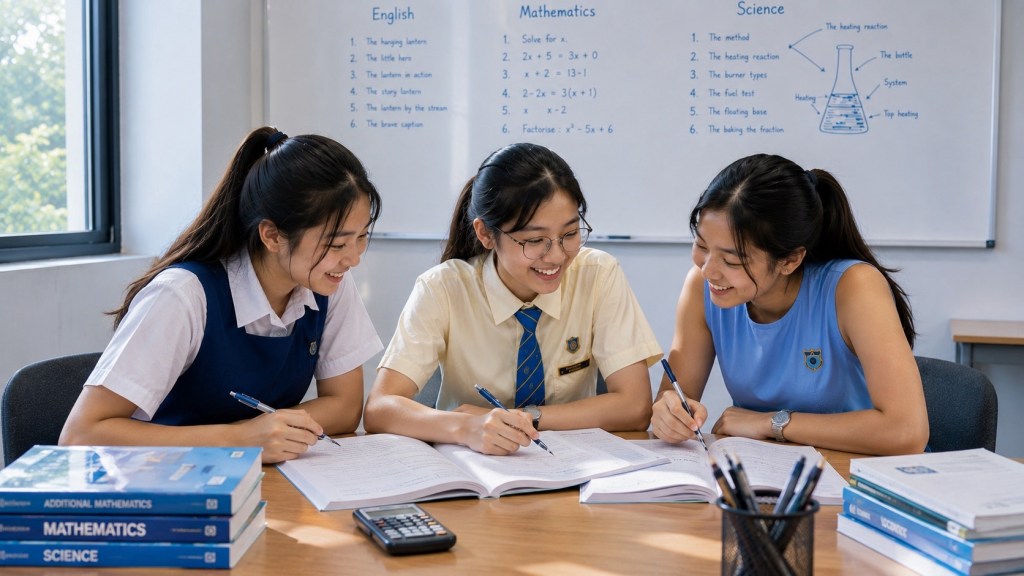
Secondary 1–2 Mathematics: Why Representation Errors Become Algebra Errors is the cross-year owner for one of the most important mathematical transitions after PSLE: the movement from visible Primary-school representations into increasingly compressed algebraic, graphical and symbolic forms.
The existing Secondary 1 Mathematics owner and Secondary 2 Mathematics owner remain the year-level routes. Specialist Learning Guide pages continue to own individual topics such as equations, functions, factorisation and word-problem modelling.
This page explains the connection above them: why a bar, table, graph, equation, variable or formula is not merely a method but a representation of mathematical structure, and how weak translation among representations becomes visible as algebra error.
1. Algebra errors often begin before algebra
A student writes an incorrect equation in Secondary 1 or manipulates an expression wrongly in Secondary 2, and the visible mistake looks symbolic. The deeper cause can be representational: the learner never built a stable bridge from quantity, relationship and diagram into mathematical notation.
When symbols arrive, weak representation becomes harder to hide because the student can no longer rely on concrete context or a familiar Primary-school template.
The algebra error is often the downstream symptom of an earlier translation error.
2. Secondary Mathematics compresses relationships into symbols
Primary Mathematics often allows relationships to remain visible through bars, objects, tables or concrete stories. Secondary Mathematics increasingly compresses those relationships into letters, expressions, equations, functions and graphs.
Compression is powerful because it makes complex reasoning shorter.
It is dangerous when the learner manipulates a compact symbol without retaining the relationship that the symbol represents.
3. Representation means more than drawing a bar model
A mathematical representation can be a number line, table, graph, diagram, equation, expression, function rule, coordinate pair, inequality or verbal statement.
The question is not whether the student draws.
The question is whether the chosen form preserves the mathematical relationships needed for reasoning.
4. Translation is the hidden skill between representations
A learner may understand a word problem verbally yet fail to write an equation, or manipulate an equation while misreading its graph.
Each movement from one representation to another is a translation.
Secondary 1–2 becomes much easier when these translations are explicit and reversible.
5. Equality is the first major algebraic representation
The equals sign should mean that two expressions have the same value, not that an answer must appear on the right.
A learner who carried the now-calculate model from Primary school may struggle with equations such as 3x + 5 = 20.
Algebra requires equality to function as a relationship.
6. Variables represent quantities, not mystery letters
A variable can stand for an unknown quantity, a changing quantity or a general number depending on context.
Students who treat x as a label rather than a quantity often combine unlike terms or misuse substitution.
The first repair is semantic: what does the symbol represent here?
7. Coefficients are multiplicative relationships
In 3x, the 3 does not sit beside x decoratively. It indicates three times the quantity represented by x.
This grows naturally from repeated groups and multiplication.
Weak multiplicative meaning can become an algebra notation error.
8. Terms are structural units
An expression such as 3x + 5 contains two terms linked by addition.
Students who read it as a string of characters rather than a structured object are more likely to combine unlike terms or distribute incorrectly.
Algebra improves when the expression is parsed into meaningful units.
9. Like terms depend on representation
3x and 5x are like terms because they represent multiples of the same variable quantity. 3x and 3y are not like terms because the represented quantities differ.
The rule becomes easier to remember when the meaning is visible.
Collecting terms is then a quantity operation, not a formatting trick.
10. Negative numbers extend the number line
A strong number-line model helps students understand direction, order and distance when negative values appear more often.
Without that representation, sign rules can become a disconnected list.
Directed-number errors often begin as weak spatial number representation.
11. A negative sign can represent different jobs
The same symbol may indicate a negative number, subtraction or the additive inverse of an expression.
Students need to interpret the role from structure.
Symbol reading is part of algebraic representation.
12. Brackets represent grouping
Brackets tell the learner which mathematical object is being treated as a unit.
Expanding 3(x + 2) requires understanding that the multiplier applies to the entire grouped expression.
Distribution errors often begin when grouping is not mentally represented.
13. Fraction bars are grouping symbols too
In algebraic fractions, the numerator and denominator may each contain entire expressions.
Students who read only local terms can cancel or operate incorrectly.
The fraction bar represents division and grouping simultaneously.
14. Algebraic substitution is a representation-preservation task
Replacing x with a number should preserve the structure of the original expression.
Brackets may be needed when the substituted value is negative or itself an expression.
Substitution errors often reveal that the learner is replacing symbols visually rather than structurally.
15. Equations represent constraints
An equation states that two expressions must be equal under certain values.
Solving means finding values that make the relationship true.
This is deeper than moving a number across and changing the sign.
16. Balance models can repair equation meaning
A balance representation makes clear that the same valid operation performed on both sides preserves equality. The student can see why subtracting five from both sides of 3x + 5 = 20 keeps the equation true rather than learning a direction-changing rule by imitation.
The visual model should eventually fade as the invariant becomes internalised.
Its purpose is to give algebraic transformation a reason.
17. Inverse operations are relationship tools
Addition and subtraction, multiplication and division can undo one another in appropriate contexts. Solving equations uses these inverse relationships to isolate the unknown while preserving equality.
A memorised transposition rule is more fragile because it hides the invariant.
When memory fails, the relationship gives the learner a way to reconstruct the method.
18. Formulae represent general relationships
A formula compresses a relationship among quantities so it can be reused across many cases. Students should know what each symbol represents, which quantities can vary and which units belong to them.
Formula substitution becomes safer when the relationship is understood.
The formula is a reusable representation, not a magic string.
19. Changing the subject is representation reorganisation
Rearranging a formula does not change the relationship it represents. The learner is rewriting the same constraint so a different quantity is isolated.
This is another example of preserving meaning while changing form.
Students who understand that invariant are less dependent on remembered transposition patterns.
20. Tables represent coordinated values
A table can show how one variable changes with another. Rows and columns preserve ordered pairs and repeated relationships, but only if the learner keeps headings and values aligned.
A one-row shift can create a false relationship even when every calculation is correct.
Table reading is part of algebraic accuracy.
21. Graphs represent relationships spatially
A point can represent a pair of values; a line can represent many pairs satisfying the same relationship. Graph reading therefore depends on coordinate meaning, scale and variable roles.
The graph is not a picture beside the algebra.
It is another representation of the same mathematical relationship.
22. Axes need quantity identities
Students should know what each axis represents, what the scale means and which variable belongs where. A correct plot on reversed axes may still answer a different question.
Axis labels are mathematical information, not decoration.
Representation begins with identifying the quantities.
23. Gradient represents rate of change
A line’s slope can encode how much one quantity changes for each unit of another. This connects graph geometry to ratio and rate reasoning.
Gradient becomes less mysterious when the learner sees it as a relationship before memorising a formula.
The graph and algebra should tell the same story.
24. Intercepts represent specific conditions
Where a graph crosses an axis corresponds to a value under a defined condition, such as one variable being zero. Students should interpret the quantity rather than merely read a coordinate.
This makes graph features meaningful.
Translation back to context is part of understanding.
25. Functions coordinate several representations
A function can be described by words, a rule, a table, a graph or input-output pairs. Secondary 2 increasingly asks learners to move among these forms.
Function errors often reveal weak translation rather than weak arithmetic.
The relationship should survive every representation change.
26. Ratio becomes algebra when the unknown is symbolic
A Primary ratio model can evolve into an equation when one quantity is unknown or several conditions interact. The underlying proportional relationship remains the same.
Students who understand the ratio structure can treat algebra as compression rather than replacement.
The bar and equation are different views of one relationship.
27. Percentage becomes algebra when the base is unknown
If a final amount or percentage is known but the original quantity is unknown, symbolic representation can express the relationship efficiently. The old Primary question what is 100% still matters.
Algebra does not remove the reference whole.
It gives the learner a compact way to preserve it.
28. Geometry becomes algebra when dimensions are unknown
A perimeter or area relationship may contain x instead of a known length. The geometry gives the constraint; algebra represents and solves the unknown.
Representation must preserve both the spatial and symbolic structure.
A correct equation begins with a correct diagram model.
29. Data reasoning becomes algebra when patterns are generalised
Patterns observed in tables or graphs can be described by expressions or rules. The learner moves from individual data points to a general relationship that can predict new values.
This is one of the clearest ways representation becomes algebraic thinking.
Generalisation is compressed pattern recognition.
30. Word problems fail when quantities are not named
A student may write x without defining what x represents and later mix quantities or units. A one-line definition can stabilise the whole solution.
Good algebra begins with quantity identity.
The symbol should always have a mathematical job.
31. Word problems fail when relationships are translated locally
The learner converts one phrase at a time into symbols without checking how the whole story fits together. This can create equations that are syntactically plausible but mathematically wrong.
Representation should begin with the full relationship model.
Local translation must answer to global structure.
32. Word problems fail when the unknown is chosen badly
Any variable can theoretically represent many quantities, but some choices make an equation much more complicated than necessary. Students should learn to choose an unknown that simplifies the dependency chain.
Variable selection is a representation decision.
A good choice lowers later symbolic cost.
33. Word problems fail when units disappear
A symbol may represent dollars, kilometres, minutes, degrees or number of objects. If units vanish from working memory, invalid additions, ratios or equations can follow.
Units are part of algebraic meaning.
They help detect impossible transformations.
34. Word problems fail when a diagram and equation disagree
A learner may draw a correct comparison model and then write an equation that uses the wrong total, or write a sound equation over a false diagram. The two representations should verify one another.
When they conflict, stop and repair the model before calculating.
Cross-representation agreement is an important checking tool.
35. Algebra is a representation system before it is a manipulation system
Manipulation matters, but every transformation acts on a representation of a relationship. Students who retain that relationship can check and reconstruct forgotten procedures.
Students who only imitate symbol moves become fragile when the surface changes.
Secondary 1–2 should therefore teach structure and notation together.
36. Error profile: the variable has no stable meaning
The learner writes x because algebra seems to require a letter, but x is never defined as a quantity. Later equations mix costs, counts or lengths because the symbol has no semantic anchor.
Repair by defining the unknown in words and units before forming the equation.
Variable identity should survive every later step.
37. Error profile: like terms are combined by surface pattern
A student combines 3x + 5 into 8x because the visible numbers are added without respecting term structure. The expression is being read as characters rather than quantities.
Use counters, area models or verbal quantity descriptions where helpful.
The repair is structural parsing.
38. Error profile: unlike variables are treated as interchangeable
The learner combines 2x + 3y because both terms contain letters, or treats x and y as labels with no independent quantity roles.
Ask what each variable represents.
Distinct quantities require distinct symbolic identities unless a relationship makes them equal.
39. Error profile: the minus sign is read inconsistently
The student understands subtraction in arithmetic but becomes confused when a negative coefficient, subtraction operation and bracketed negative expression appear together.
Name the role of each sign before manipulating.
Sign errors often begin as representation-role errors.
40. Error profile: brackets are ignored
A learner expands or substitutes as though brackets were decorative punctuation. The grouped expression is not being treated as one mathematical object.
Use colour, boxes or phrase-level reading temporarily.
Then remove the scaffold once grouping becomes internal.
41. Error profile: distribution is memorised only as arrow drawing
The student knows to draw arrows from a multiplier to terms inside brackets but cannot explain why every term is multiplied.
Area or repeated-group models can restore meaning.
The visual arrows should represent distributive structure, not replace it.
42. Error profile: cancellation is visual rather than multiplicative
A learner cancels terms across addition because matching symbols appear above and below a fraction bar. The student sees shape similarity instead of factor structure.
Rewrite products explicitly and identify factors.
Cancellation is division by a common factor, not crossing out matching ink.
43. Error profile: equation solving becomes sign-changing choreography
The learner moves terms across the equals sign and changes signs without checking whether equality is preserved. This often works on familiar examples and fails on nested or fractional equations.
Return to inverse operations on both sides.
The balance invariant makes the procedure reconstructible.
44. Error profile: substitution destroys negative-value grouping
A negative value is inserted into x² or 3x without brackets, causing sign errors. The student substitutes the numeral visually rather than replacing the variable with a complete quantity.
Use brackets around substituted negative values.
Representation fidelity should precede simplification.
45. Error profile: formula letters are mistaken for fixed abbreviations
A student sees A, r, h or v as labels rather than variable quantities and cannot rearrange or substitute flexibly.
Ask what each symbol measures and what unit it carries.
Formula fluency begins with quantity mapping.
46. Error profile: a table row loses pairing
Input and output values are shifted or sorted independently, so the relationship becomes false even though every individual number is correct.
Treat each row as an ordered pair.
Table structure preserves coordination.
47. Error profile: a graph is plotted from numbers without variable meaning
The learner plots points accurately but cannot say what movement along each axis represents. This produces fragile graph interpretation and formula matching.
Name the variables and units before plotting.
Coordinates are relationships between quantities.
48. Error profile: scale is inferred from appearance
The student assumes each grid interval is one unit or uses the same scale on both axes without reading labels.
Decode two labelled values and infer one interval.
Graph representation must be read before algebra is inferred from it.
49. Error profile: gradient is treated as rise over run with no quantity meaning
The learner can calculate a slope but cannot interpret what one unit of horizontal change does to the vertical quantity.
Return to rate language.
Gradient becomes meaningful when the ratio of changes is attached to variables and units.
50. Error profile: intercepts are read as arbitrary graph points
A student records an intercept but cannot interpret the condition under which one variable is zero.
Translate the coordinate into a sentence.
Graph features should return to the represented relationship.
51. Error profile: function input and output are reversed
The learner applies a rule backwards or places the wrong quantity on the input side because the mapping relationship is unclear.
Use labelled input-output tables and verbal rules.
Function notation should inherit direction and dependency.
52. Error profile: domain restrictions are invisible
The student manipulates an expression or function without noticing that some values are impossible because of denominators, roots or context.
Representation includes admissible values.
Algebraic freedom is constrained by the mathematical object.
53. Error profile: word-problem variables switch meaning mid-solution
x begins as the number of tickets and later is treated as total cost. The algebra may look neat while the representation has drifted.
Define the variable once and preserve its identity.
Changing meaning requires a new symbol or explicit redefinition.
54. Error profile: a comparison becomes an additive equation when it is multiplicative
Phrases such as twice as many or three times a length are translated as fixed differences. The learner has chosen the wrong relationship before algebra begins.
Use a ratio bar or verbal comparison first.
Equation form should follow relationship type.
55. Error profile: an additive comparison becomes multiplicative
The student sees more than and automatically uses multiplication because the numbers appear in a ratio-like context.
Ask whether the difference is fixed or scaled.
Translation errors often involve confusing additive and multiplicative structure.
56. Error profile: units vanish inside equations
Metres are added to seconds or dollars to number of items because the algebraic symbols no longer carry units mentally.
Keep units visible on definitions and intermediate quantities.
Dimensional consistency is a powerful representation check.
57. Error profile: a diagram is treated as drawn to scale
The learner infers equal lengths or special angles from appearance instead of given properties. The drawing has become evidence it was never intended to provide.
Separate visual aid from stated mathematical constraints.
Geometry requires disciplined representation.
58. Error profile: geometry labels are detached from the figure
An angle or length symbol is manipulated correctly on paper but attached to the wrong part of the diagram.
Trace the notation back to the exact segment or angle.
Spatial and symbolic representations must stay aligned.
59. Error profile: formula substitution is correct but the diagram model is wrong
A student inserts values accurately into an area or volume formula after identifying the wrong base, height or radius.
The procedure is not the first failure.
Diagnose the spatial representation before drilling formulas.
60. Error profile: algebraic simplification changes the represented value
Terms are dropped, signs changed or factors cancelled in a way that produces a non-equivalent expression.
Use substitution with a simple test value as a check where appropriate.
Equivalent forms should preserve output for admissible values.
61. Error profile: factorisation is treated as reverse decoration
The learner searches for brackets because the chapter is factorisation but does not recognise common factors or product structure.
Ask what multiplication would rebuild the expression.
Factorisation is a representation change from sum form to product form.
62. Error profile: expansion and factorisation are not understood as inverse representations
Students may perform both procedures separately but fail to use one to check the other.
Compare the two forms of the same expression.
Inverse representation provides a built-in verification route.
63. Error profile: an inequality is solved like an equation without preserving order
The learner treats the symbol as a decorative variant of equals and misses the order relationship, especially when multiplication or division by negative quantities changes direction.
Use number-line and order models.
The representation is a set of values, not one unknown point.
64. Error profile: coordinate pairs are read as two unrelated numbers
The student forgets that order matters and swaps x- and y-coordinates. Graph plotting then looks like a procedural error.
Treat an ordered pair as one structured object.
Position depends on both values in sequence.
65. Error profile: representation is correct only when supplied
The learner can solve once a tutor draws the graph, bar or equation but cannot choose that representation independently.
This is a routing gap, not necessarily a concept gap.
Mixed no-cue tasks should train selection.
66. Repair begins by identifying the representation that still works
If the learner can explain the relationship verbally but cannot write an equation, the concept is stronger than the symbolic translation. If the graph makes sense but the table does not, the gap is different.
Start from the representation the learner controls.
Build the missing translation from strength.
67. Use simpler numbers without changing the relationship
A dense equation or word problem can hide whether the representation itself is understood. Reduce numerical complexity while preserving the algebraic structure.
Once the representation is stable, restore the normal Secondary load.
Changing access should not silently change the mathematical target.
68. Ask the learner to narrate the representation
A short explanation such as x is the number of tickets, so 3x is the cost of three groups can reveal whether the symbols carry meaning.
The wording does not need to be formal.
It needs to preserve quantity identity and relationship.
69. Reverse translation is a powerful diagnostic
Give an equation and ask for a matching story, or a graph and ask for a verbal relationship. If the learner can only move in one direction, representation knowledge is incomplete.
Reverse tasks reveal whether symbols are meaningful or merely procedural.
Ownership is bidirectional.
70. Compare two representations of the same relationship
Place a bar model beside an equation, or a table beside a graph, and ask what corresponds across them. Students should identify the same quantities, scale factors and unknowns.
This makes invariants explicit.
Representation flexibility grows through comparison.
71. Use non-examples to strengthen boundaries
Show an equation that almost matches the story, a graph with reversed axes or a factorisation that changes value. Ask where the representation first becomes false.
Near-miss examples reveal concept boundaries.
Error analysis can teach structure efficiently.
72. Use substitution as an equivalence check
When two algebraic expressions are claimed to be equivalent, simple admissible test values can sometimes expose a false transformation.
This is not a proof of equivalence by itself.
It is a useful diagnostic and checking habit for detecting obvious representation drift.
73. Use graph–equation comparison as a checking tool
A linear equation and its graph should agree on points, intercepts and gradient where those ideas apply. If the graph tells a different story, one representation is wrong.
Students can use representation disagreement to trigger review.
Multiple forms create internal quality control.
74. Use units as an algebraic check
An expression that adds dollars to hours or leaves a speed answer without a rate unit should create suspicion.
Units constrain which symbolic operations make sense.
Dimensional consistency is one of the simplest ways to preserve meaning through algebra.
75. Use magnitude as a symbolic check
A calculated value may be algebraically tidy but contextually impossible. Estimation, bounds and sign expectations help students reject results that violate the represented situation.
Symbolic manipulation should remain supervised by number sense.
Algebra does not replace magnitude.
76. Scaffolds should reveal structure, not replace thinking
A pre-drawn equation frame, colour-coded terms or highlighted graph axis can help during initial repair. The learner should still perform the mathematical decision.
Scaffolds are useful when they make invisible relationships visible.
They become harmful when the learner waits for them permanently.
77. Colour coding should fade
Colour can temporarily distinguish like terms, positive and negative quantities, or corresponding graph and table values.
Later examples should remove the visual cue.
The goal is internal structural recognition, not dependence on classroom colouring.
78. Balance diagrams should fade
A balance can explain why the same operation preserves equality on both sides. Once the learner understands the invariant, symbolic equations should be solved without requiring the physical metaphor every time.
The model has done its job when it can disappear.
Conceptual residue should remain.
79. Bar models should evolve rather than vanish
Secondary students may use bars less frequently, but the relational reasoning behind them remains useful for ratio, percentage and word problems.
The representation can become lighter or symbolic.
Maturity is strategic compression, not rejection of visual models.
80. Tables should evolve into functional reasoning
Early tables organise values; later tables help students detect constant differences, ratios, patterns and input-output relationships.
The table becomes a bridge to algebraic rules and graphs.
Students should learn what structural feature the table reveals.
81. Number lines should evolve into directed-number and inequality reasoning
The Primary number line grows into a representation of negative numbers, intervals and solution sets.
This continuity is useful because students already know position and order.
New algebraic meaning can attach to an old spatial model.
82. Diagrams should evolve into geometric constraints
A diagram in Secondary Mathematics does more than illustrate shape. It carries labels, angle relationships, lengths and conditions that may become equations.
Students should extract constraints rather than copy appearance.
The geometry-to-algebra handoff should be explicit.
83. Algebra tiles can support structural understanding
Where used appropriately, tiles can represent positive and negative terms, coefficients, expansion and factorisation.
They are not necessary for every learner.
Their value is making symbolic structure visible before abstraction becomes independent.
84. Worked examples should expose decisions, not just steps
A strong worked solution should show why a variable was chosen, why an equation represents the story and why a transformation preserves equality.
Copying only the finished steps encourages imitation.
Students need the hidden decision architecture.
85. Faded worked examples can train reconstruction
Remove one part of a worked solution and ask the learner to supply it, then remove more on later examples.
This bridges model reading and independent generation.
Support fading should follow evidence, not a fixed timetable.
86. Self-explanation reveals shallow symbolic knowledge
Ask the learner why two terms can combine, why a sign changes or what a graph point means. A student may perform a procedure correctly and still reveal a fragile model.
Brief explanation is a diagnostic tool.
It should not become excessive verbal burden.
87. Fresh examples are necessary after correction
The original algebra problem is contaminated because the method and answer are now known. Use a new structurally similar problem.
Fresh success is stronger evidence that the representation changed.
Correction is not complete until transfer appears.
88. Delayed retesting checks whether the representation became durable
A learner can imitate a newly taught equation structure immediately and forget it later. Return after several days with changed numbers and context.
The learner should reconstruct the relationship.
Durability matters more than lesson-day fluency.
89. Mixed practice tests representation choice
When equations, graphs, ratio and geometry appear together, the learner must decide which representation and method apply.
This is closer to real Secondary Mathematics than blocked worksheets.
Selection should be trained after individual methods are understood.
90. Controlled variation exposes hidden cues
Change only one feature at a time: unknown position, sign, axis orientation, variable name or context. Observe whether the learner updates the model correctly.
Controlled variation helps identify what the student was relying on.
It separates structure from surface.
91. Near-miss problems train discrimination
Two questions can look almost identical while requiring different equations because one relationship is additive and the other multiplicative.
Compare them side by side.
Algebraic expertise depends on noticing the feature that changes the representation.
92. Representation repair should return to school work quickly
After a small diagnostic exercise, use the repaired relationship inside the learner’s current Secondary 1 or Secondary 2 topic.
The student should experience immediate usefulness.
Remediation is a bridge back to the current curriculum.
93. Support should be recorded as part of evidence
A correct equation after the tutor suggests the variable is different from an independently formed equation.
Record whether the learner needed a model, cue, vocabulary explanation or full worked example.
Progress often appears as shrinking support.
94. A repair should have an exit condition
When the learner can translate the relationship correctly on fresh, delayed and mixed work with ordinary independence, direct remediation should reduce.
Move the skill to maintenance.
Solved representation gaps should release time.
95. Failed fresh work should update the diagnosis
If the learner understood the explanation yet cannot transfer it, the original diagnosis may have targeted the wrong layer or the scaffold may be too strong.
Reinspect quantity meaning, symbolic structure and selection.
Failure of a repair is information.
96. Secondary 1 is a symbolic reset, not a rejection of Primary Mathematics
Bar models, ratio reasoning, fractions and number lines do not become obsolete after PSLE. They are compressed into expressions, equations, directed numbers and graphs.
Students who can recognise the continuity adapt faster.
The new symbols should inherit old relationships.
97. Secondary 1 needs explicit algebraic language
Terms such as variable, coefficient, term, expression, equation and formula describe structural roles. The vocabulary matters because students need a shared language for error analysis and explanation.
Definitions should connect to examples.
Terminology becomes useful when it guides a decision.
98. Secondary 1 should preserve fraction fluency inside algebra
Fractions do not disappear when letters arrive. Coefficients, ratios and algebraic fractions reuse fraction structure.
A learner who avoids fractions may start making symbolic errors that look algebraic.
Fraction confidence remains a Secondary foundation.
99. Secondary 1 should preserve ratio and rate meaning
Rates, speed and proportional relationships often become more symbolic and graphical. The learner should keep track of units and reference quantities.
Ratio becomes a general relationship tool.
This continuity helps graphs and formulae make sense.
100. Secondary 1 should preserve estimation
Exact algebraic work still benefits from magnitude and sign expectations. A value that should be positive, small or near a benchmark can provide a useful check.
Estimation supervises symbolic manipulation.
Number sense remains relevant.
101. Secondary 1 graphs should begin with quantity pairs
Plotting is not merely coordinate mechanics. Each point should represent a pair of values with a relationship.
Students should move from table to point to graph to verbal interpretation.
This builds a multi-representation function foundation.
102. Secondary 1 geometry should connect properties to equations
Angles, lengths and perimeters increasingly create equations when unknowns are represented by letters.
Students should state the geometric property before forming the algebra.
The equation should be justified by the diagram, not invented independently.
103. Secondary 1 data work should distinguish representation and conclusion
Tables, graphs and averages are representations of data, while conclusions depend on what those representations support.
Students should separate reading values from interpreting them.
This habit prepares more advanced statistics.
104. Secondary 1 transition support should fade quickly
A student may temporarily need more explicit bridges from Primary bars to equations or from number lines to directed numbers.
Those bridges should not become permanent.
The year’s job is increasing symbolic independence.
105. Secondary 2 increases the density of algebraic structure
Factorisation, fractional equations, inequalities, functions and more complex word problems place several symbolic relationships inside one task.
Representation mistakes become more expensive.
The learner needs stronger parsing and checking.
106. Secondary 2 requires stronger expression structure
Students must recognise products, sums, common factors and grouped expressions quickly enough to choose valid manipulations.
A string-of-symbols reading strategy begins to fail.
Expressions should be seen as structured mathematical objects.
107. Secondary 2 factorisation should preserve equivalence
A factorised form and an expanded form represent the same expression. Students should be able to move both directions and use one to check the other.
The form changes; the value relationship remains.
This is representation transformation.
108. Secondary 2 equations require stronger restriction awareness
Fractional forms and inequalities may introduce conditions on admissible values or solution sets.
Students should ask what values are allowed before and after manipulation.
Representation includes domain and constraint.
109. Secondary 2 functions require coordinated representations
A function rule, input-output table and graph should agree. The learner should be able to translate among them without rebuilding the topic each time.
One representation can help repair another.
Cross-form consistency is a strong check.
110. Secondary 2 geometry requires symbolic and spatial coordination
Unknown angles, lengths and areas may be represented algebraically while geometric properties constrain the equation.
Students need both layers simultaneously.
Weakness in either the diagram model or algebra can contaminate the solution.
111. Secondary 2 ratio and proportion can become equation problems
An unknown scale factor, part or total can be represented symbolically. The proportional structure should be identified before the equation is solved.
Algebra should compress the ratio model.
It should not obscure what is being compared.
112. Secondary 2 data reasoning increasingly rewards representation fluency
Tables, graphs and summary measures can carry different aspects of the same dataset. Students should know which representation answers which question most efficiently.
Representation choice becomes analytical.
The goal is not merely reading one chart.
113. The Secondary 1→2 handoff should record equality control
Can the learner solve and check equations because equality is preserved, or only because a remembered step sequence still works?
Secondary 2 exposes brittle transposition habits.
A relational model should be secure before symbolic density increases.
114. The handoff should record sign control
Directed numbers, subtraction, negative coefficients and bracketed negatives should remain distinguishable under mixed work.
Sign errors should be classified by role.
Secondary 2 cannot afford ambiguous sign reading.
115. The handoff should record variable identity
Can the student define unknowns, preserve units and avoid silently changing what a symbol represents?
This is essential for word problems and formulae.
Variable meaning should travel through the solution.
116. The handoff should record graph–equation translation
Can the learner move from a rule or table to a graph and interpret graph features back into mathematics?
Translation should be bidirectional.
Functions become easier when this bridge is stable.
117. The handoff should record model independence
Can the student choose when a table, graph, diagram or equation is useful without a teacher naming the representation?
Representation selection is a major Secondary skill.
Support conditions should be explicit.
118. The handoff should record checkability of working
Are algebraic transformations visible enough to locate a sign or equivalence error?
Overcompressed working can make repair difficult.
Secondary 2 should inherit economical but traceable solutions.
119. G1, G2 and G3 Mathematics still share representation principles
The current subject levels differ in syllabus demand and assessed depth, but variables, equality, quantity meaning, diagrams, tables and graphs remain mathematical representations.
Teaching should align to the student’s actual level.
The underlying representation discipline remains transferable.
120. Subject level should not be used as a substitute for diagnosis
A G1 learner can have strong graph reasoning and weak equations; a G3 learner can have excellent algebra and fragile units.
The level describes curriculum demand, not the whole learner.
Repair should follow the actual representation gap.
121. Moving between subject levels requires a representation gap map
When a learner takes a higher or lower subject level, identify what new symbolic load, topic depth or independence is required.
Preserve strengths that already transfer.
Do not restart Mathematics as though the learner has changed identity.
122. Strong Secondary 1 learners need deeper representation comparison
Ask whether a graph, equation or table gives the clearest route, or whether two different equations can represent the same condition.
Extension can deepen structure without premature acceleration.
Choice and justification build maturity.
123. Strong Secondary 2 learners need representation economy
They may know many methods and benefit from choosing the shortest safe representation for each problem.
Compare algebraic, graphical and numerical routes.
High performance often comes from efficient selection.
124. Catch-up Secondary 1 learners need explicit bridges
Use age-appropriate number lines, balance models, bars or tables to reconnect symbols to relationships.
Return quickly to current Secondary tasks.
A bridge should move forward.
125. Catch-up Secondary 2 learners need upstream repair without stigma
A factorisation error may require revisiting multiplication structure; an equation error may require equality; a graph error may require coordinate meaning.
Use simpler examples without childish presentation.
Repair the prerequisite and re-enter Secondary 2.
126. Algebra tuition should diagnose before drilling
If the learner repeats the same sign, equality or representation error, another page of near-identical questions may only strengthen the wrong route.
Identify the first wrong move.
Practice becomes useful after the model is corrected.
127. Algebra practice should vary surface features
Change variable letters, number signs, unknown positions and context while preserving structure.
The learner should respond to relationships rather than template shapes.
Variation tests abstraction.
128. Algebra practice should include reverse operations
Expand and then factorise, solve and then substitute back, plot and then infer the rule where appropriate.
Inverse work creates checking routes.
Representation becomes more robust when translation is reversible.
129. Algebra practice should include mixed representation sets
Combine equations, graphs, word problems and tables once individual forms are understood.
The learner must decide what representation is being used and which method fits.
This trains Secondary mathematical navigation.
130. Algebra practice should include fresh independent generation
The learner should sometimes form the equation, graph or table from scratch rather than complete a supplied scaffold.
Generation provides stronger evidence of ownership.
Support should fade as the representation becomes internal.
131. Parents should ask what the symbol represents
When algebra goes wrong, a simple question can reveal a great deal: what does x mean here? If the learner cannot answer, the problem may begin before manipulation.
Do not immediately supply the equation.
Quantity identity is the first diagnostic.
132. Parents should ask what stayed the same
When an expression is rearranged, expanded or factorised, ask what mathematical value or relationship was preserved.
This shifts attention from symbol movement to invariants.
Algebra becomes less arbitrary when the learner can name what did not change.
133. Parents should ask whether the diagram and equation agree
If a word problem has both a model and algebra, the two representations should describe the same quantities and constraints.
Disagreement is a useful diagnostic signal.
The child can inspect the translation before redoing arithmetic.
134. Parents should avoid saying algebra is just letters
This phrase can unintentionally encourage the learner to see symbols as decoration rather than quantities and relationships.
A better message is that letters let Mathematics describe general or unknown quantities compactly.
Meaning should remain visible.
135. Parents should avoid replacing every model with a shortcut
Fast transposition or memorised graph rules can produce short-term success while weakening reconstructibility.
Shortcuts are safest after the relationship is secure.
The learner needs a route back when memory fails.
136. Parents should not judge algebra only by answer accuracy
A correct answer can come from a memorised template, a calculator or a guessed model. Occasionally inspect the equation, units and explanation.
This reveals whether the representation is stable.
Process evidence helps predict transfer.
137. Parents should watch for support dependence
If the learner waits for the tutor to say use algebra, draw a table or check the sign, the external cue has become part of the method.
Ask how often fresh work begins independently.
Support should reduce over time.
138. Parents should protect current-school coherence
Different valid methods can coexist, but conflicting notation or unexplained shortcuts can increase translation load.
Understand the school representation before introducing alternatives.
One coherent system is easier to internalise.
139. Tutors should diagnose representation before procedure
A wrong algebra line may come from a false equation, not bad manipulation. Ask the learner to state the relationship before correcting symbolic steps.
This prevents downstream drilling.
Repair should start where the model first diverged.
140. Tutors should distinguish equation formation from equation solving
Some students solve supplied equations accurately but cannot create one from a word problem. Others form the equation well and then make manipulation errors.
Test both directions.
These are different capabilities.
141. Tutors should distinguish graph plotting from graph interpretation
A learner may plot points correctly and fail to explain gradient, intercept or trend, or understand the relationship but make coordinate errors.
Separate mechanical plotting from meaning.
The repair should match the layer.
142. Tutors should distinguish formula substitution from formula understanding
Correct substitution can coexist with weak variable meaning or unit reasoning.
Ask what each symbol measures and how changing one quantity affects another.
Formula fluency should remain relational.
143. Tutors should distinguish factorisation recognition from structural control
A student may factor familiar textbook patterns and fail when terms are reordered or coefficients change.
Use controlled variation.
The goal is recognising common-factor and product structure beneath surface differences.
144. Tutors should distinguish sign knowledge from sign selection
The learner may recite sign rules but misidentify whether a minus symbol is subtraction, a negative coefficient or an inverse operation.
Practise role classification.
Symbol interpretation precedes rule application.
145. Tutors should use the learner’s own wrong algebra
A genuine error reveals the representation the student actually built.
Preserve the first attempt, identify the earliest invalid translation and create one fresh nearby problem.
Personal errors are valuable diagnostic data.
146. Tutors should use specialist pages for deep repair
The existing Secondary 1 representation guide and Secondary 2 representation guide provide deeper topic routes.
This cross-year page should direct rather than duplicate them.
Owner discipline keeps the estate useful.
147. Tutors should use algebra specialist pages for local symbolic repair
Factorisation, functions and equations already have specialist owners, including the Secondary 2 factorisation guide.
Use those pages when the local structure is the active gap.
Return here for the cross-representation model.
148. Practice should begin with clean representation tasks
If the target is forming equations, keep arithmetic simple. If the target is reading graphs, avoid unnecessary algebraic complexity.
This isolates the learning job.
Later tasks can recombine the demands.
149. Practice should then add symbolic load
Once the relationship is stable, increase coefficients, negative values, brackets or multi-step transformations.
The learner should preserve the same model under denser notation.
Load progression reveals the boundary of automaticity.
150. Practice should then add contextual load
Move the same algebraic structure into money, geometry, rate or data contexts.
The learner should identify what the variables and equation represent in each setting.
Context variation strengthens transfer.
151. Practice should then add method competition
Present problems that could invite a graph, equation, table or diagram.
The learner should choose a route and explain why it helps.
Secondary Mathematics increasingly rewards representation selection.
152. Practice should include notation changes
Change x to n, a to t or use different variable names so the learner cannot rely on one visual template.
The relationship should remain recognisable.
Notation flexibility is a small but important transfer test.
153. Practice should include order changes
Reorder terms in an expression or rows in a table without changing the underlying relationship.
The learner should identify structure rather than position.
This reduces surface-pattern dependence.
154. Practice should include equivalent forms
Ask whether two expressions, equations or graphs represent the same mathematical relationship and how to verify.
Equivalence is central to algebra.
Students should become comfortable with multiple correct forms.
155. Practice should include non-equivalent near misses
Show two forms that differ by one sign, factor or term and ask whether they remain equivalent.
The learner should justify the boundary.
Near misses sharpen symbolic discrimination.
156. Practice should include reverse modelling
Give a graph and ask for a table, an equation and a verbal description, or give an equation and ask for a plausible situation.
Reverse modelling tests deep ownership.
One-way procedures are more fragile.
157. Practice should include checking by substitution
For equations or equivalent expressions, substitution can sometimes expose obvious errors and verify a candidate solution.
Students should understand when this check is valid and what it proves.
Checking should remain mathematically justified.
158. Practice should include checking by graph
A graph can reveal whether a solution point or relationship is plausible.
The graphical check should agree with the algebraic result.
Cross-representation verification strengthens reliability.
159. Practice should include checking by units
Units can expose impossible equations and misinterpreted formulae.
Students should preserve units in contextual Mathematics even when algebraic manipulation feels abstract.
Dimensional reasoning is a representation safeguard.
160. Practice should include checking by magnitude
Negative values, extreme outputs or impossible lengths should trigger review when the context constrains them.
Number sense should remain active.
A symbolically correct-looking answer still needs contextual plausibility.
161. Working should preserve transformations
Each algebraic line should show the important change from the previous line clearly enough that a sign or factor error can be located.
Working is not decoration for marks.
It is an external record of the representation changes.
162. Working should preserve equality
Students should avoid chains in which an equals sign links expressions that are not actually equal, or where an operation is silently applied to only one side.
Notation should state the truth of the mathematics.
Readable working supports valid reasoning.
163. Working should preserve definitions
If x is defined as a length or count, that meaning should remain clear through equations and the final answer.
Redefining silently is a common source of word-problem error.
Symbol identity should be stable.
164. Working should preserve restrictions
When a denominator cannot be zero, a length must be positive or a count must be an integer, those conditions belong to the problem representation.
A symbolic answer outside the allowed domain is not a valid solution.
Representation includes constraints.
165. Working should become more economical as control grows
Novices may need more explicit lines; experienced students can compress routine transformations without hiding crucial logic.
The goal is shortest safe working, not shortest possible working.
Checkability should guide compression.
166. Working should not be rewritten for appearance only
Neatness helps, but copying an entire solution after finishing can consume time without improving reasoning.
Build legible structure during the solution.
The working should serve the mathematics first.
167. Secondary 1 assessment should include equation generation
Do not judge algebra solely from solving supplied equations.
Use word or diagram contexts that require the learner to define a variable and form the relationship.
Generation is stronger evidence of representation ownership.
168. Secondary 1 assessment should include directed-number interpretation
Use number-line, contextual and symbolic forms so sign control is tested across representations.
A student may be strong in one format and weak in another.
The profile should remain multidimensional.
169. Secondary 1 assessment should include graph translation
Move among table, coordinates, graph and verbal relationship.
The learner should keep variable roles and scale consistent.
Graph knowledge should be more than plotting.
170. Secondary 2 assessment should include factorisation equivalence
Ask the learner to factorise, expand back and verify.
This tests structural control and inverse representation.
One direction alone can hide shallow pattern recognition.
171. Secondary 2 assessment should include equation constraints
Use inequalities, fractional equations or contextual restrictions at the syllabus-appropriate level.
The learner should know which values remain admissible.
Solution sets are representations with boundaries.
172. Secondary 2 assessment should include function translation
Use a rule, table and graph and ask the student to move among them.
Errors should be classified by the specific translation.
Functions are an ideal test of representation fluency.
173. Assessment should record support provenance
A correct equation formed after a variable hint is different from an independently generated one.
A correct graph after axes are labelled for the learner is also supported evidence.
Record the boundary honestly.
174. Assessment should include delayed fresh work
The learner should still form and manipulate the representation after the immediate lesson has passed.
Change numbers and context.
Durability and transfer are part of mastery.
175. Assessment should include one representation choice
Give an unfamiliar problem without telling the student whether to use algebra, graph, table or diagram.
The chosen route should be mathematically relevant and reasonably efficient.
Selection is a high-value Secondary capability.
176. False diagnosis: weak algebra when the representation was never formed
A student may be sent to more equation practice even though the real failure was translating the word problem into quantities and relationships.
Test equation formation separately from equation solving.
A good diagnosis protects the correct layer.
177. False diagnosis: careless signs when negative-number roles are confused
Repeated sign errors may look careless but follow a consistent misunderstanding of subtraction, negative values or bracketed expressions.
Ask the learner to classify each sign.
Systematic errors deserve conceptual repair.
178. False diagnosis: weak graphs when scale decoding is the issue
A learner may understand the relationship and still plot or read it wrongly because intervals or axes were misread.
Test graph structure before reteaching the function.
Representation access and concept should be separated.
179. False diagnosis: weak functions when table coordination is the issue
The function rule may be understood, but inputs and outputs become misaligned in the table.
Treat each pair as one structured unit.
The repair belongs to representation navigation.
180. False diagnosis: weak geometry when algebraic translation is the issue
The learner knows the relevant angle or perimeter property but cannot form the equation containing x.
The geometry concept is strong.
Repair the spatial-to-symbolic bridge.
181. False diagnosis: weak algebra when arithmetic is the bottleneck
A correct equation can be derailed by fraction, negative-number or multiplication errors.
Preserve the algebraic success and repair the arithmetic layer.
Do not broaden the intervention unnecessarily.
182. False diagnosis: mastery because the worksheet is familiar
A student may complete repeated expansion or equation templates rapidly because the operation is announced by the exercise heading.
Use mixed fresh work.
Selection and transfer are stronger evidence.
183. False diagnosis: mastery because a graph looks correct
A plotted line may be visually plausible while axes, points or gradient meaning are wrong.
Ask the learner to interpret one feature in words.
Meaning should verify appearance.
184. False diagnosis: mastery because the final answer is correct
A lucky guess, calculator sequence or copied model can produce the right value.
Occasionally inspect the representation and working.
Reliable algebra needs a repeatable route.
185. Frequently asked question: Why does algebra feel harder than Primary Mathematics?
Secondary Mathematics compresses more relationships into symbols and expects the learner to choose representations with less guidance.
The underlying arithmetic and proportional ideas still matter.
The shift is partly an abstraction and translation shift.
186. Frequently asked question: Should students stop using bar models?
No. They should use them when they clarify a relationship and learn to compress them into equations when algebra becomes more efficient.
Representation choice should mature.
Abandoning a useful model for appearance alone is unnecessary.
187. Frequently asked question: Should students always use algebra?
No. Algebra is powerful, but graphs, tables, diagrams and numerical reasoning can be clearer in some tasks.
The best method is mathematically valid, efficient and checkable.
Secondary Mathematics rewards flexible representation.
188. Frequently asked question: Why can my child solve equations but not word problems?
Equation solving tests manipulation after the representation is supplied. Word problems also require quantity identification, variable definition and equation formation.
The missing layer may be translation.
Practise modelling before more solving.
189. Frequently asked question: Why can my child draw a graph but not understand it?
Plotting is a procedure; interpretation requires variable meaning, scale, rate and context.
Ask what a point, intercept or change means.
The graph should become a mathematical statement.
190. Frequently asked question: Why do sign errors keep returning?
The learner may know isolated sign rules but still misread the role of minus signs under mixed algebraic load.
Use role classification and structural parsing.
Repeated errors are often representational rather than careless.
191. Frequently asked question: Why does factorisation suddenly feel difficult in Sec 2?
Factorisation asks the learner to see product structure inside a sum and reverse expansion.
Weak multiplication structure or expression parsing can become visible.
The symbolic procedure depends on structural recognition.
192. Frequently asked question: Should algebra be memorised?
Facts, notation conventions and procedures need memory, but they are more robust when tied to equality, quantity and structure.
Memory should compress understanding.
It should not replace the model.
193. Frequently asked question: How much working should students show?
Enough to preserve important transformations, definitions and constraints so the route can be checked and marks protected.
Routine steps can become more compact with mastery.
The live working owner handles this topic in greater depth.
194. Frequently asked question: Is neatness the same as good working?
No. Neatness helps readability, but mathematically valid structure matters more.
A beautiful page can still hide an invalid transformation.
Working should be traceable and true.
195. Frequently asked question: Can calculators hide representation errors?
Yes. A calculator can execute arithmetic correctly after the student has entered the wrong expression.
Model and input still need verification.
Tool accuracy cannot repair a false mathematical representation.
196. Frequently asked question: How can parents help without teaching algebra?
Ask what the variable means, what the equation says and whether the graph or diagram agrees.
These questions support representation without supplying the method.
Home can reinforce mathematical authorship.
197. Frequently asked question: How do I know tuition is working?
Look for fresh equation formation, better translation among graphs and tables, reduced prompts, smaller recurring sign errors and stronger school transfer.
Completed algebra sheets are supporting evidence.
Independent transfer is stronger.
198. Frequently asked question: What if the learner is strong in Secondary 1?
Deepen representation comparison, non-routine modelling and efficiency rather than only accelerating content.
Ask why one form is better than another.
Extension can strengthen mathematical judgement.
199. Frequently asked question: What if the learner is struggling in Secondary 2?
Find the earliest weak representation: equality, signs, terms, fractions, variables, graphs or word-problem translation.
Repair it with age-appropriate examples.
Return quickly to current Secondary 2 work.
200. The final Secondary 1 profile should be representation-specific
Record equality, directed numbers, algebraic language, equation formation, graph translation, geometry-to-equation reasoning and independent model choice.
Add support conditions where still needed.
Avoid one global algebra label.
201. The final Secondary 2 profile should show structural depth
Record factorisation, functions, equations, inequalities, graph coordination, modelling and checkable working.
The profile should distinguish concept, translation and procedure.
This helps plan upper-secondary Mathematics.
202. The Secondary 1→2 handoff should retire solved scaffolds
Colour coding, balance diagrams or pre-drawn models should leave the active layer when the learner performs independently.
Keep them available as recovery tools.
Mature support is lighter.
203. The handoff should preserve a restart routine
When an algebra problem is unfamiliar, the learner can identify quantities, define variables, note constraints and choose a representation.
This routine reduces template dependence.
Secondary 2 should inherit a way to begin.
204. The handoff should preserve a representation-check routine
Ask whether equation, table, graph or diagram tell the same mathematical story.
Disagreement should trigger review.
Cross-representation consistency is a strong checking system.
205. The handoff should preserve an equivalence-check routine
Expansion/factorisation, substitution or other valid inverse checks can test whether a transformation preserved value.
Students should know which checks fit which task.
Verification should be mathematically justified.
206. The handoff should preserve unit discipline
Variables and formulae should retain quantity identity and units in contextual problems.
This becomes increasingly important in geometry, rate and science-related Mathematics.
Units are part of meaning.
207. Final acceptance should include fresh equation formation
Give an unfamiliar but syllabus-appropriate word problem without a suggested variable or model.
The learner should define the unknown, preserve units and form a valid relationship independently.
Generation is a central acceptance condition.
208. Final acceptance should include graph–table–rule translation
Use one relationship represented in several forms and ask the learner to move among them.
Scale and variable roles should remain consistent.
This tests true representation fluency.
209. Final acceptance should include one sign-sensitive task
Use negative values, subtraction or bracketed expressions where symbol role matters.
The learner should parse before applying rules.
Sign control should survive mixed context.
210. Final acceptance should include one grouping-sensitive task
Use brackets, fractional structure or nested expressions where the learner must identify mathematical units.
The representation should remain intact through manipulation.
Grouping is a core symbolic skill.
211. Final acceptance should include one geometry-to-algebra translation
Provide a diagram with an unknown and valid property relationships.
The learner should derive an equation from geometry, solve it and return the result to the figure.
Spatial and symbolic representations should agree.
212. Final acceptance should include one representation-choice task
Give a problem where several routes are possible and do not announce the method.
The learner should choose a valid efficient representation.
Selection is stronger evidence than following a cue.
213. Final acceptance should include one error-analysis task
Show plausible wrong algebra and ask where meaning or equivalence first breaks.
The learner should diagnose the representation, not only recalculate.
Self-correction is an advanced ownership signal.
214. Final acceptance should include delayed evidence
A recently repaired translation should still work after time and inside mixed practice.
Immediate success is not enough.
Durability is part of the Secondary 1–2 foundation.
215. Final acceptance should include reduced support
Routine prompts to define x, label axes or draw a model should be absent on familiar structures.
Any remaining support should be recorded.
Independence is part of mastery.
216. Final acceptance should include learner explanation
The student should be able to state what a symbol, equation or graph represents in simple language.
Explanation reveals whether the algebra remains connected to meaning.
Formal jargon is secondary to structural accuracy.
217. A successful representation system makes algebra easier to reconstruct
Students will forget a sign rule, formula form or exact step occasionally. A strong model lets them rebuild from equality, quantity, grouping and relationship.
Recoverability is more durable than perfect memory.
This is the long-term value of representation.
218. A successful representation system reduces tutor dependence
The learner increasingly identifies the unknown, chooses the model, checks equivalence and notices impossible outputs without adult cues.
Support becomes targeted rather than continuous.
Algebra moves inside the student.
219. A successful representation system prepares upper Secondary Mathematics
Functions, geometry, statistics and more advanced algebra will require even denser symbolic coordination.
Secondary 1–2 should therefore build the translation habits before examination load increases.
The foundation is representation fluency.
220. Final compression: quantity → representation → translation → transformation → verification
Reliable Secondary 1–2 algebra begins with a quantity or relationship, places it into a valid representation, translates among forms, transforms the representation without changing its meaning, and verifies that the result still fits.
When any link breaks, the visible algebra error appears downstream.
Repair the first broken link, and the symbols become far more stable.
221. Final acceptance should require the learner to build the representation before manipulating it
Use a fresh Secondary 1 or Secondary 2 problem in which the equation, table, graph or diagram is not supplied. The learner should identify the quantities, choose symbols or axes deliberately, preserve units and constraints, and create a representation that another person could interpret before any major manipulation begins. This separates real algebraic modelling from procedural fluency on already-formed expressions.
222. Final acceptance should require the representation to survive a changed surface
Change the variable letters, context, diagram orientation, sign pattern or position of the unknown while preserving the underlying relationship. The learner should still recognise what remains mathematically invariant and reconstruct a valid route. A method that only works when the worksheet looks familiar has not yet become a portable Secondary Mathematics capability.
223. Final acceptance should require a meaningful check
The learner should be able to verify the result using a mathematically relevant route: substitution, inverse transformation, graph–equation agreement, units, magnitude or another appropriate check. The check should test the representation rather than repeat the same symbolic steps blindly. Independent verification is one of the clearest signs that algebra has become reconstructible rather than memorised.
224. The Secondary 1–2 handoff should preserve representation fluency
By the end of Secondary 2, the learner should not be dependent on one representation or one tutor cue. Words, symbols, tables, graphs and diagrams should increasingly function as interchangeable views of mathematical structure. That fluency is the durable foundation for upper-secondary equations, functions, geometry, statistics and examination reasoning.
The strongest final evidence is a learner who can encounter an unfamiliar mathematical surface, decide what each symbol or diagram must represent, construct a valid relationship, transform it without losing meaning and notice when two representations no longer agree. At that point, algebra is no longer a separate symbolic trick layered over Primary Mathematics. It has become a compact language for relationships the student can still see, test and rebuild independently.
