
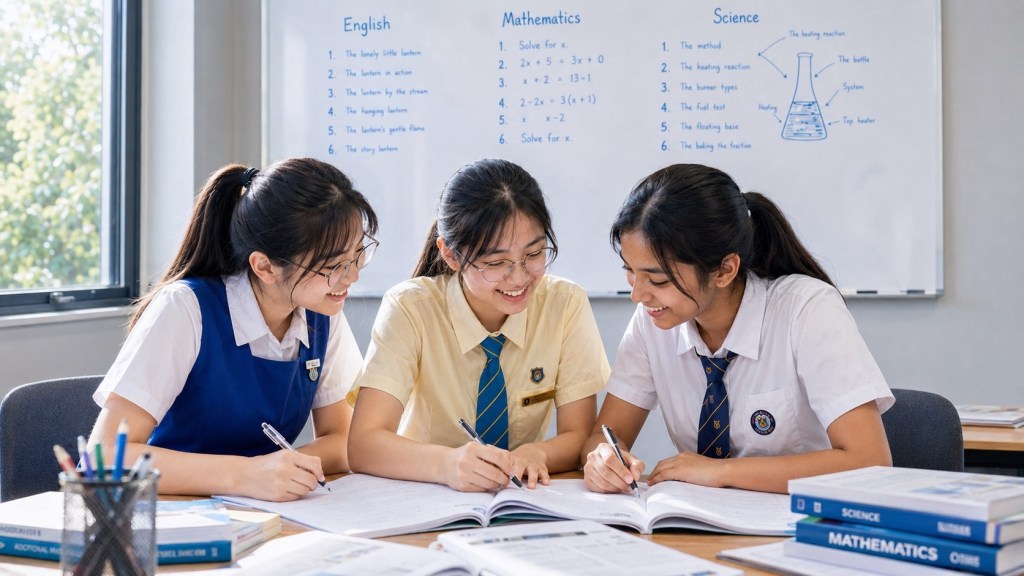
Small-group Science tuition in Sengkang should give the tutor enough visibility to diagnose how each student thinks, while giving students enough independence to attempt, compare and correct their own reasoning. Parents searching for a Science tutor in Sengkang, Primary Science tuition, PSLE Science tuition, personalised Science tutoring, small-group tuition, homework help or exam preparation are often comparing class sizes. The more important question is what the class size allows the teacher to see and do.
Large international tutoring brands promote personalised tutoring, one-to-one support, homework help, test preparation and tailored learning plans. Singapore tuition searches add small-group tuition, Science concepts, answering techniques, open-ended questions, exam questions and PSLE preparation. These phrases describe different delivery formats, but strong teaching still depends on the same core process: identify the first weak link, teach the missing capability, observe the next attempt, give precise feedback and test whether the learner can transfer the repair to a new question.
At eduKate Sengkang, formal Science tuition is currently for Primary 3 to Primary 6, including PSLE Science, in classes of up to three students for 1.5-hour lessons. Primary 1–2 Science content on this site is educational discovery material rather than a formal P1–2 tuition offer. Secondary G1, G2 and G3 Science appears in the educational estate to help parents understand the path after PSLE, but the Sengkang Science programme itself is not presented as a Secondary Science tuition offer. This page owns the parent-fit question: why a three-student format can be useful when the objective is diagnosis, feedback, transfer and growing independence.
Class size is only useful when it changes the teaching
A small class is not automatically personalised. Three students can still receive the same worksheet, the same explanation and the same correction at the same time. The numerical size matters because it creates the possibility of visibility; the tutor still has to use that visibility.
The tutor should be able to notice how each learner starts a question, where hesitation begins, which clue is ignored, whether the child retrieves a fact or reconstructs a relationship, and how the learner responds after feedback. These observations are difficult to make if teaching is organised only around finishing pages.
Conversely, one-to-one tuition is not automatically superior for every student. It offers maximum direct attention, but a learner can also become accustomed to continuous tutor interaction. A small group can create useful periods of independent work while the tutor observes another student. It can also expose learners to alternative reasoning, near-miss answers and different error patterns.
The best class size is not the smallest number in an advertisement. It is the smallest structure that still helps the learner think independently while giving the tutor enough evidence to intervene precisely.
What a three-student Science tutorial can make visible
Different first mistakes
Three students may all lose the same mark for different reasons. Student A did not know the concept. Student B knew it but misread the comparison. Student C used the right concept but stopped the explanation too early. A generic correction hides this difference. A small group gives the tutor enough proximity to classify the failures separately.
Different representations
One learner may understand a process through a diagram, another through an explanation, and another only after applying it to a concrete example. The tutor can move between representations without assuming that the same explanation is equally effective for everyone.
Different speeds
Science reasoning is not only about speed, but speed can reveal fluency. A student who answers accurately but needs excessive time may have fragile retrieval or an inefficient checking routine. Another student may be fast because the learner guesses. The tutor needs to see both pace and reasoning quality.
Different levels of independence
One child begins without prompting. Another waits until the tutor confirms every step. A third can begin but asks for reassurance before committing to an answer. These behaviours matter because a learner who is permanently prompt-dependent may appear successful inside tuition and still struggle alone in school.
Diagnosis before prescription
Parents frequently arrive with a prescription already in mind: more worksheets, more keywords, more exam papers, more drilling. Those may eventually be useful, but the tutor should first establish what is failing. Otherwise the programme can become a large dose of the wrong intervention.
A diagnostic lesson can sample several types of work. The tutor may use a recent school paper, one familiar concept question, one changed-context application, an open-ended explanation, a graph or experiment item and a short delayed-retrieval task. The objective is not to “test” the child aggressively. It is to see where the learner stops being able to operate independently.
The first weak link might be content knowledge. It might be Science vocabulary. It might be reading the question. It might be the ability to use evidence. It might be a tendency to memorise model answers. It might be timing. Each diagnosis implies a different next week.
Why personalised tutoring should not mean an entirely different curriculum for every child
Personalisation is sometimes misunderstood as giving every student a unique syllabus. In school Science, students still need the same core curriculum. The personalisation lies in route, emphasis, pacing, examples, feedback and the amount of support needed to reach the same underlying capability.
Two Primary 5 students may both be learning electricity. One needs concept repair because current and circuit ideas are confused. The other understands the circuit but loses marks because comparisons are vague. Both can remain in the same broad lesson while receiving different diagnostic questions and different feedback.
This is one advantage of a small group over a completely individualised content stream: students still share a coherent subject journey while the tutor adjusts the intervention at the point of failure.
The teaching loop: attempt → diagnose → repair → reattempt → transfer
A three-student Science class works best when each learner repeatedly passes through a short teaching loop.
- Attempt: the student tries enough of the task for the tutor to see the current reasoning.
- Diagnose: the tutor identifies the first wrong decision rather than only the final wrong answer.
- Repair: the missing concept, distinction or procedure is taught as narrowly as possible.
- Reattempt: the learner solves again without the tutor doing the thinking on the learner’s behalf.
- Transfer: the same relationship is tested in a changed context so memorised wording cannot carry the answer.
This loop can happen several times in one lesson. It is more informative than a long uninterrupted explanation because every reattempt produces evidence about what the learner can now do.
Why students should sometimes work while the tutor is helping someone else
Parents can understandably associate value with constant tutor attention. Yet continuous attention can interfere with independence if the learner begins to expect a prompt after every hesitation. In a three-student class, short periods where the tutor is attending to another learner can be educationally useful.
The student has to decide whether to reread the question, draw a diagram, retrieve from memory, skip and return, or make a first attempt. The tutor can later examine what the learner did without immediate support. This reveals capabilities that one-to-one continuous prompting can accidentally conceal.
The tutor should still monitor the room and prevent unproductive long stalls. The goal is not neglect. It is calibrated independence: enough space for the student to act, enough observation for the tutor to intervene when the evidence is useful.
Peer comparison is useful when it compares reasoning, not ability
A small group can become unhealthy if students are ranked socially or treated as fixed “strong” and “weak” learners. The productive comparison is between reasoning routes and answers, not identities.
The tutor can ask, “Which of these two explanations uses the evidence better?” or “Where does this causal chain stop?” Students can critique anonymous work or different hypothetical solutions. They learn that a response can be improved without turning the exercise into a judgment about the person who wrote it.
This supports one of eduKate’s wider teaching values: critical thinking with responsibility. Students learn to disagree with an answer precisely, explain why, and revise their own reasoning when evidence changes.
Feedback in a small group should still be individual
All three students may hear the same concept explanation, but feedback should name the individual next step. “Everyone revise harder” is not personalised feedback. Student A may need to rebuild the concept. Student B may need comparison control. Student C may need shorter, more precise explanations.
A useful feedback sentence should tell the learner what was already correct, where the first problem began and what to do differently on the next attempt. It should be actionable within minutes, not merely descriptive.
The tutor then checks whether the instruction worked. This is the difference between feedback as commentary and feedback as teaching. If the student makes the same error immediately, the feedback was either not understood or not specific enough.
Primary 1–2: discovery Science before formal small-group tuition
Parents may search for Primary 1 Science tuition or Primary 2 Science tuition because they want early advantage. At these levels, the highest-value Science experiences are often simple and observational: classify objects, compare materials, describe changes, predict outcomes, measure, notice patterns and explain everyday phenomena.
These activities can happen at home, in school and through educational reading. They prepare the language and habits needed later without importing upper-primary tuition intensity. eduKate Sengkang’s P1–2 Science material should be read in this discovery sense. The current formal Science tuition offer begins at Primary 3.
A parent can still apply the same three-step philosophy at home: let the child attempt an explanation, ask what was observed, then ask what evidence would change the child’s mind. The objective is curiosity with discipline.
Primary 3: the tutor should protect curiosity while adding structure
Primary 3 is often the first year Science becomes a formal subject. A small-group tutor can help students move from everyday noticing to organised scientific classification and explanation. The class should not become a vocabulary race.
Students need to know terms, but those terms should connect to observable characteristics, processes and relationships. In a three-student setting, learners can classify the same objects in different ways and defend which criterion is scientifically appropriate. This makes the logic of classification visible.
Early tuition should also build correction habits. When an answer changes, the child should understand why. A corrected sentence copied from the board is less valuable than a second attempt made after the misconception has been identified.
Primary 4: the class should begin to reveal hidden reasoning differences
By Primary 4, students have enough content for two children to reach the same wrong answer through different paths. One may confuse the concept; another may fail to read the diagram; another may know both but use an unsupported assumption.
A small group is valuable because the tutor can make these differences explicit. Students hear that “wrong” is not a single category. They learn to diagnose themselves: Did I forget the fact? Did I misread the condition? Did I omit the mechanism? This metacognitive language becomes useful before the heavier upper-primary workload.
Primary 5: why small-group diagnosis becomes commercially relevant
Primary 5 is a common decision point for parents because the subject becomes harder to manage through general homework support alone. Content breadth increases, systems become more interconnected and open-ended application becomes more demanding. Marks may fall even when the child is studying.
A tutor can add commercial value here by reducing wasted practice. Instead of giving every student the same large packet, the class can identify which high-dependency weakness is limiting performance. If the learner cannot interpret experiment variables, that weakness affects many topics. If explanations repeatedly stop after naming a process, the response issue crosses the syllabus.
The value proposition is therefore not “more work.” It is better-selected work, observed closely enough that the next lesson responds to evidence.
Primary 6 and PSLE: the three-student class becomes a diagnostic performance lab
For Primary 6, full papers and timed sections provide rich evidence. The tutor can watch how three students handle the same demand differently. One may rush the MCQ section, one may over-write open-ended answers, and one may lose time because retrieval is too slow.
For paper diagnosis, use PSLE Science Tuition Sengkang | Use the Paper to Find the Failure. For open-ended response mechanics, use Primary 6 Science | How to Answer Open-Ended Questions for PSLE. This guide explains why a small class can make individual performance patterns visible enough to teach.
How three students can practise the same concept at different depths
Personalisation does not require three separate lessons happening simultaneously. The tutor can hold the concept constant while varying the depth of the question.
For example, all three learners may be working on heat transfer. Student A receives a direct concept application to stabilise understanding. Student B receives a comparison question with an unfamiliar setup. Student C receives an experiment or data question where the concept must be selected without being named. The group remains coherent, yet each learner works at the edge of current capability.
Later, the students can exchange question types. Student A should eventually reach the transfer task; Student C may still benefit from a simple retrieval check to ensure speed and accuracy. Difficulty becomes adjustable rather than a permanent label attached to a child.
Why the tutor should keep an error ledger for each learner
In a three-student class, memory alone is not enough. A light error ledger helps the tutor notice whether a pattern is shrinking. The record does not need every wrong answer. It should capture repeated error classes that influence future teaching.
- Concept or knowledge gap.
- Misread comparison or condition.
- Evidence versus inference confusion.
- Incomplete causal explanation.
- Scientific vocabulary used inaccurately.
- Transfer failure after context changes.
- Timing or checking failure.
- Prompt dependence or inability to begin independently.
The ledger makes personalisation cumulative. A student is not treated as a blank slate each week. The tutor can deliberately return to an old weakness after a delay and see whether it remains repaired.
The first four weeks should make the student more legible
Parents should not expect a credible tutor to know everything about the learner after one worksheet. The first month is a period of teaching and discovery. A pattern becomes more trustworthy when it appears across several tasks and under different conditions.
By the end of the first few weeks, the explanation should become more precise. “Weak in Science” might become “concept recall is adequate, but transfer breaks when the diagram changes,” or “the child understands experiments but overclaims in conclusions,” or “accuracy is good until timing pressure appears.”
The general guide First Four Weeks of Tuition | What Progress Should Look Like helps parents evaluate early progress without treating one immediate mark change as the only evidence.
What parents should prepare before the first Science lesson
Bring recent school evidence. A marked test, several worksheets, an open-ended section and one piece of homework that caused difficulty are more useful than a broad description. Preserve the child’s original attempts. The crossed-out line, blank space or wrong first sentence may reveal the reasoning failure.
Tell the tutor what happens outside class as well. Does the child avoid starting? Need constant reassurance? Rush? Spend too long? Remember corrections only until the next day? These behaviours help distinguish content weakness from study-management and independence problems.
The practical preparation guide is Before the First Tuition Lesson in Sengkang | What Parents Should Prepare.
What progress should look like before the next major score arrives
Marks matter, but they are lagging indicators and can vary with paper difficulty. A small-group tutor should be able to point to earlier capability changes.
- The learner begins questions with fewer prompts.
- Repeated error categories appear less often.
- Corrections lead to successful second attempts.
- The student can explain why an old answer failed.
- Scientific vocabulary becomes more precise and less decorative.
- Transfer improves when the context changes.
- The learner can work independently for longer periods.
- Timed performance becomes more stable.
These indicators do not replace examination results. They explain the mechanism by which results are expected to improve. Parents should be able to see both the capability story and the eventual performance story.
When three-student tuition may be a good fit
- The learner benefits from direct tutor access but does not need continuous one-to-one prompting.
- The child can learn from comparing different reasoning approaches.
- The student needs a tutor to notice repeated patterns across schoolwork.
- Parents want a class small enough for open-ended answers to be discussed in detail.
- The learner needs both guided teaching and periods of independent attempt.
- The child can participate respectfully in a small peer group.
- The family wants systematic PSLE preparation without turning every lesson into mass drilling.
When another format may fit better
A three-student class is not automatically appropriate for every learner. A child with a highly specialised need may require one-to-one support for a period. A learner who already has strong independent capability may need only occasional consultation or a structured revision plan. A student whose primary difficulty is outside the subject—sleep, severe overload or broader language comprehension—may need a different first intervention.
The honest commercial question is not “Can tuition help?” but “What kind of support is the current bottleneck asking for?” The fit guide Is This Tuition Class the Right Fit? is designed for that decision.
Small-group tutoring should reduce dependence over time
A learner may need substantial prompting at the beginning. That support is not a problem if it shrinks as the capability grows. The tutor can track prompt dependence explicitly: full explanation, partial cue, question prompt, silent wait, independent attempt.
If the learner remains permanently at the full-prompt stage, the apparent class success may not transfer to school. A good tutor therefore becomes quieter on old capabilities even while teaching new material actively.
This gradual release is one of the clearest markers of successful personalisation. The tutor responds to need, but does not preserve need merely to keep the teaching process visible.
Why feedback should sometimes be delayed
Immediate feedback is useful when a misconception is likely to become reinforced. But not every uncertainty should be resolved instantly. Sometimes the tutor can let the student complete a reasoning chain, then review it. This reveals whether the learner can self-correct before external correction arrives.
Delayed feedback can also be used after a transfer task. If the tutor interrupts at the first hesitation, we learn little about how the student manages uncertainty. A short silent period may show that the learner knows how to reread, sketch, eliminate an assumption or retrieve a related idea.
The tutor’s judgement is to distinguish productive struggle from unproductive confusion. Small-group visibility makes this judgement more feasible because the teacher can observe without abandoning the learner.
How Science tuition should interact with school teaching
Tuition should not compete with school by creating a parallel curriculum that ignores what the child is actually being asked to learn. Schoolwork provides important evidence: which topics are current, how questions are phrased, what corrections have been made and where the student’s performance is unstable.
At the same time, tuition should add something beyond repeating the school worksheet. The added value can be diagnosis, alternative explanation, targeted retrieval, changed-context transfer, cumulative revision, open-ended feedback and preparation for the next assessment demand.
The strongest relationship is complementary. School provides the main curriculum context; tuition uses close observation and additional practice to repair the learner’s specific bottlenecks.
Homework support inside a small group should build independence
Students often bring difficult homework to tuition. The tutor can help, but clearing the worksheet should not become the central measure of lesson value. A useful response is to choose one representative question, diagnose why it is difficult, repair the relevant capability, then let the student return to the rest with reduced support.
The companion guide Why Science Tutor in Sengkang | Science Homework Help That Builds Understanding, Not Dependence develops this parent decision in depth.
Exam preparation inside a small group should stay diagnostic
Near assessments, three students can complete the same timed section and produce three different performance profiles. The tutor can compare pacing, accuracy, omission patterns and checking. This gives the class a shared task without assuming a shared weakness.
The companion Science Exam Preparation guide explains how revision notes, practice questions, past papers, mock exams and feedback can be sequenced around the learner rather than accumulated indiscriminately.
Open-ended answering inside a small group should compare reasoning
Open-ended Science is particularly suited to careful small-group comparison. Students can analyse why two answers differ, identify the missing mechanism, test whether a keyword is being used correctly and rewrite after feedback.
The companion Open-Ended Questions, Scientific Keywords and Application Skills guide explains why a child can know the content and still need tutoring support to turn that knowledge into precise written performance.
After PSLE: prepare habits that survive into Secondary G1, G2 and G3
The content changes after Primary school, but the habits remain relevant. The Singapore-Cambridge Secondary Education Certificate framework includes Science at G1 and combined Science pathways at G2 and G3. Students encounter more formal models, quantitative relationships, practical reasoning and disciplinary language.
Primary tuition should not attempt to pre-teach the whole Secondary Science curriculum. It should send the learner forward with transferable habits: retrieve knowledge, interpret evidence, explain mechanisms, check assumptions, manage corrections and work independently.
For the transition, use From PSLE to Secondary Science G1, G2 and G3: A Parent Guide. Families seeking formal Secondary Science tuition can use the broader Secondary Science Tuition Singapore route.
Science, Mathematics and Additional Mathematics: understand the different learning demands
Parents planning the Secondary years often think about Science, Mathematics and Additional Mathematics together because all three reward accurate representation, disciplined working and cumulative knowledge. There are useful cross-subject habits: read conditions carefully, keep symbols and units controlled, explain relationships, check whether an answer is plausible and return to prerequisite gaps instead of memorising procedures.
But the subjects are not interchangeable. Science asks students to connect models and evidence to natural phenomena. Additional Mathematics asks for a different mathematical language and dependency chain. eduKate Sengkang does offer Secondary 3–4 Additional Mathematics, and families should consider its learning demands separately from Science.
Parents planning that pathway can use the separate Additional Mathematics Study Guide | SEC G2 & G3, Topics and Worked Examples. Use it to plan the Mathematics pathway alongside the learner’s Science needs.
What parents should ask a Science tutor before enrolling
- How do you diagnose why an answer is wrong?
- How do you decide what each student practises next?
- How do you prevent a three-student class from becoming a mini lecture?
- How do you test whether corrections transfer to unfamiliar questions?
- How do you handle school homework without creating dependence?
- How do you track repeated error patterns across several weeks?
- How do you prepare Primary 5 students for the Primary 6/PSLE transition?
- How do you use past papers without turning tuition into paper volume?
- How do you know when to reduce prompting?
- Which levels and subjects do you actually teach at this location?
What the current eduKate Sengkang Science offer means commercially
The commercial proposition is intentionally narrow: Primary 3–6 Science, including PSLE preparation, in focused classes of up to three students. The purpose of a small group is to combine teacher visibility, peer reasoning and independent work. It is not a claim that every learner must prefer small-group tuition or that one class format guarantees a result.
Families in Sengkang and Punggol can use the educational estate to understand the programme before making contact. The Primary Science Tuition Sengkang | Managing Education page explains the broader Primary route, while the Complete Science Index maps the larger body of teaching material.
Current class availability, timetable and fees should be confirmed directly because operational details can change. The durable promise of the page is not a particular slot. It is the teaching model: diagnose the first weak link, build forward, and make the learner increasingly capable of working without rescue.
A parent observation framework after one month
- Can my child explain what the current repeated weakness is?
- Does the tutor describe the weakness more precisely than “careless” or “weak”?
- Is my child making second attempts after correction?
- Are old mistakes being revisited after a delay?
- Can my child solve changed-context questions more reliably?
- Are prompts reducing on capabilities already taught?
- Does homework take less rescue at home?
- Can the tutor explain what the next four weeks are trying to build?
These questions keep the relationship evidence-based. Parents do not need to micromanage every worksheet. They need enough visibility to know that the teaching is responding to a real learning pattern rather than simply filling lesson time.
Frequently asked questions
Why three students instead of a large class?
A three-student format gives the tutor more opportunity to observe individual reasoning, provide specific feedback and vary practice while still allowing students to compare approaches and work independently.
Is three-student tuition the same as one-to-one tutoring?
No. One-to-one provides exclusive tutor attention. Three-student tuition adds peer reasoning and short periods of independent attempt while remaining small enough for close observation. The better fit depends on the learner.
Does every student receive the same worksheet?
Students can share the same topic while receiving questions at different depths or different feedback based on the diagnosed weakness. Personalisation can occur through task selection, prompting, pacing and correction rather than through an entirely separate curriculum.
Does eduKate Sengkang teach Primary 1–2 Science?
The site contains P1–2 discovery Science education, but the current formal Science tuition programme is Primary 3–6/PSLE.
Does eduKate Sengkang teach Secondary G1/G2/G3 Science?
Secondary Science is covered on the site for educational continuity and parent planning. The stated formal Sengkang Science tuition offer is Primary 3–6/PSLE; a wider Secondary Science route is available through eduKate Singapore.
Does eduKate Sengkang teach Additional Mathematics?
Yes, Additional Mathematics is a separate Secondary 3–4 programme on the Sengkang site. It has its own learning hub and should not be confused with the Science tuition route.
How long are lessons?
The stated model is 1.5-hour lessons in classes of up to three students. Current timetable, availability and fees should be confirmed directly.
Final idea: small enough to see the learner, structured enough to let the learner work
The strongest case for small-group Science tuition is not that three is a magical number. It is that three can create an educational balance: the tutor is close enough to see the first weak link, students are independent enough to expose their real reasoning, and peers provide useful variation without turning the room into a large anonymous class.
For Sengkang and Punggol families considering Primary 3–6 or PSLE Science tuition, the first useful question is not “How many worksheets will be given?” Bring recent work and ask what the tutor sees. A credible answer should become increasingly precise: which capability is weak, how it will be repaired, what transfer task will test the repair, and how support will reduce when the learner can finally do the work alone.
How a three-student class can avoid the middle-speed trap
One legitimate concern about small-group tuition is pace. If one learner is faster and another needs more reconstruction time, the tutor must avoid teaching permanently at the speed of the middle student. A three-student format is small enough to solve this problem deliberately, but it does not solve itself.
The tutor can separate common explanation from individual practice depth. After a shared concept explanation, one student may receive a clean retrieval item, another a changed-context application, and another a more demanding data or experiment task. When the tutor rotates attention, the faster learner is not forced to sit idle and the learner who needs repair is not rushed through the weak link.
The tutor can also use extension by explanation rather than simply giving harder worksheets. A student who finishes first can be asked to justify why a tempting wrong answer fails, create a counterexample, or state which condition would make another conclusion valid. These tasks deepen reasoning without turning the group into a race.
For the student who needs more time, the tutor can reduce surface complexity while preserving the scientific relationship. Once the concept stabilises, the same learner can move back toward the common task. Differentiation should therefore be temporary and diagnostic, not a permanent public label.
Why small-group tuition should produce better questions from the student
A useful sign of growing expertise is that the learner begins asking more precise questions. Early questions may be broad: “I don’t understand this.” Later questions become diagnostic: “I know the concept, but I cannot tell whether the graph supports this conclusion,” or “I am not sure which variable should stay constant.” The student is learning to locate the uncertainty.
A three-student room can model this habit. When one learner asks a precise question, the other students hear how uncertainty can be expressed without embarrassment. The tutor can reward the quality of the question by answering the missing decision rather than immediately solving the entire item.
This matters beyond tuition. In school, the learner who can identify the exact point of confusion can make better use of teachers, corrections and independent study. The student becomes more capable of managing learning rather than waiting for an adult to diagnose everything.
The class should have a release plan for every repaired weakness
When a tutor successfully repairs a weakness, the next step should not be permanent support. The learner needs a release path. A concept may move from full explanation to guided practice, then to a cue, then to an independent changed-context question, then to delayed retrieval and finally to mixed examination practice.
This release sequence prevents an old weakness from occupying tuition time forever. It also protects the student from a subtle dependency: becoming excellent at performing the skill only in the exact routine where it was taught. Transfer requires the skill to survive when the scaffold disappears.
Parents can ask a useful question during progress reviews: “What support is my child needing less of now?” If the answer is specific—fewer prompts to identify variables, less help structuring open-ended explanations, faster independent checking—the programme is not only adding knowledge; it is releasing capability.
Why the small-group model works best with a stable teaching record
Personalisation becomes stronger when the tutor can connect today’s mistake with last month’s history. A stable record prevents the class from being driven only by whichever worksheet happened to arrive that day. It also allows the tutor to check whether an old repair survived after a delay.
The record should stay practical. It can note recurring error classes, concepts recently repaired, transfer checks that passed or failed, and the level of prompting still required. It does not need to turn the child into a spreadsheet. Its purpose is to help the teacher make a better next decision.
This longitudinal view is especially valuable from Primary 5 into Primary 6. The tutor can see which weaknesses are genuinely new and which are older patterns reappearing under greater difficulty. That distinction prevents unnecessary reteaching and helps PSLE preparation become more targeted.
Commercial value should be measured in reduced waste
Tuition costs time as well as money. A strong small-group programme should therefore reduce waste in the learner’s study system. It should reduce worksheets that repeat an already-mastered skill, reduce corrections that are read but never reattempted, reduce hours spent memorising answers that do not transfer, and reduce parent-teacher guesswork about why marks are unstable.
This does not mean every lesson will feel efficient in the moment. Some important concepts need slow reconstruction. Some diagnostic questions reveal that an earlier assumption was wrong and the route has to be rebuilt. The efficiency is strategic: the class spends effort where evidence says effort is needed.
For parents, that is a more useful commercial promise than volume. A thick worksheet pack is visible. A better diagnosis is less visible at first, but it changes every practice decision that follows.
Science and Sengkang routes: return to the Science Hub or Complete Science Index for the wider Science estate; use What about Sengkang? for the town-wide route.
Return to Science Tutor Sengkang for the complete small-group Primary Science tutoring route: diagnose the first weak link in observation, concepts, relationships, evidence, explanation and examination execution.
