
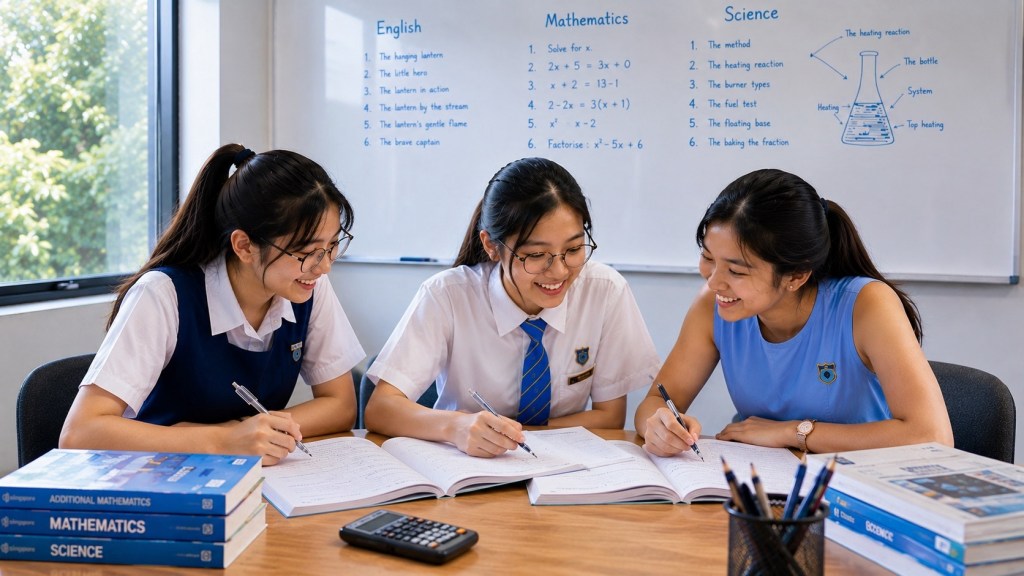
Science homework help in Sengkang should make a student more capable after the lesson, not more dependent on the tutor during the next piece of homework. Parents searching for a Science tutor in Sengkang, Primary Science tuition, PSLE Science tuition, Science homework help or a small-group Science tutor are usually not looking for somebody who can merely produce the correct answer. They are looking for a teacher who can find why the child is stuck, explain the scientific relationship clearly, guide one successful attempt, and then test whether the child can solve a changed question independently.
That distinction matters because “homework help” can describe two very different services. One service removes the immediate difficulty by supplying answers. The other uses homework as evidence: What did the child misunderstand? Which word in the question was misread? Which concept was available but not connected? Which scientific keyword was used without a mechanism? Which experiment variable was confused? Which answer was copied from memory without matching the actual evidence? A strong Science tutor turns a difficult worksheet into a diagnostic instrument rather than a rescue operation.
At eduKate Sengkang, formal Science tuition is currently for Primary 3 to Primary 6, including PSLE Science, in focused classes of up to three students. Primary 1 and Primary 2 Science pages on this site are discovery and general-education routes rather than a claim that formal lower-primary Science tuition is offered. Secondary G1, G2 and G3 Science is discussed in this educational estate because parents need to understand the road after PSLE, but eduKate Sengkang does not currently present itself as a Secondary Science tuition provider. That boundary is important: the purpose of this article is to help parents decide what kind of support is useful, not to stretch a commercial claim beyond the programme actually offered.
The parent question behind “Science homework help”
A child brings home a worksheet and says, “I don’t know how to do this.” The visible problem is the blank space. The invisible problem may be very different. One child has never understood the concept. Another knows the concept but cannot identify it inside an unfamiliar story. Another can explain the idea aloud but writes a vague answer. Another understands every line when an adult prompts the sequence but cannot begin alone. Another is simply tired, rushed or careless after a long school day. If all five children receive the same model answer, the page may be completed while the learning problem remains untouched.
Good homework support therefore begins with classification. The tutor needs to know whether the failure began in knowledge, interpretation, evidence, mechanism, language, procedure, checking or self-management. This is the same principle used across the eduKate Sengkang Science estate: find the first weak link, repair it, and then build forward. The useful question is not merely “Can we get this question right?” It is “What capability must exist so a new question can be handled tomorrow without the same rescue?”
Why international tutoring sites rank “homework help” beside “science tutoring”
Large international tutoring and revision platforms repeatedly organise their Science pages around phrases such as science tutoring, homework help, exam preparation, practice questions, revision notes, model answers, past papers and personalised support. Those phrases are popular because they correspond to real student jobs. A learner may need a concept explained, an assignment decoded, a test prepared for, a practice set selected, or feedback on an answer. The search language is broad, but the teaching response should be precise.
The risk is that “homework help” becomes an attractive phrase with a weak learning design behind it. Fast completion can feel productive because the worksheet is no longer unfinished. Yet a completed worksheet is only evidence of learning if the child can reconstruct the reasoning later. The tutor’s responsibility is therefore to protect the child from a common illusion: mistaking assisted performance for independent capability.
The assisted-performance trap
Suppose a Primary 5 student is answering a question about evaporation. The tutor asks, “What happens when exposed surface area is larger?” The child says, “Evaporation is faster.” The tutor asks, “So what happens to the amount of water after the same time?” The child answers correctly. The final response looks good. But we still do not know whether the learner could have generated the sequence without those prompts.
Assisted performance is useful during teaching. The problem begins when it is mistaken for mastery. A student may succeed because the tutor supplied the conceptual route in small pieces. To test independence, the support must be faded. The student should later meet a changed context—perhaps a wet cloth, a tray, a leaf surface or a different comparison—and reconstruct the same scientific relationship without the earlier prompt.
A tutor should not be judged only by how many stuck questions can be solved during the lesson. The stronger test is how many similar questions the student can solve after the tutor becomes quieter.
What a Science tutor should diagnose before giving the answer
1. Knowledge failure
The child genuinely does not know the relevant scientific fact, process, property or relationship. In this case, application practice is premature. The concept needs to be rebuilt through explanation, examples, retrieval and comparison before the homework question becomes useful.
2. Recognition failure
The child knows the concept in a familiar textbook example but does not recognise it when the objects, diagram or wording changes. This is a transfer problem. The repair is to expose the underlying relationship across varied contexts rather than giving another copy of the original example.
3. Question-reading failure
The student answers a related question instead of the actual one. Command words, comparison references, quantities, conditions and pronouns can redirect the scientific job. A tutor should ask the learner to identify the target before supplying content.
4. Evidence failure
The learner gives a scientifically plausible explanation that is not supported by the evidence in the question. In experiment, graph and table items, the distinction between what is observed, what is inferred and what is merely possible becomes crucial.
5. Explanation failure
The student names a keyword but leaves the causal bridge incomplete. “Because of friction” or “because of evaporation” may be related to the topic without fully explaining why the stated condition produced the stated outcome. The repair is to reconstruct the condition → mechanism → change → result chain.
6. Execution failure
The child can solve the problem when calm and guided but loses control under homework load or test timing. Then the next intervention may involve starting routines, time allocation, checking and recovery rather than another lecture on the concept.
Why three students can be a useful tutoring size
eduKate Sengkang uses classes of up to three students. The value of a three-student group is not simply that it is smaller than a large class. The useful feature is visibility. The tutor can hear how each student interpreted a question, compare different mistakes on the same item, and intervene before one student’s misconception becomes a repeated habit.
A small group can also make reasoning public. One learner may identify the correct evidence while another notices the missing mechanism. The tutor can ask students to compare two answers and decide why one is stronger. This is different from copying a model answer because the students must evaluate the structure of the reasoning. The group becomes a controlled laboratory for explanation, correction and transfer.
The limit matters. In a much larger group, a student can appear busy while hiding uncertainty. In a one-to-one lesson, there is maximum individual attention but less opportunity to observe peer reasoning. Neither format is automatically superior in every case. The right question is whether the class size and teaching method make the student’s thinking visible enough for useful feedback.
What homework help should look like during a 1.5-hour lesson
A focused lesson does not need to spend ninety minutes clearing a school worksheet from top to bottom. That can be inefficient if many items test the same weakness. A more useful lesson might use the homework to identify the failure, step sideways into a short concept repair, test the idea on one or two clean examples, return to the original question, and then finish with an unfamiliar transfer item.
- Entry: inspect recent work, errors and the child’s own explanation of what feels difficult.
- Diagnosis: locate the first failure—knowledge, interpretation, evidence, mechanism, expression or execution.
- Repair: teach the smallest concept or decision that needs rebuilding.
- Guided practice: solve a representative question while making the reasoning visible.
- Faded support: reduce prompting and let the learner reconstruct the route.
- Transfer: change the surface story, diagram or variables so memorised wording cannot carry the answer.
- Return: go back to the school homework and see whether the original difficulty now feels different.
- Receipt: end with a short statement of what the child should now be able to do independently.
Primary 1 and Primary 2: curiosity before formal Science tuition
Parents sometimes search for “Primary 1 Science tutor” or “Primary 2 Science tuition” because they want to give a child a head start. At these ages, the stronger educational question is usually not how quickly a child can memorise later syllabus vocabulary. It is whether the child is learning to observe, compare, classify, describe change, ask testable questions and distinguish what was seen from what was guessed.
eduKate Sengkang’s lower-primary Science material is therefore a discovery route. Parents can build scientific habits through ordinary life: compare materials, observe shadows, notice plant growth, describe weather, sort objects by properties and predict what may happen before checking. The objective is not to bring PSLE pressure into Primary 1. It is to make later formal Science less alien because the child already treats the world as something that can be observed carefully and discussed with evidence.
If a family is seeking formal Primary 1 or Primary 2 Science tuition, this article should not be read as an advertisement for a programme eduKate Sengkang currently claims to run. The commercial Science pathway here begins from Primary 3.
Primary 3: the first formal Science year should not become vocabulary collection
Primary 3 often introduces a new school identity: “Science is now a subject.” Students meet classifications, life cycles, materials, plants, animals and other foundational ideas. The temptation is to memorise definitions and worksheet phrases. Yet later Science becomes difficult when early facts remain isolated. A tutor should help the child organise knowledge into relationships: what feature distinguishes one group from another, what changes during a life cycle, what property makes a material suitable, and what evidence supports a classification.
Homework support at this stage should protect curiosity while adding discipline. Ask the child to point to the evidence for a classification. Ask what changed and what stayed the same. Ask whether a statement is an observation or an explanation. These moves are simple, but they prepare the reasoning architecture needed in upper Primary.
Primary 4: Science begins to demand more relationships
By Primary 4, students increasingly meet systems, interactions, measurements and questions where the answer cannot be retrieved as one isolated fact. A child may know that heat moves from a hotter object to a cooler one but still misread a setup. Another may know the parts of a plant yet fail to explain how a particular condition affects function.
A tutor’s job becomes more diagnostic. The same wrong answer can come from several causes. One learner does not know the concept. Another knows it but chooses the wrong evidence. Another understands the relationship but cannot phrase it. Homework help should separate these causes rather than prescribing the same correction to everyone.
Primary 5: the year many parents first see the application gap
Primary 5 often feels like a step change because the student carries more content, more interconnected systems, more open-ended explanations and greater expectation of independent study. This is where a common parent complaint appears: “My child studies, but the marks do not show it.”
The gap is often between recognition and reconstruction. The student recognises the answer after seeing the worksheet correction and says, “I knew that.” But knowing after the answer appears is different from retrieving the relationship, selecting the evidence and constructing the explanation without the cue. A tutor should therefore use delayed return. Revisit the idea two days later in a changed context. If the route survives, learning is becoming more durable.
Primary 6 and PSLE: homework becomes examination evidence
For Primary 6, a worksheet is not only practice. It can reveal whether the learner is ready to perform under PSLE conditions. The 2026 PSLE Science syllabus assesses knowledge with understanding as well as application of knowledge and scientific inquiry, including interpreting information, evaluating observations or methods, and communicating explanations and reasoning. That means homework should increasingly test more than recall.
The eduKate Sengkang page PSLE Science Tuition Sengkang | Use the Paper to Find the Failure develops this idea in more depth. A paper can be classified by knowledge, reconstruction, evidence, explanation and execution failures. The tutor then repairs the repeated pattern instead of simply assigning another paper.
For open-ended work, use the canonical guide Primary 6 Science | How to Answer Open-Ended Questions for PSLE. This article does not duplicate that answering system. Its narrower job is to explain why homework help should point the child back toward independent reasoning rather than produce an answer on the child’s behalf.
After PSLE: why parents should understand Secondary G1, G2 and G3 even if the current tuition offer stops at Primary
A Primary Science tutor should know where the road leads. Secondary Science changes the scale, language and abstraction of scientific ideas. The 2027 Singapore-Cambridge Secondary Education Certificate framework includes Science at G1, and combined Science pathways at G2 and G3. Students moving beyond PSLE encounter more formal models, calculations, practical reasoning and disciplinary structure.
That continuity matters during Primary tuition because weak habits do not disappear at graduation. A child who memorises keywords without mechanisms may later memorise formulas without meaning. A child who cannot distinguish evidence from inference may struggle when experiments become more formal. A child who depends on prompts for every question may find the Secondary workload especially difficult.
For the educational transition, use From PSLE to Secondary Science G1, G2 and G3: A Parent Guide. For a broader national Secondary Science tuition route, see Secondary Science Tuition Singapore. eduKate Sengkang’s present commercial Science programme remains Primary 3–6/PSLE.
When homework help is useful
- The same type of Science error returns after corrections.
- The student can recite facts but cannot use them in unfamiliar questions.
- Open-ended answers contain correct terms but incomplete scientific relationships.
- The child needs repeated adult prompting to begin.
- Experiments, tables and graphs are interpreted by guessing rather than evidence.
- Homework takes far longer than the learning value justifies.
- The child avoids Science because every difficult item feels like a verdict rather than information.
- Parents can see that marks are unstable but cannot identify the first weak link.
When a tutor may not be the first solution
Not every difficult evening requires tuition. Sometimes the problem is sleep, workload, missing instructions, poor organisation or a single newly taught concept that will settle with normal school practice. Sometimes a child is already capable but needs a quieter routine and fewer competing activities. Sometimes parents can solve the immediate problem by asking the child to explain the question aloud and identify what is actually unknown.
A tutor becomes more useful when the failure is persistent, patterned or difficult to diagnose. The decision should be based on evidence from several pieces of work, not one bad day. Bring recent tests, marked worksheets and full open-ended responses. The pattern across them is more informative than a single total score.
The difference between explaining and replacing thinking
A strong explanation reduces confusion while preserving the learner’s job. A weak form of help replaces the learner’s job. This difference can be tested by asking what happens immediately after the explanation.
If the tutor explains a concept and then solves every remaining question, the child has little opportunity to reconstruct. If the tutor explains one relationship, solves one example together, then gives the child a changed problem and waits, the learner must do cognitive work. The silence after teaching is part of teaching. It reveals whether the idea can stand without support.
Why corrections should include a second attempt
A red mark plus a model answer is information, but it is not yet proof of learning. The student should make another attempt after understanding the correction. Better still, the second attempt should not be an identical copy. Change one feature of the problem so the student must use the idea rather than reproduce the sentence.
This “repair then transfer” loop is especially valuable in Science because the same concept appears through different surfaces. Heat can be tested with containers, clothing, materials or temperature data. Forces can appear in moving objects, springs, friction or balanced systems. Plant processes can be hidden inside diagrams, experiments or comparisons. The scientific relationship should survive the change.
How parents can help without becoming the home tutor
Parents do not need to relearn every Primary Science topic. They can improve the quality of homework conversations by asking process questions instead of supplying content. “What is the question asking you to find?” “What evidence do you have?” “Which idea from class might connect to this?” “What changed?” “What stayed the same?” “What does your final sentence need to explain?”
These questions keep responsibility with the child. If the child still cannot proceed, mark the item and bring it to the next lesson. A useful tutor will appreciate seeing the original failure before it has been overwritten by a perfect adult-assisted answer.
What parents should expect from progress
Progress is not only a higher score. Scores matter, but they are compressed outcomes. Better early indicators include faster starts, fewer repeated error types, clearer explanations, more accurate evidence selection, shorter correction cycles and greater independence. A student who once needed six prompts may need two. A student who once copied a model answer may now explain why the model works. A student who once avoided unfamiliar questions may now classify the problem and begin.
Over time, those capability changes should become visible in school performance. But the tutor should be able to explain what changed before relying on the final mark as the only evidence.
A parent checklist before choosing Science homework help in Sengkang
- Does the tutor diagnose why an answer is wrong, or only show the correct answer?
- Will the child make a fresh attempt after feedback?
- Does practice move from familiar to changed contexts?
- Are scientific keywords taught inside complete relationships rather than as passwords?
- Can the tutor distinguish a knowledge gap from a reading or evidence problem?
- Is class size small enough for the child’s reasoning to be observed?
- Does the programme prepare for PSLE application as well as school homework completion?
- Is the tutor clear about what levels are actually offered?
- Does the support aim to reduce dependence over time?
- Can parents bring real schoolwork so teaching begins from evidence rather than assumptions?
Where this article sits inside the eduKate Sengkang Science estate
For the full educational field, start at the Complete Science Index. For the present Primary programme and its teaching logic, read Primary Science Tuition Sengkang | Managing Education. For PSLE paper diagnosis, use the PSLE Science tuition route. For broader study strategies and subject tutorials, browse the current Advanced Science Tutorials study guide.
This article owns one narrower parent decision: why a Science tutor can be useful when homework repeatedly exposes a hidden learning problem, and why the tutor should use the homework to build independence rather than complete it for the child.
Frequently asked questions
Should a Science tutor help with school homework?
Yes, when the homework is used as evidence and practice. The tutor should explain, diagnose and guide, but the long-term objective is that the student becomes able to complete similar work independently.
Is homework help the same as tuition?
Not necessarily. Homework help may solve immediate assignments. Tuition should also build the underlying concepts, reasoning, retrieval, application, answering and examination capabilities that make future assignments easier.
What if my child only gets stuck on open-ended questions?
That can indicate an explanation, evidence or response-control problem rather than missing knowledge. Bring complete written answers so the tutor can see where the scientific chain breaks.
Does eduKate Sengkang teach Science for Primary 1 and Primary 2?
The site contains P1–P2 discovery Science education, but the current formal Science tuition programme is Primary 3–6/PSLE.
Does eduKate Sengkang offer Secondary Science tuition?
The Sengkang site currently uses Secondary Science material for educational continuity and parent guidance, but its stated formal Science tuition offer is Primary 3–6/PSLE. Secondary Science tuition has a broader national route through eduKate Singapore.
How large are the classes?
eduKate Sengkang’s stated model is up to three students per class. Lessons are 1.5 hours, with current availability and fees confirmed directly because schedules can change.
What should I bring if I want a useful diagnosis?
Bring several recent school worksheets or tests, including the child’s original open-ended responses and corrections. The pattern across multiple pieces of work helps distinguish knowledge, application, evidence, explanation and execution problems.
Final idea: finish the homework, but build the learner
The fastest way to make a worksheet look successful is to supply answers. The more valuable way is to use the worksheet to discover what the student cannot yet do, repair that capability, and then give responsibility back. That takes more judgement than answer delivery, but it produces the result parents actually want: a child who needs less rescue because the Science has become more coherent.
For Sengkang and Punggol families considering Primary 3–6 or PSLE Science support, eduKate Sengkang teaches in focused three-student tutorials at 83 Punggol Central. Start with the learner’s level, recent marks, difficult topics and repeated error pattern. The right first lesson is the one that identifies the first weak link accurately enough that the next piece of work can be different.
Build a homework error ledger instead of collecting corrected worksheets
One of the simplest ways to make Science homework more useful is to stop treating every wrong answer as an isolated event. A student may have twenty corrected worksheets and still have no idea which failure repeats most often. A tutor can turn those pages into a small error ledger. The purpose is not to create more paperwork. It is to make the pattern visible enough that the next lesson can be chosen intelligently.
A practical ledger can record five things: the topic, the question type, the first wrong decision, the repair that worked, and whether the student later succeeded on a changed question. For example, a Primary 5 learner may appear to have many unrelated mistakes in electricity, water cycle and plant transport. The ledger may reveal that the recurring problem is actually comparison language: the child repeatedly fails to state what is being compared and therefore gives a true fact that does not answer the question. Another learner may make errors across several topics because diagrams are read as pictures rather than as information systems with labels, arrows, quantities and conditions.
This is why a Science tutor can add value beyond marking. A mark tells us where the final answer failed. Diagnosis asks where the reasoning first left the correct route. Once the first wrong decision becomes visible, practice can be concentrated there. The student does not need fifty more random questions if twelve carefully selected questions can repeatedly exercise the missing decision.
Parents can use the same ledger at home in a lighter form. After a test, do not only write the total score. Ask which mistakes were knowledge gaps, which were application gaps, which were answer-expression gaps and which came from execution under time. If the same class of failure appears across topics, that pattern is often more useful for the next month of learning than the aggregate mark.
Use the 24-hour return test to separate recognition from learning
A corrected answer feels familiar immediately after tuition. That familiarity is deceptive. The learner has the explanation, the diagram and the tutor’s language still active in working memory. A useful test is to return to the same relationship after a delay, ideally through a different surface problem. If the student can reconstruct the reasoning the next day without the original prompts, the learning is beginning to survive beyond the lesson.
The 24-hour return does not require a second full worksheet. It can be one well-designed question. If the earlier lesson repaired heat transfer, ask about a different object or setup. If it repaired plant transport, change the diagram and the direction of the question. If it repaired experiment variables, present a new investigation where the controlled variable is not the most visually obvious feature. The goal is to see whether the student can recognise the underlying structure.
This delayed check is especially valuable for students who say, “I understand when the teacher explains.” They may be completely sincere. Understanding during an explanation is a real state, but it is not the same as independent retrieval and application. Tuition should progressively move the learner from following a route to generating the route.
What useful Science feedback sounds like
Feedback is most useful when it tells the learner what to do differently on the next attempt. “Wrong,” “careless,” “use keywords” and “read properly” may be true descriptions, but they are weak instructions. They do not identify the decision that must change.
A stronger feedback sentence is specific to the failure. “You named the process, but you did not connect the process to the change in the question.” “You compared the final values but ignored that the starting values were different.” “Your answer is scientifically true, but the experiment only provides evidence for the tested conditions.” “You described what happened, but the question asks why it happened.” Each statement gives the student a repairable target.
A tutor should also avoid turning feedback into a complete replacement answer too quickly. One productive sequence is: identify the missing job, return the question to the student, allow a second attempt, then compare the attempt with a model only after the student has done the reconstruction work. That order matters. It preserves the learner’s ownership of the correction.
In a three-student tutorial, feedback can become even more powerful when two anonymised answers are compared. Students can be asked which answer uses the evidence more precisely, which one contains an unsupported assumption, or where the causal chain stops early. Evaluating another answer often makes the quality criteria easier to see than hearing a lecture about “good answering technique.”
Homework help and exam preparation are related but not identical
Homework is usually close to current classroom teaching. Examination preparation integrates knowledge across a longer time span and adds retrieval, selection, timing, checking and unfamiliar application. A child who receives good homework help may still need a deliberate exam-preparation phase because school assignments often provide contextual clues that a cumulative paper removes.
This is why the tutor should gradually widen the time horizon. Early in a topic, a student may work with immediate explanation and narrow practice. Later, the same idea should reappear inside mixed practice where the learner must first decide which concept is relevant. Near an examination, the learner should meet full sections or papers where no heading announces the topic. The cognitive job changes from “apply the idea we just learned” to “identify which idea is needed, retrieve it, apply it, communicate it and manage the clock.”
Parents searching for “Science exam preparation,” “Science practice questions,” “past papers,” “revision notes” or “mock exams” are therefore searching for more than materials. Materials become useful only when they are sequenced around what the learner needs next. A tutor can help by choosing the right difficulty, classifying errors and preventing practice from becoming either too easy to reveal weaknesses or so difficult that every question collapses into guessing.
For PSLE students, this progression connects directly to the existing PSLE Science Tuition Sengkang route, where the paper is used to identify repeated failure classes. The present article remains focused on homework support; the broader examination system belongs to that canonical owner.
What the first month of Science tuition should discover
Commercial tuition pages often make progress sound immediate and linear. Real learning is more diagnostic. A useful first month should discover enough about the learner that later practice becomes better targeted. The tutor should be learning the student while the student is learning Science.
Week one may reveal the obvious symptom: weak open-ended answers. Week two may show that the child actually understands most concepts but repeatedly ignores comparison references. Week three may show that corrections are remembered only in the original wording. Week four may show that the child can transfer correctly when given enough time but rushes under school-test pressure. Those discoveries change the intervention. Without them, tuition can become an expensive stream of generic worksheets.
Parents should therefore be cautious about promises that skip diagnosis. It is reasonable to ask what the tutor intends to observe in the first lessons and what evidence will be used to decide the next step. A small class should make it possible to notice how the child starts a question, not only whether the final line is correct.
- Concept access: can the learner retrieve the needed scientific relationship without being shown it?
- Question interpretation: can the learner identify the object, condition, comparison and command word accurately?
- Evidence use: can the learner separate what the question shows from what is merely possible?
- Explanation: can the learner connect condition, mechanism and outcome in a complete chain?
- Transfer: can the learner use the relationship when the context changes?
- Execution: can the learner perform the same reasoning under realistic time and workload?
A first month does not need to solve every weakness. It should make the learning problem more legible. Once the recurring pattern is clear, the tutor can choose a smaller number of high-value interventions and measure whether they survive across new work.
A practical parent-tutor handover can save weeks of guessing
The quality of the first lesson improves when parents bring evidence rather than only a broad description such as “Science is weak.” Recent worksheets, a school test, a corrected open-ended section and one piece of homework that took unusually long can reveal more than a long verbal history. Keep the child’s original writing visible. Do not rewrite it neatly before the tutor sees it.
It also helps to tell the tutor what happens at home. Does the child begin independently or wait for help? Does a forty-minute worksheet become a two-hour conflict? Does the child know the answer orally but freeze when writing? Does the student check corrections once and never return? These behaviours help distinguish a content problem from an execution or independence problem.
The tutor can then return information in the same concrete form. Instead of “needs more practice,” the parent might hear, “The concepts are mostly available, but the child is losing marks when the question changes the comparison. We will train comparison control across three topics and re-test next week.” That is a much more useful learning contract because it names the capability being built.
Why the best homework help should eventually feel less necessary
The paradox of good tuition is that success should reduce dependence on tuition behaviours. The learner may continue attending because the curriculum becomes harder and new capabilities are required, but the old support should not remain permanently necessary. A child who once needed the tutor to read every question should later read accurately alone. A child who once needed sentence-by-sentence prompting should later build the explanation independently. A child who once needed reminders to check every answer should eventually internalise a checking routine.
This gradual release is a useful test of teaching quality. Support can increase when a genuinely new demand appears, but it should shrink again as that demand becomes familiar. The objective is not to make the tutor indispensable. It is to make the learner increasingly capable of handling Science with less external structure.
Science and Sengkang routes: return to the Science Hub or Complete Science Index for the wider Science estate; use What about Sengkang? for the town-wide route.
Return to Science Tutor Sengkang for the complete small-group Primary Science tutoring route: diagnose the first weak link in observation, concepts, relationships, evidence, explanation and examination execution.
