
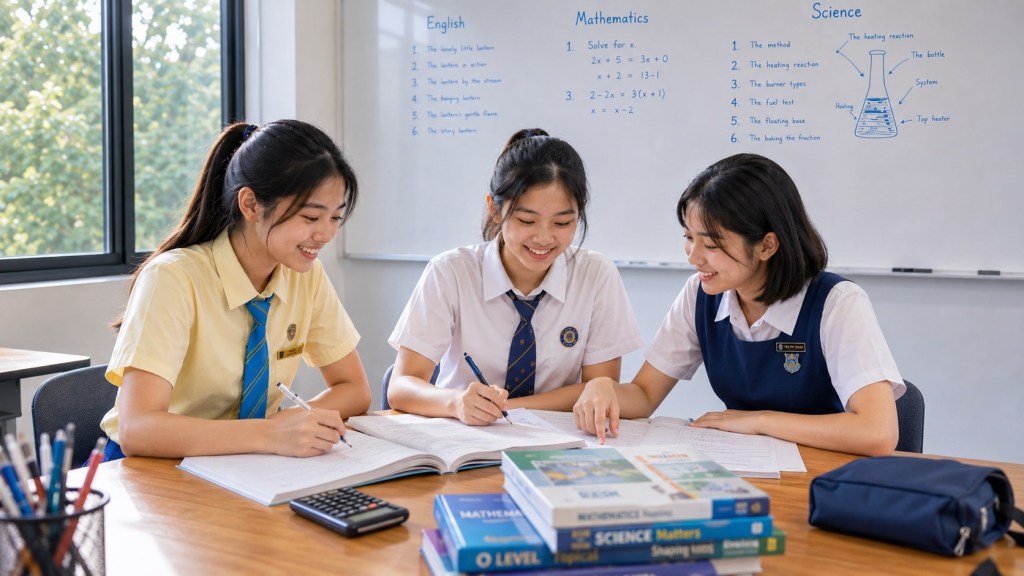
Moving from PSLE Science to Secondary Science is not simply a matter of learning more facts. The learning object changes. Students meet more abstract models, more disciplined practical work, more scientific vocabulary, more quantitative relationships and a stronger expectation that they can interpret evidence without being shown exactly which Primary-school chapter to use. Under Full Subject-Based Banding, Science may be taken at G1, G2 or G3 subject levels, so parents need to understand both the continuity and the differences.
This Advanced Science Tutorials guide is written for parents in Sengkang, Punggol and across Singapore who want to understand what happens after PSLE Science. It is educational first. eduKate Sengkang’s current public Science tuition service focuses on Primary 3–6 and PSLE Science; this article does not imply that Secondary Science tuition is presently offered at every G1, G2 or G3 level. Families looking for the current Primary programme can use the Primary Science Tuition Sengkang route.
The central transition is this: Primary Science builds a foundation of concepts, inquiry habits and explanation. Lower Secondary Science keeps that foundation but increases the resolution. A student who survived Primary Science by memorising chapter-specific answer patterns may feel the change sharply. A student who learned to retrieve concepts, read evidence, explain mechanisms and correct misconceptions already owns part of the operating system needed for Secondary Science.
Quick parent answer: what changes after PSLE Science?
- Science becomes more abstract and model-based.
- Laboratory measurements, procedures and experimental reasoning matter more.
- Students meet a larger scientific vocabulary and more precise representations.
- Questions increasingly require connecting several ideas rather than recognising one familiar chapter.
- Graphs, tables, units and quantitative relationships become more important.
- G1, G2 and G3 Science are different subject-level pathways under Full Subject-Based Banding, not simply old stream labels.
- School topic sequence can differ, so parents should use the child’s actual school scheme of work together with the official syllabus.
Start with the official G1, G2 and G3 Science documents
For Lower Secondary Science, the official curriculum references are the MOE G1 Lower Secondary Science syllabus and the MOE G2/G3 Lower Secondary Science syllabus. These are the documents parents should use when they want to understand the official learning aims and content framework.
The G2/G3 syllabus is organised around Scientific Endeavour, Diversity, Models, Interactions and Systems. The G1 syllabus uses a more contextualised structure, including laboratory measurements and procedures and modules such as machines, environment, body and health. The subject levels differ in depth, abstraction and expected application, but all are designed to build scientific literacy and a foundation for later learning.
What Full Subject-Based Banding means for Science
Parents should avoid translating G1, G2 and G3 into a simple ranking of children. The labels describe subject levels. A student’s educational needs are better understood by looking at the actual Science work: what concepts are secure, what representations are difficult, what practical skills are weak and how independently the student can reason from evidence.
This matters because two students taking Science at the same subject level can have very different problems. One may know the content but struggle with written explanations. Another may understand explanations but be weak in measurement and graphing. A third may need more support with vocabulary and prior knowledge. The subject label does not replace diagnosis.
The five biggest Primary-to-Secondary Science shifts
1. From familiar examples to scientific models
Primary Science often uses concrete, everyday contexts. Lower Secondary Science still connects to real life, but students increasingly use models to explain things that cannot be understood by direct observation alone. The particulate nature of matter, cells, light models and other representations require learners to reason with an intentionally simplified scientific model.
Parents can help by asking two questions: “What does this model represent?” and “What does it leave out?” This prevents the model from becoming another picture to memorise.
2. From naming variables to designing and evaluating investigations
Primary students learn fair-test ideas and evidence. Secondary Science increases the precision. Students need to handle measurements, apparatus, variables, data quality and the logic connecting a method to a conclusion. A learner who memorised “change one variable, keep the rest constant” must now recognise why particular controls matter.
At home, ask the student to state the investigation question first. Then identify the changed variable, measured outcome and controlled conditions. Finally, ask what evidence would weaken the conclusion. This keeps experimental reasoning connected to purpose.
3. From diagrams to multiple representations
Secondary Science uses diagrams, tables, graphs, symbolic representations, equations and models. Students must move between them. A graph may express the same relationship that was previously explained in words. A diagram may need to be connected to a microscopic model. A table may need to be converted into a graph or conclusion.
A powerful study habit is translation: explain the graph in words, draw the process from the paragraph, turn the table into a trend statement, and state what the diagram predicts. The more representations a learner can connect, the less dependent they are on one familiar format.
4. From chapter recall to concept selection
In Primary revision, worksheets are often clearly labelled by chapter. In Secondary Science, mixed work becomes more common and the student must decide which concept applies. This is where interleaving becomes useful. The learner should practise selecting the scientific idea before executing it.
Parents can ask, “What clue in the question tells you this is the relevant concept?” If the child cannot answer, the difficulty may be recognition rather than calculation or writing.
5. From teacher-supported correction to self-monitoring
Secondary students are expected to carry more responsibility for organising notes, tracking deadlines and revisiting errors. The transition is easier when students already know how to diagnose their own work. A useful error record names the first failure: wrong concept, misread graph, unit error, incomplete mechanism, weak evidence or misunderstood command.
The goal is not a giant notebook of mistakes. The goal is a small system that changes future decisions.
What remains the same from Primary Science
The underlying learning habits remain surprisingly stable. Students still need accurate factual memory. They still need to understand cause and effect. They still need to read diagrams and evidence. They still need to distinguish observation from inference. They still need to explain why an answer follows. Good Primary Science learning therefore has long value beyond PSLE.
The Complete Science Index can be used to revisit Primary concepts when a Secondary question exposes an old gap. Secondary difficulty is sometimes a new topic problem; sometimes it is an old foundation problem appearing in a more demanding context.
G1 Science: what parents should expect
G1 Lower Secondary Science is designed with strong real-life context and scientific literacy. It includes laboratory measurement and procedures and contextual modules that connect Science to machines, environment, body and health. Parents should expect practical relevance, careful use of evidence and application to everyday situations.
A productive home study routine is to connect each concept to one real-world case, then return to the school representation. Everyday examples should support the Science, not replace it. If common sense and the scientific model disagree, the student must learn which evidence and definitions govern the school question.
G2 and G3 Science: what parents should expect
G2/G3 Lower Secondary Science develops a broad foundation across scientific endeavour, diversity, models, interactions and systems. The learner encounters matter, separation, light, cells, forces, heat, chemical changes, ecosystems, electrical systems and human biological systems within the official framework. The depth and assessment expectations should be understood through the child’s school work and the MOE syllabus rather than from a generic topic list.
Parents should be cautious about buying a “Secondary 1 complete topic” package and assuming every school teaches the same sequence in the same term. Use the school’s actual scheme of work. The official lower-secondary syllabus describes the curriculum framework; schools can organise teaching across the lower-secondary years in ways that suit their programme.
The first eight weeks after PSLE: a better transition plan
- Week 1: reset routines—files, notes, homework capture and correction system.
- Week 2: practise reading units, scales and measurements carefully.
- Week 3: build a vocabulary system that connects terms to models and examples.
- Week 4: practise diagrams and representation changes.
- Week 5: practise laboratory reasoning and variables.
- Week 6: mix two topics so the student must select the concept.
- Week 7: complete a short timed set and classify errors.
- Week 8: review which support can now be removed.
This is not an official eight-week MOE programme. It is a parent transition framework. The important aim is to build Secondary Science habits before the volume of content becomes the only thing the family notices.
How to study Secondary Science notes
Do not begin by rewriting the whole textbook. Use notes as a map. After a lesson, close the source and reconstruct the key model, relationship or process. Reopen the notes only to correct gaps. Then answer one changed-context question. This converts notes from storage into a retrieval tool.
If the student creates summaries, each summary should produce questions. A good note can be covered and tested. A note that is beautiful but never used for retrieval may be organisationally satisfying without improving performance.
How to learn Secondary Science vocabulary
Vocabulary becomes denser. Students should learn terms in families and contrasts rather than isolated definitions. Pair each term with its boundary: what counts, what does not, what it is often confused with and where it appears in a diagram or experiment.
For example, a student should not merely recognise a term in bold print. They should be able to use it in a sentence that explains a scientific relationship. Retrieval cards can help, but every vocabulary session should eventually return to an application question.
How to study practical Science
Before a practical, identify the purpose, apparatus, variables, likely measurements and safety considerations. During the practical, record observations carefully rather than writing the expected answer. After the practical, compare the evidence with the prediction and ask whether the method justifies the conclusion.
Parents do not need to recreate school laboratories at home. The useful home work is interpretation: read a method, identify the logic, predict the outcome and critique a possible error source.
How to handle graphs and calculations
Secondary Science increasingly requires numerical discipline. Students should identify the physical quantity, unit, relationship and scale before manipulating numbers. A wrong unit is not a decorative mistake; it can reveal that the learner has lost track of what the number represents.
For graphs, use a fixed routine: variables, units, scale, trend, key region, anomaly and conclusion. Then connect the pattern to a scientific model. Students who rush to explain before reading the graph often answer the topic they expected rather than the evidence they were given.
How parents should respond when Secondary Science marks fall
Do not assume the child suddenly became weak in Science. Compare the new tasks with Primary work. Is the vocabulary denser? Are diagrams more abstract? Are calculations new? Is the student losing marks in practical design? Are explanations incomplete? Has the school moved to mixed-topic assessments? The first changed demand often reveals the repair target.
Use three recent pieces of work. Classify every significant lost mark. If most are content gaps, rebuild content. If most are interpretation errors, train question reading. If most are representation errors, practise graph–diagram–text translation. If most occur under time pressure, timing may be the real problem.
The parent role in Secondary 1
Parents should move from answer provider to learning systems manager. Check whether homework is captured, corrections are completed and weak topics are revisited. Ask for one explanation rather than inspecting every line. Encourage the student to approach teachers when school-specific instructions are unclear.
Independence should increase, but disappearing completely can be premature. The best parent involvement becomes lighter and more strategic as the learner proves capability.
The parent role in Secondary 2
Secondary 2 often carries more cumulative content and decisions about later subject pathways. Avoid turning every mark into a prediction of the child’s future. Use the year to strengthen fundamentals, study routines and evidence-based self-assessment. When schools provide subject-selection criteria or advice, use the school’s current information rather than relying on old assumptions about previous streaming systems.
A student who can explain strengths and weaknesses accurately is better prepared for later choices than a student who knows only the overall mark.
Common transition mistakes
- Buying too many revision books before diagnosing the actual weakness.
- Treating Secondary Science as a larger version of PSLE worksheets.
- Assuming G1, G2 or G3 labels explain the child’s individual difficulty.
- Rewriting notes instead of retrieving and applying.
- Ignoring units and measurement because the concept seems more important.
- Memorising model answers without understanding the model.
- Using tuition to replace schoolwork rather than repair specific gaps.
- Waiting for a major examination before creating an error-correction routine.
When extra help is useful
Additional help can be useful when the student repeatedly misunderstands foundational models, cannot connect practical work to theory, struggles with representations, or has lost the routine needed to keep up with cumulative content. The help should be specific. “Needs more Science” is not a diagnosis. “Cannot interpret particle-model diagrams” or “cannot connect a graph trend to the mechanism” is closer to a teachable target.
eduKate Sengkang currently presents its public Science tuition offer around Primary 3–6 and PSLE. This Secondary Science guide is part of the educational Science estate and parent-learning lane. It provides continuity for families who want to understand what comes next without making a claim about active Secondary Science class availability.
What a strong Primary-to-Secondary transition looks like
The student no longer asks only, “Which chapter is this?” The student asks, “What model or evidence is this using?” The student can make a first attempt before opening notes. The student can explain why a wrong answer failed. The student can move between words, diagrams and data. The student can ask a teacher a specific question instead of saying, “I don’t understand Science.”
Marks may still fluctuate while new content arrives. The deeper sign of progress is increasing control over learning.
A simple weekly Secondary Science routine
- One short retrieval session from the week’s lessons.
- One representation session: diagram, graph, table or model.
- One application set with mixed contexts.
- One correction session based on actual mistakes.
- One delayed return to an older topic.
- A weekend check: what can now be done without notes or prompts?
Questions parents can ask without teaching the answer
- What is the scientific model here?
- What evidence in the question matters?
- Which variable changed?
- What does this unit tell you the quantity is?
- What happens first?
- What would you expect if your explanation were wrong?
- Can you show the same idea as a diagram or graph?
- Which old Primary concept is this building on?
- What is the first step you can do without help?
Internal routes for the Science transition
- Science Hub
- Complete Science Index
- PSLE Science Learning Guide
- Advanced Science Tutorials | How to Study Science Effectively
- Advanced Science Tutorials | Science Homework Help for Parents
- Primary Science Tuition Sengkang
Final operating rule
The move from PSLE Science to Secondary Science is a change in resolution, not a complete reset. Keep the good Primary habits—retrieval, explanation, evidence and correction—then add stronger models, representations, practical reasoning, quantitative discipline and independent study control. Parents do not need to predict the entire Secondary journey. They need to help the learner identify the next scientific job and become increasingly able to do it without rescue.
