
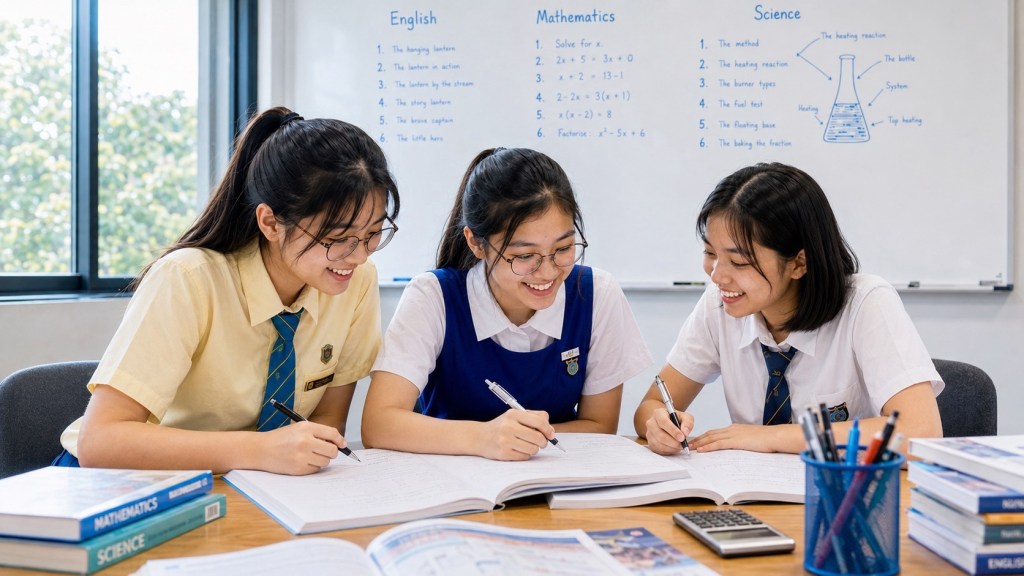
Science homework help for parents does not require a parent to remember every school topic, every scientific term or every model answer. The most useful role is often smaller and more powerful: help the child understand the question, expose the reasoning, locate the first weak link and return responsibility for the final answer to the learner. This Advanced Science Tutorials guide is written for parents from the early Primary years through PSLE and the transition into Secondary Science.
For Sengkang and Punggol families, the problem is familiar. A child arrives home with a Science worksheet, gets stuck, and asks, “What is the answer?” The parent may know the topic, half-remember it or have no idea. In all three situations, the risk is the same: homework can be completed without learning. The goal of parent help is therefore not simply to produce a finished page. It is to make the child more capable of finishing the next page with less help.
This article is an educational parent guide. It does not replace the Science Hub, the Complete Science Index or the local Primary Science Tuition Sengkang route. Those own broader Science discovery and programme information. This guide owns the narrower question: how should a parent help with Science homework without doing the Science for the child?
The five-step parent homework protocol
- Ask what the question is asking. Do not start with the answer.
- Ask what the child already knows. Retrieve before teaching.
- Find the first missing step. Vocabulary, concept, evidence, diagram, variable or explanation.
- Give the smallest useful prompt. Enough to restart thinking, not enough to replace it.
- Fade the help. The child finishes, explains the answer and later tries a similar question independently.
Why giving the answer feels efficient
Parents are usually helping under time pressure. Dinner is waiting, another subject has homework and bedtime is approaching. Giving the answer can end the immediate problem. It may even seem kind because the child is frustrated. The difficulty is that fast completion can hide a slow learning problem. If the child receives the final sentence before making the key decision, the page is complete but the reasoning remains borrowed.
Homework is most valuable when it reveals what the child can and cannot yet do. That makes mistakes useful evidence. A wrong answer can show a misconception, a vocabulary gap, a reading problem, a weak model or a rushed decision. If the adult erases the mistake too early, the evidence disappears before anyone diagnoses it.
Start with the question, not the chapter
When a child says, “I don’t know this topic,” ask the child to read the exact question and describe the required job. Is the question asking for a fact, a comparison, an explanation, a prediction, a graph interpretation, an experimental variable or a conclusion? Many homework problems become smaller when the task is identified correctly.
This habit also prepares students for examinations. Science knowledge is necessary, but the learner must choose what to do with that knowledge. A parent who repeatedly asks “What is this question asking you to do?” is helping the child build a transferable reading routine rather than teaching one isolated answer.
Retrieve before you explain
Before opening notes or searching online, ask the child to say what they already remember. This may be incomplete. That is fine. Retrieval exposes the starting point. If the child knows four of five steps in a process, the parent can focus on the missing step. If the child knows the terms but not the relationship, the parent can ask for the mechanism. If nothing is retrievable, then review is justified.
The same principle is used in effective study: attempt first, then check. The related How Studying From Homework Works guide develops the idea that homework should become evidence, repair and independent performance rather than task completion alone.
The prompt ladder: help only as much as necessary
- Level 1 — attention: “Read the last sentence again. What is it asking?”
- Level 2 — cue: “Which part of the diagram changes?”
- Level 3 — structure: “What happens first, and what happens because of that?”
- Level 4 — choice: “Is this about heat transfer or temperature?”
- Level 5 — model: demonstrate one similar example, then return to the original problem.
- Level 6 — direct instruction: teach the missing concept when the learner genuinely does not have it.
Start as high on the ladder as possible, with the least support. Move down only when necessary. After the child restarts, remove the support again. The important part is fading. A prompt that is useful once becomes harmful if the learner needs it forever.
How to help when you do not know the Science
You can still support the reasoning process. Ask the child to show where the answer should come from: textbook, school notes, diagram, table, experiment description or previous example. Ask for the claim, the evidence and the relationship between them. Ask what variable changed and what was measured. Ask the child to explain why one possible answer is stronger than another.
If the topic truly requires subject knowledge you do not have, use a reliable source together rather than pretending. For Singapore Primary Science and PSLE, the official MOE Primary Science syllabus and SEAB PSLE Science syllabus are authoritative curriculum references. For a specific school question, the child’s teacher notes and textbook usually provide the most direct local context.
How to help with definitions
If homework asks for a definition, do not immediately dictate it. Ask the child to give the meaning in ordinary language. Then compare with the precise scientific wording. Identify which words carry the boundary of the concept. Finally, close the source and ask the child to reproduce the idea again. This prevents copying from being mistaken for remembering.
For vocabulary that is repeatedly forgotten, create a short retrieval card. Avoid turning the entire subject into flashcards. Definitions are one layer of Science, not the whole discipline.
How to help with explanation questions
An explanation normally needs a relationship. Ask three parent questions: what changes, why does it change, and what happens as a result? The child may not need all three explicitly in every answer, but the sequence helps reveal whether the mechanism exists in the learner’s mind.
If the child gives a true fact that does not answer the question, say, “That may be correct. How does it explain what happened here?” This protects against a common Science habit: writing everything remembered about the topic instead of answering the specific situation.
How to help with diagrams
Ask the child to identify what the diagram represents before naming labels. Then cover one label and ask the child to reconstruct it. Ask what each arrow, connection, boundary or symbol means. Rotate the page or redraw the essential parts in a new orientation. A learner who understands the model should remain able to reason even when the picture looks different.
Parents should also ask what the diagram does not show. Scientific diagrams simplify reality. This question helps older students understand models instead of treating every line as literal.
How to help with graphs and tables
Use a fixed reading sequence: title, headings, axes, units, variables, pattern, comparison and conclusion. Ask the child to describe what the data show before explaining why. This separates evidence from mechanism. If the child jumps straight to a favourite topic explanation, return to the numbers or trend.
For Primary 6, the specialist internal route is Graphs, Tables and Data Interpretation for PSLE.
How to help with experiments and fair tests
Start with the investigation question. Then ask: what is deliberately changed, what is measured, and what should stay the same? If the child cannot identify the variables, rewrite the comparison in one simple sentence. Many experimental questions become clearer when the purpose is explicit.
If the homework asks how to improve the experiment, do not accept “make it more accurate” without detail. Ask what weakness exists and how the proposed change addresses it. Repeating measurements, increasing sample size or controlling a condition are not interchangeable answers; the improvement must match the problem.
How to help with multiple-choice questions
Ask the child to predict the answer before looking closely at all options when possible. Then explain why the chosen option works and why the nearest distractor fails. If the child guessed correctly, treat the question as not yet secure. A correct letter without a defensible reason is weak evidence of understanding.
Turn one successful MCQ into an open-ended prompt. This removes the answer choices and checks whether the child can generate the Science independently.
How to help with open-ended questions
Ask the child to underline or name the command word, object, condition and evidence. Then ask for the shortest complete scientific bridge. Do not reward length for its own sake. A long answer can still be wrong if it never connects the relevant cause and effect.
If you have a model answer, use it after the child’s attempt. Compare the reasoning, not only the wording. Hide the model and ask for a fresh version. Then use a similar question with different surface details. This is how a model answer becomes a learning scaffold rather than a copying template.
How to respond to “But my teacher says I must use the keywords”
Keywords matter because scientific language is precise, but keywords are not a substitute for relationships. A sentence can contain the expected vocabulary and still fail to explain the situation. Help the child first build the logic, then refine the language. The final answer should use appropriate scientific terms because they make the reasoning clearer, not because the words themselves are magic.
This is particularly important in PSLE Science, where application and communication of reasoning matter alongside knowledge.
What to do when your child says the answer is “careless”
Ask what the first wrong decision was. Did the child misread a unit? Skip a word? Choose the wrong concept? Copy a number incorrectly? Fail to check a diagram? Give a true but irrelevant fact? Different “careless” errors need different prevention routines. A generic instruction to “be more careful” rarely changes the next paper.
Create a tiny error register with no more than a few recurring patterns. Before homework or practice, the child reviews the relevant one. After the work, check whether that specific decision improved.
Primary 1 and Primary 2: Science readiness at home
Formal Primary Science in Singapore begins from Primary 3, but younger children can build useful habits. Ask them to observe, compare, classify, measure and explain simple everyday changes. “What do you notice?” “How are these two objects different?” “What changed?” “How could we check?” These questions build scientific attention without pushing formal syllabus content too early.
At these ages, curiosity is more useful than worksheet acceleration. The adult models careful noticing and respectful uncertainty: it is acceptable to say “I don’t know; how could we find out?”
Primary 3 and Primary 4: protect understanding from copying
As formal Science begins, students meet more vocabulary, diagrams and investigations. Help should focus on building connections. Ask the child to classify using a stated criterion, explain the function of a part, or predict a simple outcome before checking. If the child copies a model answer, return later with the source closed and ask for the idea again.
The Primary 3 experiments, fair tests and evidence guide provides a useful route when investigation reasoning is the weak link.
Primary 5 and Primary 6: shift from chapter help to cumulative reasoning
Older Primary students need to connect current homework to earlier topics. A Primary 5 worksheet may reveal a forgotten Primary 3 concept. A Primary 6 question may combine several themes. Parent help should therefore ask, “What older idea is this using?” and “Which earlier mistake does this resemble?”
For PSLE preparation, route from the PSLE Science Learning Guide or the Complete Science Index to the exact skill that needs repair.
Secondary G1, G2 and G3: the parent role changes
Lower-secondary Science becomes more abstract, with stronger use of models, practical work, disciplinary vocabulary and data. Parents are less likely to remember every topic. That makes process support even more useful. Ask the student to identify the model, evidence, variable, principle or representation being used. Encourage the student to return to school notes and official curriculum resources rather than relying on an adult’s memory.
The MOE G1 Lower Secondary Science syllabus and G2/G3 Lower Secondary Science syllabus show the different course structures and learning expectations.
When homework help turns into conflict
If every Science homework session becomes an argument, separate the relationship problem from the content problem. Decide on a short help window. Agree that the child attempts first. The parent then gives one or two prompts, not an unlimited stream of corrections. If the learner remains stuck, mark the question for teacher or tutor follow-up instead of escalating the evening.
A calm unfinished question can be more educational than a completed worksheet produced through forty minutes of conflict. The next adult who sees the work needs honest evidence of what the child could not yet do.
When to stop helping
- When the child can state what the question is asking.
- When the child has restarted the reasoning after a prompt.
- When the child can use notes independently.
- When the child can explain the answer without your wording.
- When further help would mainly make the work faster rather than improve understanding.
Stopping is part of good support. Independence cannot be demonstrated while the adult continues steering every step.
When Science tuition may be useful
Tuition may help when the same misconceptions recur across weeks, the child cannot interpret school feedback, homework depends heavily on adult rescue, or the learner needs structured practice that home routines cannot supply. The useful purpose is not to transfer homework completion to another adult. It is to diagnose, teach, practise, fade support and return the learner to independent work.
eduKate Sengkang’s current public Science service focuses on Primary 3–6 and PSLE Science in small groups. Parents can review the Primary Science Tuition Sengkang route for programme information. Educational articles that discuss broader Science progression are not claims that every level mentioned is an active tuition class.
A parent script for the next stuck Science question
- “Read the question aloud. What is it asking you to do?”
- “What do you already know that might help?”
- “Show me the part where you got stuck.”
- “What changed? What stayed the same? What was measured?”
- “What happens first?”
- “Which evidence supports that?”
- “Try the answer in your own words.”
- “Now check the notes and improve only what is inaccurate.”
- “Close the notes and explain it once more.”
What good homework help looks like after one month
The child should need fewer prompts for familiar question types. The child should be more willing to make a first attempt before asking for help. Corrections should become more specific: “I confused the changed variable and the measured variable” instead of “I am bad at Science.” The parent should spend less time supplying information and more time asking short diagnostic questions.
That is the direction of travel: less adult work, more learner control. Progress may be uneven, especially when new topics arrive, but the support system should continually return thinking to the child.
Internal routes for parents
- How Studying From Homework Works
- Science Hub
- Complete Science Index
- PSLE Science Learning Guide
- Primary Science Tuition Sengkang
Final operating rule
Help with Science homework by protecting the child’s thinking. Clarify the job. Retrieve what is known. Prompt the smallest missing step. Check the evidence. Fade the support. Then make the learner explain or solve again without borrowed wording. The best parent help is visible in what the child can do after the parent stops helping.
