
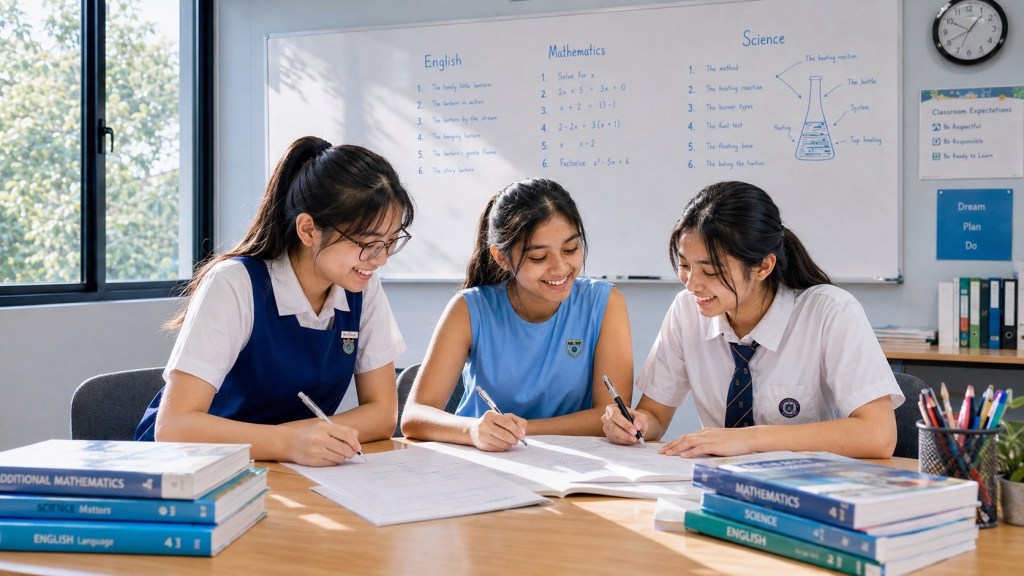
Science exam preparation in Sengkang is not simply a matter of doing more practice questions. Parents searching for a Science tutor in Sengkang, Primary Science tuition, PSLE Science tuition, Science exam preparation, Science revision, past papers, mock exams or model answers are usually trying to solve a deeper problem: how to turn months of classroom learning into reliable performance when the student has to decide what knowledge applies, retrieve it without prompts, explain it precisely and keep control under time.
The highest-traffic Science revision and tutoring sites internationally organise their student journeys around familiar search language—revision notes, exam questions, past papers, practice questions, model answers, flashcards, mock exams, homework help and personalised tutoring. Those resources matter, but the material itself is not the learning system. Two students can complete the same paper and gain very different amounts from it. One classifies mistakes, repairs the cause and returns later under changed conditions. The other checks the answer, nods, and moves on.
At eduKate Sengkang, formal Science tuition is for Primary 3 to Primary 6, including PSLE Science, in classes of up to three students for 1.5-hour lessons. Primary 1–2 Science material on this site is educational discovery content rather than a claim of formal P1–2 Science tuition. Secondary G1, G2 and G3 Science is covered as a parent-education and transition route because Primary learning has consequences after PSLE; it is not presented here as an eduKate Sengkang Secondary Science tuition offer. This article owns one parent decision: why a tutor can make exam preparation more diagnostic, sequenced and transferable than simply accumulating revision materials.
Exam preparation begins before the revision period
If examination preparation starts only when the calendar says “revision,” much of the difficult work has been postponed. Strong exam performance depends on structures built earlier: accurate concepts, connected knowledge, retrieval habits, question-reading control, evidence use, explanation, correction and the ability to recognise a concept when its surface story changes. A revision period can strengthen these capabilities, but it cannot always build all of them quickly from zero.
For Primary 3 and Primary 4, this means treating ordinary classwork as future examination preparation without turning childhood into continuous test drilling. Students can learn to retrieve a concept after a delay, explain why an answer is correct, compare two cases, identify evidence and make a second attempt after feedback. These are low-pressure habits that later make formal revision much more efficient.
For Primary 5, the time horizon changes. There is now enough curriculum breadth that forgotten knowledge and weak transfer become visible. A student may perform well in a just-taught topic yet struggle when several topics are mixed. This is the year to build cumulative retrieval and mixed practice deliberately, because Primary 6 will require the learner to manage both current school demands and the full PSLE Science field.
For Primary 6, exam preparation becomes explicit. But even then, the first question should not be “How many papers can we finish?” It should be “What does the learner need the papers to reveal?”
The five jobs hidden inside a Science examination
A Science paper compresses several cognitive jobs into one visible answer. When a mark is lost, parents often see only the final outcome. A tutor can unpack the performance so that practice targets the failed job rather than the topic label alone.
1. Recognise the scientific demand
The student must work out what kind of scientific relationship the item is testing. The question may never name the topic directly. It may present a diagram, an investigation, a comparison or a real-world context. Recognition is therefore different from recall. A child can know the concept and still fail to identify that the concept is needed.
2. Retrieve the relevant knowledge
Once the demand is recognised, the learner must access the right facts, processes, properties, mechanisms or relationships without being shown the notes. Retrieval is why revision should not remain permanently open-book. Notes are useful for building understanding, but an examination requires access without the page being visible.
3. Apply knowledge to the actual evidence
Science examinations often provide information that changes what can be concluded. The student must connect general knowledge to the specific objects, data, conditions or observations in front of them. A true statement that ignores the evidence may still be a poor answer.
4. Communicate the reasoning
The learner must put enough of the scientific chain into words, labels, tables, graphs or calculations that the reasoning can be credited. “Keyword” knowledge helps only when the word is placed inside a complete answer. Naming “evaporation,” “friction” or “photosynthesis” is not automatically equivalent to explaining what the process does in the given situation.
5. Execute under time
A student can understand Science and still underperform if the paper is paced badly, difficult questions absorb too much time, checking is random or an early mistake destabilises the rest of the section. Examination execution is a separate capability and should be trained separately from concept learning.
A practice paper is valuable when it tells you which of these jobs failed. Otherwise it is only a long worksheet with a score at the end.
Why more past papers can produce less learning
Past papers are powerful because they approximate the decision environment of an examination. They also create a common trap: once parents believe papers are “exam practice,” quantity can become the default measure of seriousness. A student may complete paper after paper while the same reasoning error survives.
Imagine that a learner repeatedly loses marks in experiment questions because the student changes two variables at once when describing a fair test. Completing another full paper will certainly produce more experiment questions, but it also consumes time on sections the child may already handle well. A targeted repair block may be more efficient: isolate fair-test design, compare examples and non-examples, practise identifying independent, dependent and controlled variables, then return to a new paper to see whether the repair transfers.
This is one reason tutoring can improve the efficiency of revision. The tutor can interrupt the paper cycle when the evidence says a narrower repair is needed. The paper remains important, but it becomes a diagnostic sampling tool rather than the curriculum itself.
A four-stage Science exam-preparation cycle
Stage 1: Build and organise
Before heavy timed practice, the learner needs a usable knowledge architecture. Topic notes should not be a stack of isolated facts. The student should know relationships: what causes what, which variables matter, how systems interact, what evidence supports a conclusion, and which common cases are easy to confuse.
A tutor can help organise this knowledge through concept maps, comparison tables, retrieval questions, diagrams and short explanations. The objective is not to create beautiful notes. It is to make the knowledge easy to retrieve and use.
Stage 2: Retrieve and reconstruct
The learner now practises bringing the knowledge back without looking. Flashcards can help for definitions and distinctions, but Science revision also needs prompts that require relationships and mechanisms. “What is evaporation?” is useful. “Why does increasing exposed surface area change the rate of evaporation, and how would you recognise that relationship in a different setup?” is more demanding.
A tutor should notice whether the student retrieves only labels or complete relationships. If recall is fragile, more application questions may create frustration rather than improvement. Repair retrieval first.
Stage 3: Apply and transfer
Once knowledge is accessible, the learner should meet unfamiliar or altered contexts. This is where exam questions, school papers and carefully selected practice become valuable. The question should force the student to decide which concept applies rather than announcing the topic in advance.
Transfer practice should vary one or more surface features while preserving the underlying scientific structure. The child learns that heat transfer remains heat transfer whether the context is a cup, a metal spoon, clothing or a container. The story changes; the relationship survives.
Stage 4: Execute and recover
Timed sections and full papers belong here. The student is no longer only practising Science; the student is practising the management of Science performance. The tutor observes starting speed, time distribution, question selection, checking behaviour, recovery after uncertainty and whether accuracy deteriorates near the end.
If timed performance exposes a concept gap, the cycle can move backwards temporarily. Good exam preparation is not a one-way conveyor belt. It loops between performance and repair.
How a Science tutor should use revision notes
Revision notes are high-intent search material because students want a compact representation of a large syllabus. They can be useful, especially when a learner needs a clean reference after months of school material have become scattered. But notes do not automatically create recall, and concise notes can hide the very relationships a weak student does not yet understand.
A tutor should therefore ask what job the notes are doing. Are they a reference during initial repair? A checklist for retrieval? A source of diagrams? A way to compare related concepts? If a student spends the entire revision period rereading notes, the experience may feel fluent because the material is familiar. The examination, however, removes the notes. Familiarity is not access.
A useful transition is read → close → reconstruct → check → repair. After reading a short section, the learner closes it and explains the idea from memory, sketches the system, answers a retrieval question or writes the causal chain. The notes then become a checking tool rather than a permanent crutch.
How a tutor should use practice questions
Practice questions are most valuable when the difficulty and purpose are controlled. A student who is rebuilding a concept may need clean, direct questions first. A student who already understands the concept may need mixed, unfamiliar application. A student preparing for PSLE may need open-ended questions where the scientific relationship must be expressed precisely. The same “hard question” is not equally useful for all three students.
A tutor can also control variation. If every question looks almost identical, the learner may succeed by pattern matching. If every question is radically different, the learner may never stabilise the underlying route. Good sequencing often moves from similarity to controlled variation to mixed practice.
In a three-student class, the tutor can use different questions for the same underlying relationship. Students can compare why three different contexts all require the same scientific idea. This makes transfer visible instead of leaving it as an abstract teaching goal.
How model answers should be used without creating imitation
Model answers are useful because they show the level of precision expected. They can also create the illusion that Science is a language-copying subject. Students sometimes memorise a polished sentence and then paste it into a new question where one condition has changed.
A better use of a model is analytical. Ask: What part of the question does each phrase answer? Which scientific relationship is stated? Where is the evidence used? Which words would need to change if the setup changed? What could be removed without damaging the answer? This turns the model into a structure to understand rather than a paragraph to imitate.
The learner should then close the model and answer a changed question independently. If the student can only reproduce the original wording, the model has not yet become transferable knowledge.
Mock exams should answer a question, not merely create pressure
A mock examination can test whether separate capabilities hold together under realistic conditions. But a mock should have a purpose. Early mocks may be diagnostic: where does performance collapse? Later mocks may be for pacing, endurance and recovery. Near the examination, they may confirm that recent repairs survive in a full-paper environment.
The score matters, but the post-mock review matters more. A tutor can divide lost marks into categories, identify whether the same failure is repeating, and decide what the next week should contain. Without this review, mock exams can become emotional events rather than learning instruments.
Parents should resist the temptation to react to every mock score as a final forecast. A practice score is a sample of performance under one set of conditions. The useful response is to ask what the paper revealed and what will change before the next sample.
Primary 1–2: early Science should build habits, not exam anxiety
Families sometimes search for Primary 1 Science tuition or Primary 2 Science tuition because they want a child to be “ahead.” For Science, the better preparation at this stage is often observation, comparison, classification, measurement language, prediction and explanation of everyday phenomena. The learner can build the habits that later make formal Science more intelligible without importing upper-primary examination pressure too early.
eduKate Sengkang’s P1–2 Science content is therefore educational discovery material rather than a formal tuition offer. Parents can use simple activities—sorting materials, observing shadows, watching plants, comparing floating objects, describing changes—to make evidence and curiosity normal parts of conversation.
Primary 3: build the language of evidence early
Primary 3 is the first formal Science year for many Singapore students. Examination preparation at this level should remain proportionate. The most valuable work is often accurate concept building and disciplined explanation. Can the child classify based on observable characteristics? Can the child distinguish a feature from a function? Can the child describe a life-cycle change in the correct order?
Short retrieval and application checks can be introduced without turning every lesson into a mock exam. The aim is to make later revision easier because the knowledge was organised correctly from the start.
Primary 4: begin cumulative return
By Primary 4, students have enough Science behind them that old ideas can be revisited while new ones are learned. This is an ideal time to introduce cumulative return. A short warm-up can mix one current question with two older concepts. The student begins learning that Science knowledge does not expire at the end of a chapter.
This matters because later examinations mix topics. If every practice session remains chapter-isolated, the learner never practises the act of selecting the right concept from a larger field.
Primary 5: build the PSLE runway without making every week a PSLE week
Primary 5 is where many families begin looking seriously for Science tuition. The learner now needs to retain more content, manage more complex systems and write stronger open-ended explanations. This is also where a tutor can begin building a one-year runway to PSLE through cumulative retrieval, application and correction habits.
The objective is not to force full PSLE intensity for twelve months. It is to arrive in Primary 6 with fewer inherited weaknesses. A Primary 5 student who can retrieve old concepts, use evidence, explain cause-and-effect and return to corrections has a much stronger platform than a student who starts PSLE preparation with a folder of forgotten worksheets.
Primary 6: use the PSLE paper to find the failure
For Primary 6, the canonical eduKate Sengkang route is PSLE Science Tuition Sengkang | Use the Paper to Find the Failure. That owner explains the diagnostic logic in depth. A paper can reveal knowledge failure, reconstruction failure, evidence failure, explanation failure or execution failure. The important move is to respond to the category rather than only the lost mark.
For open-ended mechanics, use Primary 6 Science | How to Answer Open-Ended Questions for PSLE. This page does not compete with that answering owner. Its narrower role is to show parents how a tutor can sequence revision notes, practice questions, papers and feedback into a coherent exam-preparation system.
Why “scientific keywords” are not enough for PSLE preparation
Parents often hear that Science answers need keywords. Keywords matter because technical terms carry precise meanings. But a keyword by itself does not demonstrate a relationship. “Friction” can be relevant to motion, but the answer may still need to explain how friction acts and what change follows. “Evaporation” can be relevant to water loss, but the answer may need to connect exposed surface area or temperature to rate and then to the observed amount.
A tutor should therefore teach keywords as components of mechanisms. Students should know not only the word, but when it applies, what it connects, and what conclusion it can support. This reduces the habit of inserting technical vocabulary into an answer and hoping the marker will infer the missing reasoning.
The revision timetable should be built from dependencies
A generic timetable may allocate Monday to Biology, Tuesday to Chemistry and Wednesday to Physics. For Primary Science, topic labels differ, but the same planning problem remains: time is being assigned without asking what depends on what. A stronger timetable identifies high-dependency weaknesses first.
If a student cannot interpret experiment variables, that weakness affects many topics. If the learner cannot read graphs accurately, the same problem recurs in different content areas. If explanations repeatedly stop after naming the process, the response problem crosses the syllabus. These cross-topic capabilities deserve early attention because repairing them improves more than one chapter.
The existing Science Revision Timetable and Weekly Study Plan provides a broader planning route. A tutor can adapt that logic to the individual learner rather than treating every student’s calendar as identical.
The three-student advantage during exam preparation
Small-group tuition has a specific advantage during revision: the tutor can compare reasoning without losing visibility. One student may solve a question quickly but omit evidence. Another may be slower but more precise. A third may know the concept yet misread the command word. These differences become teaching material.
The tutor can ask students to evaluate two answers, identify which one would survive a changed condition, or explain why the same concept appears in three different questions. Students learn from variation while still receiving direct feedback. The group stays small enough for the tutor to see who is reconstructing and who is following.
This does not mean a three-student class is automatically the right format for every learner. Parents should consider whether the child can participate, attempt independently and benefit from hearing peer reasoning. The broader fit guide is Is This Tuition Class the Right Fit?.
What useful exam-preparation feedback should tell the student
- Which part of the question was interpreted correctly.
- Where the first wrong decision occurred.
- Whether the missing piece was knowledge, evidence, mechanism, expression or execution.
- What the learner should do differently on the next attempt.
- Which new question will test whether the repair transfers.
- When the concept should be revisited again after a delay.
- Whether the weakness is local to one topic or appearing across the syllabus.
This kind of feedback turns correction into an operating instruction. “Revise more” becomes “You can recall the concept, but you are not using the comparison reference. We will practise comparison control across three different topics and re-test it under time.” The second statement can guide action.
How parents can tell whether revision is becoming more effective
A rising test score is useful evidence, but it may take time and can fluctuate with paper difficulty. Parents can also look for leading indicators. Does the child start questions faster? Are fewer prompts needed? Can the child explain why a correction is needed? Do repeated mistakes become less frequent? Does the student return to old material without acting as though it is completely new?
Another strong indicator is transfer. If the learner repairs an error in one context and then succeeds when the surface details change, the learning is becoming more flexible. If success disappears as soon as the diagram, object or wording changes, more transfer practice is needed.
After PSLE: the G1, G2 and G3 Science transition
Parents planning ahead should understand that Secondary Science changes the form of the work. The Singapore-Cambridge Secondary Education Certificate framework includes Science at G1 and combined Science pathways at G2 and G3. Students meet more formal disciplinary language, practical reasoning, quantitative relationships and increasingly abstract models.
The relevant Primary preparation is not pre-teaching Secondary chapters. It is building habits that survive the transition: retrieve accurately, read evidence, distinguish observation from inference, use models carefully, explain causal relationships and check whether a conclusion is warranted.
For the transition itself, read From PSLE to Secondary Science G1, G2 and G3: A Parent Guide. Families seeking a broader Secondary Science tuition route can use Secondary Science Tuition Singapore. eduKate Sengkang’s present formal Science tuition offer remains Primary 3–6/PSLE.
When a Science tutor is likely to add value to exam preparation
- The learner has revision materials but does not know what to do with them.
- Past-paper scores repeat the same pattern without improvement.
- The child can answer chapter worksheets but struggles when topics are mixed.
- Open-ended answers contain relevant facts but do not form complete explanations.
- The student understands corrections but cannot reproduce the reasoning later.
- Timing problems appear only in full papers.
- Parents cannot distinguish a content gap from a question-reading or execution gap.
- Practice volume is high but confidence and independence are not increasing.
When more tuition may not be the first answer
A tutor is not automatically the solution to every low score. If the child is exhausted, sleep-deprived or overscheduled, another lesson may reduce rather than increase learning. If the learner has strong capability but no revision routine, a simpler planning intervention may be enough. If one unusual paper produced a sudden dip, several pieces of evidence should be reviewed before a major programme change.
The useful principle is proportionality. Add teaching when teaching is the missing input. Add practice when practice is missing. Add rest when fatigue is the constraint. Add structure when the child knows the Science but cannot organise the work. A tutor who diagnoses well should be able to distinguish these cases.
What the first four weeks should establish
The first month of exam-focused tuition should not be a performance theatre where every lesson tries to prove immediate improvement. It should establish a baseline and find the learner’s repeated failure pattern. Bring several recent school papers and worksheets. Preserve original answers. Let the tutor see how the child begins, not only what the corrected page looks like.
By the end of the first few weeks, parents should be able to hear a more precise description than “weak in Science.” Perhaps the student has good content recall but weak transfer. Perhaps evidence questions are strong but causal explanations are incomplete. Perhaps accuracy is good until time pressure appears. The more precise the diagnosis, the more efficient the next block of practice can become.
The general progress guide First Four Weeks of Tuition | What Progress Should Look Like explains how parents can judge early progress without demanding an instant score jump.
A parent checklist for choosing Science exam preparation in Sengkang
- Does the tutor use papers to diagnose rather than merely assign more papers?
- Are revision notes converted into retrieval and application, not endless rereading?
- Will the child make second attempts after feedback?
- Are model answers analysed rather than copied?
- Is mixed practice introduced when the learner is ready for concept selection?
- Are timed sections used to diagnose execution separately from knowledge?
- Can the tutor explain which error pattern is being targeted this month?
- Is the programme truthful about the levels actually taught?
- Does the class size allow individual reasoning to remain visible?
- Will support gradually reduce as the learner becomes more independent?
Where this owner sits in the Science estate
Start at the Complete Science Index for the wider subject estate. For the current Primary programme, use Primary Science Tuition Sengkang | Managing Education. For paper diagnosis, use the PSLE Science tuition owner. For study methods, use How to Study Science Effectively Without Re-reading Notes.
This page owns a different parent intent: why Science tutoring can make exam preparation more efficient by sequencing revision notes, retrieval, practice questions, papers, feedback and timed performance around the learner’s actual failure pattern.
Frequently asked questions
How early should PSLE Science exam preparation begin?
The capabilities behind PSLE performance should be built progressively from earlier Primary years, while formal full-paper preparation becomes more relevant in Primary 6. Primary 5 is a useful runway for cumulative retrieval, application and correction habits.
Are past papers enough for PSLE Science?
Past papers are valuable, but they are most effective when errors are classified and repaired. Repeating papers without changing the underlying failure can produce a large volume of practice with little transfer.
Should a child memorise model answers?
Model answers are better used to study structure, precision and evidence. The learner should then answer a changed question independently to confirm that the scientific relationship, not the sentence, was learned.
How many students are in an eduKate Sengkang Science class?
The stated model is up to three students for 1.5-hour lessons. Current scheduling and fees should be confirmed directly because availability can change.
Does eduKate Sengkang offer Primary 1 or Primary 2 Science tuition?
The site contains educational P1–2 Science discovery content, but the current formal Science tuition programme is Primary 3–6/PSLE.
Does this Sengkang programme offer Secondary G1, G2 or G3 Science tuition?
Secondary Science is covered here for educational continuity and parent planning, but eduKate Sengkang’s stated formal Science tuition offer is Primary 3–6/PSLE. A broader Secondary Science route is available through eduKate Singapore.
Final idea: prepare the learner, not just the paper
Revision notes, flashcards, practice questions, past papers, model answers and mock exams are all useful tools. None of them decides the learning sequence by itself. The tutor’s value is in seeing what the learner can already do, finding the first weak link, choosing the next useful task, and checking whether the repair survives after support is removed.
For Sengkang and Punggol families considering Primary 3–6 or PSLE Science tuition, bring recent school evidence rather than only the final grade. A useful exam-preparation programme begins by discovering what the paper is telling us about the learner. Once that message is clear, revision can become narrower, calmer and more productive.
How to decide whether a low mock score needs reteaching or more exam practice
A low mock score does not tell parents what intervention to choose. Two students can receive the same mark for completely different reasons. One may have large concept gaps. Another may know the content but spend too long on early questions and leave marks unfinished. A third may understand the concept but write answers that do not use the evidence given. Treating all three with another full paper is unlikely to be equally useful.
The tutor can make the decision by sampling the student outside the timed paper. Ask the learner to redo selected questions without time pressure and to explain the reasoning aloud. If performance remains weak, the problem is likely upstream in knowledge, recognition or application. If performance becomes strong when the clock is removed, execution deserves more attention. If oral reasoning is strong but written answers remain vague, response construction becomes the target.
This separation matters because exam preparation should not become a punishment for low scores. The next task should be selected because it tests or repairs a hypothesis about the failure. A useful tutor is continually asking, “What evidence would tell me whether this is a knowledge problem, an application problem or an execution problem?”
The difference between revision coverage and revision depth
Parents often worry about whether every topic has been revised. Coverage matters, but a tick beside every chapter can hide shallow access. A student may have “done” a topic because notes were reread and a worksheet was completed once. The more important question is whether the knowledge can be retrieved, applied and explained after the context changes.
A tutor can therefore track revision at several depths. First, can the student recall the core fact or relationship? Second, can the student distinguish it from a similar idea? Third, can the learner recognise when it is relevant inside an unfamiliar question? Fourth, can the student use evidence to apply it? Fifth, can the learner communicate the reasoning under time? A topic is much more examination-ready when these layers are visible.
This depth model also prevents an inefficient end-of-year rush. Instead of discovering in the final weeks that ten “covered” topics are not actually retrievable, cumulative checks reveal fragility earlier. Revision becomes maintenance and strengthening rather than emergency reconstruction.
Why the last ten minutes of a lesson matter
A lesson can feel excellent while the tutor is explaining. The final minutes reveal whether the student can carry anything away. A strong closing routine asks the learner to reconstruct one or two important ideas without notes, solve a short changed item, state the error pattern that was repaired, and identify what should be checked again later.
This closing routine serves two purposes. It compresses the lesson into an accessible memory and gives the tutor immediate evidence about independence. If the student cannot restate the relationship after ninety minutes of work, another explanation may not be the best next move. The tutor may need to reduce the amount covered and increase retrieval.
Parents can ask a simple question after class: “What can you do now that you could not do before the lesson?” A useful answer is capability-based: “I can tell whether a question needs evidence from the graph or a general Science fact,” or “I can explain why the variable has to stay the same.” That is more informative than “We did three worksheets.”
A calm final-month strategy is usually more useful than a desperate one
As an examination approaches, families can feel pressure to increase everything at once: more papers, more notes, more tuition, later nights and more correction. The risk is that fatigue reduces the quality of retrieval and reasoning precisely when stable execution matters most. A good final month is selective. It protects sleep, continues cumulative retrieval, targets the remaining repeated weaknesses and uses full papers only often enough to test integrated performance.
The tutor should also reduce unnecessary novelty. If the learner has a working checking routine, a familiar way to classify open-ended questions and a reliable pacing plan, the final weeks are not the time to replace every routine with a new system. Improvement can still happen, but it should be attached to evidence from actual performance.
The objective is not to make the student feel that the examination is easy. It is to make the student know what to do when a question is difficult: identify the demand, retrieve what is relevant, use the evidence, construct the explanation, move on when necessary and return deliberately. That recovery behaviour is part of examination preparation.
Science and Sengkang routes: return to the Science Hub or Complete Science Index for the wider Science estate; use What about Sengkang? for the town-wide route.
Return to Science Tutor Sengkang for the complete small-group Primary Science tutoring route: diagnose the first weak link in observation, concepts, relationships, evidence, explanation and examination execution.
