
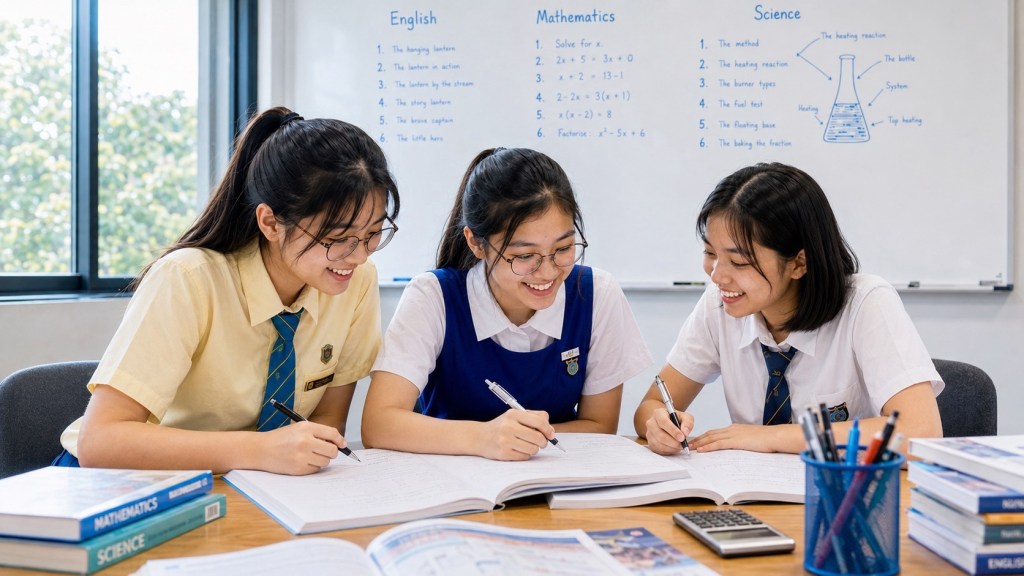
Secondary Mathematics can be learned faster, but the fastest route through SEC G1, G2 and G3 Mathematics is not to rush through more chapters. It is to make the language of algebra, equations, graphs, geometry and problem solving increasingly automatic so that a student spends less mental effort decoding notation and more effort choosing the right mathematical relationship. Parents searching for Secondary Mathematics tuition in Sengkang, G1 Mathematics, G2 Mathematics, G3 Mathematics, algebra help, equations, functions, graphs or a Mathematics tutor are often describing the same hidden problem: the student understands an explanation in class but cannot reliably rebuild the route alone.
The search language used by large international Mathematics learning platforms is useful here. Algebraic expressions, linear equations, functions, graphs, inequalities, geometry, trigonometry, statistics and word problems appear repeatedly because these are not isolated topics; they are connected representations of quantities and relationships. A student who can move between words, symbols, tables and graphs learns faster because each representation supports the others. A student who can manipulate symbols but cannot say what they mean often slows down as soon as a question changes shape.
In Singapore, SEC Mathematics is organised by subject level, and the exact assessed scope depends on the student’s subject and examination syllabus. Parents should therefore use current official syllabus documents rather than assume G1, G2 and G3 are simply three versions of one identical course. The current SEAB G1 syllabus page, G2 syllabus page and G3 syllabus page are the right reference points for examination scope. On eduKate Sengkang, the wider route is mapped through the Mathematics Tuition Sengkang hub, the Secondary Mathematics Sengkang capability map and the Complete Mathematics Index. This article has a narrower job: make the tutorial-learning process itself faster.
Quick Read: The Secondary Mathematics Speed Equation
Fast learning in Secondary Mathematics usually comes from four improvements working together. First, basic arithmetic and fraction skills become cheap enough to retrieve that they no longer interrupt algebra. Second, notation becomes meaningful rather than decorative. Third, the student can change representation: words to equation, equation to graph, graph to statement, diagram to relationship. Fourth, practice is mixed often enough that the learner must choose a method rather than merely repeat the method printed at the top of the worksheet.
A useful tutorial loop is diagnose → model → explain the decision → guided attempt → independent attempt → representation switch → mixed retrieval → delayed retest. The loop matters more than raw worksheet count. If a student needs the same hint on every question, the tutorial has not yet transferred the decision to the learner.
1. Why Secondary Mathematics Feels Different After Primary School
Primary Mathematics often allows students to reason with concrete quantities, models and arithmetic relationships. Secondary Mathematics keeps those foundations but increases the density of symbols, abstraction and generalisation. Instead of solving one numerical case, students are increasingly asked to describe a relationship that works across many possible values.
That shift can make a previously strong learner feel slower. The student may still be able to calculate, but now has to interpret variables, algebraic conventions, negative numbers, graphs and formal relationships. The solution is not to abandon the earlier intuition. It is to connect it to symbolic language.
2. Algebra Is Compression
Algebra is often introduced as letters and rules, but its deeper value is compression. A statement such as “three more than twice a number” can become 2x + 3. A repeated relationship can be expressed once rather than recalculated from the beginning. A graph can show an entire family of input-output pairs at once.
Students learn algebra faster when every new symbol is tied to what it represents. The letter is not an object to fear; it is a placeholder for a quantity. The equals sign is not an instruction to “write the answer”; it states that two expressions have the same value.
3. The Equals Sign Must Become Relational
One of the most important transitions is understanding equality as balance. In arithmetic, students often see 7 + 5 = 12 and unconsciously read the equals sign as “now calculate.” In algebra, equations such as 3x + 4 = 19 require the student to preserve equality while transforming both sides.
A tutorial should therefore ask what remains true after each algebraic step. Why can the same quantity be added to both sides? Why does dividing both sides by the same non-zero number preserve equality? This makes procedures easier to reconstruct when memory fails.
4. Negative Numbers Must Be Stable Before Algebra Becomes Fast
Many apparent algebra errors are really signed-number errors. A student may know how to solve an equation but lose marks because subtracting a negative value or multiplying signs remains uncertain. When that happens, algebra consumes too much working memory because every line contains a possible arithmetic hazard.
Short retrieval work on signed numbers can therefore accelerate an entire Secondary Mathematics tutorial. The repair should be narrow: number-line meaning, addition and subtraction, multiplication and division signs, and order of operations. Once those are stable, algebraic manipulation becomes noticeably cheaper.
5. Fractions Do Not Disappear in Secondary Mathematics
Fractions return inside algebraic fractions, ratios, gradients, probabilities, rates and formulas. A learner who survived Primary Mathematics by using calculator decimals for every fraction may now struggle to see exact relationships.
The tutorial should preserve fraction meaning. A fraction is division and a ratio between quantities. Equivalent forms can be useful, but simplification must respect factors and restrictions. Teach students to ask what can legally cancel and why. Cancelling marks without factor structure creates fragile habits.
6. Algebraic Expressions Need Structure Before Expansion
An expression is not merely a string of symbols. It has terms, factors, coefficients, powers and operations. Students should learn to see 3(x + 2) as a product before they expand it, and x² – 9 as a difference of squares when that structure becomes relevant.
Structural reading speeds up manipulation because the learner recognises available moves. Without structure, every line looks new. With structure, a large expression can be compressed into a familiar pattern.
7. Expansion and Factorisation Are Inverse Views
Expansion distributes multiplication over addition. Factorisation reverses that process by exposing a common product or algebraic pattern. Teaching them as unrelated chapters increases memory load. Teaching them as opposite directions creates a reversible mental model.
A fast tutorial often asks students to move both ways. Expand a factorised form, then reconstruct the factors. Check factorisation by re-expanding. The inverse relationship becomes a built-in error detector.
8. Equations Are Not a Sequence of Magic Moves
Students often memorise phrases such as “move it to the other side and change the sign.” The shortcut can produce answers, but it hides the equality structure and becomes dangerous when expressions become more complicated.
A better learning route treats every step as an equivalent equation. Simplify where helpful, perform the same valid operation on both sides, and keep the unknown visible. The student should be able to say what changed and why. This explanation becomes shorter as fluency grows.
9. Formulae Require Subject Control
Rearranging a formula is equation solving with several symbols. A student who understands equality and inverse operations can generalise; a student who memorises a different trick for every formula becomes overloaded.
Teach the learner to identify the target variable, then remove operations in a controlled order. Check by substituting simple values or by asking whether the rearranged form is dimensionally and logically sensible.
10. Word Problems Need Translation, Not Guessing
Secondary word problems often become more compact than Primary stories but more abstract. The student must decide what the variable represents, write a relationship and interpret the resulting value in context.
Before solving, write a definition: let x represent what? Then state the equation or system. The act of naming the variable forces clarity. If two quantities change together, define their relationship before calculating.
11. Graphs Are Pictures of Relationships
A graph should not be treated as a drawing exercise. Axes represent variables, points represent paired values, gradient represents a rate of change in many contexts, and intercepts encode special conditions. The visual form can reveal behaviour that an equation hides.
A tutorial becomes faster when equations and graphs are taught together. Ask what changing a coefficient does to a graph. Ask which part of an equation predicts an intercept. Ask how a graph can confirm whether an algebraic answer is plausible.
12. Coordinate Geometry Connects Algebra and Space
Coordinate geometry is one of the best bridges between symbolic and visual Mathematics. A line can be described by points, gradient, equation and geometric relationships. Students who see these as separate topics miss the compression.
Use one problem in several forms. Calculate a gradient, sketch the line, interpret its sign, write an equation and explain what the intercept means. Repeated representation switching builds flexible control.
13. Functions Are Input-Output Rules, Not Just a New Letter
At more advanced stages, function notation can feel unfamiliar because f(x) looks like multiplication. It is not. It names the output of a function when the input is x. International resources such as Khan Academy’s functions materials organise learning around evaluating functions, domain and range, graphs and transformations because those ideas all describe how inputs map to outputs.
Singapore students should still follow their actual school and examination syllabus for assessed scope. The useful learning point is universal: function notation becomes easier when it is connected to a rule, a table and a graph rather than memorised as syntax.
14. Tables Are Underused Bridges
A table can sit between words and graphs. It makes input-output pairs explicit and can reveal constant differences, multiplicative patterns or non-linear change. For a student who finds graphs abstract, a small table often provides the missing bridge.
Ask the learner to predict the next row, then explain the rule. Convert the rule into an expression, then plot selected pairs. This gradual shift makes abstraction feel earned rather than imposed.
15. Geometry Still Depends on Language Precision
Secondary geometry adds formal properties and more complex relationships, but many errors begin with imprecise reading. “Parallel,” “perpendicular,” “similar,” “congruent,” “bisector,” “tangent” and “radius” carry exact mathematical meaning.
Teach the student to annotate diagrams with known properties rather than rely on appearance. A diagram may not be drawn to scale. The proof or calculation must come from stated information and valid properties.
16. Trigonometry Is a Relationship System
Students often approach trigonometry as three buttons or three ratios to memorise. It becomes easier when sine, cosine and tangent are tied to right-triangle relationships, angle information and side roles. The student should know what is being related before choosing a formula.
Later trigonometric work becomes more demanding, so early meaning matters. Draw, label, identify the target, choose the relationship, then calculate. The calculator comes after the mathematical decision.
17. Statistics Requires Interpretation, Not Only Computation
Mean, median, mode, range and graphical displays can be calculated, but the examination may also test whether the student understands what a measure says about a data set. A fast learner connects computation to meaning.
Ask what changes when an extreme value is added. Ask which measure is most affected. Ask what a graph communicates and what it conceals. These small interpretation questions build the reading habits needed for unfamiliar data.
18. Probability Needs a Clear Sample Space
Probability questions become slow when possible outcomes are not organised. Tables, lists and tree diagrams can reduce ambiguity by making the sample space visible.
The representation should match the problem. A simple event may need only counting. A multi-stage event may benefit from a tree. The goal is not to draw diagrams because a chapter says so; it is to choose a representation that reduces uncertainty.
19. G1, G2 and G3 Should Not Be Turned Into Ability Labels
Subject levels describe the level at which a subject is being studied; they should not become a permanent judgement about a student’s overall capability. A learner can be strong in one subject and need more support in another. Progress can also change over time.
For parents, the practical question is not “Which label is my child?” but “What Mathematics is the child currently expected to learn, which prerequisite is unstable, and what evidence will show readiness for the next demand?” Current school guidance and official syllabus information should govern decisions.
20. The Same Learning Mechanism Can Serve Different Subject Levels
Although G1, G2 and G3 have different syllabus expectations, students at any level can benefit from the same underlying learning mechanisms: clear modelling, guided practice, retrieval, spaced return, feedback, variation and independent proof.
What changes is the mathematical content, complexity, pace and expected transfer. A responsible tutorial adjusts the task without lowering the standard of thinking about the task.
21. Speed Comes From Symbol Fluency
A student who pauses at every negative sign, fraction bar, exponent or bracket has less attention available for the problem itself. Symbol fluency therefore matters. This does not mean mindless speed drills. It means enough deliberate practice that common notation can be read accurately with low effort.
Use brief retrieval: simplify one expression, interpret one exponent, evaluate one substitution, compare two signed values. Small repeated checks can unlock larger tasks.
22. Representation Switching Is a Core Secondary Skill
Give one relationship and ask for four views: a sentence, an equation, a table and a graph. The student will usually have one preferred representation and one weak one. The weak translation is often where later examination questions become difficult.
Practice switching deliberately. The point is not artistic variety. It is to prove that the student understands the relationship independently of its surface form.
23. Worked Examples Should Show Decisions
A worked example is most valuable when the tutor narrates why a step was chosen. “I am factorising because I need the expression in a form that reveals its roots.” “I am drawing a table because two quantities change together.” “I am using this trigonometric ratio because these are the known and unknown sides.”
Then remove the narration and ask the student to generate it. Finally remove the example and give a fresh problem. The tutorial has succeeded only when the decision survives.
24. Fading Prevents Hint Dependence
Hint dependence is one of the most common hidden causes of slow homework. In tuition the student appears capable because prompts arrive immediately. At home, the same student stalls because the tutor’s cue has become part of the method.
Fade support systematically. First ask a broad question: “What relationship do you see?” Then a narrower cue if needed. Record the smallest prompt that produced movement. On the next similar problem, begin with less help.
25. The “One Fresh Question” Rule
After repairing an error, use one fresh question before moving on. This simple rule distinguishes recognition from performance. A student who nods while reading a corrected solution may still be unable to rebuild it.
The fresh question should preserve the target relationship but change the numbers, wording or representation. Success provides evidence; failure locates the next weak decision.
26. Retrieval Should Include Old Algebra
Secondary Mathematics is cumulative. A student studying a new topic still needs access to older algebra, fractions, signed numbers and geometry. If revision contains only the current chapter, older prerequisites quietly decay.
A five-minute retrieval set can include one old equation, one fraction manipulation, one graph interpretation and one current idea. The set is short because its purpose is availability, not exhaustion.
27. Spacing Makes Knowledge Survive the Timetable
Students often experience the illusion of mastery after a long revision session because the method remains active in short-term memory. Returning after a delay is a stronger test.
Schedule short returns. Today, tomorrow, several days later, then inside a mixed set. The exact spacing can vary. The principle is to make retrieval happen after some forgetting has begun.
28. Interleaving Teaches Method Selection
Ten identical linear-equation questions can build procedure. A mixed set containing an equation, a factorisation, a graph question and a geometry item teaches choice. Both kinds of practice have a place.
Use blocked practice when a new method is fragile. Shift toward mixed practice once basic execution is stable. Examinations require recognition as well as calculation.
29. Timing Is Diagnostic Data
A slow question is not automatically a weak question. Some problems genuinely require thought. But repeated long pauses at the same type of step are informative. Track where the time goes: reading, recalling a fact, choosing a method, algebraic manipulation, calculator entry, checking or recovering after an error.
The tutor should repair the bottleneck, not merely command the student to work faster.
30. Calculator Skill Should Support, Not Replace, Mathematics
A calculator can perform arithmetic but cannot decide what the problem means. Students need reliable entry, brackets, modes, rounding control and estimation. They should also recognise when an exact form is required or when a decimal approximation is reasonable.
Before accepting a display, estimate. If the result is wildly outside the expected range, inspect the mathematical setup and the input. Calculator discipline is part of examination control.
31. Error Logs Should Record Causes
Writing “careless” beside every error teaches nothing. Classify causes: notation, sign, prerequisite fact, equation setup, graph reading, property recall, calculator input, unit, time pressure, or incomplete checking.
A cause-based log reveals whether ten wrong questions are actually one problem. That is how revision becomes shorter and more targeted.
32. Test Corrections Need a Transfer Step
After a school test, do not simply copy model solutions. For each important error, state the cause, repair the missing knowledge and solve a fresh related question. Then revisit it after a delay.
This turns a disappointing paper into a diagnostic asset. The score describes what happened; the correction cycle changes what happens next.
33. How a Three-Student Tutorial Can Move Faster
In a group of up to three, students can work on the same core concept while the tutor branches the support. One may need a signed-number repair, another a representation cue, and another a harder transfer item. They do not need identical worksheets to be learning the same mathematical idea.
The small-group advantage is diagnostic visibility combined with independent work. The tutor can observe each student without turning the lesson into ninety minutes of one-to-one prompting.
34. What a 90-Minute Secondary Mathematics Tutorial Can Do
A useful 1.5-hour lesson can begin with retrieval, identify one high-priority weakness, teach or model a relationship, give guided practice, test an independent item, then mix the concept with older work. The final phase can use school questions, a transfer problem or timed examination practice depending on the learner.
The exact allocation changes. The important feature is that explanation is followed by evidence. The student should leave with a smaller dependency on the tutor than when the lesson began.
35. What Parents Should Ask Instead of “Did You Finish the Worksheet?”
Ask: What did you learn to recognise? Which step used to need a hint? What can you now do without notes? Which old skill caused trouble? What fresh question proved the correction? What will you retrieve again later?
These questions direct attention toward learning rather than page count. They also give the parent useful information without requiring the parent to reteach the lesson.
36. What “Good Progress” Looks Like Before Marks Rise
Marks are important but can lag behind learning. Early progress may appear as faster starts, fewer repeated sign errors, better working, more accurate graph reading, less hint dependence and more successful correction of unfamiliar questions.
These indicators matter because they are mechanisms that can later support improved assessment performance. A tutor should be able to explain which indicator is changing and why it matters.
37. When More Practice Is the Wrong First Response
If a student has completed many similar questions and still makes the same mistake, the issue may not be quantity. The learner may misunderstand equality, confuse a notation rule, lack a prerequisite fact or fail to recognise when a method applies.
Stop the repetition and diagnose. One carefully chosen explanation followed by one fresh proof question can be more valuable than another twenty repetitions of the same error.
38. When More Practice Is Exactly Right
Once the concept is understood but execution is still slow or inconsistent, additional deliberate practice can be useful. The student may need fluency with algebraic manipulation, graph plotting, standard geometry properties or calculator procedures.
The key is that practice now has a defined target. Volume follows diagnosis rather than replacing it.
39. Secondary 1: Protect the Transition
Secondary 1 is a major transition point because students must reorganise Primary knowledge into more formal structures. Do not assume that a weak first test means the whole foundation is missing. Identify whether the problem is notation, negative numbers, algebraic language, pace, new study routines or question interpretation.
The existing Why Secondary 1 Mathematics Feels Different After PSLE owner covers that transition in more depth. This tutorial series uses the same principle: diagnose the change before prescribing more work.
40. Secondary 2: Consolidate Before Upper-Secondary Complexity
Secondary 2 often becomes the year where algebraic fluency, geometry, graphs and other relationships need to become stable enough to support upper-secondary work. A student can still recover effectively if weak links are identified before they compound.
Use mixed diagnostic questions rather than chapter scores alone. A learner may pass each chapter immediately after teaching but struggle when methods are mixed. That difference is important.
41. Secondary 3: New Work Exposes Old Gaps
Upper-secondary content can make an earlier weakness suddenly visible. A student may blame trigonometry when the true problem is algebraic rearrangement, or blame coordinate geometry when signed-number arithmetic is unstable.
The current chapter is the place where the weakness appears, not necessarily where it began. Efficient tuition traces the failure backward only as far as necessary, repairs it and reconnects the student to current work.
42. Secondary 4: Performance Control Matters
By Secondary 4, learning and examination control interact closely. The student needs durable knowledge, method selection, timing, calculator discipline, complete working and a recovery protocol for difficult questions.
Revision should increasingly use mixed and timed conditions while still protecting targeted repair. A full paper is not useful if every review ends with “do more papers.” The paper should tell you what to change.
43. From G3 Mathematics Toward Additional Mathematics
Students moving into or studying Additional Mathematics need strong algebraic control because many later topics use algebra as the working language. Functions, trigonometry, coordinate geometry and calculus-related work can become unnecessarily hard when factorisation, equations, indices or fractions are still expensive.
The next article in this series is written for parents who see an A-Math chapter failing and need to determine whether that chapter is actually the root problem.
44. Search More Precisely Than “Best Math Tuition Sengkang”
A parent searching for help can name the learning problem: Secondary Mathematics algebra weak, equations help, negative numbers, graph interpretation, G2 Mathematics support, G3 Mathematics tutor, Secondary Maths word problems, Mathematics tuition small group Sengkang, or child understands in class but cannot do questions alone.
Precise search terms often produce more useful educational material and make a first conversation with a tutor more diagnostic.
45. A Parent Decision Framework
Consider additional support when the learner repeatedly cannot begin independent questions, the same prerequisite error appears across topics, homework time is rising, school corrections do not transfer to fresh questions, or confidence is falling because the student cannot identify what is wrong.
Tuition should have a defined job. The purpose may be repair, consolidation, acceleration, examination preparation or maintaining a strong learner’s precision. Different jobs require different lesson design.
46. Commercial Value: What Small-Group Tuition Should Buy
Questions, videos and notes are abundant. The scarce value is diagnosis and instructional judgement: which prerequisite matters, which example makes the relationship visible, how much help to give, when to remove it, what fresh problem to use and when to return after delay.
At eduKate Sengkang, the three-student model is intended to keep that diagnostic resolution high. A parent should evaluate whether tuition is producing growing independence rather than merely producing completed material.
FAQ: How Can My Child Learn Secondary Mathematics Faster?
Reduce wasted learning. Make basic arithmetic and notation fluent, identify the exact weak link, use worked examples for decisions rather than copying, switch representations, practise independently and return after delay. Faster learning comes from fewer repeated breakdowns, not from rushing every question.
Is G3 Mathematics always better than G2 or G1?
No general ranking is useful. Subject level should match the student’s current school programme, requirements and readiness. Use school guidance and official MOE/SEAB information for decisions. The learning goal at any level is to build secure knowledge and independent mathematical capability.
Why does my child understand tuition but still fail school tests?
Possible causes include hint dependence, blocked practice, weak delayed retrieval, difficulty recognising question types when mixed, time pressure, incomplete working or a prerequisite that was temporarily supported during tuition. Test the student on fresh, mixed questions without prompts.
Should a student memorise algebra rules?
Some conventions and facts need fluent recall, but rules should be connected to mathematical structure. A student who understands equality, factors and inverse operations can reconstruct more when memory fails.
How often should Secondary Mathematics be revised?
Regular shorter returns are generally more useful than relying only on a single long session before a test. The exact schedule depends on workload and need. Include current work, older retrieval and mixed practice.
Does a student need tuition if marks are already good?
Not necessarily. A strong student may progress well through school lessons and independent study. Tuition has value only if it solves a real learning or performance need, such as extension, precision, difficult transfer or preparation for a new demand.
Where should parents continue on eduKate Sengkang?
Use the Mathematics Tuition Sengkang hub, the Secondary Mathematics capability map and the Complete Mathematics Index. These remain the principal routing owners; this tutorial article supports them.
Closing: Make Mathematical Language Cheap Enough to Think With
Secondary Mathematics becomes faster when symbols stop feeling like obstacles and become compact tools. Equality expresses balance. Algebra compresses relationships. Tables organise pairs. Graphs reveal behaviour. Geometry properties constrain space. Trigonometry connects sides and angles. Statistics and probability organise uncertainty.
The tutor’s job is to identify which part of that language is still expensive for the learner, repair it, and then prove that the student can use it without prompts. For Sengkang and Punggol families, that is the standard worth looking for: not the fastest worksheet completion, but the fastest reliable conversion of teaching into independent Mathematics.
