
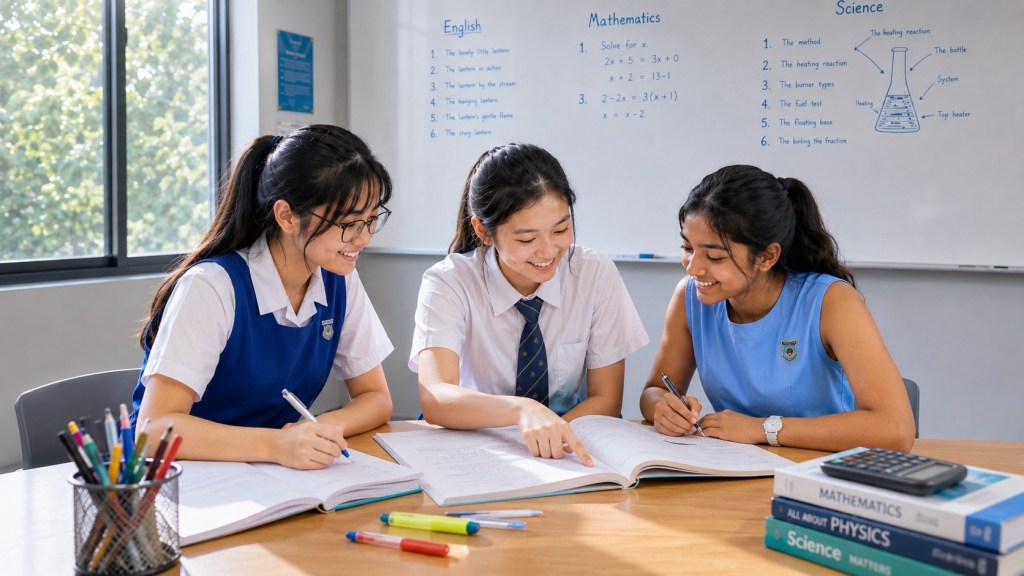
Primary Science foundations begin before a child sits a formal Science paper, but they should not begin with premature exam drilling. Parents searching for Primary Science tuition, a Science tutor in Sengkang, PSLE Science preparation or a Primary 1 to Primary 6 Science learning plan usually want the same thing: a clear route that prevents small gaps in observation, language, evidence and explanation from becoming large gaps by Primary 5 and Primary 6.
For families in Sengkang and Punggol, the useful question is not “How early should my child start memorising Science answers?” It is “Which scientific habits should be stable at each stage?” In Singapore, formal Primary Science is taught from Primary 3. That makes Primary 1 and Primary 2 valuable foundation years for noticing, comparing, classifying, measuring, describing change and asking sensible questions about everyday phenomena. From Primary 3 onward, those habits can be connected to the official Science curriculum, increasingly precise vocabulary, investigations, models, data and explanations.
This parent guide maps the journey from Primary 1 to Primary 6 without creating six disconnected mini-curricula. The lane is cumulative: Primary 1–2 build the language and habits of noticing; Primary 3–4 build formal concepts and evidence; Primary 5–6 build integration, transfer and PSLE readiness. A Science tutorial should therefore teach the next skill while preserving the earlier ones. The goal is not simply to finish more worksheets. It is to help a child become progressively better at seeing a scientific problem, selecting relevant knowledge, explaining what happens, using evidence and correcting mistakes.
Quick answer: what should parents build from Primary 1 to Primary 6?
- Primary 1: careful observation, simple comparison, accurate everyday vocabulary, noticing change and asking “what do I actually see?”
- Primary 2: classification by stated properties, measurement habits, simple cause-and-effect language, recording observations and distinguishing guesses from evidence.
- Primary 3: transition into formal Primary Science: concepts, scientific vocabulary, simple investigations, diagrams, tables and explanation routines.
- Primary 4: stronger mechanisms, fair tests, variables, data interpretation, connections across topics and clearer written explanations.
- Primary 5: cumulative retrieval, more complex systems, unfamiliar application, experimental reasoning and disciplined error correction.
- Primary 6: PSLE integration: select the right concept, interpret information, reason from evidence, explain precisely, manage mixed-topic questions and perform under examination conditions.
The sequence is not a promise that every child develops at exactly the same speed. It is a diagnostic map. If a Primary 5 student cannot compare evidence accurately, the repair may belong to a much earlier foundation. If a Primary 3 student can already explain relationships clearly, teaching can move forward without forcing unnecessary repetition.
Why Primary 1 and Primary 2 matter even though formal Science begins later
There is a difference between preparing for Science and starting the Primary 3 syllabus early. The first can be healthy and natural. The second can become counterproductive if it turns young children into answer memorisers before they understand what scientific thinking is for.
A seven- or eight-year-old already meets Science every day. Ice melts. Wet clothes dry. Shadows move. Plants change as they grow. Metal spoons feel different from wooden ones. Objects roll, bounce, float or sink. Food changes when heated. A child does not need a chapter test to investigate these experiences. The parent’s job is to help the child look carefully and speak accurately.
The most useful early distinction is between what was observed and what was inferred. “The ice became smaller” is an observation. “The ice became smaller because it gained thermal energy from the surroundings” is an explanation that depends on knowledge. Young learners do not need technical philosophy of science, but they benefit from hearing the difference between “I saw” and “I think this happened because”.
Foundation 1: observation before explanation
Science often begins with noticing something worth explaining. Observation sounds simple, but it can be surprisingly weak in students who rush to name a topic before examining the evidence. At home, ask children to describe a phenomenon without explaining it first. Put two leaves side by side and ask what is similar and different. Watch an ice cube over several minutes and record changes. Compare shadows at two times of day. Look at condensation on a cold container. Ask for details: colour, size, position, number, shape, movement, temperature reading, time or sequence.
Then ask which observations are relevant. A child who notices every detail but cannot decide what matters may struggle later with questions that contain distracting information. Relevance is a learnable skill. “The cup is blue” may be visible but irrelevant to a heat question. “The water temperature changed from 60°C to 45°C” is likely central. In tuition, the same habit can be trained with diagrams, photos, data tables, apparatus drawings and short demonstrations.
Foundation 2: comparison and classification
Comparison is one of the hidden engines of school Science. Students compare materials, organisms, states, forces, circuits, rates, conditions and experimental results. Weak comparison leads to vague answers such as “A is better” or “B has more” without stating what is being compared. Teach a complete comparison sentence: identify the property, state both cases, then state the relationship.
Classification adds another demand: the rule must be explicit. Ask, “What property are you using to group these?” Two classification rules may both be valid when they are based on stated properties. By upper primary, comparison should also include controlled conditions. If two experiments differ in several important ways, students must be cautious about attributing the outcome to one variable. That caution grows from the simple habit of asking, “Are we comparing like with like?”
Foundation 3: measurement and units
Measurement turns impressions into evidence. “It is hotter” is different from “the temperature is 5°C higher.” “It took longer” is different from “it took 40 seconds longer.” Students who treat units as decorative labels often struggle later when calculations, graphs and rates appear. For younger children, measurement can be simple: use a ruler accurately, read a scale from the correct starting point, record time consistently and compare quantities with suitable tools.
At Primary 3 and Primary 4, connect measurements to tables and graphs. Ask why a heading needs a unit, whether intervals are equal, where the highest and lowest values occur and whether a conclusion is supported by the data. At Primary 5 and Primary 6, measurement becomes part of experimental reasoning: why an instrument suits a quantity, why conditions should be consistent, why repeated readings can be useful and why an odd result should be examined rather than silently ignored.
Foundation 4: scientific vocabulary as a network
Science vocabulary matters because scientific words compress relationships. But a word learned as an isolated definition is fragile. A child may recite “conductor” and still fail to recognise why a material is relevant in a circuit or a cooking-utensil question. For each important term, build four connections: meaning, example, non-example and relationship.
For “evaporation”, define it at the right curriculum level, identify examples, distinguish it from boiling or condensation and connect it to relevant conditions. For “variable”, connect the word to what is changed, measured or kept the same in an investigation. Parents can help by asking children to use the term inside a full explanation rather than merely spell it.
Reading also matters. Science questions pack meaning into words such as increase, decrease, constant, faster, less than, highest, initial, final, similar, different, evidence, infer, predict and conclude. A student who reads these imprecisely may know the Science but answer the wrong relationship. During diagnosis, ask the child to paraphrase the question before deciding the concept is weak.
Foundation 5: cause, mechanism and outcome
Many open-ended Science answers fail in the middle. The student names the starting condition and final outcome but does not explain what connects them. A useful scaffold is WHAT CHANGED → WHICH SCIENCE IDEA MATTERS → WHAT HAPPENS IN THE SYSTEM → WHY THAT PRODUCES THE OUTCOME.
Suppose a question asks why clothes dry faster under certain conditions. “Because it is windy” repeats the condition. “Because evaporation is faster” names a process but may still be incomplete. A stronger explanation identifies how the changed condition affects the process. The exact detail should match the syllabus and question, but the student should learn to make the connecting step visible.
Foundation 6: diagrams, tables, graphs and models
Science is not written only in paragraphs. Students must move between words and representations. A circuit diagram, life cycle, particle model, table or graph can hold information more efficiently than prose. Whenever a new representation appears, ask three questions: What does each part mean? What relationship is being shown? What information is not shown?
The third question matters because a model simplifies reality. Students should not assume a diagram is a photograph of exactly what happens. Primary 3 and Primary 4 learners can convert information between prose, tables and labelled diagrams. Upper-primary learners can compare graphs, interpret trends, infer from patterns and decide what further evidence would be useful. This flexibility later supports Secondary Science, where abstract models and quantitative representations become more common.
Why the first six foundations work together
A learner may know vocabulary but misread a graph, or interpret a graph correctly but fail to explain the mechanism. That is why “more Science practice” is too vague a prescription. A tutor should know which layer is unstable. The fastest repair is often narrow: fix the graph comparison, rebuild the term network, rehearse the causal chain or teach the student to separate observation from inference.
The Ministry of Education’s Primary Science Teaching and Learning Syllabus emphasises inquiry practices, evidence, explanation, communication and reflection. Parents can use that as a reminder that strong Science learning is broader than remembering content headings.
Foundation 7: fair tests and evidence
A fair test is not just a phrase to memorise. It is a way of making a comparison interpretable. If a student wants to know whether one condition affects an outcome, other relevant conditions should be controlled sufficiently for the comparison to be useful. Parents can practise this through safe, simple situations: compare equal ice cubes in two locations, or compare the distance a toy car rolls on two surfaces while keeping the release method as consistent as possible.
The child should state what is changed, what is observed or measured, and what should remain similar. Then ask a more mature question: “What else could have affected the result?” This teaches caution. One small experiment does not justify every possible conclusion. By upper primary, students should become increasingly comfortable linking a conclusion to the actual evidence collected rather than to what they expected to happen.
Foundation 8: correction as part of learning
Strong Science students are not students who never make mistakes. They become better at identifying what kind of mistake happened and what change will prevent it. A simple error code can help: K for knowledge, R for question reading, M for missing mechanism, D for data or diagrams, E for experimental reasoning and C for communication.
The code is not a judgement. It is a routing tool. If a child repeatedly produces M errors, more memorisation may not solve the problem. If the pattern is R, teach question conditions and command words. If it is D, practise axes, trends and comparisons. Efficient tuition begins when the error pattern changes what happens in the next lesson.
Primary 1: build attention and language
Primary 1 Science preparation should feel like disciplined curiosity, not a compressed upper-primary class. Ask children to look, describe, compare and predict. Useful prompts include: “What changed?” “What stayed the same?” “How do you know?” “Which two are most alike, and what property are you using?” “What would you measure if you wanted to compare them?”
The learning receipt for Primary 1 is not a stack of Science marks. It is richer observation, more precise everyday language, willingness to revise a guess when evidence changes and comfort with asking why. Parents should resist correcting every imperfect idea immediately. Let the child make a prediction, collect evidence and then reconsider.
Primary 2: build comparison, measurement and simple evidence
Primary 2 can extend the same habits. Children can record short observations, sort objects by stated properties, make simple measurements and explain comparisons with complete sentences. A parent might ask a child to compare three materials after a small, safe test. The task is not to teach a future syllabus answer. It is to observe carefully, keep the comparison fair enough to be useful and state what evidence supports the conclusion.
By the end of this stage, the child should increasingly expect explanations to connect to evidence. That expectation is more valuable than memorising a list of upper-primary keywords years early.
Primary 3: the formal Science transition
Primary 3 is where formal Primary Science begins in Singapore. The challenge is not only new content. The child must learn a new way of reading, representing and explaining. Establish a repeatable lesson cycle: learn one concept, retrieve it without notes, use it in an example, compare it with a nearby idea, answer one fresh question, then correct the error.
Keep volume manageable. A small number of questions that reveal thinking is more valuable than a large worksheet completed mechanically. Vocabulary should become more precise, but always attach a term to a phenomenon. If a child can define a word but cannot recognise when it applies, the knowledge is not yet sufficiently connected.
A parent checkpoint after Primary 3
Ask whether the child can do five things without excessive prompting: retrieve the basic concept, explain it in ordinary language, use the relevant scientific term, interpret a simple representation and apply the idea to a slightly changed context. If one of these is consistently weak, that becomes the next teaching priority rather than simply adding more chapters.
Primary 4: connect concepts to experiments and explanations
By Primary 4, many learners can remember facts but start to encounter a larger gap between knowing and explaining. This is a good year to make mechanisms explicit and strengthen experimental reasoning. Ask students to distinguish aim, variable, observation, result, inference and conclusion. The exact terminology used by a school may vary, but the logical distinctions matter.
Primary 4 is also a good year to practise “same Science, new context”. If a concept was taught with one apparatus, apply it to another situation. If a process was learned in a diagram, ask for a verbal explanation. If a graph was discussed, ask the child to recreate the relationship in a table. Each conversion tests whether the child owns the idea or only recognises one presentation.
Primary 5: build the PSLE engine before the PSLE year
Primary 5 often feels like the year Science becomes more demanding because content accumulates while questions increasingly require integration. Students can no longer rely on remembering one chapter at a time. Start cumulative retrieval. Each week, bring back earlier material alongside current topics. Mix question types so the student must identify which concept applies.
Primary 5 is also where answer scope becomes important. Some students write everything they know. Others write a keyword and stop. Teach them to identify the specific relationship requested by the question and include enough reasoning to make that relationship visible. Do not turn every lesson into a timed paper. Timing before understanding simply measures instability faster.
Primary 6: integrate for PSLE Science
Primary 6 is not the year to abandon learning and switch entirely to paper completion. Past papers and timed practice are useful, but they should reveal what to repair. The 2026 PSLE Science syllabus assesses knowledge with understanding together with application, prediction, interpretation, analysis, evaluation and communication of explanations and reasoning.
A strong Primary 6 tutorial therefore keeps four lanes active: knowledge, evidence, mechanism and examination control. Knowledge means the concept can be retrieved. Evidence means tables, graphs, diagrams and experimental information are read accurately. Mechanism means the answer explains why the stated condition leads to the outcome. Examination control means the student manages question scope, time and checking.
A paper should generate an error map, not just a score. If three marks were lost to the same misconception, repair the misconception. If marks were lost because the question asked for a comparison and the child described only one case, practise comparison language. If timing collapses late in the paper, examine decision speed and checking habits rather than assuming the entire syllabus must be retaught.
A ten-step parent diagnostic
- Can the child retrieve the basic concept without notes?
- Can the child explain it in ordinary language?
- Can the child use the correct scientific term?
- Can the child read the question condition accurately?
- Can the child interpret the diagram, table or graph?
- Can the child identify relevant evidence?
- Can the child connect cause, mechanism and outcome?
- Can the child use the concept in a new context?
- Can the child communicate the answer at the right scope?
- Can the child still do it after a delay?
Stop at the first unstable step. That is often the highest-value place to teach next. A child who cannot retrieve the concept does not need advanced transfer questions yet. A child who understands and transfers but writes too much needs answer control, not full reteaching.
The Primary-to-Secondary bridge begins in upper primary
Secondary Science is not difficult only because there is more content. The larger change is representational. Students meet more abstract models, more mathematical relationships, more formal practical reasoning and more discipline-specific vocabulary. A Primary learner who has practised moving between words, diagrams, tables, graphs and mechanisms has already built part of that bridge.
Upper-primary students do not need Secondary textbooks to prepare. They need strong transferable habits: interpret evidence before guessing, identify variables, explain relationships rather than recite keywords, read scales and graphs accurately, and distinguish a model from the real system it represents. This keeps Primary tuition focused on Primary learning while still building capabilities that remain useful after PSLE.
Four safe home Science routines
1. The five-minute observation notebook
Choose one everyday phenomenon and write three observations, one question and one possible explanation. Keep observation separate from explanation. Over time, the notebook trains attention and scientific language.
2. The compare-two routine
Compare two objects, materials, graphs or processes. State the property first, then both cases, then the relationship. This works from Primary 1 to Primary 6 because the complexity can grow without changing the structure.
3. The close-the-book explanation
After reading or tuition, close the material and explain one idea from memory. Reopen it and check what was missing or distorted. This is more diagnostic than rereading the same paragraph several times.
4. The one-change investigation
For a safe household question, identify one condition to change and what will be observed or measured. Discuss which other conditions should stay similar. The objective is the logic of a fair comparison, not producing a dramatic result.
A 12-week foundation audit for parents
This is not an exam-cramming timetable. It is a way to discover whether the child’s Science foundations are balanced. Spend one week noticing each capability: observation, comparison, measurement, vocabulary, causal explanation, models, data, fair tests, evidence, retrieval, unfamiliar application and error correction.
Use schoolwork already available rather than buying a new resource simply to conduct the audit. Ask one or two questions that isolate the capability. A child can be strong in content knowledge but weak in data interpretation, or strong in experiments but weak in written explanation. At the end, do not produce a percentage. Produce a route: maintain one strength and repair the two weakest foundations.
What parents should avoid at each stage
Primary 1–2: avoid turning curiosity into constant correction. Let children predict, observe and revise. Primary 3–4: avoid rewarding copied phrasing as if it proves understanding; close the model answer and ask for reconstruction. Primary 5: avoid waiting until the PSLE year to mix old and new topics. Primary 6: avoid collecting papers without analysing them. Ten papers can repeat the same misconception ten times.
When Science tuition can add value
Tuition is most useful when it provides something the learner is not reliably getting from independent study: accurate diagnosis, immediate feedback, structured retrieval, explanations matched to the actual weak link, deliberate transfer and repeated return to corrected errors. A Science tutor in Sengkang or Punggol should be able to explain how a lesson changes after a child gives a wrong answer.
eduKate Sengkang uses a three-student tutorial model because the small group can make reasoning visible. The teacher can hear each learner explain, compare different misconceptions and vary the level of prompting. Small group size is not itself the educational mechanism; the mechanism is the observation and feedback that the format makes possible when used properly. Parents comparing options should look for a route from diagnosis to independent performance.
How to know the foundation is strong enough to move on
- The child can explain the core idea without copying.
- The child can distinguish it from a nearby misconception.
- The child can recognise when the idea is relevant in a new question.
- The child can interpret a suitable diagram, table or graph.
- The child can use evidence to justify a conclusion.
- The child can identify and correct recurring errors.
- The child can return to the idea after several days and still use it.
A parent–tutor handover that saves weeks of guessing
When a child begins Science tuition, the most useful information is not a long history of every mark. It is a compact learning handover. Bring one recent school paper, one piece of ordinary homework and, if available, one older paper. Together they show current performance, routine working habits and whether the same errors persist over time. The tutor can then compare rather than rely on a single test-day snapshot.
Parents can summarise three observations: what the child says is difficult, what the parent has actually noticed, and what school feedback emphasises. Keep these separate. A child may say “I cannot remember anything” when the real pattern is that knowledge is remembered but not applied. A parent may say “careless” when the paper reveals repeated misunderstanding of graph scales. The tutor’s job is to convert these descriptions into testable hypotheses.
During the first tutorials, the teacher should sample prerequisite knowledge, explanation, representations, data, experimental reasoning and unfamiliar application. The goal is not to produce another full examination. It is to discover the earliest unstable layer. Once that layer is identified, the teaching can become narrower and faster.
How to respond when a child says Science is “too much to remember”
Sometimes the complaint is accurate: the student has allowed too much content to accumulate without retrieval. But often the deeper problem is organisation. Facts are stored as separate statements instead of a connected model. Ask the child to group knowledge by relationship: parts and functions, cause and effect, input and output, structure and role, condition and outcome, variable and measurement.
For example, a topic on a biological system should not become thirty independent sentences. Build a simple map: what enters, what happens, what leaves, which structures are involved, how each structure supports the process, what changes under different conditions and what evidence would show that change. Retrieval from a connected structure is often easier than retrieval from an unorganised list.
Then use short cumulative quizzes from memory. Retrieval should be low-stakes during learning. The purpose is to reveal what is available, not to punish forgetting. After checking, repair only the missing or distorted links and return to them later. This is more efficient than rereading an entire chapter every time one detail is forgotten.
How parents can read a Science mistake without overreacting
One wrong answer is evidence, but it is not yet a pattern. Before concluding that a child has “lost the topic”, compare similar questions. Was the concept wrong each time? Did the child misread a single condition? Was the calculation correct but the unit missing? Was the reasoning sound but the explanation incomplete? Was the student rushed near the end of the paper?
Repeated errors deserve a system response. Isolated errors may need only a quick correction and a delayed check. This distinction protects children from unnecessary reteaching and protects parents from buying more material when the real need is a five-minute repair.
Building independence: reduce prompts deliberately
A child can look successful in tuition because the tutor quietly performs the difficult decisions: highlighting the relevant sentence, naming the topic, choosing the formula, reminding the key word and signalling when the answer is incomplete. To build independence, reduce those prompts. Move from full modelling to a structured question, then to one cue, then to delayed feedback, then to a fresh problem with no cue.
Track the amount of help, not only correctness. If a Primary 4 learner once needed the tutor to identify the independent variable but can now identify it alone, that is meaningful progress. If a Primary 6 learner can now reject an irrelevant concept before writing, the examination route is becoming more efficient.
The final goal is not a child who never asks questions. It is a child who asks better questions: “I understand the concept but I do not know which evidence from the graph supports it,” or “I can explain the process but I am unsure how much detail this question needs.” Such questions show that the learner has begun to diagnose the learning problem instead of experiencing Science as one undifferentiated difficulty.
Six parent conversations that strengthen Science without teaching the answer
Conversation 1: “Show me what the question changed.” This directs attention to the experimental or situational condition before the child hunts for a memorised keyword. It is especially useful when a question contains several facts and only one matters to the outcome.
Conversation 2: “What do you know for certain from the evidence?” This separates observation from inference. The child may know that a graph rises, that a bulb did not light, or that one plant grew more. The explanation comes after the evidence is described accurately.
Conversation 3: “Which Science idea could connect those two facts?” This helps the child select a concept without supplying the full answer. If the child cannot select the concept, return to prerequisite retrieval rather than forcing a guessed explanation.
Conversation 4: “What happens in the middle?” This is the mechanism question. It prevents answers that jump directly from condition to outcome. The student may need to describe movement, transfer, interaction, a change in rate, a structural function or another process appropriate to the topic.
Conversation 5: “Would your explanation still work if I changed this detail?” Change one surface feature and see whether the student can preserve the scientific relationship. This tests transfer and exposes answers that were memorised too narrowly.
Conversation 6: “What will you look for next time so you catch this yourself?” Finish correction with a future cue. The cue might be “compare both cases”, “check the unit”, “name the variable”, “use evidence from the graph” or “explain the mechanism, not just the keyword”. This turns feedback into a reusable checking habit.
These conversations are deliberately short. Parents do not need to replace the classroom or tutor. Their role is to preserve the child’s thinking time and make reasoning visible. If a parent supplies the answer immediately, the homework may finish faster but the diagnostic evidence disappears. If the parent asks one well-chosen question, the child has a chance to locate the missing step.
A useful final check is delayed independence. Revisit one corrected idea several days later without showing the old solution. Ask the child to reconstruct the concept, explain one mechanism and solve one changed example. If the student succeeds with less help, the foundation has strengthened. If the same error returns, that is not a reason for panic; it is evidence that the idea needs another retrieval-and-application cycle before the family treats it as secure.
Useful routes on eduKate Sengkang
- Primary Science Tuition Sengkang | The Next Clear Step
- PSLE Science Learning Guide
- Complete Science Index
- Primary 3 Science Tuition | For Beginners
- Primary 4 Science Tuition | For Beginners
- Primary 5 Science Tuition | For Beginners
- Primary 6 Science Tuition | For Beginners
- Master Science Tutorials Quickly | 60-Minute Science Tutorial System
Frequently asked questions
Should Primary 1 and Primary 2 children take formal Science tuition?
There is no need to imitate upper-primary exam preparation before formal Primary Science begins. Early preparation is better focused on observation, comparison, measurement language, curiosity, evidence and clear explanation. Families should respond to the individual child rather than assume earlier exam drilling is automatically better.
Is memorising model answers useful?
Accurate phrasing can help, but memorisation without mechanism is fragile. Students should understand why the answer is correct, what conditions make it relevant and how the same concept changes under a new context.
What should parents do if marks fall suddenly?
Do not assume the entire subject has collapsed. Compare recent work and classify the errors. A sudden fall can come from a new topic, question interpretation, data handling, answer scope, timing or a small number of repeated misconceptions. Find the first weak link before adding more work.
How much Science homework is enough?
There is no universal page count. Homework should serve a purpose: retrieval, application, correction, cumulative review or examination practice. If the child can complete many pages mechanically without revealing or repairing a weak link, volume is not the right measure.
The Primary 1–6 Science parent receipt
A useful Primary Science journey can be summarised in six verbs: notice, compare, measure, explain, test, transfer. Primary 1 and Primary 2 build early habits. Primary 3 and Primary 4 formalise language and concepts. Primary 5 and Primary 6 connect the network, increase transfer and prepare the child to reason under PSLE conditions.
Parents do not need to race the syllabus to build a strong Science learner. They need to protect the sequence. A child who observes carelessly cannot reason well from evidence. A child who does not understand vocabulary cannot select concepts reliably. A child who memorises conclusions without mechanisms cannot transfer them. A child who never revisits corrected errors will keep paying for the same mistake. The fastest long-term route is a foundation strong enough that each new level has something reliable to stand on.
