
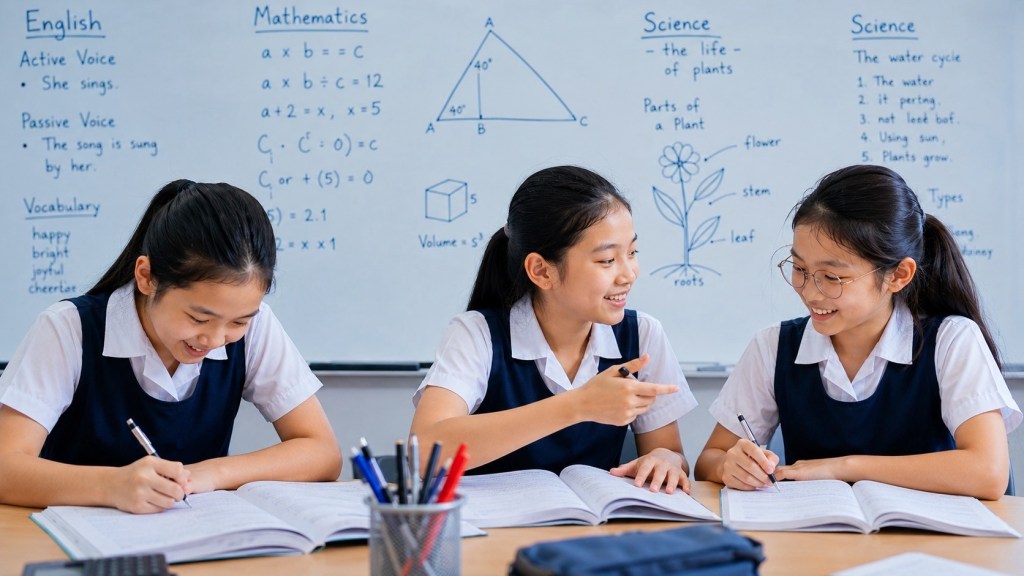
Primary 6 Science for a beginner is not simply Primary 5 with harder worksheets. It is the year when the learner must integrate the whole Primary Science system while also learning to perform under examination conditions. Concepts from several years can appear in one unfamiliar context, and the question may require interpretation, evidence, application and a complete scientific explanation rather than direct recall.
At eduKate Sengkang, Primary 6 Science is taught in focused 3-pax tutorials so the tutor can diagnose the exact source of lost marks. A student may have a concept gap, weak retrieval, experiment confusion, poor diagram reading, incomplete open-ended answers, slow question selection or fragile checking habits. These problems can look similar on a score sheet but require different teaching.
The beginner route therefore starts with control, not panic. We rebuild the minimum foundations needed for current work, connect topics into a coherent system, train evidence-based answering, revisit older concepts through spaced retrieval and gradually increase the amount of mixed and timed practice. The aim is a learner who can think independently when the question no longer looks familiar.
The wider route sits inside the Primary 6 Science Learning Hub and the Science Hub. Families can also read the Primary Science Tuition Sengkang guide.
- Up to three students per tutorial.
- 1.5-hour weekly Science lesson.
- Primary 6 curriculum integration and PSLE preparation.
- Concept repair, retrieval, experiment reasoning, data interpretation and open-ended answers.
- Timed control introduced after the relevant knowledge and method are stable.
- 83 Punggol Central, Singapore 828761.
- Enquiries: WhatsApp +65 8823 1234.
Primary 6 Is an Integration Year
Earlier Primary Science is often learned chapter by chapter. Primary 6 exposes whether those chapters have become a connected knowledge system. A question about an organism may draw on adaptation, food relationships, life cycles and environmental conditions. A physical Science question may combine force, energy, heat, light or electricity with an experimental setup. The chapter label is no longer enough to tell the student what to do.
This is why students who can recite notes sometimes struggle in mixed papers. Their knowledge is present but difficult to retrieve without a chapter cue. We therefore train topic recognition from the scientific relationship itself: what is moving, changing, being compared, causing an effect or being measured?
A second transition is examination control. The learner must manage a full paper, allocate attention, recover from a difficult item and preserve enough time to check. But timing should not be trained as a substitute for understanding. Speed built on unstable knowledge simply produces faster mistakes.
The Primary 6 programme therefore has two layers working together: scientific mastery and performance control. One without the other is incomplete.
The Primary 6 Science Boundary and PSLE Context
The current Singapore Primary Science framework continues the knowledge, practices and values developed across the primary years. Primary 6 commonly includes energy, forces, environmental relationships and adaptation, while the examination can draw on the broader Primary Science syllabus. The official curriculum reference is the MOE Primary Science Teaching and Learning Syllabus.
For the examination year, families should use official information from the Singapore Examinations and Assessment Board. The 2026 PSLE examination formats and the 2026 PSLE Science syllabus document describe the examination framework and assessment objectives. Preparation should follow those official requirements rather than rumours about supposed secret question types.
Energy forms and conversions
Students need to recognise common forms of energy and follow how energy changes from one form to another in systems. The difficulty is rarely naming one form in isolation. Questions often ask the learner to trace a sequence, identify the relevant device or explain an observable effect.
We teach energy questions as pathways. What energy enters the system? What changes occur? What useful or other forms appear? The learner follows the chain rather than guessing from the object.
Forces
Primary 6 force work commonly includes gravity, friction and elastic spring force. Students must reason about how forces affect objects and use the correct force in the context presented.
A frequent error is naming any familiar force without checking the interaction. We train students to identify the object, the interacting surfaces or bodies, the direction of the effect and the evidence shown.
Environment and food relationships
Environmental questions require students to see organisms as part of interacting systems. Food chains and food webs, population changes and environmental effects demand careful cause-and-effect reasoning.
We teach students to follow one change through the system step by step. A decrease in one population does not automatically produce every imaginable ecological consequence; the answer must follow the relationships provided.
Adaptation and survival
Adaptation questions ask students to connect a structural or behavioural feature to how it improves an organism’s chance of surviving or reproducing in a particular environment.
The strongest answers identify the feature, the environmental challenge, the function of the feature and the resulting advantage. Vague phrases such as ‘helps it survive better’ are refined into the actual mechanism.
Cumulative Primary 3–5 knowledge
Primary 6 does not erase earlier Science. Matter, heat, light, magnets, plant functions, body systems, water, reproduction and electricity remain part of the student’s working knowledge.
We use mixed retrieval deliberately so earlier concepts remain available. The learner should not have to relearn Primary 4 heat from the beginning while also preparing a Primary 6 mixed paper.
Why 3-Pax Tutorials Are Useful in the Examination Year
Primary 6 students can lose the same number of marks for very different reasons. One student may not know the concept. Another may know it but fail to recognise which concept applies. A third may interpret the evidence correctly but omit the final causal link. A fourth may understand everything but rush, misread a qualifier or run out of time.
In a three-student class, the tutor can see those distinctions. Each student can be questioned aloud, each script can be reviewed closely and the next task can be adjusted around the recurring pattern. The small group also allows comparison: students hear another learner’s reasoning and learn to judge whether an explanation is scientifically sufficient.
The aim is not to create a permanently tutor-dependent child. Prompts are reduced deliberately. As PSLE approaches, the student should increasingly make the decisions alone: identify the task, retrieve the concept, use the evidence, construct the answer, check the response and move on.
- Individual error maps rather than generic ‘careless’ labels.
- Frequent retrieval from older Primary Science.
- Close review of open-ended explanations.
- Experiment and data questions discussed from evidence first.
- Timed work introduced in manageable blocks.
- Post-paper review focused on decision errors, not only score.
- Recovery routines for difficult questions and stalled thinking.
The Primary 6 Operating System
1. Recognise the scientific job
Before solving, the learner identifies whether the question is asking for a comparison, prediction, explanation, conclusion, experimental improvement, variable, adaptation advantage or system relationship. This reduces irrelevant answering.
2. Retrieve the minimum relevant knowledge
The student pulls only the concepts needed for the question. This prevents keyword dumping and reduces working-memory overload.
3. Read the evidence
Diagrams, tables, graphs, labels and conditions are treated as part of the question, not decoration. The learner marks the evidence that constrains the answer.
4. Build the relationship
The answer connects evidence and concept to the requested outcome. In open-ended Science, the missing middle is often where marks disappear.
5. Check the boundary
The student asks whether the answer claims more than the evidence shows, whether both sides of a comparison were addressed and whether the correct object or variable was named.
6. Move on with control
A difficult item should not consume the entire paper. Students learn when to pause, mark the question, continue and return later with fresh attention.
7. Review errors structurally
After practice, the question is not only ‘What is the correct answer?’ We ask ‘Which decision failed?’ That creates a correction rule that can transfer to another question.
Repair Before Full-Paper Drilling
A beginner in Primary 6 can feel pressure to start doing complete PSLE papers immediately. Full papers are useful, but they are poor teaching tools when every topic contains unstable foundations. The student spends too much time failing across many fronts and too little time repairing the first causes.
We begin with diagnostic sampling. A few carefully chosen questions can reveal whether the main problem is concept knowledge, retrieval, experiment logic, answer construction or performance control. High-leverage gaps are repaired in focused sets before they are tested again inside mixed work.
As stability improves, the practice scale grows: one concept, one mixed cluster, one timed section, then larger paper segments and full papers. This progression allows speed and endurance to develop on top of a functioning reasoning system.
The principle is simple: do not confuse exposure with mastery. A student can complete many papers and repeatedly practise the same mistakes. Quality review determines whether practice changes future performance.
What a 90-Minute Primary 6 Science Lesson Can Look Like
Retrieval from the whole curriculum
The lesson opens with short mixed retrieval. One question may use heat, another electricity, another a body system and another adaptation. This prevents the student from relying on chapter labels and reveals which older knowledge is becoming inaccessible.
Concept or misconception repair
The tutor selects one high-leverage weakness. A force misconception, an energy-conversion gap or a mistaken ecological relationship is rebuilt with a clean example before exam-style complexity is reintroduced.
Application cluster
Students work through a small family of questions that share the same underlying reasoning but differ in surface details. The aim is to recognise the mechanism when the names, diagrams or contexts change.
Experiment and data work
A setup, table or graph is analysed from purpose to evidence. Students identify what is changed, what is observed, what should be comparable and what conclusion the data actually supports.
Open-ended answer construction
The learner writes explanations under increasing independence. Feedback focuses on missing scientific links, unsupported claims, vague comparison and unnecessary wording.
Timed control
When the underlying method is stable, a short section is completed under time. The goal is to preserve accuracy while making decisions more efficient, not to reward reckless speed.
Error review and next-step rule
Every recurring error produces a rule or check for future work. The lesson ends with the student stating what will be done differently next time.
Worked Primary 6 Science Examples
Energy: following the conversion chain
A question shows a device powered by a battery and asks about energy changes. A weak response may name several energy forms without order. We teach the student to trace the pathway: identify the starting energy store or source, the device or process, the useful output and any other relevant energy forms. The sequence makes the explanation testable and prevents random keyword listing.
Forces: identifying the interaction
A learner sees an object moving slowly and writes gravity because gravity is familiar. We ask what interaction in the question could change the motion. If surfaces are rubbing, friction may be relevant; if a stretched spring acts on an object, elastic spring force may be relevant. The student learns to choose the force from the interaction and evidence rather than from memory alone.
Food web: following one change carefully
When the population of one organism changes, students sometimes predict that every other organism will change in the same direction. We trace direct feeding relationships first, then consider reasonable secondary effects. The answer stays within the food web shown and avoids claims that require information the question never provided.
Adaptation: completing the advantage
A child may write that thick fur helps the animal survive. We ask how. In a cold environment, the relevant mechanism may involve reducing heat loss, which helps the animal maintain a suitable body temperature. The final answer connects feature, environmental challenge, function and survival advantage.
Experiment: result versus explanation
A graph may show that a variable changes as another variable is adjusted. The student first states the observed pattern, then uses the relevant Science to explain it. Keeping observation and explanation separate during thinking prevents the learner from replacing data with a memorised story.
Open-Ended Science in Primary 6
Primary 6 open-ended questions often expose the difference between knowing a concept and controlling an explanation. A student may recognise the topic immediately and still lose marks because the response is vague, incomplete or unsupported by the evidence.
We use a target-evidence-concept-link routine. Target: what exactly is being asked? Evidence: which observation, value, diagram feature or condition matters? Concept: which scientific relationship explains it? Link: how does that concept produce the requested outcome? The routine is flexible; it is not a sentence template.
Comparison questions require both sides. Prediction questions require the predicted outcome and an appropriate reason. Experiment questions require careful treatment of variables and evidence. Adaptation questions require a functional advantage tied to the environment. System questions require sequence, transport or interaction. The answer structure follows the scientific job.
Students also learn to stop. Long answers can create new errors. Once the required mechanism is complete, additional facts may be irrelevant or even contradictory. Concision is a form of control when it comes after complete reasoning.
Model answers are studied as finished examples of a reasoning process. We ask which part answers the target, which part uses evidence and which part completes the mechanism. The learner should be able to write a different correct answer when the surface changes.
Experiment and Data Reasoning for PSLE Science
Experiment questions are not a separate species of Science. They are concept questions with a design and evidence layer. The learner still needs subject knowledge, but must also understand what the investigation is trying to establish.
We teach students to state the purpose in plain language first. What relationship is being tested? Then identify the factor deliberately changed, the result measured or observed, and the conditions that should be kept comparable. This makes the setup easier to reason about than a memorised list of variable labels.
After that comes data. Students read the actual values, pattern or graph before reaching for an explanation. They practise describing increases, decreases, plateaus, differences and exceptions accurately. A claim should match the evidence rather than the answer the student expected to see.
When asked to improve a method, the child must identify the weakness that the improvement solves. Repeating a measurement can improve confidence in a result; changing a measuring instrument may improve precision; controlling an unintended difference may make a comparison fairer. The improvement should have a reason.
Students are also trained to distinguish what an experiment shows from what it does not show. This is a powerful protection against overclaiming. A well-designed answer respects the boundary of the data.
The Primary 6 Error Map
Knowledge gap
The concept itself is missing or wrong. The solution is focused reteaching with examples and non-examples, followed by retrieval.
Retrieval gap
The student learned the concept previously but cannot access it without notes. The solution is spaced retrieval and mixed practice rather than repeated rereading.
Recognition gap
The concept is known but not recognised inside an unfamiliar context. The solution is varied examples that preserve the mechanism while changing the surface.
Evidence gap
The student ignores a graph, table, label or condition. The solution is an evidence-first reading routine.
Experimental-design gap
The learner confuses what is changed, measured or controlled. The solution is to restate the investigation in plain language and rebuild the comparison.
Explanation gap
The student has the right idea but omits the causal link. The solution is to ask what happens next and why until the requested outcome is reached.
Performance gap
Knowledge is adequate but the paper is rushed, stalled or poorly allocated. The solution is timed blocks, skip-and-return routines and deliberate checking priorities.
Building a Primary 6 Retrieval System
Primary 6 revision cannot depend on rereading the entire syllabus whenever a test approaches. The curriculum is too broad and the examination requires knowledge to be available quickly. We therefore build a retrieval system that cycles old ideas through the year.
Short retrieval is often enough. Explain one heat-transfer situation, trace one circuit, reconstruct one body system, interpret one food web change, identify one force and explain one adaptation. The purpose is not to exhaust the student. It is to keep access pathways open.
Topics that are repeatedly forgotten return more frequently. Topics that are stable can be spaced further apart. This makes revision responsive rather than treating every chapter as equally weak.
Mixed retrieval is essential because PSLE questions do not arrive with textbook tabs. The student must decide which knowledge to use. Mixing topics trains that selection process and reduces the shock of unfamiliar paper order.
Retrieval should also include explanation, not only recognition. A multiple-choice item can sometimes be answered correctly through elimination or familiarity. Asking the student to explain the mechanism reveals whether the knowledge is truly available.
From Untimed Mastery to Timed Performance
Timing is introduced in layers. We first want the student to solve accurately with a clear method. Once that is stable, a small cluster is timed. Then a larger section. Eventually, full-paper work becomes useful because the learner is practising endurance and allocation rather than simply exposing weaknesses.
We teach students to notice when a question has become a time trap. A difficult item can be marked and revisited. This protects the rest of the paper and reduces the emotional cost of one unfamiliar problem.
Checking also becomes selective. Instead of rereading every line vaguely, the student checks high-risk features: units, comparison wording, labelled parts, transferred values, the direction of a relationship, unanswered subparts and open-ended causal links.
After timed work, review is more important than the raw time. Did speed reduce accuracy? Which questions caused long stalls? Were mistakes caused by rushing or by missing knowledge? The next practice target should follow that diagnosis.
The goal is calm efficiency. A fast student who makes avoidable errors is not yet controlled; a careful student who cannot finish also needs adjustment. Performance work seeks the balance appropriate to the paper.
Recovery Protocols for Difficult PSLE Science Questions
A difficult question should trigger a recovery routine rather than a spiral. First, the learner identifies what is definitely known: the objects, variables, labels, values and observable changes. This creates a small stable platform even when the full answer is not yet obvious.
Second, the student rewrites the demand in simpler words. Is the question asking what happened, why it happened, what should be changed, which setup is fair, or how one organism is affected? Removing unnecessary wording often reveals the scientific job.
Third, the learner searches for a familiar relationship beneath the unfamiliar context. Is this really a heat-transfer question wearing a new story? A force question with a strange object? An adaptation question using an organism the child has never studied before? The syllabus concept is usually more familiar than the surface.
If the route still does not appear, the student marks the item and moves on. Returning later is a legitimate examination strategy. Fresh attention after completing easier questions can make the hidden structure more visible.
Finally, when the question is reviewed after the paper, we do not celebrate a lucky guess or condemn the learner for being stuck. We identify which part of the recovery routine failed and practise that decision separately. Recovery itself is a trainable skill.
Three Primary 6 Student Pathways
Recovery pathway
This learner enters the examination year with significant gaps or a recent decline. We identify high-leverage concepts first, repair them in focused sets, keep school work connected and delay excessive full-paper drilling until the foundation can support it. Progress is measured by the shrinking number of recurring error types.
Stabilisation pathway
This learner usually knows the content but performance varies. The work emphasises retrieval, mixed recognition, experiment logic, open-ended completeness and timed control. The aim is to make a good day more reproducible.
Extension pathway
This learner is already strong. We use unfamiliar contexts, multi-concept questions, evidence evaluation, explanation compression and more demanding timing. Extension means greater flexibility and precision, not merely more papers.
What Progress Should Look Like
Primary 6 progress is visible when the learner gains control across different layers, not only when one practice score rises.
- Older topics can be retrieved without extensive reteaching.
- Mixed questions are classified by mechanism rather than chapter appearance.
- Experiment variables and evidence are identified more reliably.
- Graphs and tables are described accurately before explanation.
- Open-ended answers contain complete causal links.
- Adaptation answers connect feature, function, environment and advantage.
- Force and energy questions are reasoned from relationships rather than guessed.
- The learner can skip and return to a time-consuming item without panic.
- Checking is targeted to likely errors.
- Post-paper review produces specific correction rules.
A rising score is encouraging, but consistency across several papers and contexts is more informative than one isolated result. We look for fewer repeated mistakes and stronger recovery when the question changes.
How Parents Can Support the Primary 6 Science Year
Protect regular study rhythms. Primary 6 pressure can tempt families into irregular bursts of very long revision. Shorter, consistent retrieval and focused correction are usually easier to sustain and make it possible to revisit the syllabus repeatedly.
When a practice paper is returned, do not focus only on the total. Ask which error types produced the lost marks. A concept error, a reading error and a timing error should not receive the same remedy.
Encourage the child to explain corrections aloud. If the learner can state why the first answer failed and what rule will prevent it next time, the correction is more likely to transfer.
Keep official examination information separate from rumours. Use MOE and SEAB sources for syllabus and format. Anxiety grows when preparation is driven by speculative claims about what supposedly must appear.
Maintain sleep, school attendance and ordinary routines as much as possible. Science performance depends on attention and working memory; exhausted drilling can create the appearance of work while reducing learning quality.
When Primary 6 Science Tuition May Be Useful
Tuition may help when the child has broad content gaps, repeatedly loses open-ended marks despite knowing the chapter, struggles with experiment questions, cannot retain older topics, or performs much worse under timed conditions than during homework.
It can also help a strong student who needs systematic mixed practice, more demanding transfer and better examination control. The teaching route should match the actual bottleneck rather than the latest score alone.
Late intervention can still be useful, but priorities become more selective as the examination approaches. The programme focuses on the highest-leverage weaknesses and avoids pretending that every small gap can be rebuilt at equal depth in limited time.
Primary 6 Science Class Details
Format: 3-pax small-group Science tutorial.
Duration: 1.5 hours weekly.
Location: 83 Punggol Central, Singapore 828761.
- Primary 6 concept teaching and repair.
- Cumulative Primary 3–5 retrieval.
- Experiment and data interpretation.
- Open-ended answer construction.
- Mixed-topic transfer.
- Timed sections and full-paper control when appropriate.
- Error mapping and correction rules.
- PSLE-oriented review aligned to official syllabus and format.
Parents can bring recent school papers, preliminary papers when available, marked open-ended responses, current revision materials and examples of questions that repeatedly cause difficulty. Those artefacts help identify whether the immediate priority is knowledge, reasoning or performance.
Frequently Asked Questions
Is it too late to start Primary 6 Science tuition?
The useful answer depends on the size and type of the gap. Focused repair can still help, but a later start requires sharper prioritisation. We diagnose what will produce the greatest improvement in understanding and performance rather than attempting to redo everything at once.
Should my child do full papers every week?
Full papers are valuable when they serve a purpose: integration, timing and endurance. If major concepts are unstable, focused repair and shorter mixed sets may produce more learning before full-paper frequency increases.
How do you help with open-ended Science?
We teach target, evidence, concept and causal link, then practise across comparison, prediction, experiment, adaptation and system questions. Students learn to write complete answers without unnecessary length.
How do you address careless mistakes?
We replace the label with a diagnosis. Misreading a qualifier, copying a value wrongly, answering the wrong object and leaving out a causal link are different errors with different checking routines.
Do you use PSLE-style questions?
Yes, appropriate examination-style practice is part of preparation. We do not reproduce copyrighted national examination questions here; live teaching uses lawful materials and focuses on the skills and official assessment demands.
What if my child is strong already?
Strong students work on transfer, evidence evaluation, precision, multi-concept integration and timing. The aim is to make high performance more stable rather than simply increase worksheet volume.
Do you follow the latest examination requirements?
Preparation is anchored to the current MOE syllabus and official SEAB examination information. Those sources are more reliable than unofficial predictions.
How much homework is given?
Continuation work is targeted to retrieval, repair, mixed application or timed control. The amount varies with the student’s current need and school workload.
The Goal: A Student Who Can Operate Independently
Primary 6 Science tuition is successful when the student increasingly knows what to do without being told. An unfamiliar question should trigger a routine rather than panic: identify the task, inspect the evidence, retrieve the concept, build the relationship, check the boundary and manage the time.
That independence matters beyond one examination. The learner is practising a scientific way of thinking: claims supported by evidence, mechanisms explained clearly, errors examined rather than hidden, and knowledge retrieved when the situation changes.
Continue through the Primary 6 Science Learning Hub, the wider Science Hub, and the Primary Science Tuition Sengkang guide.
eduKate Sengkang teaches Primary Science in focused groups of up to three students. Lessons are by appointment. For current class availability, WhatsApp +65 8823 1234.
Properly Taught Kids Shine a Bright Light Into the Future.
A Final Primary 6 Science Readiness Check
A learner is becoming examination-ready when knowledge can be retrieved without chapter prompts and used in a changed context. Ask the student to move from a food web to an energy question, then to an experiment, without opening notes between them. The important sign is not instant perfection. It is whether the child has a repeatable process for identifying the scientific job and recovering the relevant idea.
Readiness also appears in the quality of correction. A student who only copies a model answer may repeat the same error elsewhere. A student who can say, “I ignored the evidence,” “I named the force without checking the interaction,” or “I stopped the explanation before the consequence,” has a rule that can change the next attempt.
Finally, check paper behaviour. Can the learner leave a difficult question temporarily, continue calmly, return later and perform a targeted check? PSLE Science is not only a test of what has been learned. It is also a test of whether that knowledge can be selected, expressed and managed under finite time. Preparation is complete only when understanding and control work together.
A strong final revision system therefore protects both accuracy and recovery. The student knows what to retrieve, what to inspect, what to write, what to check and when to move on.
What a 90-Minute Primary 6 Science Lesson Can Look Like
The lesson begins with short retrieval from across the Primary Science curriculum. One item may use heat, another electricity, another a body system and another adaptation. This prevents the learner from relying on chapter labels and shows which older concepts are becoming difficult to access.
Next comes one high-leverage repair. The tutor may revisit a force misconception, a weak energy-conversion chain, a confused food-web relationship or an experiment variable. The point is not to reteach an entire year. It is to repair the first unstable decision that is causing several later mistakes.
Students then work through a small application cluster. The contexts change, but the underlying mechanism stays the same. This trains recognition: the child should see the same scientific relationship even when names, diagrams and surface details are unfamiliar.
Experiment and data work follows. A setup, table or graph is analysed from purpose to evidence. Students identify what is changed, what is measured or observed, what should stay comparable and what conclusion the evidence can support. Only after the evidence is clear do they explain the result scientifically.
Open-ended answers are then refined. Feedback focuses on scientific correctness, relevance and completeness. The tutor identifies the missing link instead of rewriting the whole answer. The child is expected to repair the response and explain why the first version was insufficient.
When the method is stable, a short timed block is introduced. Timing is not used to create pressure for its own sake. It is used to test whether the learner can preserve the same quality of thinking when the clock is running.
The lesson ends with a brief reconstruction from memory and one or two correction rules. A useful lesson should leave the learner with a clearer operating method, not merely more completed pages.
Worked Primary 6 Science Examples
Consider an energy question involving a battery-powered device. A weak answer may list several energy forms without order. We ask the learner to trace the pathway: what energy is available at the start, what component uses it, what useful output appears and what other energy changes are relevant. The sequence prevents random keyword listing.
In a force question, a student may choose gravity simply because it is familiar. We instead identify the interaction. Are two surfaces rubbing? Is a spring stretched or compressed? Is an object being pulled by Earth’s gravity? Choosing the force from the interaction and evidence produces more reliable answers than choosing from memory alone.
In a food-web question, students sometimes predict that every population changes in the same direction. We trace the direct feeding relationships first, then consider reasonable secondary effects. The answer stays inside the web shown and does not invent relationships that are absent.
Adaptation questions often attract vague phrases such as ‘helps the animal survive’. We complete the mechanism. If thick fur is relevant in a cold environment, the learner explains how it reduces heat loss and why that improves the animal’s ability to maintain a suitable body temperature. Feature, function, environment and advantage are connected.
In an experiment, a graph may show a clear pattern. The student first states what the data show, then uses the relevant concept to explain it. Separating observation from explanation during thinking prevents the learner from replacing the evidence with a memorised story.
Open-Ended Science in Primary 6
Primary 6 open-ended questions often reveal the difference between knowing a concept and controlling an explanation. A student may recognise the topic immediately yet lose marks because the answer is vague, incomplete or unsupported by the evidence.
We use a flexible target-evidence-concept-link routine. The target is what the question is actually asking. The evidence is the observation, value, diagram feature or condition that matters. The concept is the scientific relationship that explains it. The link connects the concept to the requested outcome. Sometimes one concise sentence performs all four jobs.
Comparison questions require both sides of the relationship. Prediction questions require the predicted outcome and an appropriate reason. Experiment questions require careful treatment of variables and evidence. Adaptation questions require a functional advantage tied to the environment. System questions require sequence, transport or interaction. The answer structure changes because the scientific job changes.
Students also learn when to stop. Long answers can create new errors. Once the required mechanism is complete, adding unrelated facts wastes time and may introduce contradictions. Concision is useful when it follows complete reasoning.
Model answers are therefore studied as examples of finished reasoning, not scripts to memorise blindly. We ask which phrase answers the target, which uses evidence and which completes the mechanism. The learner should be able to produce a different correct answer when the surface changes.
Experiment and Data Reasoning for PSLE Science
Experiment questions are concept questions with an additional design and evidence layer. The learner still needs subject knowledge, but must also understand what the investigation is trying to establish.
We teach students to state the purpose in plain language first. What relationship is being tested? Then identify the factor deliberately changed, the result measured or observed, and the conditions that should remain comparable. This makes the setup easier to reason about than a memorised list of variable labels.
Students read the actual values, trend or graph before reaching for an explanation. They practise describing increases, decreases, plateaus, differences and exceptions accurately. A claim should match the evidence rather than the answer the learner expected to see.
When asked to improve a method, the child identifies the weakness that the improvement solves. Repeating a measurement may increase confidence in a result. Using a more suitable measuring instrument may improve precision. Keeping an unintended difference constant may make the comparison fairer. The improvement must have a reason.
We also teach limits of evidence. One result may support a conclusion without proving every possible explanation. A learner who asks ‘What does this experiment actually show?’ is less likely to overclaim.
The Primary 6 Error Map
A knowledge gap means the concept itself is missing or wrong. The remedy is focused reteaching with examples, non-examples and retrieval. A retrieval gap is different: the learner once understood the concept but cannot access it without notes. That requires spaced recall, not another full explanation every time.
A recognition gap appears when the concept is known but hidden inside an unfamiliar context. Varied examples are used so the learner recognises the mechanism even when the surface changes. An evidence gap appears when a graph, table, label or stated condition is ignored. The remedy is an evidence-first reading routine.
An experimental-design gap appears when the child confuses what is changed, measured or controlled. We restate the investigation in plain language and rebuild the comparison. An explanation gap appears when the right concept is present but the causal chain stops early.
A performance gap appears when knowledge is adequate but the paper is rushed, stalled or poorly allocated. This is treated with timed blocks, skip-and-return routines and targeted checking. Calling all of these errors ‘careless’ would hide the different repairs they require.
Building a Primary 6 Retrieval System
Primary 6 revision cannot depend on rereading the entire syllabus whenever a test approaches. The curriculum is too broad and the examination requires knowledge to be available quickly. We therefore cycle older ideas through the year.
Short retrieval is often enough. Explain one heat-transfer situation, trace one circuit, reconstruct one body system, interpret one food-web change, identify one force and explain one adaptation. The purpose is not to exhaust the student. It is to keep access pathways open.
Topics that are repeatedly forgotten return more frequently. Topics that are stable can be spaced further apart. This makes revision responsive rather than treating every chapter as equally weak.
Mixed retrieval is essential because examination questions do not arrive with textbook tabs. The child must decide which knowledge to use. Mixing topics trains that selection process and reduces the shock of unfamiliar paper order.
Retrieval should include explanation, not only recognition. A multiple-choice item can sometimes be answered correctly through elimination or familiarity. Asking the student to explain the mechanism reveals whether the knowledge is truly available.
From Untimed Mastery to Timed Performance
Timing is introduced in layers. We first want the student to solve accurately with a clear method. Once that is stable, a small cluster is timed. Then a larger section. Eventually, full-paper work becomes useful because the learner is practising endurance and allocation rather than simply exposing weaknesses.
Students learn to notice when a question has become a time trap. A difficult item can be marked and revisited. This protects the rest of the paper and reduces the emotional cost of one unfamiliar problem.
Checking also becomes selective. Instead of rereading every line vaguely, the learner checks high-risk features: units, comparison wording, labelled parts, copied values, the direction of a relationship, unanswered subparts and open-ended causal links.
After timed work, review is more important than the raw time. Did speed reduce accuracy? Which questions caused long stalls? Were mistakes caused by rushing or missing knowledge? The next practice target follows that diagnosis.
The goal is calm efficiency. A fast student who makes avoidable errors is not yet controlled; a careful student who cannot finish also needs adjustment. Performance work seeks the balance appropriate to the paper.
Three Primary 6 Student Pathways
The recovery pathway is for a learner entering the examination year with significant gaps or a recent decline. We identify high-leverage concepts first, repair them in focused sets, keep school work connected and delay excessive full-paper drilling until the foundation can support it.
The stabilisation pathway is for a learner who usually knows the content but performs unevenly. The work emphasises retrieval, mixed recognition, experiment logic, open-ended completeness and timed control. The aim is to make a good day more reproducible.
The extension pathway is for a learner who is already strong. We use unfamiliar contexts, multi-concept questions, evidence evaluation, explanation compression and more demanding timing. Extension means greater flexibility and precision, not merely more papers.
What Progress Should Look Like
Primary 6 progress is visible when the learner gains control across several layers, not only when one practice score rises. Older topics can be retrieved without extensive reteaching. Mixed questions are classified by mechanism rather than chapter appearance. Experiment variables and evidence are identified more reliably.
Graphs and tables are described accurately before explanation. Open-ended answers contain complete causal links. Adaptation answers connect feature, function, environment and advantage. Force and energy questions are reasoned from relationships rather than guessed.
The learner can skip and return to a time-consuming item without panic. Checking becomes targeted to likely errors. Post-paper review produces specific correction rules. A rising score is encouraging, but consistency across several papers and contexts is more informative than one isolated result.
How Parents Can Support the Primary 6 Science Year
Protect regular study rhythms. Primary 6 pressure can tempt families into irregular bursts of very long revision. Shorter, consistent retrieval and focused correction are easier to sustain and make it possible to revisit the syllabus repeatedly.
When a practice paper is returned, do not focus only on the total. Ask which error types produced the lost marks. A concept error, a reading error and a timing error should not receive the same remedy.
Encourage the child to explain corrections aloud. If the learner can state why the first answer failed and what rule will prevent it next time, the correction is more likely to transfer.
Use official MOE and SEAB information for syllabus and examination format. Preparation becomes less useful when it is driven by rumours about supposed secret question types or predictions that cannot be verified.
Maintain sleep, school attendance and ordinary routines as much as possible. Science performance depends on attention and working memory; exhausted drilling can create the appearance of work while reducing learning quality.
Final Primary 6 Readiness Checks
Before the final examination stretch, we check whether the learner can operate without chapter labels. A mixed set may include a force situation, a food-web change, an experiment, a heat question and a circuit. The important skill is deciding what each question is really testing before choosing the concept.
We also check delayed recall. A student may look strong immediately after a revision session but weak two weeks later. Durable knowledge should survive a gap. We ask the learner to reconstruct older ideas from memory and then apply them to a changed context.
A third check is explanation control. The learner should give a complete answer without writing everything known about the topic. We look for the relevant observation or condition, the correct scientific relationship and the requested consequence. When the causal chain is complete, the student stops.
A fourth check is evidence discipline. In a data question, the student should refer to the actual trend or values before explaining. In a diagram question, the learner should identify the feature that supports the conclusion. In an experiment, the student should separate what was changed from what was observed.
Finally, we check recovery. The examination will contain questions that feel unfamiliar. The learner needs a routine for those moments: slow down briefly, identify what is known, mark useful evidence, attempt the first defensible step, move on if necessary and return later.
Primary 6 Science Class Details
Format: 3-pax small-group Science tutorial.
Duration: 1.5 hours weekly.
Location: 83 Punggol Central, Singapore 828761.
- Primary 6 concept teaching and repair.
- Cumulative Primary 3–5 retrieval.
- Experiment and data interpretation.
- Open-ended answer construction.
- Mixed-topic transfer.
- Timed sections and full-paper control when appropriate.
- Error mapping and correction rules.
- PSLE-oriented review aligned to official syllabus and format.
Frequently Asked Questions
Is it too late to start? The answer depends on the size and type of the gap. Focused repair can still help, but a later start requires sharper prioritisation. We concentrate on high-leverage weaknesses instead of pretending every small gap can be rebuilt at equal depth.
Should a child do full papers every week? Full papers are useful when they serve integration, timing and endurance. If major concepts are unstable, focused repair and shorter mixed sets may produce more learning before full-paper frequency increases.
How do we help with open-ended Science? We teach target, evidence, concept and causal link, then practise across comparison, prediction, experiment, adaptation and system questions. Students learn to write complete answers without unnecessary length.
How do we address careless mistakes? We replace the label with a diagnosis. Misreading a qualifier, copying a value wrongly, answering the wrong object and leaving out a causal link are different errors with different checking routines.
What if a child is already strong? Strong students work on transfer, evidence evaluation, precision, multi-concept integration and timing. The aim is to make high performance more stable rather than simply increase worksheet volume.
The Goal: A Student Who Can Operate Independently
Primary 6 Science tuition is successful when the student increasingly knows what to do without being told. An unfamiliar question should trigger a routine rather than panic: identify the task, inspect the evidence, retrieve the concept, build the relationship, check the boundary and manage the time.
That independence matters beyond one examination. The learner is practising a scientific way of thinking: claims supported by evidence, mechanisms explained clearly, errors examined rather than hidden, and knowledge retrieved when the situation changes.
Continue through the Primary 6 Science Learning Hub, the wider Science Hub, and the Primary Science Tuition Sengkang guide.
eduKate Sengkang teaches Primary Science in focused groups of up to three students. Lessons are by appointment. For current availability, WhatsApp +65 8823 1234.
Properly Taught Kids Shine a Bright Light Into the Future.
