
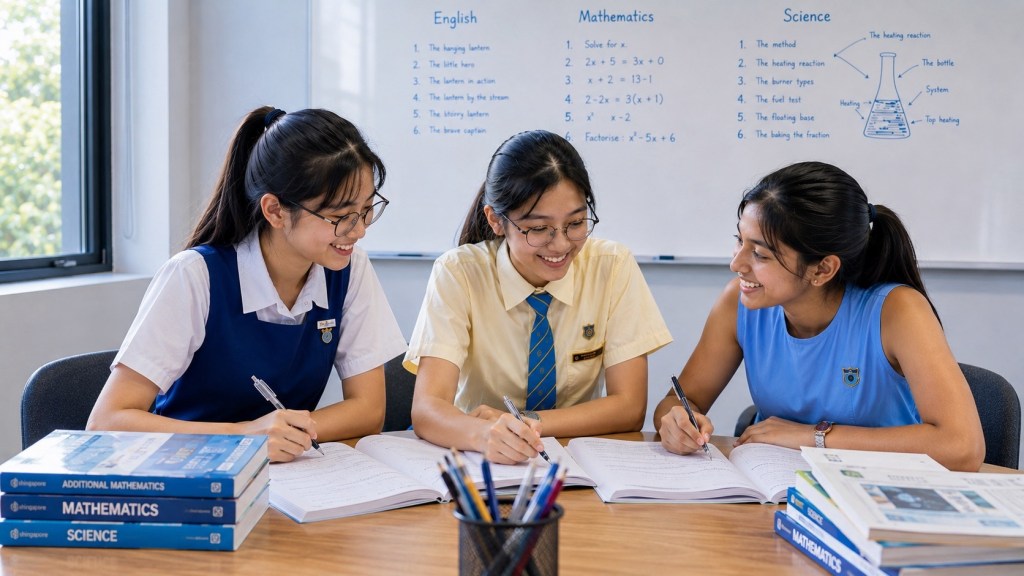
Additional Mathematics can feel as if every difficult chapter is a new crisis. A student struggles with quadratics, then logarithms, then trigonometry, then calculus, and the family concludes that each topic needs a separate rescue plan. Parents searching for Additional Mathematics tuition in Sengkang, A-Math tutor, Secondary 3 A-Math, Secondary 4 A-Math, algebra help, functions, trigonometry, differentiation or integration are often seeing the visible chapter rather than the invisible prerequisite. The fastest route is frequently to identify the earlier mathematical capability that the chapter is trying to use.
The vocabulary on major international Mathematics learning platforms makes the dependency chain easier to see: algebraic manipulation, equations, functions, graphs, transformations, trigonometry and calculus are connected. A function question may fail because factorisation is weak. A trigonometric equation may fail because exact algebra is unstable. A calculus problem may fail because the student cannot rearrange an expression or interpret a graph. Repeating the current chapter without repairing the prerequisite can make practice feel endless.
In Singapore, parents should anchor syllabus decisions to the student’s actual subject level and current examination requirements. For the 2027 SEC framework, the official SEAB G2 syllabus page and SEAB G3 syllabus page list the relevant Additional Mathematics syllabuses. On eduKate Sengkang, the canonical local owners remain Additional Mathematics Tuition Sengkang and the Additional Mathematics Learning Hub. This article supports those owners with a narrower parent question: when the current chapter is failing, how do we determine whether that chapter is actually the problem?
Quick Read: Diagnose Backward, Then Teach Forward
When a student fails an A-Math question, begin at the first wrong or missing decision. Ask what knowledge that decision required. If the missing capability comes from an earlier topic, repair only enough of that prerequisite to restore access to the current work. Then return immediately to the chapter and test a fresh problem.
This is faster than restarting the whole syllabus and safer than drilling the current chapter blindly. The logic is: locate → trace → repair → reconnect → prove → retrieve later. The goal is to keep the student moving with the school while fixing the dependency that caused the breakdown.
1. A-Math Is a Dependency Network
Additional Mathematics is not a bag of unrelated chapters. Algebra is used inside functions. Functions are represented by graphs. Trigonometric equations use algebra. Coordinate geometry uses equations and geometric interpretation. Calculus uses functions, algebra and graphs. Kinematics can use calculus while also demanding careful interpretation of direction, velocity and acceleration.
When a dependency is weak, later topics can all look weak. This is why a diagnostic view is more useful than a chapter score alone.
2. The Current Chapter Is Where the Weakness Appears
Suppose a student is failing differentiation questions. It is tempting to conclude that differentiation is the problem. But inspect the working. Can the student simplify powers? Expand brackets? factorise? substitute? rearrange? interpret a tangent? recognise the function being differentiated?
The derivative rule may be known perfectly while the surrounding algebra fails. Repeating derivative rules would then be low-value practice.
3. Build a Prerequisite Map Before Building a Revision Plan
A simple A-Math prerequisite map can begin with signed numbers, fractions, indices, algebraic manipulation, factorisation, equations and graph meaning. From there, branches extend into quadratics, coordinate geometry, functions, logarithms, trigonometry and calculus.
The map does not need to be a formal chart. It can be a tutor’s working model: “This question failed at this step; that step depends on this earlier capability.” The map keeps revision targeted.
4. Algebra Is the Working Language of A-Math
Students sometimes treat algebra as one chapter that can be “finished.” In A-Math, algebra is closer to a language used throughout the subject. If it remains slow, every later topic becomes slower.
A useful diagnostic therefore tests algebra independently of the current chapter. Can the learner manipulate fractions, factorise, solve equations and work with indices when those skills are presented in a plain algebra context? If yes, move forward. If not, repair the specific skill.
5. Signed Numbers Can Still Break Advanced Work
A student can understand a sophisticated method and still lose the question through a negative sign. This is not trivial if it repeats. Sign control is part of mathematical reliability.
Track whether sign errors arise in expansion, substitution, rearrangement, coordinate geometry or differentiation. A repeated sign pattern deserves direct repair rather than being labelled “careless.”
6. Algebraic Fractions Reveal Structural Understanding
Algebraic fractions test whether the learner sees factors and restrictions. Students who cancel terms across addition or subtraction are treating notation visually rather than structurally.
The repair is not “remember not to cancel.” Factor expressions, identify common factors, state restrictions where relevant, and explain why cancellation applies to factors. Structural understanding reduces future rule confusion.
7. Indices Need Meaning and Fluency
Index laws become tools in exponential and logarithmic work, algebraic manipulation and calculus. If the student remembers several laws but confuses when to add, multiply or subtract indices, practice should return to what the operations represent.
Use contrasting examples. Multiply powers with the same base. Raise a power to a power. Divide. Include zero and negative indices when appropriate to the syllabus. Ask why each law fits that structure.
8. Factorisation Is a Gateway Skill
Factorisation supports quadratics, algebraic simplification, equation solving, graph interpretation and later calculus work. A student who expands comfortably but factorises slowly has only one direction of control.
Practise recognition: common factor, quadratic structure, difference of squares and other syllabus-relevant forms. Then verify by expansion. The two directions should reinforce each other.
9. Quadratics Are More Than a Formula
Quadratic work connects algebra, equations and graphs. A student may be able to use a formula mechanically while failing to interpret roots, turning behaviour or line-curve intersections.
Teach multiple representations. Factorised form reveals roots. Expanded form reveals coefficients. A graph shows shape and intercepts. A completed-square form can reveal another structural view when relevant. The learner becomes faster by choosing the form that exposes what the question needs.
10. The Discriminant Is a Relationship, Not an Ornament
When the discriminant is part of the syllabus, it should be connected to what it says about roots and intersections, not merely inserted into a memorised formula.
Ask the learner to predict graph behaviour from the sign of the discriminant, then confirm graphically. This ties symbolic work to visual meaning and reduces isolated memorisation.
11. Simultaneous Equations Need Interpretation
Students can learn elimination or substitution but still fail to define the quantities correctly. In applied problems, the equation system begins with representation.
Have the student state what each unknown means, build the relationships, then solve. After obtaining values, interpret them in context. A mathematically correct pair that does not answer the question is not a complete solution.
12. Functions Are a Major A-Math Bottleneck
Function notation can expose whether a student understands input-output relationships. If f(x) is misread as multiplication, later work with composites, inverses or transformations becomes unnecessarily confusing.
International platforms such as Khan Academy’s functions resources group evaluating functions, domain and range, graphs and transformations because they describe the same object from different angles. Use the same learning principle while following the student’s actual Singapore syllabus scope.
13. Function Notation Must Become Ordinary Language
Ask the student to read f(3) aloud as “the output of f when the input is 3.” Ask what f(x) means before any calculation. Ask what changes when x is replaced by an expression.
This reduces symbolic intimidation. The notation becomes compact language rather than a code to decode from memory.
14. Graphs Should Be Used to Check Algebra
An equation can produce a root; a graph can show where the corresponding function crosses an axis. Algebra may predict an intersection; a graph can reveal whether the result is plausible. Transformations can be anticipated from structure and then inspected visually.
Using both views creates error detection. It also prepares students for questions where graphical and algebraic information are mixed.
15. Coordinate Geometry Depends on Both Algebra and Geometry
A coordinate-geometry question may fail because the student cannot calculate gradient, rearrange a line equation, use a midpoint relationship or interpret perpendicularity. Each of these can be tested separately.
Do not reteach the whole chapter when only one component is weak. Repair the failing tool, then return to a complete coordinate problem.
16. Surds and Exact Values Need Patience With Form
Students who are accustomed to decimal approximations can become uncomfortable with exact forms. Surds, algebraic fractions and trigonometric exact values require the learner to preserve structure rather than convert immediately to decimals.
Teach the reason for exactness. Exact forms can retain relationships that rounding would obscure. Calculator approximations can still be used as a check when appropriate, but not as a replacement for the required form.
17. Exponentials and Logarithms Need Inverse Thinking
Logarithms become easier when they are understood as the inverse language of exponentiation. Instead of memorising a disconnected set of log laws, connect exponential statements to logarithmic statements.
Move between forms deliberately. Ask which exponent produces a value. Use graph views where appropriate. The inverse relationship provides a conceptual anchor for manipulation.
18. Logarithm Laws Depend on Algebraic Structure
Students often misapply logarithm laws because they remember surface patterns. The laws preserve multiplication, division and powers in specific ways; they do not arbitrarily split sums.
Contrast valid and invalid transformations. Ask the student to identify the operation inside the logarithm before choosing a law. This small classification step prevents many errors.
19. Trigonometry Can Fail Because Algebra Is Weak
A student may know the trigonometric identity or equation method but lose control when rearrangement, factorisation or exact values enter. Diagnose the algebra separately.
This is especially important because repeated trigonometric drilling can hide the real problem: the student recognises the trig content but cannot execute the algebraic middle.
20. Trigonometric Identities Need Equality Thinking
An identity is an equality that holds under the relevant conditions, not an instruction to move symbols randomly from one side to the other. Students should understand the goal: transform one or both sides using valid identities and algebra until the equivalence is shown.
Teach pattern recognition, but preserve logic. Every transformation should be legal, and the final equality should emerge from structure rather than guesswork.
21. Trigonometric Equations Need Solution Discipline
Solving a trigonometric equation requires more than finding one calculator angle. Students need to respect the required domain or interval, identify all valid solutions and reject values that do not satisfy the original conditions.
A diagnostic should separate identity knowledge, algebraic manipulation, calculator mode, reference-angle reasoning and interval control. Different failures need different repairs.
22. Radians Need Meaning Before Formulae
When radians enter, students can memorise arc-length or sector-area formulae without understanding the angular measure. A radian links angle to arc length relative to radius.
Build the geometric meaning first. Then formulae become relationships that can be reasoned about rather than isolated facts.
23. Differentiation Is About Change
Rules for differentiating powers are important, but calculus becomes more durable when the derivative is connected to rate of change and gradient. A tangent is not just a line drawn beside a curve; its gradient represents local change.
Ask what the derivative means before calculating. Then connect symbolic differentiation to a graph. This gives students a reason to care about signs, turning behaviour and stationary points where relevant.
24. Calculus Errors Often Begin Before Calculus
A student can differentiate correctly and still fail because the original function was not simplified, a negative index was misread, a coefficient was lost or an equation was not rearranged.
When reviewing calculus work, mark the exact line where the mathematical route first becomes invalid. Do not blame the topic name when the error is an old algebra dependency.
25. Integration Needs Reverse-Process Thinking
Integration is often introduced as a reverse process to differentiation in parts of the syllabus. That connection should be explicit. If differentiation of a power is understood, integration rules become easier to organise.
Students also need disciplined notation and constants where required. The tutorial should distinguish conceptual meaning, procedural rule and application.
26. Area Applications Need Geometry and Sign Awareness
When integration is used in area-related contexts, the learner must interpret the diagram, limits and whether a curve lies above or below another object. Pure symbolic integration is only part of the job.
Sketch first when helpful. A small visual check can prevent setting up the wrong expression even when the integration technique is correct.
27. Kinematics Is an Interpretation Test
Kinematics can combine displacement, velocity, acceleration and calculus. Students may perform differentiation or integration correctly while misunderstanding direction, rest, turning points or total distance.
Teach the physical meaning of signs and changes. A negative velocity does not mean “wrong”; it represents direction relative to the chosen convention. Total distance and displacement are different quantities.
28. Mixed Questions Are Where Mastery Becomes Visible
Chapter practice tells the student which toolbox to open. Mixed examination questions require the student to recognise the toolbox. This recognition is part of mastery.
Once a method is stable in blocked practice, interleave it with other topics. Ask the learner to name the first clue that suggested the method. This makes route selection explicit.
29. A-Math Speed Is Usually Recognition Plus Fluency
Strong students often look fast because they recognise structures early and execute common algebra with low mental cost. They do not necessarily “think faster” in a vague sense. They waste fewer steps.
Training should therefore target recognition and fluency separately. First classify the structure. Then practise the execution that should become automatic.
30. The First Independent Question Is the Truth Test
A tutor explanation can make any topic look easier. The important evidence is the first fresh problem attempted without prompts. If the student cannot begin, identify the missing decision before giving the answer.
The next hint should be the smallest useful hint. If “What kind of function is this?” is enough, do not immediately demonstrate the whole solution. Preserve as much student thinking as possible.
31. Hint Dependence Can Make Tuition Look Better Than It Is
A student who receives quick prompts may complete many difficult problems in class and still struggle at home. The class performance includes invisible tutor support.
Track hints. How many were needed? What type? Did the student need the same cue again? Over time, successful tuition should reduce hint dependence on comparable work.
32. Retrieval Practice Should Include Algebra Every Week
Even during a trigonometry or calculus chapter, include a few old algebra items. Retrieve factorisation, indices, equations, fractions or function notation. These are working tools that must remain available.
The retrieval set can be very short. Its value is maintaining access to the language A-Math keeps reusing.
33. Spacing Prevents “I Knew It Last Week”
Immediate success after tuition is weak evidence because the method is still active in memory. Return after a delay. Then return inside mixed work.
If performance collapses, the learner may need another retrieval attempt, a clearer representation or a better connection to prior knowledge. Spacing exposes fragility before the examination does.
34. Error Logs Should Track Dependencies
Instead of recording “wrong logarithm question,” write the cause: algebraic fraction error, wrong log law, equation setup, domain issue, calculator error, or incomplete checking. The topic label is too broad.
Over several weeks, dependency patterns appear. The same algebra weakness may be causing errors across three chapters. That becomes the high-leverage repair target.
35. Separate Knowledge Errors From Control Errors
Some mistakes happen because the student does not know the mathematics. Others happen because the student knows it but loses control under time, mixes methods, omits working or fails to check.
The interventions differ. Knowledge errors need teaching and practice. Control errors may need mixed retrieval, timing routines, working conventions or examination protocols.
36. Timing Can Reveal the Bottleneck
Track where time accumulates. Is the student slow to recognise the question, perform algebra, use the calculator, draw a graph or check the result? A total time tells you that a problem was slow; a process time tells you why.
Speed training should target the bottleneck. Telling a student simply to “be faster” supplies no method.
37. Use a Stuck Protocol
When stuck, the learner can follow a short recovery routine: reread the target, list known quantities or expressions, identify the topic relationship, change representation, write one valid mathematical statement, and only then consider skipping temporarily.
A protocol prevents panic from becoming blankness. It gives the student a route back into the problem.
38. Examination Working Is Part of Mathematical Communication
Clear working helps markers see method, but it also helps the student debug. Each line should have a reason. Excessive mental calculation can make recovery difficult when an early step goes wrong.
Tutorials should practise readable working before the examination period, not add it as a last-minute formatting rule.
39. Calculator Discipline Matters More as Questions Compound
A correct mathematical setup can still be lost through mode, brackets, rounding or transcription. Students should know which values should stay exact, when to round and how to check calculator output against an estimate.
Treat calculator skill as an operational layer beneath the mathematics, not the mathematics itself.
40. What Parents Should Bring to an A-Math Diagnostic
Bring a recent test or two, current school assignments, examples of homework that took unusually long, and teacher feedback if available. A giant archive is usually unnecessary.
The tutor wants evidence of the first failing decision. A recent paper often provides enough material to distinguish topic weakness, prerequisite weakness and examination-control weakness.
41. What Parents Should Ask the Tutor
Ask: What is the first unstable prerequisite? How will you know the repair worked? What will be retested without hints? How will the student stay connected to current school work? Which errors are mathematical and which are performance-control errors?
These questions make tuition accountable to observable learning rather than generic promises.
42. When A-Math Tuition Is Actually Working
Look for reduced hint dependence, cleaner algebra, faster recognition, fewer recurring errors, better delayed retrieval, stronger performance on mixed questions and more independent correction. Marks should eventually reflect these changes, but the mechanisms often become visible first.
A useful tutor should be able to show the evidence without claiming that every short-term score movement has one simple cause.
43. When More Tuition Time Is Not the Answer
If the same teaching method is repeated for longer while the error mechanism remains unidentified, adding hours may not help. A different explanation, narrower repair or more independent proof may be needed.
Time is a resource. Good tuition should improve the productivity of that time, not merely increase it.
44. When More Practice Is Necessary
If the student understands the structure but execution remains slow, deliberate repetition can be appropriate. Algebraic manipulation, standard differentiation, graph features, exact trigonometric values or calculator procedures may need fluency.
The difference is that the practice now has a defined target and an exit condition. Stop when performance is accurate, reasonably fluent and transferable.
45. Secondary 2 Preparation for A-Math
For students approaching Additional Mathematics, preparation should focus on the foundations that the subject will reuse rather than rushing far ahead into advanced chapters. Secure algebra, fractions, indices, equations, graphs and disciplined working create leverage.
The existing How to Prepare for Secondary 3 A-Math in Secondary 2 article covers that transition directly. This article’s job is diagnosis once difficulty appears.
46. Secondary 3: Build the Engine Early
Secondary 3 students often benefit from repairing algebra immediately because later chapters reuse it. If the first weeks reveal slow manipulation, frequent sign errors or inability to interpret function notation, do not wait for several topic failures before responding.
Early repair can reduce the amount of relearning required later because fewer new topics become entangled with the same prerequisite.
47. Secondary 4: Protect Mixed-Paper Performance
Secondary 4 revision increasingly demands switching between topics. A learner who performs well in chapter worksheets but struggles in mixed papers needs method recognition and retrieval under changing contexts.
Use papers diagnostically. After each one, group errors by cause, repair one or two high-leverage weaknesses, and retest on fresh questions before the next full paper.
48. A-Math and E-Math Should Share Foundations Where Possible
Students may experience E-Math and A-Math as two separate workloads, but several capabilities can support both: algebra, graphs, coordinate reasoning, trigonometry, calculator control and careful working, depending on syllabus scope.
Where there is genuine overlap, strengthen the shared foundation rather than teach duplicate habits. This reduces cognitive fragmentation.
49. Commercial Value: A Three-Student A-Math Tutorial
In a three-student group, learners can share a topic while receiving different repairs. One student may need factorisation, another function interpretation, and another examination-control practice. They can observe alternative approaches while still completing independent work.
The commercial value is diagnostic visibility, not a promise that three students have identical needs. A strong small-group lesson can branch without losing the common mathematical conversation.
50. What a 90-Minute A-Math Lesson Can Look Like
Begin with five to ten minutes of retrieval, including old algebra. Use the next segment to diagnose and teach the current high-priority relationship. Follow with a worked example that explains decisions, then a guided attempt, then an independent fresh problem.
The later part of the lesson can mix the topic with older work, use a school question or run a timed transfer check. End by identifying what will be retrieved again later. The lesson is a learning cycle, not a worksheet quota.
51. Sengkang and Punggol Parents: Search the Weak Link
Instead of searching only “best A-Math tuition Sengkang,” search the actual difficulty: A-Math algebra weak, functions confusing, trigonometric identities help, differentiation mistakes, logarithm laws, A-Math calculator errors, Secondary 3 A-Math tutor, Secondary 4 A-Math revision, or small-group Additional Mathematics tuition Sengkang.
Precise search language can lead to more useful educational information and a more efficient first conversation with a tutor.
52. The Official Syllabus Is a Boundary, Not a Teaching Sequence
An examination syllabus tells families what is within scope, but it does not diagnose how one student should learn it. Two students can be studying the same syllabus while needing different prerequisite repairs.
Use official SEAB documents to define assessed content. Use student evidence to define the tutorial route.
53. International Resources Are Useful for Explanations, Not Singapore Scope
High-quality international resources can offer alternative explanations and practice for functions, algebra, trigonometry and calculus. They can be valuable when a student needs another representation.
However, do not use an international platform as the authority for what a Singapore student will be examined on. That belongs to the current Singapore syllabus and school programme.
FAQ: Why Is My Child Failing A-Math Even After Doing Many Questions?
The repeated questions may be practising the visible chapter while the real weakness sits underneath it. Check algebraic manipulation, signed numbers, fractions, indices, equations, function meaning and other prerequisites used by the failed step. Then test a fresh question after the repair.
Should we restart the entire A-Math syllabus?
Usually not automatically. Trace the current error back to the last stable prerequisite, repair the minimum necessary foundation, then reconnect to current work. A complete restart may be appropriate in some circumstances, but it should follow evidence rather than panic.
Is A-Math mainly about algebra?
Algebra is a major working language across many A-Math topics, but the subject also includes other important relationships and representations such as functions, graphs, geometry, trigonometry and calculus-related ideas according to the relevant syllabus. Strong algebra makes many of those topics easier to access.
Can a student improve A-Math quickly?
A student can sometimes improve rapidly when one high-leverage prerequisite is repaired. But durable progress still needs independent practice, retrieval after delay and mixed transfer. “Quickly” should mean efficient learning, not unrealistic guarantees.
How can I tell whether tuition is working?
Look for lower hint dependence, fewer recurring algebra errors, stronger delayed recall, better mixed-question recognition, more independent corrections and improved school evidence over time. Ask the tutor what specific mechanism is changing.
Does every A-Math student need tuition?
No. Some students learn successfully through school teaching and independent study. Tuition is useful when it has a clear job that ordinary study is not currently solving.
Why choose a small group instead of one-to-one?
A small group can combine tutor visibility with independent work, peer explanation and method comparison. One-to-one can also be appropriate for some learners. The important question is whether the format produces accurate diagnosis and growing independence.
Where should I continue on eduKate Sengkang?
Use Additional Mathematics Tuition Sengkang for the main local owner, then browse the Additional Mathematics Learning Hub for topic-level routes. This article is intentionally a supporting diagnostic guide rather than another competing A-Math hub.
Closing: Fix the Dependency, Then Return to the Chapter
A-Math becomes overwhelming when every weak chapter is treated as a separate emergency. It becomes more manageable when the student and tutor can identify the mathematical dependency underneath the error. Factorisation may be blocking quadratics. Algebra may be blocking trigonometry. Function meaning may be blocking graphs. Signed-number control may be damaging calculus. Examination control may be hiding knowledge that is actually present.
The fastest responsible tutorial is therefore not the one that covers the most pages. It is the one that finds the first unstable dependency, repairs it precisely, reconnects the student to current work and proves the repair on a fresh problem without hints. For families in Sengkang and Punggol, that is the standard of Additional Mathematics support worth paying for.
Additional Mathematics route: return to Additional Mathematics Tuition Sengkang for the S3–S4 learning system, or use the Complete Mathematics Index for the wider Mathematics estate.
