
Science tutorials work quickly only when they solve the right learning problem. A student can spend an hour copying notes, completing worksheets or watching explanations and still leave with almost the same weakness. The faster route is not to rush through more content. It is to identify the first weak link, retrieve the knowledge that should already be available, explain the relationship in the student’s own words, apply it to an unfamiliar case, correct the error precisely, and then return to the idea later without the original support.
This guide is for parents and students searching for Science tutorials, Science tuition in Sengkang, Science tutor support, how to study Science effectively, how to improve Science grades, Primary Science, PSLE Science and Secondary Science learning. It is written for the eduKate Sengkang learning corridor serving families around Sengkang, Punggol and north-east Singapore, but the tutorial system itself is portable: it can be used at home, in school, in tuition or during independent revision.
The central idea is simple. A useful Science tutorial should create an observable change between entry and exit. The student should not merely have seen more Science. The student should leave able to recall something without looking, explain a mechanism more accurately, discriminate between nearby ideas, use evidence more carefully, solve a fresh question, or identify and repair a specific error. That is what makes a tutorial a learning event rather than a time block.
Quick answer: the 60-minute Science tutorial
A strong one-hour Science tutorial can be organised around six jobs:
- 0–10 minutes: Diagnose. Use a few carefully chosen questions to locate the first weak link.
- 10–20 minutes: Retrieve. Bring back the prerequisite facts, relationships and vocabulary without notes.
- 20–35 minutes: Explain. Rebuild the mechanism, model or reasoning chain with teacher guidance only where needed.
- 35–50 minutes: Apply. Use the idea in a fresh question, diagram, experiment, table, graph or unfamiliar context.
- 50–57 minutes: Correct. Turn errors into precise repair instructions instead of vague advice such as “revise more”.
- 57–60 minutes: Exit test. Ask for one unsupported explanation or application that proves what can now be done independently.
This is not a mandatory stopwatch formula. Some topics need more modelling, practical work or discussion. The value of the structure is that every phase has a learning job. It prevents the common pattern in which the teacher explains for fifty minutes, the student nods, and both people discover only during the next test that the student could not reconstruct the idea alone.
Why fast Science learning is not the same as fast coverage
Parents often ask how a child can learn Science quickly. The question is reasonable, especially before a test or after marks begin to fall. But “quickly” can mean two very different things. It can mean moving through many pages at high speed, or it can mean reducing the number of wasted learning cycles needed before the student can use the knowledge independently.
The first version produces visible activity. The second produces usable learning. A student who reads ten chapters in one evening may feel familiar with the material because the words are present on the page. A student who closes the book, reconstructs a concept, tests it on a fresh example, finds the missing link and corrects it may cover less content in the same hour but build a stronger route back to the idea later.
This distinction matters in Singapore Science because the official learning and assessment documents emphasise more than recall. The Ministry of Education’s 2023 Primary Science Teaching and Learning Syllabus includes gathering evidence, formulating explanations, connecting explanations to different contexts, communicating and justifying explanations, and reflecting on learning. The 2026 PSLE Science syllabus assesses knowledge with understanding as well as application, prediction, interpretation, analysis, evaluation and communication of explanations and reasoning.
That gives parents a useful test for any Science tutorial. Ask not only, “How many topics did they finish?” Ask, “What can the student now do with the topic that could not be done at the start?”
Step 1: diagnose the first weak link
A tutorial becomes slow when it treats every wrong answer as the same problem. “Weak in Science” is not a diagnosis. It is a description of an outcome. Two students can obtain the same mark for completely different reasons, so they should not automatically receive the same teaching.
One student may not know the scientific concept. Another may know the concept but confuse two similar terms. A third may understand both but fail to read the question condition. A fourth may identify the concept correctly but cannot construct the causal mechanism. A fifth may reason correctly but communicate the explanation so vaguely that the marker cannot see the required relationship. A sixth may perform well untimed and collapse under examination timing.
Start with a short diagnostic sample. Do not use fifty questions when five well-chosen questions can tell you more. A useful diagnostic set includes one direct recall item, one explanation item, one comparison or discrimination item, one data or representation item, and one unfamiliar application. The purpose is not to generate a score. The purpose is to locate the earliest point at which the student’s scientific route breaks.
A simple diagnostic ladder
- Can the student name or define the idea?
- Can the student explain how the idea works?
- Can the student distinguish it from a nearby idea?
- Can the student recognise when the idea is relevant?
- Can the student use it in a new situation?
- Can the student communicate the answer precisely enough for another person to follow?
- Can the student still do it after a delay?
If the student fails at step two, doing twenty step-five questions is inefficient. If the student succeeds through step five but fails under time pressure, reteaching the whole chapter wastes time. Fast tutorials narrow the repair to the first unstable layer.
Step 2: retrieve before the teacher explains again
Before supplying an explanation, ask what the student can reconstruct without looking. Retrieval is valuable because it turns memory into an observable event. The teacher can see which facts, definitions, relationships and conditions are available and which have become inaccessible or distorted.
This is different from asking, “Do you remember?” Many students will say yes because the page looks familiar. Instead, remove the page. Ask the student to draw the circuit, label the parts, define conductor and insulator, explain the energy change, state the conditions for a fair test, or describe what a graph shows. The gap between recognition and independent production is often where the real work begins.
Evidence-informed study guidance from The Learning Scientists highlights retrieval practice as a core learning strategy, and their wider guidance combines retrieval with spacing, elaboration, interleaving, concrete examples and dual coding. The practical lesson for a Science tutorial is not “quiz constantly.” It is to ask students to bring back the knowledge they need before the answer is supplied again.
Retrieval should also grow in richness. A definition is a starting point, not the finish. For evaporation, a tutorial might move from “What is evaporation?” to “Why can it occur below boiling point?” to “How would increased airflow affect the rate?” to “Which wet cloth would dry faster in these two conditions, and why?” Each prompt asks the student to recover more of the causal structure.
Step 3: rebuild the explanation as a mechanism
Science becomes much easier to transfer when students learn mechanisms rather than isolated answer phrases. A mechanism is the middle of the explanation: what happens between the condition and the outcome.
Consider heat transfer. A weak answer might say, “The metal spoon gets hot because metal is a good conductor.” The keyword is present, but the mechanism is compressed. A stronger explanation identifies the temperature difference, the transfer of thermal energy through the material, and the resulting change in the spoon. The exact level of detail should fit the student’s curriculum, but the principle is stable: connect cause, process and outcome.
For Primary Science, a useful scaffold is:
QUESTION CONDITION → RELEVANT SCIENCE IDEA → WHAT CHANGES OR MOVES → WHY THAT CHANGES THE SYSTEM → REQUIRED OUTCOME.
For Secondary Science, the chain may include particle models, forces, energy stores and transfers, chemical changes, cell processes, rates, proportional relationships or practical constraints. The vocabulary becomes more technical, but the tutorial job is the same: make the hidden middle visible.
A strong teacher does not insist on one memorised sentence when several scientifically accurate explanations are possible. Instead, the teacher checks whether the student has included the relationships necessary for the question. That makes the learning more robust when the surface context changes.
Step 4: apply the idea to something unfamiliar
A student does not fully own a Science idea merely because it was explained correctly in the same example used during teaching. The most important part of a fast tutorial often comes after the explanation, when the teacher changes the context.
If the lesson is about conductors, move from a spoon to a circuit or a cooking utensil. If it is about evaporation, change the container shape, airflow or temperature. If it is about forces, change the surface, direction or mass. If it is about cells, change the organism or function. If it is about acids and alkalis, change the substances and evidence available. The student should have to decide what stays scientifically relevant.
Transfer questions answer a crucial question: did the student learn the underlying Science, or only the tutorial example?
International examination guidance points in the same direction. Cambridge International study resources encourage students to become familiar with different styles of questions, command words, past papers and example responses so they understand both knowledge and skill demands. The principle is broader than any one examination board: students need practice recognising what a new question requires.
Step 5: correct the error, not the student
“Careless.” “Weak.” “Did not study enough.” “Needs more confidence.” These labels are common, but they are poor repair instructions because they do not tell the student what to change next.
A tutorial should convert each important error into a small operational statement. For example:
- “I compared the final values but the question asked for change, so I must calculate or describe the difference from start to finish.”
- “I named photosynthesis but did not connect the changed light condition to the rate of food production.”
- “I treated an inference as an observation. Next time I must separate what was directly measured from what I concluded.”
- “I used a correct keyword without explaining what it was doing in this experiment.”
- “I changed two variables in my fair-test answer. I must identify the independent variable and keep the other relevant conditions constant.”
These repairs can be revisited. Over several tutorials, the student begins to build a personal error library. The aim is not to collect mistakes forever. It is to notice repeated failure patterns early enough that the student starts catching them independently.
Step 6: finish with an exit test
The final minutes of a tutorial should answer one question: what can the student now do without the teacher?
An exit test can be short. Ask for a fresh explanation, one diagram from memory, one new comparison, one unfamiliar application or a verbal reconstruction of the lesson’s core mechanism. The teacher should resist the urge to rescue immediately. A small pause is useful because independent retrieval is part of the evidence.
Do not use an exit test as a performance trick where the question is almost identical to the example completed thirty seconds earlier. Change the surface enough to reveal whether the student can select and use the idea. Then return to the idea again after a delay in the next lesson or during home revision.
A worked Primary Science tutorial: evaporation
Suppose a Primary 5 student has completed a worksheet on evaporation but continues to answer application questions inconsistently.
Diagnosis: ask the student to define evaporation, identify where it occurs, and compare two wet cloths placed under different airflow conditions. The student gives the definition correctly but says the cloth under the fan dries faster “because the fan gives heat.” The first weak link is not vocabulary. It is the mechanism connecting airflow with evaporation.
Retrieve: ask what happens to water particles at the surface, what water vapour means, and what happens to the air just above a wet surface. Keep the prompts small. Do not yet provide the complete answer.
Explain: rebuild the relationship. Moving air removes water vapour near the wet surface more quickly, so more water can continue to evaporate into the surrounding air. The exact phrasing should remain within the curriculum level and the conditions given by the question.
Apply: present three new cases: a wet cloth in still air, under a fan, and folded into a smaller exposed area. Ask the student to predict and justify. Then change only one condition at a time.
Correct: record the original false mechanism: “fan gives heat.” Replace it with the scientifically relevant relationship for the setup. Ask the student to state why the original explanation was not supported by the question.
Exit: ask, “Why can hanging clothes apart rather than on top of each other affect drying?” The student now has to retrieve surface exposure and evaporation ideas in a fresh context.
A worked Secondary Science tutorial: density and misleading intuition
Now consider a lower-secondary learner studying density. The student knows the formula but repeatedly assumes that a heavier object must have a higher density.
Diagnosis: give two objects with different masses and volumes. Ask which has greater density and why. If the student chooses purely by mass, the problem is conceptual discrimination, not arithmetic.
Retrieve: ask for the definition of density, the quantities involved and the unit relationship. Ask the student to explain what “mass per unit volume” means without using the formula.
Explain: use two cubes of the same volume but different mass, then two objects with the same mass but different volume. The student should articulate how both variables matter.
Apply: mix direct calculation with comparison questions where no calculation is needed. Include a graph or table. Ask the student to decide when the formula is necessary and when proportional reasoning is enough.
Correct: replace “heavier means denser” with “density compares mass with the volume occupied.”
Exit: give a new pair of objects and ask for a verbal explanation before any arithmetic. The tutorial is successful only if the student’s selection rule has changed.
How to choose the five diagnostic questions that matter most
Fast tutorials depend on the quality of the first questions. A random worksheet can produce a lot of data and still reveal very little. Choose questions that probe different layers of understanding rather than five items that all test the same surface procedure.
The first question should check the prerequisite. If the lesson is on electrical circuits, can the student identify a closed circuit and the function of common components? If the lesson is on chemical reactions, can the student distinguish a physical change from a chemical change at the expected level? If the lesson is on forces, can the student identify the forces acting before reasoning about motion?
The second question should ask for a mechanism. “What happens?” is not enough. Ask “Why?” or “How does this condition lead to that outcome?” This reveals whether the student has a causal model rather than a label.
The third question should discriminate between nearby ideas. Compare mass and weight, heat and temperature, observation and inference, conductor and insulator, breathing and respiration, melting and dissolving, or independent and dependent variables. Confusions often hide until two plausible ideas are placed side by side.
The fourth question should change the representation. Move from prose to a graph, table, diagram, apparatus drawing, data set or model. Some learners appear strong only because they have memorised the chapter’s usual wording. Representation change reveals whether the underlying relationship is stable.
The fifth question should be unfamiliar but fair. It should use the same Science in a new surface situation. If the student can select the correct concept and explain why it applies, the tutorial has a much better starting map.
When there are only 20 minutes: the micro-tutorial
Not every revision session can be an hour. Before school, after dinner or during a busy examination week, twenty focused minutes can still be useful if the learning job is narrow.
- Minutes 0–3: one diagnostic question.
- Minutes 3–7: retrieve the prerequisite without notes.
- Minutes 7–12: repair one mechanism or misconception.
- Minutes 12–17: solve one fresh application.
- Minutes 17–20: explain the correction aloud and schedule the next return.
The micro-tutorial is not suitable for every problem. A practical investigation, major conceptual rebuild or new topic may need much longer. But it is excellent for one recurring error. A child who repeatedly confuses independent and dependent variables does not always need another two-hour revision block; the child may need a short, repeated discrimination routine across several days.
How parents can use the 60-minute system at home
Parents do not need to become Science teachers to use the structure. The most useful parental role is often to help create the conditions in which the child has to retrieve, explain and reflect rather than immediately being shown the answer.
Start by asking the child to show what the question is testing. Then ask what information is given, what changed, which concept may be relevant and what part of the answer is uncertain. If the parent knows the content, resist the temptation to deliver a mini-lecture immediately. The child’s first unsupported attempt is valuable evidence.
When checking revision, ask questions such as:
- “What can you explain without looking?”
- “What is the relationship between these two variables?”
- “Which part of your answer is evidence and which part is inference?”
- “What would change if this condition were different?”
- “Which mistake have you made more than once this week?”
- “Can you solve one fresh question before we say this topic is revised?”
For younger children, use everyday observation and simple comparison. For older students, use past-paper questions, graphs, experiments and explanation tasks. The principle is the same: do not let revision end at familiarity.
Why three-student tutorials can make the diagnostic loop visible
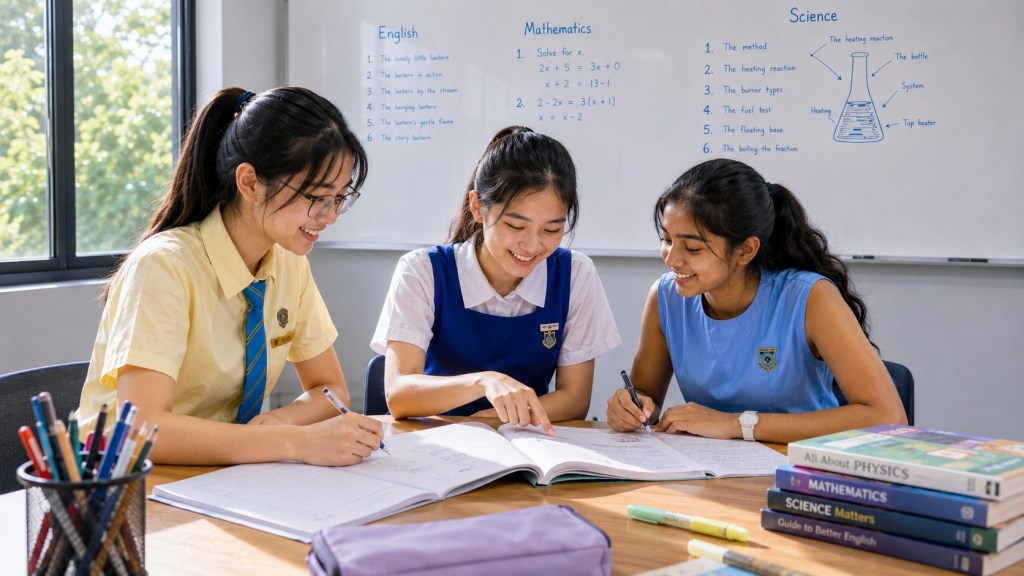
Small-group tuition only adds value when the small group changes what the teacher can observe and respond to. A three-student format is not automatically better simply because the number is small. The value appears when the teacher can hear each learner reason, see each working process, compare misconceptions, vary the level of support and require every student to retrieve and explain.
In a three-student Science tutorial, one student can explain, one can challenge or compare, and one can apply the idea to a fresh case. Roles can rotate. A teacher can see whether agreement is based on understanding or copying. The group is large enough for productive comparison but small enough that silence is visible.
This is part of how eduKate Sengkang approaches small-group teaching: diagnose the first weak link, teach the mechanism, practise under changed conditions and look for evidence of independent use. Families comparing a Science tutor in Sengkang or Punggol should ask how a class identifies individual errors inside the group, not only how many worksheets are assigned.
Common ways a Science tutorial wastes time
1. Reteaching the entire chapter after every mistake
If the student’s weak link is question reading or explanation structure, another full content lecture may add very little. Diagnose before reteaching.
2. Giving the model answer too early
A model answer can be useful, but if it arrives before the student attempts the reasoning, it hides the diagnostic evidence. Ask first, compare second.
3. Doing only same-format practice
Repeated success on nearly identical questions can create a false sense of mastery. Change the context, representation or response demand.
4. Treating keywords as magic marks
Scientific vocabulary matters, but a correct term cannot substitute for the relationship the question requires. Teach the meaning carried by the word.
5. Correcting without scheduling a return
A corrected answer immediately after feedback does not prove the learning will be available later. Revisit the idea after time has passed.
6. Using marks as the only evidence
Marks matter, but they arrive late. During learning, look for earlier indicators: independent recall, explanation quality, transfer, error discrimination and delayed success.
How to measure progress without turning every lesson into a test
Parents often want evidence that tuition is working. That is reasonable. The mistake is to use only the next school mark, because a mark combines many topics and may arrive weeks after the teaching decision that needs to be evaluated.
Use a small dashboard of learning evidence. Can the student retrieve yesterday’s key idea without notes? Can the student explain one mechanism with fewer prompts? Can the student identify the relevant concept faster when topics are mixed? Can the student correct a repeated error before the teacher points it out? Can the student solve a new question several days after the tutorial? These are not substitutes for school assessment, but they are earlier signals.
A useful weekly record might contain four lines: knowledge available, explanation quality, transfer success, recurring error. Keep it brief. The purpose is to guide the next tutorial, not create administrative homework.
Over time, the student should need fewer cues for the same class of problem. That reduction in support is one of the clearest signs that the teaching is moving from assisted performance to independent control.
How the system changes from Primary to PSLE to Secondary Science
The six tutorial jobs remain stable, but the content and representations become more demanding.
Primary 1–2 foundations: build observation, comparison, classification, measurement language, curiosity and evidence habits through everyday phenomena. Formal Primary Science in Singapore develops from Primary 3, so early work should support later scientific thinking rather than imitate upper-primary exam drilling.
Primary 3–4: establish accurate concepts, scientific vocabulary, simple investigations, tables, diagrams and explanation habits. This is where students learn that Science is not only remembering facts but using them to explain what happens.
Primary 5–6 and PSLE: increase transfer, question reading, data interpretation, experimental reasoning, answer control and cumulative retrieval across topics. Students need to move between knowledge and unfamiliar application more reliably.
Secondary G1/G2/G3 pathways: increase abstraction, subject-specific models, practical reasoning, mathematical relationships and discipline-specific vocabulary. Physics, Chemistry and Biology ideas become more explicit. Students must learn not only more content but more powerful representations.
A weekly tutorial architecture
One tutorial cannot carry the whole subject. The gains become more durable when the same diagnostic logic continues across weeks.
- Week A: diagnose and rebuild one high-value concept.
- Week B: retrieve that concept after delay and connect it to a neighbouring idea.
- Week C: mix the concept with others so the student must decide what is relevant.
- Week D: use a fresh examination or practical context and review the error log.
Meanwhile, each lesson should include a small amount of cumulative return. The student’s Science knowledge should become a connected network rather than a sequence of chapters that disappear after each test.
Spaced practice is useful here because learning is revisited across time rather than compressed into one sitting. The practical classroom version can be simple: return to previously taught material in later lessons and combine retrieval with new applications.
What “mastery” should mean in a Science tutorial
Mastery should not mean perfect performance forever. It should mean the student has moved beyond fragile familiarity. A useful mastery check asks whether the student can:
- retrieve the core idea without the answer being visible;
- explain the mechanism or relationship accurately;
- distinguish the idea from plausible alternatives;
- recognise when the idea is relevant;
- use it with a new representation or context;
- communicate the reasoning clearly;
- detect at least some of the student’s own recurring errors;
- return to the idea successfully after a delay.
No single question proves all of these. That is why tutorial evidence should accumulate across time.
Choosing a Science tutor in Sengkang: questions parents can ask
Commercial claims are easy to make. Diagnostic questions are more useful. Parents comparing Science tuition in Sengkang, Punggol or elsewhere can ask:
- How do you identify whether the problem is knowledge, reasoning, question reading or communication?
- How much of the lesson requires students to produce answers without copying?
- How do you revisit corrected errors later?
- How do you make sure a small group still gives individual evidence?
- How do you connect Primary Science concepts to PSLE application?
- How do you prepare students for the increase in abstraction in Secondary Science?
- What does a student do after a wrong answer besides receiving the correct one?
- How do you know when the student can perform independently?
The answers reveal the teaching model. A strong tutorial should have a visible route from diagnosis to repair to independent performance.
Useful internal routes on eduKate Sengkang
- Primary Science Tuition Sengkang | The Next Clear Step
- PSLE Science Learning Guide | Questions, Evidence, Investigations & Revision
- Complete Science Index | eduKate Sengkang Science Estate
- Advanced Science Tutorials | How to Study Science Effectively Without Re-reading Notes
- Advanced Science Tutorials | Common Science Misconceptions
- Advanced Science Tutorials | Science Problem Solving Strategies
Frequently asked questions
Can a student really improve Science in one hour?
One hour can produce a meaningful local improvement if the tutorial targets a specific weak link. It cannot compress an entire curriculum into one lesson. The goal is to make one piece of the learning route more reliable and then build on it.
Should the tutorial use worksheets or notes?
Both can be useful. The question is what job they serve. Notes can support accurate reconstruction; worksheets can provide practice and transfer. Neither should replace independent retrieval and reasoning.
How much memorisation does Science need?
Students need accessible factual and conceptual knowledge, but memorisation should support explanation and application. Memorising a model answer without understanding the relationships makes performance fragile when the context changes.
What if the child understands orally but writes weak answers?
That suggests the teaching should separate scientific understanding from communication. First confirm the mechanism orally, then teach how to translate it into a concise written explanation that matches the question.
What if the child gets answers right but very slowly?
Correct-but-slow work can indicate fragile retrieval, inefficient decision making, over-checking or a need for more fluent prerequisite knowledge. Diagnose the delay rather than assuming the solution is simply more timed papers.
Is this system only for PSLE Science?
No. The same tutorial architecture can be used from early Primary foundations through PSLE and Secondary Science. What changes is the depth of the scientific model, the representations and the independence expected from the learner.
Final tutorial receipt
At the end of a fast, useful Science tutorial, the learner should be able to answer six questions:
- What was my first weak link today?
- What knowledge can I now retrieve without looking?
- What scientific mechanism or relationship did I rebuild?
- Where did I apply it in a new situation?
- What exact error will I watch for next time?
- What can I now do independently that I could not do at the start?
That is the fastest kind of Science learning worth pursuing. Not speed for its own sake. Not frantic coverage. Not a thicker stack of completed worksheets. The aim is a shorter path from confusion to diagnosis, from diagnosis to explanation, from explanation to application, and from correction to durable independent use.
When those transitions become the normal rhythm of a tutorial, Science becomes easier to teach, easier to revise and easier for a parent to evaluate. The student is no longer simply “doing Science”. The student is building a system for learning Science.
The tutor feedback ladder: reduce help until the student owns the Science
A fast Science tutorial should not merely produce the correct answer while the teacher is present. It should deliberately reduce the amount of support needed. This gives the tutor a practical feedback ladder. At the most supported end, the teacher may model the full reasoning. At the least supported end, the student identifies the problem, selects the relevant concept, constructs the explanation, checks the evidence and corrects the answer independently. Progress is the movement between those two states.
Level 1: full model. Use this when the student genuinely lacks the concept or has a deeply incorrect model. The tutor demonstrates the scientific relationship and makes the reasoning visible. The important step is not to stay here. After modelling, remove the example and ask the student to reconstruct the idea.
Level 2: structured prompt. Instead of giving the answer, provide the skeleton: “What changed? Which Science idea connects to that change? What happens next?” The student supplies the content. If the student succeeds, the tutor has evidence that less support is already possible.
Level 3: single cue. Give one short cue such as “energy transfer”, “controlled variable”, “compare the starting values” or “what evidence supports that inference?” A single cue is useful diagnostically because it shows whether the knowledge exists but is not being selected at the right moment.
Level 4: delayed feedback. Let the student complete the question before intervening. Then ask the student to locate the weakest sentence or step. This shifts checking from the teacher to the learner and makes self-correction part of the Science routine.
Level 5: independent transfer. Change the context, representation or data and give no cue. The learner must decide what the question is really about. This is the level that matters most for examinations and later study because real questions do not arrive with the teacher’s hint attached.
The ladder also prevents a common tuition problem: a child can appear highly successful because the tutor is doing invisible cognitive work. The tutor has already selected the concept, broken the question into parts, highlighted the relevant information and signalled when an answer is incomplete. The student then supplies the final few words. The page looks correct, but the independence test has not yet been passed.
Parents can use the same ladder when helping at home. Rather than moving immediately from “I don’t know” to the complete answer, start with a question that points the child back to the evidence. If that is not enough, add one cue. If that is not enough, rebuild the prerequisite. The amount of help should match the size of the missing step.
Over several weeks, keep an eye on which level is normally required. A learner who once needed a full model for experimental variables may later need only a reminder to identify what was changed, and later no reminder at all. That reduction in prompting is meaningful progress even before a major school examination produces a new grade.
The end point is not a student who never asks for help. Good learners ask precise questions when they meet genuine difficulty. The end point is a student who can distinguish “I have not learned this yet” from “I learned this but cannot retrieve it”, “I know the concept but cannot recognise where it applies”, and “my reasoning is sound but my written explanation is incomplete”. That diagnostic language makes future Science tutorials faster because the student increasingly participates in locating the weak link.
