
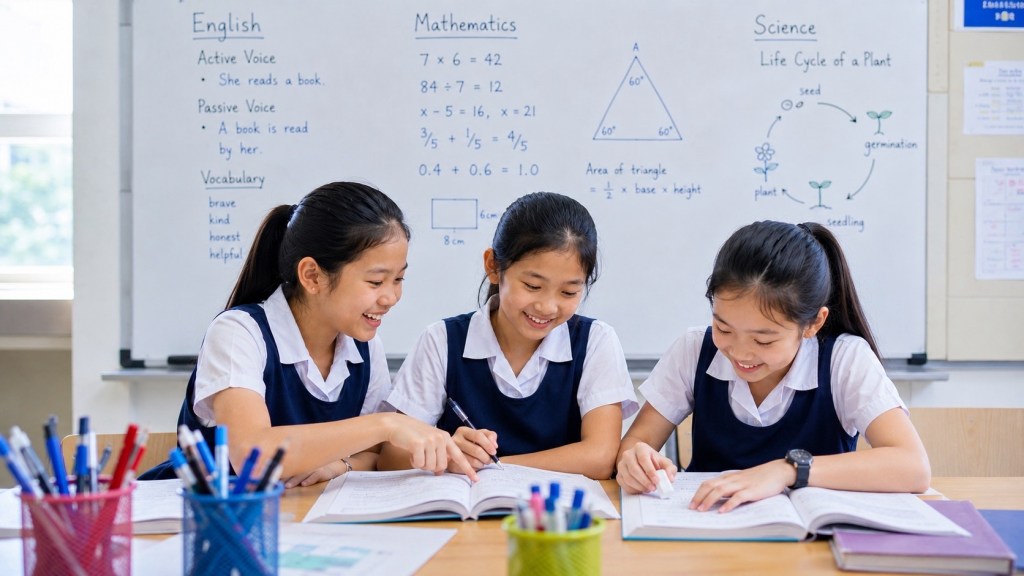
Primary 3 Science tuition for beginners should do one thing before anything else: make the subject feel intelligible. A child entering formal Science does not need a mountain of notes. The child needs a clear way to observe, compare, classify, describe evidence and explain what a question is actually asking.
At eduKate Sengkang, Primary 3 Science is taught in small 3-pax tutorials so the tutor can see how each learner thinks, not only whether the final answer is right or wrong. Lessons are 1.5 hours weekly. The programme is designed for children who are beginning Science, children who have become unsure after the first school assessments, and children who are doing well but need stronger reasoning and answering habits before Primary 4.
The aim is not to make Primary 3 feel like Primary 6. The aim is to build the first layer properly: curiosity with discipline, vocabulary with meaning, evidence with explanation, and practice with correction.
For the wider subject map, start with the Primary 3 Science Learning Hub. Families considering tuition can also read the Primary Science Tuition Sengkang guide.
- Class size: up to three students.
- Lesson duration: 1.5 hours weekly.
- Focus: Primary 3 Science concepts, scientific language, question reading, evidence, open-ended answers and independent checking.
- Location: eduKate Sengkang, 83 Punggol Central, Singapore 828761.
- Enquiries: WhatsApp +65 8823 1234.
Primary 3 Is a More Important Transition Than It First Appears
Primary 3 is often described as the year Science begins. That is true, but it understates the transition. The real change is that the child is being asked to move from everyday noticing into disciplined scientific noticing.
Before formal Science, a child can say that a butterfly is pretty, a magnet is strong, a cup floats, a leaf is green or a puppy grows. These observations are useful beginnings. Primary 3 asks for more control. Which feature matters? What is being compared? What evidence supports the claim? Is the child describing an observation or adding an explanation? Is the classification rule consistent?
That change can be surprisingly demanding because the language of Science is stricter than ordinary conversation. In daily life, a child may say that a magnet ‘sticks’ to a paper clip. In Science, the useful idea is attraction between a magnet and a magnetic material. In daily life, a child may say that a raincoat material is ‘good’. In Science, the learner must identify the relevant property, such as waterproofness or flexibility, and connect that property to the use.
Primary 3 therefore builds a new habit: do not answer from impression alone. Look for the feature, relationship or evidence that makes the answer scientifically defensible.
This is why a beginner may appear to know the topic and still lose marks. The child may recognise the animal, remember the material name or know that magnets attract, but the question may require a basis of classification, a comparison, a property-to-use explanation or a complete cause-and-effect link.
A good beginner programme teaches the hidden job inside the question. Once the child can see that job, Science stops feeling like a collection of random facts.
The Current Primary 3 Science Boundary
Singapore’s current Primary Science syllabus begins formal Primary Science through a framework that develops scientific knowledge, practices and values. For Primary 3, the core content includes Diversity of Living and Non-Living Things, Diversity of Materials, Cycles in Plants and Animals through life cycles, and Interaction of Forces through magnets. Families can refer to the MOE Primary Science Teaching and Learning Syllabus for the official boundary.
That boundary matters. Beginners do not benefit when later-year terminology is poured into every lesson simply to sound advanced. Strong teaching keeps the concept at the correct level, then deepens the reasoning inside that level.
Diversity of living and non-living things
The beginner learns to distinguish living from non-living things using relevant characteristics, and to classify living things with consistent observable features. Classification is not guessing from appearance. It is choosing a basis and applying it consistently.
A child who says ‘it is a bird because it flies’ needs refinement because not all birds fly and many non-birds do. A better route is to use defining observable characteristics that are appropriate to the task. The lesson is larger than birds: scientific categories must be supported by the right evidence.
Diversity of materials
Primary 3 materials work is not a catalogue of nouns. The important reasoning chain is object → material → property → suitable use. Students compare familiar materials such as wood, metal, ceramic, rubber, glass, plastic and fabric, and think about properties such as strength, flexibility, transparency, waterproofness and whether something floats or sinks in water.
The transferable skill is relevance. A property can be true and still be irrelevant to the question. If a window needs to allow a person to see through it, transparency matters more than a property that has no bearing on that job.
Life cycles
Life-cycle learning asks the child to track stages, sequence and change through time. The learner compares plant and animal life cycles, notices similarities and differences, and learns not to assume that every organism develops through the same visible stages.
This topic quietly prepares the child for later systems thinking. The student is learning to follow a process, identify stages and explain what changes while preserving the overall pattern.
Magnets
Magnets introduce interaction and evidence. A learner must distinguish attraction from repulsion, recognise that magnets have poles, know that unlike poles attract and like poles repel, and use tests appropriately. The repulsion test is particularly important because attraction alone does not prove that both objects are magnets.
Magnets also teach a powerful scientific habit: one result may not be enough to establish a conclusion. The child learns to ask what the test actually proves.
Why Sengkang Parents Choose 3-Pax Science Tutorials
A class of three creates enough room for conversation while remaining small enough for close observation. This matters in Science because the visible wrong answer is often only the final symptom. The useful question is what the child did just before the answer went wrong.
One pupil may classify by colour when the question requires body covering. Another may know the correct material property but fail to connect it to the object’s function. Another may understand a life cycle but reverse two stages. Another may know that unlike poles attract but use the word ‘repel’ carelessly in writing.
In a large class, all four errors can look like ‘Science mistakes’. In a 3-pax tutorial, the tutor can listen to the reasoning, inspect the wording and correct the first unstable decision.
The advantages of three students
- Frequent opportunities for every child to answer aloud.
- Immediate checking of diagrams, labels, evidence and written explanations.
- Enough peer discussion for students to hear another way of thinking.
- Less room for a quiet learner to hide confusion for an entire lesson.
- Pacing that can slow down at the precise concept that is unstable.
- Short retrieval checks tailored to each student’s recurring mistakes.
- Guided comparison of answers so students learn why one explanation is stronger than another.
- A calm environment for beginners who need confidence without being rescued from every difficult step.
The class is small by design. The objective is not constant intervention. It is accurate intervention, followed by a gradual transfer of control back to the child.
What We Teach in Primary 3 Science Tutorials
Schools may sequence units differently, so tuition should coordinate with the student’s current school work while preserving the full Primary 3 foundation. We organise teaching around five connected layers rather than isolated worksheet chapters.
1. Concept meaning
The child should be able to explain the idea in ordinary language before being expected to reproduce textbook wording. If a learner cannot explain why a transparent material may be suitable for a window, memorising the word ‘transparent’ has not yet built usable knowledge.
2. Scientific vocabulary
Vocabulary is taught as a tool for precision, not as a spelling list. Words such as classify, property, waterproof, flexible, transparent, life cycle, stage, attract, repel, pole and magnetic are attached to examples, contrasts and questions.
We also teach the child to avoid vague substitutes when the scientific term carries important meaning. ‘It sticks’ may be replaced by ‘the magnet attracts the paper clip’. ‘It is good for the raincoat’ becomes ‘it is waterproof, so water does not pass through easily and the wearer stays dry’.
3. Observation and evidence
Primary 3 learners must learn the difference between what they can observe and what they infer. If a diagram shows an animal with feathers, feathers are an observation. Saying that the animal can fly may be an unsupported inference unless the evidence establishes it.
This distinction prevents many later problems in Science because pupils learn early that an answer should not claim more than the evidence allows.
4. Question reading
The child learns to notice command words and targets. ‘State’ is different from ‘explain’. ‘Compare’ requires a relationship. ‘Give one reason’ requires one relevant reason, not everything the child remembers. A question asking about Material A should not be answered with a fact about Material B.
5. Answer construction
We teach children to complete the scientific link. A useful beginner route is: identify the target → select the relevant observation or property → state the scientific idea → connect it to the requested outcome.
The route is not a rigid sentence template. It is a thinking check. Different questions require different forms, but the child should learn that an explanation needs a connection, not just a keyword.
Our First-Principles Teaching Method
A beginner programme works best when difficulty is increased deliberately rather than randomly. We therefore build from the first unstable point and make each layer usable before adding more complexity.
1. Diagnose the exact weakness
We avoid broad labels such as ‘weak in Science’. A child can be weak in several very different ways: vocabulary, classification, question reading, evidence use, sequencing, scientific expression, recall, confidence or checking.
The tutor looks at school papers, asks short diagnostic questions and listens to the child’s explanation. The purpose is to find the first decision that fails.
2. Rebuild from that first weak link
If the child cannot reliably distinguish object from material, more difficult property questions will only create noise. We repair the distinction first. If the child changes classification rules halfway through, we stabilise the idea of one consistent basis. If the child knows magnet facts but cannot interpret a test, we return to what attraction and repulsion can actually prove.
3. Fence the problem before expanding it
We begin with a clean example containing one main decision. Once that decision is stable, we vary the surface: a new material, a new animal, a different life cycle, another magnet arrangement. Then we mix two decisions in one question.
This protects beginners from drowning in complexity while still preparing them for transfer.
4. Move from concrete observation to representation
Where useful, children handle or imagine real objects, then work with pictures, tables, sequences and diagrams. The goal is to recognise the same scientific relationship even when the representation changes.
5. Ask the child to think aloud
Students explain what they noticed, what the question wants, which clue matters and why a chosen answer follows. Thinking aloud reveals hidden shortcuts that a correct multiple-choice answer can conceal.
6. Retrieve after a delay
A concept is not secure because it was understood five minutes ago. Earlier learning returns in short retrieval checks. We revisit old ideas after time has passed and mix them with newer ones.
7. Build independent checking
The child learns a short check: Did I answer the requested object? Did I use the relevant evidence? Is the Science correct? Did I complete the link? Did I add anything the question did not support?
These habits make the learner less dependent on a tutor saying, ‘Check again.’
What Happens During a 90-Minute Primary 3 Science Lesson
Each lesson changes according to the learners and school schedule, but the underlying rhythm remains stable.
Warm-up retrieval
Students begin with a short recall or discrimination task from earlier learning. Examples may include identifying the correct classification basis, matching a material property to a use, sequencing life-cycle stages or predicting attraction and repulsion between magnet poles.
Concept instruction
The tutor introduces or revisits one central relationship. Explanations use clear examples and non-examples so children see not only what is correct, but why a tempting alternative is wrong.
Guided practice
Students work through questions with prompts available. The tutor watches where reasoning changes direction. Prompts are reduced as control improves.
Independent application
A small set is completed without step-by-step help. This is where we find out whether the child can use the idea rather than merely follow the tutor.
Mixed transfer
The surface changes. A new animal replaces the familiar one. A different material is used. A life cycle is shown in an unfamiliar diagram. A magnet test is described instead of drawn. The student must recognise the underlying scientific job.
Error review
Mistakes are classified. Was the concept unknown? Was the evidence missed? Was the wrong object answered? Was a correct idea written vaguely? Did the child overclaim beyond the diagram? This turns correction into a reusable rule.
Focused continuation work
Home practice is kept purposeful. It should reinforce the lesson, not become a pile of repetitive pages that a beginner completes mechanically.
Three Primary 3 Student Pathways
Not every beginner arrives in the same state. We usually see three broad pathways.
The repair pathway
This learner may already be confused by Science vocabulary, school worksheets or early tests. The child may guess frequently, avoid open-ended questions or say that Science has too many facts.
The priority is to stop confusion from becoming a habit. We locate the first unstable ideas, rebuild them in a smaller space and reconnect them to the current school topic.
The stabilisation pathway
This learner understands lessons but results vary. One week the work is strong; the next week the same child loses marks through vague wording, missed clues or incomplete explanations.
The priority is consistency. Retrieval, checking and mixed practice are used to make performance less dependent on the exact worksheet format.
The extension pathway
This learner is doing well and enjoys Science. Extension does not mean racing into Primary 5 terminology. It means deeper Primary 3 reasoning: better classification, stronger comparison, more careful evidence, clearer explanations and unfamiliar applications.
The priority is depth before acceleration.
Why Scientific Language Receives Special Attention
Primary 3 is the ideal year to teach that scientific language is not decorative. Words organise thinking.
Consider the sentence ‘The material is good.’ It tells us almost nothing. Which property? Good for what? Compared with what alternative? A more precise statement such as ‘The material is waterproof, so it is suitable for the rain cover because water does not pass through easily’ contains a property, a function and a relationship.
The same principle applies to magnets. ‘The magnet pushes it away’ may be clarified into ‘the like poles repel’. In classification, ‘it looks like a bird’ becomes a statement tied to observable characteristics.
We do not demand adult technical language from an eight- or nine-year-old. We teach the minimum precise language needed to make the child’s reasoning visible.
That habit compounds. By Primary 5 and Primary 6, open-ended Science requires increasingly careful explanation. Children who learn early that wording should reflect a scientific relationship have less to unlearn later.
How We Reduce Careless Science Mistakes
Calling every error ‘careless’ is unhelpful because different mistakes require different repairs.
Reading errors
The child answers a different object, misses ‘one difference’, ignores a labelled condition or overlooks a word such as ‘not’. Correction requires annotation and deliberate target checking.
Vocabulary errors
The idea is partly correct but the chosen word changes the meaning. Correction requires contrasting the terms in context, not copying definitions repeatedly.
Classification errors
The child changes the basis halfway through or uses a feature that does not separate the groups. Correction requires stating the rule before placing examples.
Evidence errors
The child writes a plausible story not supported by the diagram or observation. Correction requires pointing to the exact evidence before writing the conclusion.
Sequence errors
Stages of a life cycle are known but placed in the wrong order. Correction requires reconstructing the cycle from memory and checking direction.
Answer-completion errors
The child gives the keyword but not the connection. Correction requires asking, ‘So what?’ or ‘Why does that property make it suitable?’ until the link is complete.
We track patterns across work. Once a repeated pattern becomes visible, the child can learn a specific correction rule instead of hearing the vague instruction to ‘be more careful’.
Teaching Ahead Without Rushing
It can be useful to meet a topic before it appears in school, but pre-teaching should reduce surprise, not create a race.
A quiet first encounter can make later school teaching easier because the vocabulary and central relationship are already familiar. When the school lesson arrives, the child can spend more attention on detail rather than using all available working memory simply to decode new terms.
However, we do not stack new content on top of an unstable base. If material properties remain confused, there is little value in racing ahead. If classification is weak, later diversity questions will remain fragile.
The principle is simple: secure the floor, then widen the room.
What Progress Should Look Like
Progress is broader than one test score. Parents may first notice that the child starts homework with less resistance, uses more precise words, can explain why an answer is correct, reads diagrams more carefully and recovers from a mistake without becoming stuck.
Other useful signs include:
- the child can state a classification basis before sorting examples;
- material answers connect a property to a stated use;
- life-cycle stages are sequenced and compared more reliably;
- magnet answers distinguish attraction from repulsion;
- the child points to evidence rather than inventing extra information;
- open-ended answers become shorter but more complete;
- wrong answers are corrected with a reason, not merely copied;
- older topics can still be retrieved after newer topics have been taught;
- the learner asks more specific questions when confused;
- confidence becomes connected to understanding rather than guessing.
Marks often improve when concept knowledge, recall, reading and scientific expression begin working together. Responsible tuition does not promise an instant grade. The rate of improvement depends on the size of the existing gap, attendance, school demands, practice between lessons and the time available before assessment.
When Should a Primary 3 Student Begin Science Tuition?
Support may be useful when a child repeatedly says that Science is confusing, can remember facts but cannot explain them, leaves open-ended questions blank, guesses from everyday assumptions, misreads diagrams, forgets vocabulary quickly or becomes anxious before school Science tests.
It can also be useful for a child who is already strong but needs a more deliberate programme for explanation, evidence and transfer.
Parents do not need to wait for a serious failure. Early repair is often simpler because fewer misconceptions have had time to become automatic.
Class Details
Format: 3-pax small-group tutorials.
Level: Primary 3 Science.
Duration: 1.5 hours weekly.
Teaching approach:
- clear concept explanation;
- guided observation and classification;
- scientific vocabulary in context;
- question-reading routines;
- guided and independent practice;
- retrieval and mixed review;
- error analysis and correction;
- carefully paced preparation for school assessments.
Materials may include:
- curated notes and concept maps;
- diagrams and classification tables;
- topic practice;
- open-ended explanation tasks;
- mixed revision;
- short retrieval checks;
- focused continuation work.
Class placement and schedules depend on current availability. Families can enquire with the child’s level, school topic, current concerns and preferred timing.
What Parents Can Bring to a Consultation
Useful materials include recent school worksheets, test papers, marked open-ended questions, the current school topic list, teacher comments and examples of questions the child avoids or repeatedly answers incorrectly.
We are not only looking at the final mark. A score can hide very different learning states. One child may have a concept gap. Another may understand the concepts but lose marks through reading. Another may know the answer but communicate it too vaguely.
The consultation helps identify whether the immediate job is repair, stabilisation or extension.
Frequently Asked Questions
Is Primary 3 too early for Science tuition?
Not automatically. Some children are learning comfortably and do not need additional support. Tuition becomes useful when the subject transition exposes a gap, the child needs a calmer pace, school work is becoming confusing or the family wants structured extension. The purpose should be better learning, not simply more work.
Do students need to memorise model answers?
Students need accurate scientific language, but memorising long answers without understanding can create fragile performance. We teach the concept and relationship first, then help the learner express it clearly in different question contexts.
Will tuition teach beyond the Primary 3 syllabus?
We may make useful connections when they clarify the current idea, but the core teaching stays within the Primary 3 boundary. Depth, evidence and transfer are more valuable than prematurely loading later-year terminology.
How do you help a child who is shy?
A three-student class gives the tutor room to invite answers without turning every response into a public performance. Quiet learners can be checked frequently and gradually become more comfortable explaining their thinking.
What if my child is already doing well?
Strong students can work on deeper classification, more careful evidence use, unfamiliar representations and better explanation. Extension should strengthen transfer and independence rather than simply rush through future chapters.
Do you follow the school sequence?
We coordinate with current school topics while protecting the full Primary 3 foundation. School sequences differ, so the programme remains flexible rather than forcing every child through the same weekly chapter list.
How much homework is given?
Continuation work is focused. The goal is to retrieve, apply and correct the lesson, not to maximise page count. A small set that exposes a weak link is more useful than repetitive completion without reflection.
How do parents know whether progress is real?
Look beyond one paper. Can the child explain more clearly? Retrieve older ideas? Correct a mistake independently? Use evidence? Handle a changed example? Stable improvement across these behaviours is stronger evidence than one unusually easy or difficult test.
Where Next
Primary 3 Science is the first formal layer of a longer journey. The best outcome is not a child who can reproduce one worksheet. It is a child who can look carefully, choose relevant evidence, name the idea precisely and explain the relationship in a way another person can follow.
Continue with the Primary 3 Science Learning Hub, move through the wider Science Hub, or read the Primary Science Tuition Sengkang guide.
eduKate Sengkang teaches Primary Science in focused groups of up to three students at 83 Punggol Central, Singapore 828761. Lessons are by appointment. For current class availability, WhatsApp +65 8823 1234.
Properly Taught Kids Shine a Bright Light Into the Future.
Worked Primary 3 Science Examples: Turning Everyday Answers Into Scientific Answers
A useful way to understand Primary 3 Science is to compare an everyday answer with a scientific answer. The everyday answer is often not nonsense. It may show that the child has noticed something important. The teaching task is to make that observation precise, relevant and complete enough for the question.
Example 1: Classifying living things
Suppose a question asks why two animals belong in the same group. A child may write, “They look the same.” That answer is too broad because appearance includes many features and does not identify the basis of classification. The tutor asks a tighter question: which observable feature is shared by both animals and is relevant to the grouping? The child may then identify feathers, number of legs, body covering or another appropriate characteristic shown by the evidence.
The correction is not merely to replace one sentence with another. The child learns a reusable routine: name the classification rule first, check that every item in the group satisfies it, and do not switch to a different rule halfway through.
Example 2: Choosing a material for a purpose
A learner may say, “Plastic is good for the bottle because plastic is strong.” That can be correct in some contexts, but it may not answer the actual question. If the bottle is meant to hold water without leaking, waterproofness may be the relevant property. If the question compares a transparent bottle with an opaque one so the user can see the liquid level, transparency may matter instead.
The scientific habit is to match the property to the stated function. We ask: what must the object do, which property helps it do that job, and how does that property produce the useful result? This simple property-to-function chain becomes increasingly important as Science questions become more complex.
Example 3: Reading a life-cycle diagram
A child may memorise the familiar sequence for one animal and then force the same sequence onto another. Instead, we teach the learner to read the evidence in the diagram: identify each shown stage, follow the arrows, compare what changes and what remains part of the same cycle, and avoid importing a stage that is not represented.
When two life cycles are compared, the student is encouraged to write the relationship explicitly. A strong comparison names both organisms and the feature being compared. This prepares the learner for later questions where several systems, variables or stages must be compared carefully.
Example 4: Testing whether an object is a magnet
If an unknown object attracts one pole of a known magnet, some children immediately conclude that the unknown object is also a magnet. The result does not prove that conclusion because a magnetic material can also be attracted. A repulsion result is stronger evidence that both objects are magnets, because repulsion occurs between like poles of magnets.
This is an important beginner lesson in scientific inference: an observation may support several explanations, and a good test should distinguish between them. The child begins to understand that Science is not only remembering facts; it is choosing evidence that can justify a conclusion.
Example 5: Answering only what the evidence supports
Suppose a picture shows that Plant A is taller than Plant B. The child may be tempted to add that Plant A received more water, more sunlight or better soil. Unless the question provides that information, those statements are guesses. The scientifically disciplined answer stays within the evidence: Plant A is taller, or Plant A grew more over the stated period if measurements establish growth.
This habit of not overclaiming is one of the most valuable skills a beginner can learn. It protects the child from plausible but unsupported stories and builds the foundation for later experiment and data questions.
How Parents Can Support Primary 3 Science at Home
Home support is most useful when it extends curiosity without turning every dinner table conversation into another lesson. Parents do not need to reproduce tuition at home. A few well-chosen questions can strengthen the habits that matter.
Ask for the reason, not only the answer
When a child gives an answer, ask, “What made you think that?” or “Which part of the picture tells you?” This invites the learner to connect a conclusion to evidence. If the answer is wrong, the explanation often reveals where the reasoning changed direction.
Use ordinary objects for property language
A raincoat, window, spoon, rubber band, ceramic cup, plastic container and piece of fabric can become quick material-property examples. Ask which property matters for the object’s job. The purpose is not to quiz every object, but to make scientific vocabulary feel connected to real choices.
Let the child make predictions
Before checking whether an object is attracted to a magnet, ask the child to predict and explain why. Before reading the next stage in a life-cycle diagram, ask what the child expects. Prediction makes existing thinking visible and gives the learner something to compare against the result.
Treat mistakes as information
If a child confuses attract and repel, changes classification rules or gives an unsupported explanation, the mistake tells us what needs repair. Repeating the correct answer five times is less useful than identifying the decision that created the error and practising that decision again in a different example.
Keep retrieval short and spaced
Instead of one long revision session, ask two or three questions from an older topic on another day. Can the child still explain why a material was suitable? Can the child reconstruct a life cycle from memory? Can the child describe what a repulsion test proves? Short retrieval after a delay helps knowledge remain usable.
Protect the child’s ownership
The long-term goal is a learner who can read, think, attempt, check and correct without waiting for an adult to approve every step. Parents can support this by giving time for an attempt before rescuing, asking the child to explain corrections, and praising careful reasoning rather than speed alone.
Primary 3 is a good year to establish this balance. The child is still close enough to the beginning of formal Science that habits can be shaped gently, yet the subject is rich enough for genuine reasoning. A strong foundation here makes later Science feel like an extension of familiar thinking rather than a sudden wall of facts.
