
Anchor Green Primary School was established in December 2007 and began teaching on 2 January 2008 at 31 Anchorvale Drive. Its anniversary account records 273 pupils in nine classes spanning Primary One to Three, under founding principal Mrs Dhillon Awtar Singh. The official-opening ceremony followed on 2 October 2009, officiated by Dr Lam Pin Min.
Its subsequent history connects campus development with environmental learning. PUB’s own 2012 award record describes a wetland learning trail created by the school in 2011, while the school traces later environmental programmes and facilities in its anniversary account. These records show why a school history can reach beyond its classrooms into the surrounding neighbourhood. The worked activities below explore that connection through observation, quantities, design and communication; their invented measurements are teaching examples, not school performance statistics.
eduKateSengkang • Neighbourhood history and learning
Choose your reading route
Read the historical record, follow the worked explanations, or begin with independent practice.
Route 1 · Chapters 1–2: Founding structure and milestones
A school beginning across several levels; Establishment, daily work and formal recognition.
Route 2 · Chapters 3–4: Campus and wetland learning
A campus that grows in stages; The wetland becomes a learning resource.
Route 3 · Chapters 5–6: Explanation and programme development
Designing an explanation for a younger child; Environmental programmes acquire names and structure.
Route 4 · Chapters 7–8: Partnerships and recognition
Partnerships connect the school and neighbourhood; Recognition, creativity and the limits of a milestone.
Route 5 · Chapters 9–10: Practice and a connected account
Independent practice with explained answers; Bringing the campus and environmental story together.
Full chapter index · Independent practice · Sources · Continue exploring
Contents
Chapters 1–2 · Founding structure and milestones
Chapters 3–4 · Campus and wetland learning
Chapters 5–6 · Explanation and programme development
Chapters 7–8 · Partnerships and recognition
Chapters 9–10 · Practice and a connected account
CHAPTER 1 OF 10 • Founding structure and milestones
1. A school beginning across several levels
Anchor Green’s first intake covered three primary levels, rather than a single Primary One cohort. That detail changes how readers should imagine the founding school. Children were entering at different points in primary education, and the institution had to support more than one stage from the beginning. The total headcount describes the scale of that start, but it does not tell us how the pupils were distributed among levels or how many were in each individual class.
There is a useful calculation available from the published totals. Dividing 273 pupils by nine classes gives an average of 30⅓ pupils per class. A fractional average does not imply that any class contained a fraction of a child. It is a summary across groups. Actual class sizes are whole numbers, and several different sets of whole-number class sizes can produce the same total and average.
For an invented example, six classes of 30 and three classes of 31 contain 6 × 30 + 3 × 31 = 273 pupils. Another arrangement could redistribute pupils while preserving the same total. Neither arrangement is being presented as Anchor Green’s real class structure. The example demonstrates why an average cannot reveal the underlying distribution without additional evidence about each class.
Now change the question. Can the same totals establish a pupil-to-teacher ratio? No, because the number of teachers is not supplied in that calculation. The denominator is classes, not teachers. A reader who quietly changes the label changes the meaning of the statistic. This is a valuable habit for children reading any school profile: identify who or what is counted before deciding what the resulting quotient can tell us.
The opening also illustrates a wider feature of neighbourhood development. A new institution can assemble people whose earlier experiences differ. Some children may begin formal primary education, while others enter at a later level. That general possibility helps explain why a founding history should leave room for varied experiences without inventing individual biographies. The documented structure gives a starting point for questions, rather than permission to manufacture personal memories.
CHAPTER 2 OF 10 • Founding structure and milestones
2. Establishment, daily work and formal recognition
The school’s establishment, first teaching day and official opening are three milestones. They belong together because each describes a stage in the making of a working institution. Establishment concerns its organisational beginning; the first teaching day concerns everyday educational activity; the ceremony marks a public occasion. A timeline becomes clearer when those actions are written beside the dates rather than hidden under a single broad label.
The anniversary account is a retrospective institutional source. It selects milestones to tell the school’s story after years of operation. A retrospective account can connect events that were originally recorded separately, but its later publication date should not be mistaken for the date of those events. For a child’s project, note both the historical event and the kind of surviving source being used to describe it.
An original exercise can use three objects from an invented club: a signed founding document, a register from its first meeting and a programme for its opening celebration. Which object answers “When was the club established?” Which answers “When did members begin meeting?” Which answers “What was commemorated?” The objects may overlap in what they reveal, but their principal purposes differ. Children learn to choose evidence that fits a question.
Suppose the celebration programme contains a photograph of members at work. That photograph may show an activity, but the programme’s date does not automatically establish when the photograph was taken. It might be an earlier image selected for the occasion. A caption or other record is needed to connect the image to a specific day. This is a practical distinction when using anniversary booklets, where older photographs often appear alongside later commentary.
The historical value lies in the sequence. A school can already be educating children before an official ceremony takes place, and it can continue developing long afterwards. Treating the ceremony as the finish of all campus development would be as misleading as treating it as the beginning of every lesson. The following chapters therefore follow activities and facilities beyond the first opening milestones.
The anniversary account dates an indoor sports hall to 2011, a kindergarten annex completed under PERI upgrading to 2018 and the first MOE Kindergarten intake to 2019. These entries separate a physical addition from the educational activity that follows it. A completed annex and a first intake are related events, but they answer different questions and should retain separate places in the chronology.
A campus is a collection of spaces with different functions. Adding one facility can affect how existing areas are used, how groups move and how activities are scheduled. A hall is not simply extra floor area: it can offer a different setting from a classroom or field. The historical record of an addition invites questions about those functions, even when public sources do not provide the detailed internal timetable.
Consider an invented diagram of a school with a classroom block, a hall and a garden. Draw a line between spaces whenever a planned activity involves moving between them. A science observation might connect classroom and garden; a performance might connect classroom and hall. The diagram represents relationships, not a measured campus map. It helps a child see how one added space can create new combinations of activity.
Now give the model a timing condition. A group has a 50-minute period. Walking to a garden takes four minutes each way, setting up takes six minutes and packing away takes four. The observation time is 50 − 4 − 4 − 6 − 4 = 32 minutes. Ignoring movement and preparation would overstate the time available for the main task. These figures are invented; they explain a scheduling mechanism rather than an actual school route.
If the outward journey increases to seven minutes but the return remains four, observation time falls to 29 minutes. The change is three minutes, not six, because only one journey changed. This transfer check encourages careful reading of conditions. It also provides a useful lens for campus history: changes to space can matter through the activities and movements they enable, rather than through building size alone.
CHAPTER 4 OF 10 • Campus and wetland learning
4. The wetland becomes a learning resource
PUB’s Watermark Award 2012 record identifies Anchor Green as a recipient and describes its ABC Waters Learning Trail at Sengkang Floating Wetland, developed in 2011. The materials included an activity booklet and a large storybook, Legend Of The Wetlands, written and illustrated by teachers for preschoolers. The record also describes feedback from an approximately 120-pupil Primary Four cohort and parent volunteers during a NEWater Scientist pilot.
This is an institutional original from the water agency, rather than merely a school claim copied into a directory. It gives the neighbourhood connection a specific form: teachers developed materials for younger learners around a local place, and pupils and parents contributed feedback to another educational initiative. The record does not establish that the same trail operates today or that every detail of the pilot became part of a later programme.
Place-based learning begins with something that can be encountered or represented concretely. A wetland can prompt questions about water, living things, human design and responsibility. A child can move from “What do I notice?” to “What might explain it?” and then to “What evidence would help?” The educational value comes from connecting observation and explanation, not simply from moving a lesson outdoors.
Feedback adds another step to that process. In an original teaching exercise, give a short explanation to one reader and ask the reader to explain the relationship in their own words. If they repeat a technical term but cannot use it in a changed example, the explanation may need a clearer model. Record the misunderstood step rather than simply asking whether the reader liked the activity. Enjoyment and understanding can both matter, but they are different questions.
A second trial should change the explanation deliberately. Perhaps replace an unfamiliar word with a labelled drawing, or divide one long instruction into two observable actions. Ask a new but related question afterwards, so success cannot come only from remembering the first answer. This small cycle makes revision purposeful. It also helps children understand why testing educational materials with their intended audience can be part of the work, rather than a minor task performed only after all design decisions are finished.
A storybook and an activity booklet perform different jobs. A story can give a young reader a reason to care and a sequence to remember. An activity can direct attention to a feature or ask the reader to compare observations. Neither automatically replaces accurate explanation. An effective learning design can connect them: the story raises a question, the activity helps investigate it and a discussion clarifies what has been learned.
For a family version, use a drawing of a fictional pond rather than assuming access to a school activity. Include a tree, a path, a drain and a patch of floating vegetation. Ask a child to identify what is visible, then ask which questions the drawing cannot answer. It cannot reveal actual water quality, species identity or maintenance arrangements. Recognising those limits is the beginning of inquiry, because it identifies what further evidence would be needed.
| Record | Time | Historical significance |
|---|---|---|
| School established | December 2007 | Organisational beginning |
| Teaching begins | 2 January 2008 | Children enter a working school |
| Official opening | 2 October 2009 | Formal ceremony |
| Wetland trail developed | 2011 | Local place becomes a teaching resource |
| Watermark award ceremony | 28 September 2012 | Recognition recorded by PUB |
CHAPTER 5 OF 10 • Explanation and programme development
5. Designing an explanation for a younger child
The wetland materials raise an important design question: how does an older learner explain an environmental idea to a preschooler? Shortening sentences helps, but audience adaptation involves more than reducing word count. The writer must choose a manageable question, make the relationship visible and avoid assuming background knowledge. A good explanation invites the younger child to notice something rather than demanding that they memorise unfamiliar terms immediately.
Here is an original activity. Draw two identical fictional gardens, one with a bare patch of soil and one with a planted patch. Ask “What might happen when rain falls?” Let the child suggest an explanation, then distinguish the picture from an experiment. The drawing generates a question; it does not prove the answer. This keeps the activity honest while giving the learner a concrete starting point.
An invented model can add quantities. Suppose 200 millilitres of water are poured onto each of two demonstration trays under controlled conditions. One collects 140 millilitres of runoff and the other 90 millilitres. The observed difference is 50 millilitres. Relative to the first tray’s runoff, the second is about 35.7 percent lower: 50 ÷ 140 × 100. Relative to the original poured amount, the difference is 25 percent: 50 ÷ 200 × 100. These are different comparisons.
Neither percentage is inherently wrong, but each needs its denominator stated. A child-friendly explanation might first compare the collected volumes directly, then introduce the percentage only when the comparison is understood. The demonstration figures do not describe Sengkang Floating Wetland, and a small tray cannot establish the performance of a real water-management system. Its purpose is to make a relationship measurable under simplified conditions.
Change the condition: one tray receives 300 millilitres instead of 200. Comparing runoff totals alone is no longer a fair test of the original question. The input has changed. The child can propose either equalising the inputs or carefully changing the question to compare proportions under the new conditions. This is the kind of reasoning that turns an attractive activity into a useful investigation.
CHAPTER 6 OF 10 • Explanation and programme development
6. Environmental programmes acquire names and structure
The school’s milestone records associate SLEEC, Serve and Lead through Environmental Education, with its Learning for Life Programme in 2014, and ELEA, Empowering Learners to be Environmental Activists, with its Applied Learning Programme in 2019. The sequence shows institutional development around an environmental emphasis. It should not be interpreted as proof that every activity, participant or timetable remained unchanged between the two stages.
Programme names can help an organisation connect individual activities to a larger purpose. A garden activity, a water investigation and a communication task may otherwise appear unrelated. A shared programme can ask how each contributes to understanding and action. The name alone, however, does not show how well the connection works. Historical writing should preserve the documented milestone while explaining the mechanism without assuming the intended benefits have been measured.
The later ELEA page describes a connection between attitude, awareness and action, alongside hands-on learning and application across subjects. Read this as a published explanation of educational intent. It gives families a way to understand the programme’s logic, while leaving open the separate question of what particular learners did and learned in a given year. A stated approach and an evaluated result are different kinds of evidence.
An invented household project illustrates the three parts. A child cares about reducing unnecessary packaging, learns to distinguish reusable containers from single-use ones and then tries a different packing method for a week. Caring supplies a motive; knowledge helps choose an action; trying the action creates something to evaluate. Skipping any part can weaken the project. Enthusiasm without understanding may select an ineffective action, while knowledge without an opportunity to act may remain abstract.
Evaluation should ask whether the action addressed the original question. If the project aimed to reduce single-use items, count those items consistently before and after. If it aimed to reduce mass, weigh materials consistently instead. Item counts and mass cannot be silently exchanged. A lighter object and a heavier object each count as one, so the two measures can tell different stories about the same change.
CHAPTER 7 OF 10 • Partnerships and recognition
7. Partnerships connect the school and neighbourhood
The school’s environmental-partnership page dates its relationship with NEA to 2008 and describes work with PUB around water education and the nearby reservoir. It specifically places preschool wetland trails before Covid-19. That historical qualification matters: the page does not establish that those trails are currently available. It also describes partnerships involving nature and environmental learning with other organisations, showing a wider network around the school.
A partnership is useful to examine because different participants can contribute different resources. A school knows its learners and teaching goals; an external organisation may contribute specialist knowledge, materials or experience. A family member may help test whether an explanation is clear to a child. This general division of contribution can make learning richer, but the quality of any particular partnership still depends on what participants actually do together.
Draw an original network with a learner at the centre and four connected nodes: teacher, family, specialist organisation and local place. Label the connections with actions rather than vague praise. A teacher might frame a question, a family member help record observations, a specialist explain a concept and a place supply a concrete setting. The diagram is a teaching model, not a chart of Anchor Green’s formal agreements.
Now remove the specialist node in the model. Which parts can the group still do responsibly, and which questions need referral? Children can still describe what they see and organise their notes, but identifying an unfamiliar species may require reliable guidance. Remove the family node instead and discuss another way to organise the activity. A network becomes meaningful when the learner can explain the function of its connections, not merely count how many organisations appear.
PUB’s 2012/2013 annual report independently records the Watermark presentation at the Singapore Environment and Water Awards Ceremony on 28 September 2012. The award’s year, the ceremony date and the learning trail’s development year are separate facts. Keeping them separate lets a reader trace work, recognition and reporting in sequence. It also shows how records from different institutions can complement a school’s retrospective anniversary account.
CHAPTER 8 OF 10 • Partnerships and recognition
8. Recognition, creativity and the limits of a milestone
The Ministry of Sustainability and the Environment’s recipient list confirms Anchor Green among the 2017 President’s Award for the Environment recipients. This external institutional record corroborates the school’s account of that recognition. The award is a historical milestone; it is not a numerical measurement of water saved or a statement that the institution had no remaining environmental challenges.
Awards can direct attention to work that deserves further study, but they should not replace the work’s history. A child’s project becomes more informative when it asks what activities preceded recognition, which people or organisations contributed and what kinds of evidence survive. The award date supplies a point on the timeline. The learning materials, programme descriptions and partner records explain more about the activities behind that point.
The anniversary account also records a quilt made from recycled cloth for SG50 and a collaborative AG15 mural in 2023. These examples connect environmental reuse and collective creativity with school memory. They should be described as particular documented projects, without inventing the dimensions, number of pieces, individual contributors’ experiences or exact material savings. Their historical interest lies in how a shared occasion was given a tangible form.
An original quilt-design problem can explore that idea. Imagine a rectangular display made from 48 square panels arranged in six rows of eight. If each finished panel is 20 centimetres wide, the display measures 120 by 160 centimetres before borders. Its area is 19,200 square centimetres, or 1.92 square metres. The calculation assumes finished dimensions and no gaps; cutting allowances would require additional fabric beyond the visible panel area.
If a two-centimetre border is added around the entire display, the outer dimensions become 124 by 164 centimetres. Both sides gain four centimetres because the border appears at each end. The outer area is 20,336 square centimetres, so the border adds 1,136 square centimetres. This invented geometry case reveals how a collective artwork involves measurement and coordination as well as symbolism. It does not estimate the school’s actual quilt.
CHAPTER 9 OF 10 • Practice and a connected account
9. Independent practice with explained answers
First, an invented school has 248 pupils in eight classes. A pupil writes that every class has 31 children because 248 ÷ 8 = 31. What needs correction? The average is 31, but equal class sizes have not been established. Four classes of 30 and four of 32 would produce the same total. The calculation is valid; the universal claim about every class goes beyond the information supplied.
Second, a fictional trail is developed in 2032, receives an award in 2033 and is described in a report published in 2034. Which year belongs beside “developed”? The answer is 2032. The three entries describe work, recognition and publication. A later report can preserve evidence about an earlier event, but its publication date should not be substituted for the event date. Explain the action attached to each year before ordering the records.
Third, two invented demonstration trays receive the same input. Their runoff is 120 and 90 millilitres. The second has 30 millilitres less runoff, a decrease of 25 percent relative to the first: 30 ÷ 120 × 100. If someone obtains 33.3 percent, ask what denominator they used. Dividing by 90 describes a different relative comparison. Correct units and a named reference quantity make the answer interpretable.
If the reference runoff were zero, a percentage change relative to that value would be undefined because division by zero is not valid. Report the measured volumes and their absolute difference instead. This boundary case reminds learners that a familiar percentage formula needs a meaningful, non-zero reference quantity before it can be applied.
Fourth, a fictional artwork has five rows of seven finished squares, each 10 centimetres wide. It contains 35 squares and measures 50 by 70 centimetres without borders. Its area is 3,500 square centimetres. A three-centimetre border makes the outer dimensions 56 by 76 centimetres, not 53 by 73. The condition “around” adds width on opposite sides. Drawing the border before calculating helps prevent the error.
Finally, a historical page says a preschool activity occurred before the pandemic. Can it be advertised as a current public activity? No. The statement establishes an earlier period, not present availability or permission to join. A historical project can retain the activity as evidence of outreach while directing present-day questions to current official information. This preserves the useful history without converting it into an unsupported service claim.
CHAPTER 10 OF 10 • Practice and a connected account
10. Bringing the campus and environmental story together
Anchor Green’s story can be organised around three related developments: a new school begins with children at several levels, its campus gains facilities and its environmental work connects learning with nearby places and partners. These developments should remain linked without being forced into a single cause-and-effect claim. A hall, an award and a teaching resource are different kinds of milestone, each requiring its own explanation.
A family exhibition can use three panels. The first identifies the founding structure and chronology. The second traces one environmental resource from development to recognition. The third explains a creative project as a form of collective memory. Write a linking sentence between panels so a reader understands why the chosen objects belong together. The connections matter more than including every possible date on a crowded display.
For an oral-history extension, ask a willing participant about a specific object or activity, with permission to record or quote the response. An open question such as “What do you remember doing with this booklet?” is more useful than suggesting the desired answer. Record when the interview took place and distinguish the remembered period. Personal recollection can enrich an institutional timeline while remaining a different kind of evidence from a dated official document.
Test the completed account by changing the reader. Someone unfamiliar with Anchorvale should still understand where the school fits, which events belong to its beginning and why the wetland resource matters. Replace unexplained programme initials with their meanings on first use. Explain whether a number is a historical headcount, an approximate figure from a source or an invented teaching assumption. That clarity makes local knowledge accessible beyond the people who already share it.
The neighbouring school histories offer useful comparisons. Compare a school beginning across several levels with one filling its levels from a first Primary One intake, or compare an environmental programme with an arts emphasis. The aim is to understand different institutional paths through the same growing town. Anchor Green’s records are especially valuable for showing how a school can turn a nearby place into material for learning, collaboration and shared responsibility.
Frequently asked questions
Which date should be used for Anchor Green’s beginning?
Keep establishment, first teaching day and official opening as separate entries. Each answers a different question about the institution’s start. The opening paragraphs give the verified sequence from the school’s anniversary account. A concise timeline can remain simple while preserving those distinctions, and it avoids making the ceremony date stand for all the preparation and teaching that came before it.
Does the first pupil total reveal the exact class sizes?
It permits an average when combined with the number of classes, but it does not reveal the distribution. Different whole-number class sizes can produce the same average. Nor does a classes-based average establish a pupil-to-teacher ratio. A good school-history caption identifies what is counted and keeps the founding figures attached to their historical period rather than presenting them as today’s numbers.
What makes the wetland learning trail historically interesting?
It connects a neighbourhood place, teacher-created materials and an audience beyond the ordinary classroom. PUB’s award documentation gives that connection a dated institutional record. The activity booklet and storybook also illustrate different ways of helping young learners encounter an environmental question. Their historical documentation should not be read as proof of a current publicly bookable trail or an unchanged programme schedule.
Are the runoff and quilt calculations actual school results?
No. They are original invented examples with stated inputs, dimensions and assumptions. They explain fair comparisons, denominators, area and borders. Neither estimates a real environmental outcome or the dimensions of a school artwork. If a child reuses them, the invented status should remain clear, and any independently collected measurements should be recorded separately with their method and units.
How can families continue the research?
Use the anniversary account for the school’s selected milestones, PUB records for the water-learning history and the ministry’s recipient list for environmental recognition. Follow the retained links to neighbouring histories for comparison. For present programmes, admissions or access, use current official school information. Historical sources can be explored as published records without assuming that an earlier outreach arrangement remains available today.
Sources and reading notes
Anchor Green Primary: AG15 Our Journey — Retrospective institutional original; founding, campus and selected anniversary projects. Opened 22 October 2026.
PUB: Watermark Award 2012 recipient record — Institutional original PDF, page 1; trail developed in 2011, named materials, approximate pilot cohort; no current operation inferred.
PUB: Annual Report 2012/2013 — Institutional original PDF; water sustainability champions section records ceremony on 28 September 2012.
Anchor Green Primary: environmental partnerships — Institutional retrospective description, including explicitly pre-Covid preschool trails; no present availability claimed.
Anchor Green Primary: ALP ELEA — Later programme description updated August 2026; attitude, awareness and action are stated approach, not measured outcomes.
Ministry of Sustainability and the Environment: past PAE recipients — Institutional recipient list independently confirms school’s 2017 award.
Anchor Green Primary: Our Journey, AG15 account
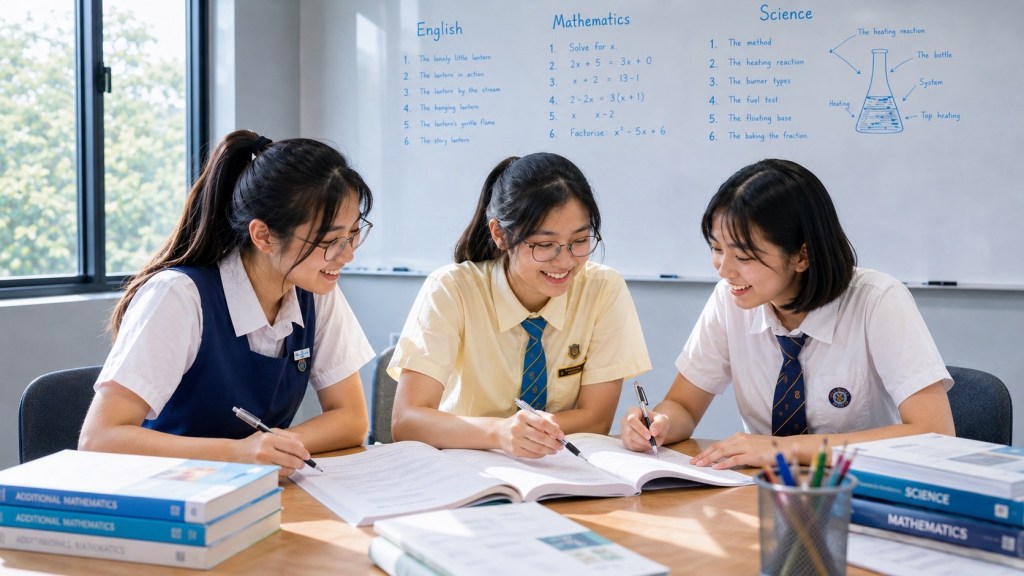
The dates and founding figures above describe historical milestones. Check official school channels for current arrangements. The featured classroom photograph illustrates eduKate’s learning theme and does not depict the named school.
More Sengkang school stories
Anchor Green learning and parent guide
Nan Chiau Primary School History: From 1947 Roots to Sengkang in 2001
Sengkang Green Primary School History: From 2012 Preparation to a 2013 Start
Fern Green Primary School History: 2018 Beginnings and the 2021 Official Opening
