
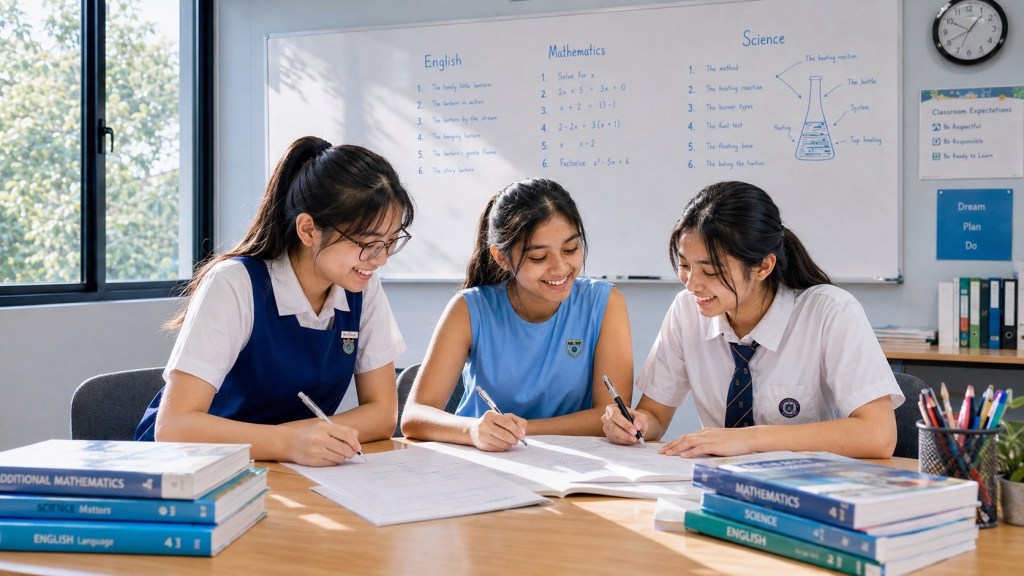
Did you know that the best revision check is often a question the student has not seen before? PSLE revision is working when a pupil can retrieve the needed knowledge, recognise how to use it, answer the actual task and check the result with less help. Finished papers and highlighted notes show activity; an independent fresh attempt shows what the learning can do.
For English and Mother Tongue, check understanding and expression across the components the student takes. For Mathematics, check method selection as well as calculation. For Science, check whether the explanation connects the concept to the supplied evidence. Compare a first attempt, a corrected attempt and a later related task; this reveals whether feedback has changed the student’s decisions.
Begin today with one recent mistake. Ask the pupil to explain the original choice, make a specific repair and try a different question requiring the same skill. Record whether help was needed. Then use the current SEAB PSLE format for the pupil’s examination year and subject offering to check that the whole revision plan covers the right demands.
Find your next learning step
eduKate Sengkang · Effective learning from Primary school to SEC
Continue this learning series
Primary 1–2 · Primary 3–4 · Primary 5–6 · PSLE revision checks: you are here · After PSLE: PG1–3 · SEC: G1–3
Understand the learning task · Choose practical actions · Check your next step · Full contents
Contents: 8 practical sections
- What should a parent measure besides a score?
- How do you check English revision?
- How do you check Mother Tongue revision?
- How do you check Mathematics revision?
- How do you check Science revision?
- When should full-paper practice enter the plan?
- What does a useful revision review sound like?
- Common questions about PSLE progress
A score is useful, but it compresses many skills into one number. Two pupils with the same mark may have very different difficulties. One may misunderstand concepts; another may lose time organising answers; another may read accurately but omit required information.
Look at the work before drawing a conclusion. Group recurring difficulties by the decision involved: reading the question, recalling knowledge, selecting a method, expressing reasoning, checking or managing time. The groups need not be elaborate; they only need to guide the next task.
Compare similar evidence over time. A later paper may be harder or cover different content. A lower score alone does not establish regression, just as a higher score on easier familiar work does not establish broad readiness.
Choose a comprehension response and ask what the question requires, which evidence supports the answer and whether the written response preserves the meaning. If the pupil supplies a memorised phrase that does not fit, practise the link between question and evidence.
For writing, choose one clear criterion. Does the response meet the task? Are the events connected? Is the required information complete? Can the pupil improve the piece after feedback without receiving a replacement paragraph to copy?
Listening and oral preparation need actual listening and speaking where required by the current format. A pupil should practise responding to the stimulus and following a question. Written worksheets alone cannot show the whole language profile.
Use the student’s actual language offering and teacher guidance. Check understanding in listening and reading, expression in speaking and writing, and accurate use of relevant vocabulary. Foundation and Standard offerings should be matched to the correct official formats rather than assumed identical.
Ask a qualified language teacher to identify recurring language-specific errors. A parent can still help organise the routine, collect feedback and encourage an independent return to the corrected skill.
Do not infer that strong English performance guarantees strong Mother Tongue readiness. Equally, a language difficulty does not tell you the pupil’s whole learning capacity. Check each language through its own evidence.
Use a fresh question on a taught topic and ask for the reasoning. Can the pupil identify relevant information and explain why the method fits? A correct numerical answer from a guessed operation is not the same as a reliable solution.
Check working line by line. Units, equivalent quantities, arithmetic and diagram relationships all matter. For an illustrative equal-sharing question, the pupil should explain why division is appropriate and what the quotient represents.
After an error, change a meaningful feature: the unknown quantity, the representation or the context. If the pupil can respond to that change, the correction is beginning to transfer. Keep the variation within the assessed level and current learning.
Give a question with observations, a diagram or an investigation. Ask the pupil to distinguish the evidence from the explanation. The answer should connect the relevant scientific idea to this situation.
If the pupil lists several facts hoping one will earn credit, practise selecting. What specifically answers the question? What extra claim is unsupported? Precision can be improved by making the relationship clearer rather than adding more sentences.
Use the task wording to decide what to produce. An observation, a conclusion, a reason and a suggested improvement have different jobs. Review these demands through actual school feedback rather than an inflexible universal answering formula.
Full papers can show switching between topics, sustained attention and time management. They are useful when you want evidence about combined performance. They are less efficient when the student repeatedly stalls at one missing prerequisite.
After a paper, select the few corrections with the greatest learning value. Revisit them before starting another full paper. A cycle of paper, score and immediate replacement paper can leave the same reasoning mistakes in place.
For timed work, separate accuracy from speed when necessary. Establish a reliable method first, then practise using it within the relevant conditions. Use the official format for the correct examination year rather than a remembered format from an older cohort.
Ask three calm questions: ‘What became more reliable? What is still uncertain? What will you practise next?’ Have the student point to the work. This keeps the review concrete and gives them a role in planning.
Keep a modest record. One Mathematics method, one English writing decision, one Mother Tongue language pattern and one Science explanation may be enough for a weekly conversation. The record should help choose actions, not become an administrative project.
When the learner is tired or overwhelmed, reduce the immediate task and make the starting point clearer. Seek school guidance for persistent difficulties. Protecting the ability to return to learning is part of preparation.
Is every mistake a knowledge gap? No. Reading, representation, expression, attention and time can also affect the answer. Diagnose from the work.
Does one high paper score prove readiness? It provides encouraging evidence. Check a range of components and fresh tasks before drawing a broader conclusion.
What should happen after a correction? The pupil should make a later independent attempt that genuinely tests the repaired skill. That is how feedback becomes useful learning.
Useful routes for the next task
How we know learning has really held
Using practice papers as learning evidence
Primary 6 English: listening, oral and the Secondary 1 bridge
Official sources and scope
Curriculum and examination references checked on 10 October 2026. The examples and home-study routines above are teaching illustrations, not additional examination requirements. Confirm your own subject offering, school sequence and examination year.
SEAB PSLE formats, candidate information and readiness resources
