
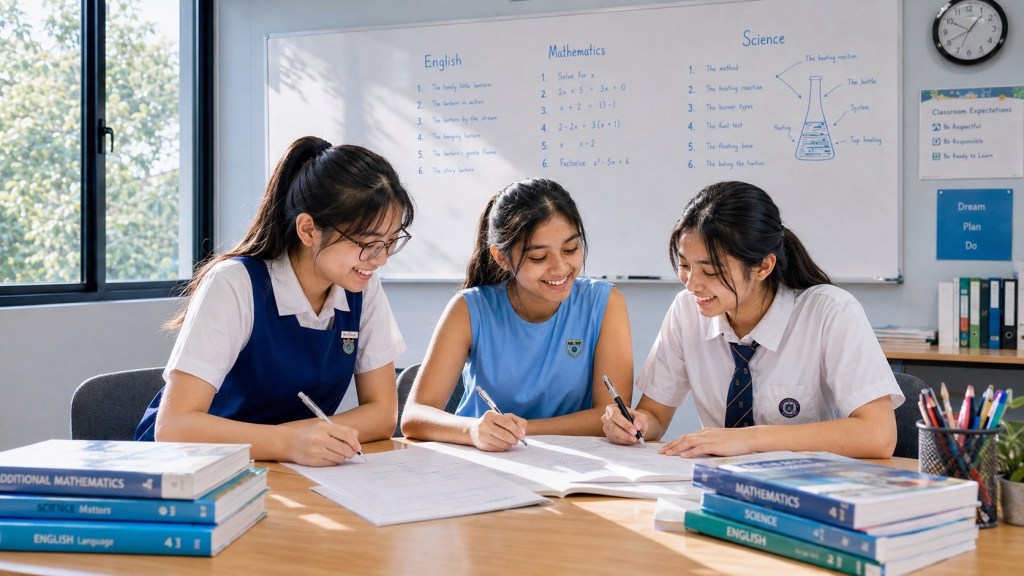
Did you know that ‘revise all subjects’ becomes much easier when it is broken into visible learning jobs? For Primary 5 and 6, start with current school work and recent feedback. For each subject, name one secure skill, one recurring difficulty and one next task. This gives revision a direction before the timetable fills up.
English and Mother Tongue need reading, writing, listening and oral practice matched to the student’s actual course. Mathematics needs concepts, method selection, accurate working and checking. Science needs understanding, evidence interpretation and explanations that answer the question. Rotate these actions across the week, and return to a repaired skill through fresh work instead of repeatedly copying the same correction.
Today, choose the difficulty that interrupts the most other work. Repair that foundation, attempt a related question independently and schedule a later check. Use full papers to examine combinations of skills and examination control when appropriate. Keep school projects, other subjects, rest and CCA commitments visible; useful progress is work the student can reproduce, not simply a very full study calendar.
Find your next learning step
eduKate Sengkang · Effective learning from Primary school to SEC
Continue this learning series
Primary 1–2 · Primary 3–4 · Primary 5–6: you are here · PSLE revision checks · After PSLE: PG1–3 · SEC: G1–3
Understand the learning task · Choose practical actions · Check your next step · Full contents
Contents: 8 practical sections
- Why does more revision sometimes produce little change?
- How should language revision cover more than Paper 2?
- How can Mathematics revision protect earlier foundations?
- How should Science revision connect knowledge to explanation?
- What does a balanced week look like?
- How should students use errors?
- How do parents know whether tuition is helping?
- Questions about the Primary 5 to Primary 6 transition
A student may spend an hour reading notes because it feels orderly, even though the real problem is choosing a method. Another may finish a Mathematics paper while repeatedly losing the same units. A third may know Science concepts but write general facts instead of explaining the situation.
Begin with a few examples rather than a broad label. ‘Weak in English’ is too large to act on. ‘Cannot link inference answers to textual evidence’ describes a skill that can be taught and checked. Likewise, ‘struggles with fractions’ should be unpacked into meaning, equivalent values, operations or word-problem interpretation.
A good revision plan chooses an action that matches the obstacle. If the difficulty is understanding, provide teaching. If it is recall, practise retrieving the idea. If it is transfer, change the context. If it is completing work under time, first confirm that the student can do it accurately without that pressure.
For English, include purposeful writing, comprehension, grammar and vocabulary alongside listening and oral work as required by the current format. Choose tasks from teacher feedback rather than treating every component as equally weak.
In writing, revise a small portion with a clear goal. A student might strengthen the cause of a turning point or complete the required information in a functional writing task. Compare the old and new versions and ask what changed for the reader.
Mother Tongue learning needs its own texts, listening material, spoken practice and language-specific correction. The routine can share the same attempt–feedback–return structure without assuming that English grammar or composition rules transfer directly to another language.
Earlier learning frequently reappears inside new problems. A student uncertain about the size of a fraction may struggle with a later comparison. A unit conversion error may undermine an otherwise sensible measurement solution. Repair the part that is needed, then reconnect it to the current topic.
For example, suppose a question gives 2.5 litres and asks for millilitres. The student should know that one litre is 1,000 millilitres, calculate 2,500 and keep the unit attached. A subsequent question can embed the conversion inside a comparison, so the student must decide when it is necessary.
A worked solution should show why a step is valid. When correcting, ask the student to mark the first line where the reasoning became unreliable. Correcting only the final answer leaves the earlier decision untouched.
Use a concept in several representations: words, a diagram, observations and a short explanation. Ask what the evidence supports and what it does not. This encourages careful application without making the answer unnecessarily long.
An illustrative evaporation question might compare equal amounts of water in different exposed surface areas under otherwise comparable conditions. The student must use the stated conditions and relevant idea, not simply write ‘heat’ because the topic involves water.
Keep the response tied to the information given. If the task asks for a reason, explain the relationship. If it asks for an observation, describe the result. If it asks for an improvement, identify a suitable change to the investigation. Check the current school curriculum and assessed scope.
Start with fixed commitments: school, travel, CCA, family responsibilities and sleep. Then place the most important learning tasks into the time genuinely available. A realistic plan with room for a missed task is more usable than an ideal plan requiring constant catch-up.
Rotate the type of effort. A demanding writing revision need not be followed immediately by another long writing task. A short oral conversation or focused concept check can make use of a smaller slot. Exact durations depend on the student and task; there is no universal number of minutes that guarantees results.
Keep all school subjects visible, including Art, Music, PE, Social Studies and CCE. Projects and practical work need their own preparation. PSLE revision is a major task, but the child remains a whole student.
Make the error record small enough to revisit. For each recurring mistake, record the original decision, the correction and a question that will test the repaired idea. Avoid copying pages of solutions without a later attempt.
A useful entry might read: ‘I compared fractions without checking the whole. Next time, identify the whole before comparing.’ The next question should genuinely require that decision. If the student succeeds only when the reminder is visible, keep practising with gradually less prompting.
Separate mistakes caused by missing knowledge from slips after correct reasoning. They may need different responses. Accurate diagnosis helps the learner act without turning every wrong answer into a judgment about ability.
Ask what the student can now do that was previously unreliable. Look for independent attempts, better explanations, fewer repeated errors and appropriate task selection. Assessment scores also matter, but they need context: different papers can test different combinations of skills.
In 3-pax tuition, close attention should allow the tutor to inspect reasoning and give each student a manageable next task. Group size alone does not prove teaching quality. Ask how the lesson connects with the child’s school topics and how learning is checked later.
Share recent school feedback and the actual weekly workload. Support works best when the next task fits both readiness and available time. Adding practice that the student cannot meaningfully complete can obscure rather than clarify progress.
Must Primary 5 become a year of daily PSLE papers? No. Build the current curriculum, independence and foundations while using appropriately chosen assessment practice.
Should weak subjects receive all the time? Give the important gap extra attention while maintaining secure subjects through small checks. Use evidence to adjust the balance.
What can a student do now? List one next action per subject, choose the most useful one for today and arrange a later independent check.
Useful routes for the next task
The Primary 5 English PSLE runway
Primary 5 to Primary 6 Mathematics transition
Primary 5 Science bridge and PSLE runway
Official sources and scope
Curriculum and examination references checked on 10 October 2026. The examples and home-study routines above are teaching illustrations, not additional examination requirements. Confirm your own subject offering, school sequence and examination year.
SEAB PSLE: official examination information and current formats
