
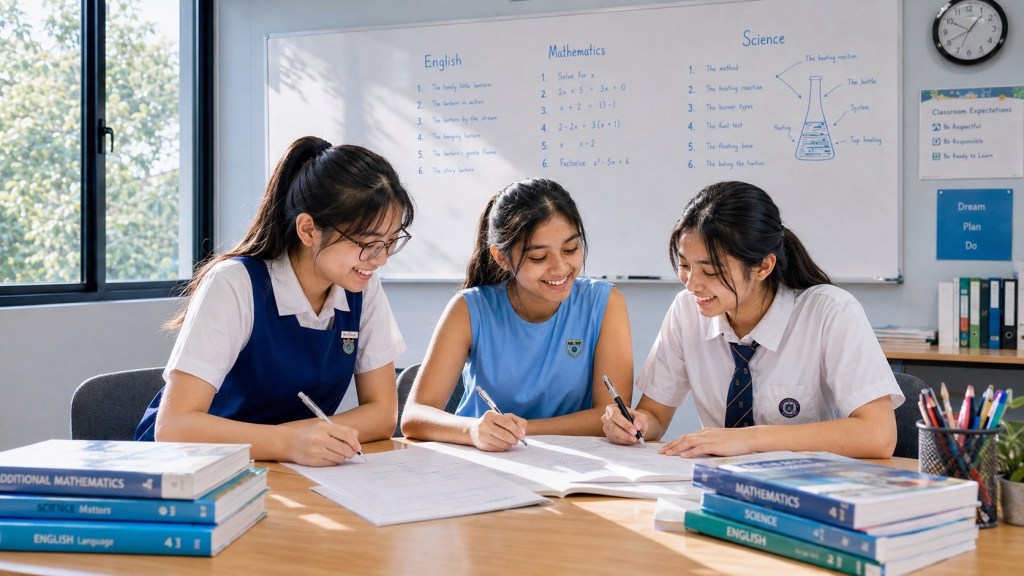
Did you know that a child can finish every worksheet and still need help starting the next one? In Primary 1 and 2, effective learning means gradually learning to understand an instruction, attempt a small task, explain a choice and check the result. Start with a familiar school task, ask your child to tell you what it requires, and let them make the first move before you help.
For English and Mother Tongue, combine listening, speaking, reading and a little writing around meaningful language. For Mathematics, connect objects, pictures, number sentences and spoken explanations. Keep the practice manageable: one clear learning goal, one independent attempt and one useful correction. Art, Music, Physical Education and Character and Citizenship Education also build participation, observation and the ability to follow and explain a sequence.
The immediate next step is simple: choose one skill your child can almost manage alone. Help with the difficult part, then return the task to them. Tomorrow, try a similar task with slightly less help. Use this guide for the overall learning routine and the linked subject guides for deeper teaching; formal Primary Science begins at Primary 3, so early curiosity should remain age appropriate.
Find your next learning step
eduKate Sengkang · Effective learning from Primary school to SEC
Continue this learning series
Primary 1–2: you are here · Primary 3–4 · Primary 5–6 · PSLE revision checks · After PSLE: PG1–3 · SEC: G1–3
Understand the learning task · Choose practical actions · Check your next step · Full contents
Contents: 7 practical sections
- What does independence look like at this age?
- How do English and Mother Tongue practice connect?
- How should Mathematics move from answers to understanding?
- What about subjects beyond worksheets?
- A small routine that parents can actually use
- How do you know the child is ready for the next step?
- Questions parents often ask
Independence is a collection of small actions. A child might locate the correct page, read a short instruction, choose a pencil, begin the first question and ask a precise question when stuck. They do not need to behave like an older student or manage an entire afternoon without support.
Watch the starting point. Does your child know what the teacher is asking? Can they read the words but miss the action? Can they do the calculation when you read the question aloud? Those situations call for different help. Giving more pages before identifying the difficulty can make the work longer without making the next step clearer.
A useful prompt is, ‘Show me the part you understand.’ It reveals a starting position and gives the child something concrete to do. Follow with one question about the uncertain part rather than a long explanation of the whole worksheet.
Build language around a small shared experience. Read a short passage, talk about what happened, choose one useful word and invite a sentence using it. In Mother Tongue, use material the child understands and language support aligned with their teacher’s current work. The learning principle is similar, but pronunciation, writing systems and specific language conventions need appropriate teaching.
If a child reads ‘The puppy hid because it was frightened,’ ask what happened and why. Then try a new sentence about another animal. This checks whether the child understands the relationship rather than remembers one answer. For writing, ask for a spoken sentence first when the ideas are clear but writing stalls.
Spelling is more useful when it returns to meaning. After practising a word, have the child read it in a sentence and use it naturally. Correct one manageable pattern at a time. A page covered in adult corrections can hide the one action the learner needs to practise.
Suppose there are eight counters and three are moved away. Ask your child to show what remains, draw the situation and write 8 − 3 = 5. Now ask how they know. You are connecting a real action, a picture and mathematical notation.
If the child calculates correctly but cannot interpret a story, work on translating the words. If they understand the story but repeatedly miscount, work on accurate counting and number relationships. If they need your approval after every line, give a small checking method they can use themselves.
Try a nearby variation: eight counters with two moved away. Can the child explain what changes? Keep the numbers and topic within the current school work. The aim is a usable foundation for Primary 3, not a race to advanced content.
In Art, invite the child to describe a choice of shape, colour or material. In Music, practise a short rhythm, listen to the result and try again. In PE, following rules and rehearsing a movement sequence also require attention and feedback. Use the teacher’s guidance for activities and safe participation.
CCE learning can appear in how a child asks for help, takes turns, cares for shared materials or explains a considerate choice. These are worthwhile parts of school life. They should not be reduced to another stack of exam questions.
Everyday observation can prepare a child for later Science. Ask what they noticed about a shadow, plant or material and allow honest uncertainty. Avoid presenting this as a formal Primary 1 or Primary 2 Science examination syllabus.
Begin by asking, ‘What are you learning today?’ Let the child point to an example. Next, complete one task together only if needed. Give a related task to attempt independently, then compare the result with the instruction or a teacher-approved example.
Finish with one sentence: ‘Next time, I will…’ It might be ‘read the question twice’ or ‘check that my sentence has a verb.’ On another day, revisit the same skill through a fresh task. The return matters more than an elaborate reward chart.
The amount of help should change with the child. Some will need an adult to read instructions; others can plan a short sequence. A routine is working when the child starts more confidently and needs fewer unnecessary prompts, not merely when the clock shows a longer study session.
Compare three things: the first attempt, a later attempt and a slightly changed task. Look for clearer understanding, fewer prompts and a useful checking habit. Readiness is uneven; a child can be strong in oral language and still need help spelling, or confident calculating and uncertain reading a problem.
When a difficulty persists, collect two or three examples and ask the teacher which prerequisite needs attention. Describe what happened rather than label the child lazy or weak. ‘She can explain the answer aloud but cannot begin the written sentence’ is actionable information.
If you consider 3-pax tuition, ask whether the lesson gives each child opportunities to attempt, explain and correct work. The reason for a small group is visible attention to the learner’s thinking. The child should leave with a next action that can also be practised outside tuition.
Should I stop helping completely? No. Offer help that fits the obstacle and gradually reduce it as the child becomes more capable. Independence grows through supported practice.
Should Primary 2 children start PSLE papers? Use level-appropriate school work and build language and number foundations first. A paper written for an older pupil is a poor diagnostic when most of its content has not been taught.
What should we do this evening? Ask your child to explain one instruction, attempt one manageable task and show how they checked it. That is a practical first learning step.
Useful routes for the next task
Primary 1–3 independent English learning foundations
Primary 1 to Primary 2 Mathematics readiness
Official sources and scope
Curriculum and examination references checked on 10 October 2026. The examples and home-study routines above are teaching illustrations, not additional examination requirements. Confirm your own subject offering, school sequence and examination year.
