
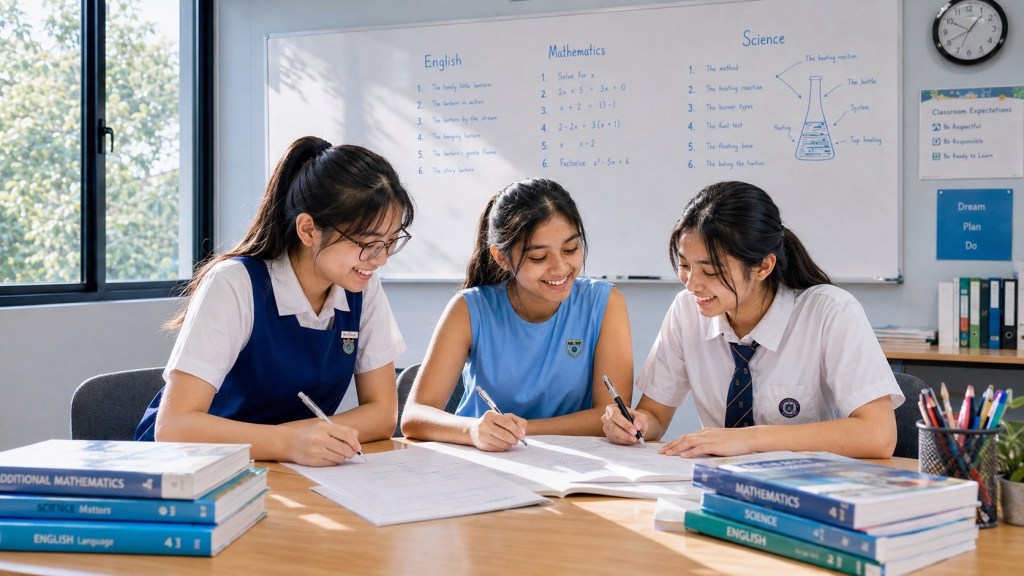
Did you know that a student may remember a lesson perfectly and still struggle to answer a new question about it? Primary 3 and 4 learning increasingly asks children to connect ideas, interpret information and explain their reasoning. Start by finding where the connection breaks: reading the task, understanding the concept, choosing a method or expressing the answer.
Use a different practice action for each subject. In English and Mother Tongue, link a response to the passage or speaking task. In Mathematics, show how the story becomes a diagram or number sentence. In Science, explain an observation using a relevant concept and the information given. Across all three, ask the child to attempt first, check with feedback and return later to a similar question.
The quickest useful change is to replace ‘Do more revision’ with a named task: ‘Explain why this answer fits this question.’ Keep Art, Music, PE, Social Studies and CCE within the child’s school learning too. This guide helps organise the whole week; the existing subject guides below provide the detailed lessons, so you can choose the closest route without rebuilding everything.
Find your next learning step
eduKate Sengkang · Effective learning from Primary school to SEC
Continue this learning series
Primary 1–2 · Primary 3–4: you are here · Primary 5–6 · PSLE revision checks · After PSLE: PG1–3 · SEC: G1–3
Understand the learning task · Choose practical actions · Check your next step · Full contents
Contents: 8 practical sections
- Why does familiar work suddenly feel more difficult?
- How should English and Mother Tongue become more independent?
- How can Mathematics practice reveal the real gap?
- How should Science answers move beyond remembered keywords?
- How do other school subjects fit into the routine?
- A weekly plan with a purpose for every session
- What progress should parents and students look for?
- Common questions about Primary 3 and 4 learning
The length of the task can hide its real demand. A longer English passage may require tracking a character’s reason across several sentences. A Mathematics problem may require deciding which quantity is changing. A Science question may require both noticing a result and explaining it.
Before reteaching a whole topic, ask the student to describe the question in their own words. If they misread it, practise interpretation. If they understand it but cannot recall the idea, revisit the concept. If they know the idea but cannot use it in this situation, practise connecting the two.
These are different learning problems. Treating all of them as insufficient effort encourages the student to repeat the same unsuccessful action. A small, well-chosen repair can make the next school lesson easier to follow.
Use a short section of a school text. Ask what the question wants, which words support the answer and how the answer should be written. For an inference, distinguish what the text says from what the student reasonably concludes.
In composition, work on one decision at a time: choosing a relevant event, ordering the events or showing why a character makes a choice. A beautiful sentence is not enough if it sends the story away from the task. Ask the child to retell the plan before writing the full piece.
For Mother Tongue, combine listening and speaking with reading and writing as appropriate to the language and school work. A student who recognises vocabulary on a list may still need practice understanding it in speech or using it in a new sentence. Language-specific feedback belongs with a qualified teacher.
Take an accessible word problem and separate it into four actions: identify the quantities, represent their relationship, calculate and check. Ask the student to point to the information supporting each step.
An illustrative example is three equal packs with six pencils each. The student should connect equal groups to 3 × 6, find 18 and explain the unit. A changed question might ask how many equal packs can be made from 18 pencils. The arithmetic is related, but the direction of the reasoning changes.
For harder work, keep the same habit while using the topics currently taught at school. A diagram is useful when it records a relationship. Drawing a memorised shape without explaining what its parts represent is a signal to revisit meaning.
Formal Primary Science begins at Primary 3. Students need to observe carefully, understand concepts and use them to explain particular situations. A keyword copied from notes is only useful if it fits the evidence and the question.
Suppose a question provides observations of a material absorbing water. Ask which observation matters, what it suggests about the material and how that answers the task. Do not add claims about strength or transparency when the evidence concerns absorption alone.
Use a three-part conversation: ‘What happened? What idea explains it? What does that mean here?’ Written answers should follow the actual question, not a compulsory sentence template. The relevant concept and a clear connection to the situation matter more than decorative length.
In Social Studies, use age-appropriate questions about people, communities and choices based on the school lesson. In Art and Music, record what was attempted, what feedback was received and what the child will change next.
PE learning includes practising skills, understanding rules and participating responsibly. CCE involves reflection and action in everyday relationships. These subjects contribute to a student’s school development even when the home conversation focuses heavily on assessed academic subjects.
Plan preparation for a project or performance before its deadline. A portfolio, presentation or practical task needs time for making and revising. It cannot always be completed through the same last-minute reading used for a short knowledge quiz.
Give each study slot a job. One session might repair a fraction misunderstanding; another might revise an English paragraph after feedback; another might explain a Science observation without looking at the notes. Write the job in plain language.
Mix current work with a little return to earlier learning. If an earlier topic is secure, use a small check rather than an entire worksheet. If the check reveals a gap, spend time on the exact prerequisite and then return to the current task.
Leave room for rest, school commitments and family life. A timetable is a planning tool. When a day changes, move the important unfinished task rather than treating the whole week as a failure.
Ask whether the child can explain the method, answer a changed question and identify the remaining uncertainty. A correct answer immediately after watching an example is useful, but it does not establish that the child can work independently later.
Keep one before-and-after example for a recurring difficulty. Note the help used. ‘Answered with no diagram prompt’ or ‘selected evidence without being told the paragraph’ tells you more than the number of pages finished.
Seek help when the same obstacle repeatedly interrupts school work. Bring examples to the teacher or tutor and ask for the next prerequisite to repair. In a 3-pax setting, look for time spent hearing each student reason and using the answer to choose the next question.
Should every subject use flashcards? Flashcards can check selected facts or vocabulary. They do not replace writing, problem solving, practical work or explanations.
Should we do a whole paper every day? Choose practice according to the learning goal. A short targeted task is often a clearer way to investigate one difficulty than another full paper.
What is the first step tonight? Choose one recent wrong answer. Ask your child to read the task, explain the attempt and make one specific correction.
Useful routes for the next task
Primary 3 to Primary 4 Mathematics readiness
Primary 3 Science syllabus: what is required and what comes later
Official sources and scope
Curriculum and examination references checked on 10 October 2026. The examples and home-study routines above are teaching illustrations, not additional examination requirements. Confirm your own subject offering, school sequence and examination year.
