
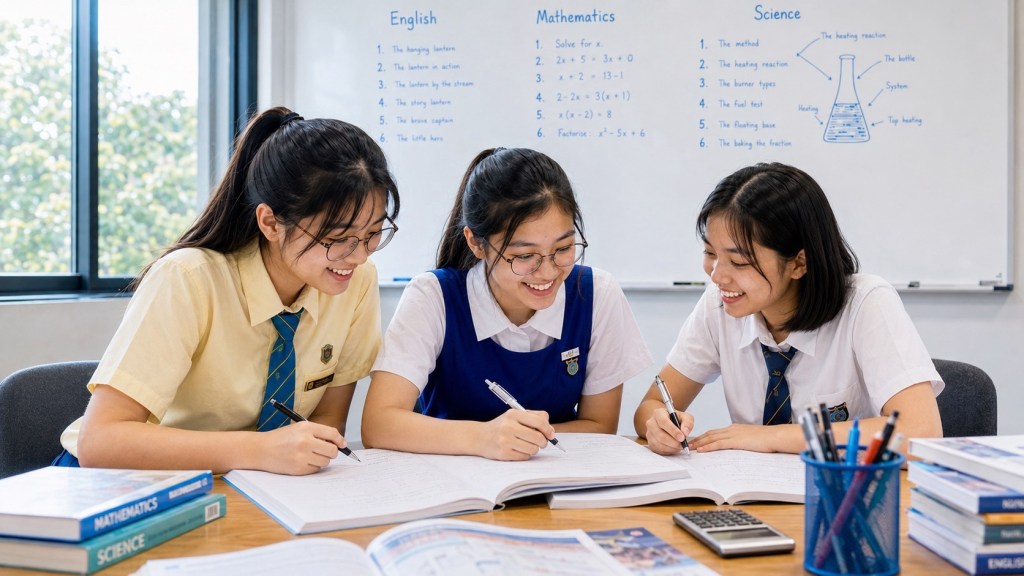
North Vista Secondary School sits inside a real Sengkang family week: school travel, CCA, homework, subject-level decisions, assessment cycles and the gradual move from Primary-school support to Secondary-school independence. This parent learning guide is not a ranking and does not attempt to reproduce the school’s own website. It uses the school’s current public information to help a family understand the learning environment, then routes back to the learner’s actual needs.
As of September 2026, the school’s official site identifies its Rivervale Link campus, student resource hub, blended-learning support, examination resources and distinctive programmes spanning sustainability, student development, leadership and media. Those are school-owned facts and programmes; families should use the official school website for admissions, school notices, timetables and programme details. eduKate Sengkang’s job here is different: to help parents translate the school context into questions about workload, learner state, subject fit, tuition fit and the next useful action.
The larger national framework also matters. Full Subject-Based Banding has changed the way Secondary learning is organised: subjects may be offered at G1, G2 or G3, and from the 2027 graduating cohort the Singapore-Cambridge Secondary Education Certificate (SEC) replaces the separate GCE N(T), N(A) and O-Level certificates. SEAB’s SEC overview is the canonical source for the examination transition. The practical lesson for parents is simple: read the child subject by subject, not through an old stream label.
North Vista Secondary School: begin with the school the child actually attends
The school is at 11 Rivervale Link, placing it in the Rivervale side of the Sengkang learning map. A school name is useful context, but it is not a diagnosis. Two students in the same form class can need completely different support because the first may be blocked by an old prerequisite while the second understands the content but loses marks through timing, question reading or fragile recall.
The Atlas therefore starts with evidence. What changed in the last paper? Which question types failed? Did the learner know what to do but execute poorly, or did the first method never appear? Can the learner reproduce the skill after a delay? Does it survive unfamiliar wording? The answer decides whether the next step is explanation, retrieval, mixed practice, transfer work, examination rehearsal or simply more independent use.
What North Vista Secondary School publicly emphasises
North Vista’s current public Applied Learning Programme centres on a “Farm to Table” sustainability theme, including hands-on high-tech farming and hydroponics for Secondary 1 students, with deeper opportunities for selected learners. Its wider Vistarian Experience also includes a Learning for Life Programme, student leadership and overseas-learning routes. See North Vista’s Applied Learning Programme and The Vistarian Experience for the school’s current description.
Parents should treat these programmes as part of the learner’s total operating environment. Enrichment, CCA, leadership, project work and authentic learning can develop valuable capabilities, but they also occupy real time and attention. A good weekly plan protects those experiences rather than treating every non-exam activity as a threat to marks.
Secondary 1: learn the new operating system
The first Secondary year changes more than syllabus content. Students now coordinate more teachers, more subject-specific vocabulary, longer timetables, CCA and a greater share of self-management. The useful first target is not perfect marks. It is a learner who can locate homework, understand instructions, begin revision without being chased, identify when help is needed and carry a correction into the next attempt.
For the transition route, use I Am Brave: The First Term of Secondary 1. If the first assessments are lower than expected, separate transition noise from a genuine capability gap before adding work.
Secondary 2: repair dependencies before the corridor narrows
Secondary 2 often exposes weaknesses that were previously masked by familiar work. Algebra becomes less forgiving, English responses demand tighter inference and expression, Science explanations require better control of relationships and evidence, and the student’s weekly system has to survive more independent decisions. This is a good year to repair the earliest weak dependency rather than waiting for Secondary 3 to magnify it.
Secondary 3: subject load and abstraction rise together
By Secondary 3, the student is managing more specialised content and more consequential subject combinations. The right response to a poor result is not automatically “do more papers”. A paper should be read as a diagnostic object: classify marks lost through knowledge, method selection, representation, language, time, checking or recovery. Then repair the smallest cause that can change the next performance.
Secondary 4: build for the certificate actually being sat
For students graduating in 2026, the existing GCE examination structure still applies. From the 2027 graduating cohort, the SEC framework applies, with subjects reflected at their respective G1, G2 or G3 levels. Families should therefore check the student’s actual subject level and graduating year instead of using a generic “O-Level” label for every learner.
The Sengkang route for the final year is I Am Brave: The Secondary 4 Year together with Examination Craft. The goal is to move from topic competence to paper-level performance: mixed questions, time control, selective checking, recovery after a difficult item and evidence that the skill survives fatigue.
English: diagnose meaning before adding worksheets
A weak English mark can come from different places: literal comprehension, inference, vocabulary in context, grammar, writing structure, answer scope, oral fluency or examination timing. Use the Secondary English Learning Hub to identify the capability rather than treating “English” as one undifferentiated weakness.
Mathematics: find the first structural failure
In Mathematics, later errors often begin earlier than they appear. A graph problem may actually be an algebra problem; an algebra problem may be a signed-number problem; a word problem may be a representation problem. The Secondary Mathematics S1–S4 Capability Map is the local route for identifying the dependency before repeating the surface topic.
Science and Additional Mathematics: match the route to the subject actually taken
Science learning should distinguish recall from mechanism, evidence and explanation. Additional Mathematics should only be routed where the student actually takes the subject and at the applicable level. Use the Science Hub and Additional Mathematics Learning Hub for the relevant subject route rather than assuming every Secondary learner has the same combination.
A parent evidence check after every assessment
- What held? Which capabilities survived without prompts?
- What failed first? Find the earliest point at which the route became unreliable.
- What was only fragile? A correct answer once is not yet a stable capability.
- What transferred? Could the student use the idea when wording, representation or context changed?
- What was examination interference? Separate time, fatigue, sequencing and checking from missing knowledge.
- What should change next? One targeted change is more useful than an undefined instruction to “work harder”.
When tuition fits — and when it may not
Tuition is useful when there is a teachable bottleneck that benefits from diagnosis, modelling, guided practice, feedback and a planned release of support. It is less useful when the main problem is a timetable that has become impossible, chronic sleep loss, a school matter that requires direct school support, or a learner who already has the capability and mainly needs space to use it independently.
The long-term measure is not how much help the learner receives. It is how much more the learner can eventually do without help.
What this guide does not do
This page does not rank North Vista Secondary School against other schools, predict a child’s outcomes, reproduce internal assessment materials or imply access to non-public school information. School facts can change. Families should verify current admissions, subject offerings, programmes, timetables and policies through the school’s official website and MOE.
Where this page sits in Atlas V2.0
Use Secondary Schools in Sengkang: A Parent’s Local Learning Guide to compare school-context questions without turning the exercise into a league table. Use What about Sengkang? for the wider locality route. Then return to eduKateSengkang Learning Atlas V2.0 when the question becomes: what is the learner’s state, what failed first, and what should happen next?
North Vista operating guide: sustainability work as a transfer laboratory
North Vista Secondary’s current Applied Learning Programme uses a “Cities and Urban Landscapes” context and a Farm-to-Table focus connected to food sustainability. The school describes hands-on farming and related activities as a way for students to connect classroom learning with authentic problems, encounter STEM-related areas and learn beyond the textbook.
For a parent, this is a useful transfer laboratory. The programme can show whether a student can move from a school concept into a real system involving resources, constraints, measurement, evidence and trade-offs. It can also expose where the learner relies too heavily on the task looking exactly like the worksheet used during teaching.
Farm to Table: one context can contain several school capabilities
A food-sustainability problem can draw on Science, Mathematics, communication and decision-making at the same time. The Science may involve plant needs, systems, variables or environmental relationships. The Mathematics may involve measurement, rates, comparison, data or optimisation. English becomes relevant when the learner has to interpret a brief, explain a conclusion or present a recommendation.
This is why project success should not be reduced to “STEM ability”. If a learner struggles, ask which component failed. Did the student misunderstand the system? Misread the task? Fail to record evidence? Calculate incorrectly? Make a claim that the evidence did not support? Lose track of the deadline? The intervention changes with the cause.
Hands-on work: doing is not the same as understanding
Practical participation can create the feeling of understanding because the activity is memorable. The stronger test comes later: Can the learner explain what variable mattered? Predict what would happen if a condition changed? Interpret a new result? Distinguish observation from inference?
A student who can repeat the procedure but cannot answer those questions may be Stable only under familiar conditions. A learner who can reconstruct the mechanism and use it in a changed setup is closer to Transfer-Ready.
Sustainability: teach trade-offs, not slogans
Real sustainability problems rarely have one variable. Choices can involve resource use, cost, resilience, practicality, yield, waste and human behaviour. For learning, the useful habit is to make assumptions visible and distinguish what the evidence establishes from what is a value judgement or recommendation.
That habit helps beyond Science. It improves English argument, data interpretation and the ability to reason with constraints rather than search for one memorised “correct” sentence.
North Vista parent evidence beyond the examination score
The school’s wider Vistarian Experience includes student development and learning opportunities beyond ordinary lessons. Parents can use those experiences as additional evidence about the learner, but not as substitutes for academic evidence.
- Initiation: Can the learner start an unfamiliar task without waiting for step-by-step rescue?
- Planning: Can they break a larger project into workable next actions?
- Evidence: Can they record what happened and distinguish observation from interpretation?
- Revision: What changes after feedback or a failed attempt?
- Communication: Can the learner explain the system and the reason for a decision?
- Transfer: Does the same reasoning appear later in a different subject or assessment?
Secondary 1: protect the transition while new experiences expand
Secondary 1 already carries a large operating-system change: more teachers, CCA, new subject language, different assessment habits and greater responsibility for materials and deadlines. A rich programme environment adds valuable experiences, but it also means the learner must learn to manage the week.
Parents can help most by making the system visible and then gradually handing it back. One task list, one start routine, one way to track deadlines and a predictable review point are often more useful than constant reminders across the evening.
Secondary 2 and 3: project confidence should not hide academic dependencies
A student may be confident in project work and still carry a weak academic dependency. For example, a learner who participates well in a sustainability task may still struggle with algebra, precise comprehension or formal Science explanation. The opposite can also happen: strong test performance may coexist with hesitation when a task becomes open-ended.
The Atlas treats those as different states of capability. The aim is not to force the learner into one global label such as “strong” or “weak”. It is to identify where the next condition should change.
Secondary 4: move from authentic learning to reliable paper performance
By the final year, the student must convert subject knowledge into examination performance. Projects and authentic contexts can strengthen understanding, but the paper adds new constraints: time, mixed topics, question order, fatigue, checking and the need to recover after a difficult item.
That is why Examination Craft remains separate. Knowledge repair should happen before full-paper rehearsal where possible. Once the knowledge is stable, paper practice should test integration rather than become a substitute for teaching.
North Vista and the 2027+ SEC route
From 2027, graduating students sit the SEC with subjects at their respective G1, G2 or G3 levels as applicable. A parent should therefore read the timetable subject by subject. The learner may need different kinds of support across different subject levels, and not every subject is offered at every level.
The practical rule is to verify current school offerings directly with North Vista and current examination syllabuses with SEAB, then build the study route around the student’s actual subjects rather than inherited stream language.
When tuition fits around North Vista
External tuition is useful when it has a defined job that school and home practice are not currently solving: prerequisite repair, concept clarification, deliberate practice, feedback, transfer, examination timing or independent checking. It should not turn the learner’s already full week into a second school timetable.
For a student involved in project, CCA and wider school experiences, the opportunity cost is especially visible. A good intervention earns its place by changing the evidence: fewer repeated errors, stronger retrieval after delay, better transfer, more reliable paper execution or less dependence on prompts.
What a strong North Vista route looks like
A strong route eventually produces a learner who can move between classroom knowledge and the real-world context without losing precision. The student can define the problem, choose relevant knowledge, observe or measure carefully, interpret evidence, revise after feedback and explain the result. When that capability also survives examinations and independent work, the school experience and the learner runtime are reinforcing one another.
