
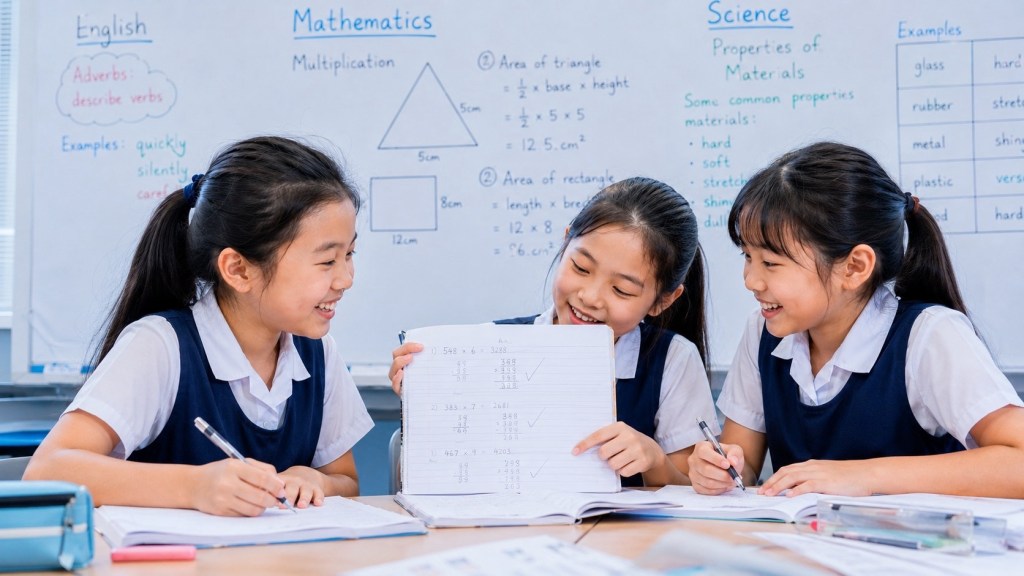
Primary 2 Tuition Sengkang · Level Flagship 2 of 10
Primary 2 is the year familiarity can become independence—or quietly become dependence in better disguise. The child knows the classroom, recognises the worksheet forms and may sound more fluent. The important question is whether the learner can now carry meaning, method and responsibility with fewer adult prompts.
P2 deserves more respect than the phrase “another lower-primary year” suggests. It is the final year before the Primary 3 expansion, when formal Science arrives, texts carry more information and multi-step work begins to expose every fragile foundation. The P2 job is therefore not to hurry towards P3. It is to make the existing floor independent enough to support P3.
Featured Answer: What Is Primary 2 Tuition?
Primary 2 tuition is the deliberate conversion of early supported success into reliable foundational performance. It helps the child read for meaning, write connected thoughts, understand number relationships, follow a short sequence, retrieve familiar knowledge and complete more of the task without continuous adult assembly.
The goal is not merely a faster child. It is a learner whose fluency remains connected to understanding.
Supported performance → guided control → independent foundation.
Contents
- Why P2 is not a quiet year
- The fluency trap
- Primary 2 English
- Primary 2 Mathematics
- Discovery and preparation for Science
- The independence ladder
- Common weak links
- How P2 tuition should teach
- Evidence that learning has held
- Three learner cases
- The parent role
- Preparing for Primary 3
- Primary 2 diagnosis
- Fluency and meaning
- Independence threshold
- Science readiness without teaching ahead
- A workable P2 week
- 4-, 8- and 12-week review
- Primary 3 readiness
- Frequently asked questions
- Where next?
Primary 2 Is Not a Quiet Year
P1 receives attention because it is new. P3 receives attention because Science appears and work becomes more complex. P2 sits between them and can therefore be underestimated. Yet it performs a crucial civilising function inside the learner: it turns externally maintained routines into internal habits.
In P1, an adult may reasonably remind the child where to write, what to read and which material to take out. By P2, those prompts should begin to fade. The learner should increasingly decode the instruction, orient to the page, choose a first move and recognise when an answer does not fit. This transfer of control is gradual. It is also measurable.
A child can score well while this transfer is not happening. Parents may sit beside every homework task. Worksheets may repeat familiar forms. Tuition may preview every school topic. The marks look stable, but the stability is borrowed. P2 is the right time to discover whether the child can stand when some of that scaffolding is removed.
The Fluency Trap: Smooth Is Not Always Secure
Fluency matters. Slow decoding can overload comprehension; slow calculation can consume attention needed for problem solving. But speed is educational only when it compresses secure knowledge. Speed built from guessing, imitation or over-rehearsed formats creates a convincing surface over a weak structure.
Three tests protect against the fluency trap:
- Explain: Can the child say why the answer or method makes sense?
- Change: Can the child succeed when wording, order or representation changes?
- Delay: Can the child retrieve the capability later without the original cue?
A P2 learner who passes all three is building genuine fluency. One who succeeds only in the original form needs more meaning, not simply more speed.
Primary 2 English: Reading Must Carry More Meaning
At P2, reading should become less dependent on immediate adult mediation. The child needs to track characters, events, causes, pronouns, time words and simple implied relationships across a passage. Vocabulary grows, but so does the need to infer meaning from context and syntax.
Comprehension begins before the question
Children often read a passage as preparation for answering, then search for phrases after seeing the questions. A stronger process builds a mental model during reading. Who is present? What changed? Why did it change? Which word refers to which person or object? What does the character know at this point? This model makes later questions easier because meaning already exists.
Writing becomes connected thought
P2 writing should move beyond isolated correct sentences. The learner begins to connect ideas through sequence, cause, contrast and detail. “Then” cannot carry every relationship. Sentence variety is useful, but clarity comes first: each sentence should have a purpose inside the larger piece.
Grammar should become control
Grammar is not only a collection of names. It is the control surface of the sentence. Tense locates events in time. Agreement keeps the sentence coherent. Pronouns manage reference. Conjunctions show relationships. Teaching is strongest when the child can use and repair these systems in real sentences rather than merely identify them on a worksheet.
Primary 2 English Tuition Sengkang: Build Independent Reading and Writing →
Primary 2 Mathematics: Fluency, Models and Relational Thinking
P2 Mathematics extends number range and calculation, but the deeper job is to make operations relational. Addition and subtraction are not merely opposite buttons. They describe changes and part–whole structures. Multiplication and division begin to organise equal groups, repeated quantities and sharing.
A learner may memorise a procedure yet remain unable to tell what the answer means. Strong instruction keeps returning symbols to situation and situation to symbols.
Calculation should free attention
Basic facts and efficient methods matter because working memory is finite. When every calculation requires reconstruction, little attention remains for reasoning. But fluency practice should be distributed, accurate and connected to structure. Children should notice tens, doubles, complements and decompositions rather than depend only on counting by ones.
Models should reveal the event
A model is useful when it helps the learner see quantities and relationships that language alone has hidden. It is not useful when it becomes another ritual copied without understanding. P2 tuition should ask the child to construct, explain and sometimes correct a model. This reveals whether the diagram is carrying meaning or merely decorating the page.
Primary 2 Mathematics Tuition Sengkang: Fluency, Models and Problem Solving →
Discovery and Preparation for Formal Science
P2 is an excellent year to strengthen scientific habits without pretending the child is already inside the formal upper-primary syllabus. The useful habits are simple and deep: observe before explaining, compare one feature at a time, use accurate words, notice patterns, distinguish evidence from assumption and ask what would change our mind.
These habits also strengthen English and Mathematics. Describing the difference between two leaves develops vocabulary and comparison. Recording how ice changes develops sequence and time language. Sorting objects by a stated property develops classification and rule consistency. The child learns that careful noticing is a form of intelligence.
Primary 2 Discovery Science Preparatory Route
The Primary 2 Independence Ladder
Independence is not an on/off quality. It is a ladder. A child may be independent in reading but highly dependent in writing, or independent with familiar Mathematics but unable to begin an unfamiliar problem.
- Adult does; child watches.
- Adult models; child completes a small part.
- Adult asks; child selects the next step.
- Child attempts; adult gives a narrow cue.
- Child performs; adult checks after completion.
- Child performs, checks and explains independently.
Good tuition knows where the learner currently stands and moves one rung at a time. Jumping from full support to “do it yourself” can produce failure without learning. Remaining indefinitely on the first two rungs produces completion without growth.
Common Primary 2 Weak Links
| Visible difficulty | Possible weak link | Useful test |
|---|---|---|
| Reads fast but misses simple questions | Meaning is not being updated across sentences | Pause after each paragraph and ask what changed |
| Uses good vocabulary orally but writes little | Speech-to-writing bridge or transcription load | Let the child say, sequence and then write one idea |
| Knows sums but guesses operations | Relationship and representation are unstable | Ask for a drawing before the equation |
| Forgets work taught last week | Practice produced familiarity rather than retrieval | Use delayed, no-notes recall in a changed format |
| Needs many reminders | Task initiation or routine has not internalised | Give a visual first-move checklist, then fade it |
| Becomes upset by correction | Error is being read as identity or danger | Normalise revision and praise specific recovery moves |
“Weak in P2” is too broad to guide instruction. A precise weak link gives the child a fairer description and the teacher a testable intervention.
How Primary 2 Tuition Should Teach
P2 tuition should alternate between consolidation and controlled novelty. Too much familiarity produces effortless completion without transfer. Too much novelty produces overload. The lesson needs a stable centre and one meaningful stretch.
- Retrieve one earlier idea without notes.
- Identify the precise distinction for the lesson.
- Connect the new work to something already understood.
- Model the decision, not only the procedure.
- Use paired examples that look similar but require different thinking.
- Let the child explain, draw, sort or reconstruct.
- Fade cues and introduce a short delay.
- Finish with one transfer item and one reflection question.
The tutor should watch for borrowed control. Does the child begin only after eye contact? Does the phrasing of a prompt contain the answer? Is success lost when examples are mixed? These observations are not minor. They reveal how much of the performance belongs to the learner.
Evidence That P2 Learning Has Held
- The child reads a short passage and can summarise the central event.
- The child writes connected sentences with an understandable sequence.
- The child explains why an operation fits a mathematical situation.
- The child retrieves familiar facts with growing fluency.
- The child checks whether an answer is plausible.
- The child begins routine work without repeated prompting.
- The child uses a taught idea when the wording changes.
- The child asks for help at the point of confusion rather than before attempting.
- The child can correct an error and explain the correction.
These are signs that P2 is doing its true job: making the lower-primary foundation portable.
Three Primary 2 Learner Cases
Case 1: The high worksheet score with heavy parent support
The child submits accurate homework, but a parent interprets every instruction and checks each answer immediately. Tuition first establishes an independent baseline. Tasks are shortened, support is delayed and the child is taught a visible start–work–check routine. Accuracy may initially fall. That drop is useful telemetry: it reveals what the adult had been carrying. The next improvement belongs more genuinely to the learner.
Case 2: The fast reader who cannot retell
The intervention preserves reading practice but inserts meaning checkpoints. The child names the actor, action, cause and change after each paragraph, then connects them into a short oral retelling. Over time, the checkpoints become internal questions rather than tutor prompts.
Case 3: The calculator without a model
The child computes accurately but cannot represent word problems. Lessons contrast combine, compare and change situations using the same numbers. The child must show the event with objects or bars before writing a number sentence. The aim is not slower Mathematics. It is calculation under semantic control.
The Parent Role: Hold the Environment, Not Every Answer
Parents can support P2 independence by making routines predictable while leaving the child a genuine share of the work. A calm place, a regular start time, access to materials and an agreed stopping point reduce avoidable friction. Within that environment, the child should read the instruction, attempt a first move and identify the exact help required.
- Ask “What does the question want?” before “What is the answer?”
- Use a five-minute independent start before offering help.
- Invite the child to explain one school idea at dinner.
- Read texts slightly beyond the child’s independent level aloud and discuss them.
- Practise number facts briefly and regularly rather than through exhausting bursts.
- Let mistakes remain visible long enough to support correction.
- Tell the tutor what support was needed at home; that is valuable diagnostic information.
What Primary 2 Tuition Should Not Become
- A preview service that makes school easy only because every lesson was seen before.
- A race towards P3 content before P2 independence is visible.
- A fluency programme that rewards speed while meaning disappears.
- A correction system in which the adult erases every error before the child studies it.
- An evening load that competes with sleep and school readiness.
- A promise that one teaching method fits every learner.
Preparing for the Primary 3 Expansion
Primary 3 will ask the learner to read in order to learn new content, manage longer mathematical chains and enter formal Science. The best preparation is not simply early exposure to P3 worksheets. It is a P2 learner who can carry instructions, maintain meaning, represent relationships, retrieve foundations and recover with less adult intervention.
The transition question is therefore:
Can the child use the lower-primary foundation when nobody has pre-announced exactly which part will be needed?
Continue to Primary 3: The First Big Academic Expansion →
Primary 2 Diagnosis: Is the Foundation Independent or Merely Familiar?
Primary 2 can look comfortable because the child recognises school routines and common worksheet formats. Familiarity is useful, but it can hide dependence. A learner may complete work because the page looks known, the parent gives the first cue, the tutor has already previewed the chapter or the same question pattern has been practised repeatedly. The diagnostic question is whether the child can still perform when those supports are reduced.
| Observed P2 success | Hidden risk | Fresh test | What stable evidence looks like |
|---|---|---|---|
| Reads quickly | Fluency without comprehension | Retell the passage without looking back. | Main events and relationships remain accurate. |
| Gets spelling correct after practice | Short-term recognition | Return several days later without the list. | Words can be recalled and used in a sentence. |
| Completes arithmetic worksheets fast | Procedure without number meaning | Change the representation or ask for an estimate. | The child explains why the operation makes sense. |
| Solves familiar word problems | Template matching | Change the wording while preserving the relationship. | The model or equation still fits. |
| Finishes homework neatly | Heavy parent orchestration | Let the child plan and complete one short section alone. | Work proceeds with fewer prompts. |
This distinction matters because Primary 3 will add formal Science, longer texts and more multi-step work. If P2 success depends on hidden scaffolds, the P3 expansion can expose several weaknesses at once.
Fluency Must Release Attention for Meaning
Fluency is valuable because it reduces the mental cost of basic operations. A child who decodes every word laboriously has less attention left for comprehension. A child who counts every simple sum has less attention left for the structure of a problem. But fluency becomes misleading when speed is treated as the goal rather than as support for deeper thinking.
Reading fluency
Reading should become smoother enough that the child can hold the sentence and paragraph meaning. The useful question after reading is not only “How many words were correct?” It is whether the learner can say what happened, who did what, why it mattered and what a new word probably means from context.
Mathematical fluency
Basic number facts should become accessible enough that the learner can think about relationships. If every problem still consumes attention on counting, later multi-step work becomes unnecessarily hard. Yet speed drills should not replace understanding. Ask for number bonds, alternate methods, estimates and explanations.
Writing fluency
Sentence construction should become easier enough that the child can think about sequence and meaning. Copying a model sentence is not the same as generating one. Use short prompts that require the learner to decide what they actually want to say.
The Primary 2 Independence Threshold
P2 is the year when several school behaviours should begin crossing from externally maintained to internally carried. This does not mean a seven- or eight-year-old should operate like a Secondary student. It means the direction of travel should be visible.
- The child can read a short instruction and begin.
- Materials are organised with fewer repeated reminders.
- The learner can work for a short period without an adult beside them.
- A mistake can be corrected without restarting the entire page.
- The child can identify when they genuinely do not understand.
- Simple checking happens before the adult inspects the work.
- The learner can return to an unfinished task after a break.
These behaviours matter because P3 increases the number of things the child must coordinate. A learner who still needs every step assembled by an adult will experience the new academic load as much larger than it needs to be.
Preparing for Primary 3 Science Without Teaching the P3 Syllabus Early
Families sometimes prepare for Primary 3 Science by buying Science assessment books in Primary 2. That is not necessary for most children. A better preparation is to strengthen the reasoning and language Science will require.
- Observe carefully: describe what is actually seen before explaining it.
- Classify: group objects by a stated property and explain the rule.
- Compare: say how two things are similar or different using the same criterion.
- Sequence: explain what happened first, next and after that.
- Cause and effect: distinguish “what happened” from “why it happened”.
- Evidence: point to the observation that supports a claim.
- Vocabulary: use precise everyday language before memorising specialist words.
A child who can observe, compare, classify and explain enters P3 Science with a stronger thinking system than a child who has memorised a list of P3 facts without the reasoning underneath them.
A Workable Primary 2 Week
The P2 week should preserve enough repetition for foundations to stabilise while still leaving room for reading, play, family life and recovery. The aim is reliable foundations, not maximum academic density.
| Activity | Useful dose | Evidence to watch |
|---|---|---|
| Independent reading | Frequent, manageable sessions | Retelling, vocabulary and sustained attention improve. |
| English writing | Short connected responses | Ideas increasingly appear without sentence copying. |
| Mathematics retrieval | Short practice across known foundations | Basic relationships become faster without losing meaning. |
| Problem solving | Small number of well-chosen questions | The child represents before guessing an operation. |
| Tuition | Targeted lesson where a defined need exists | Support reduces and school performance becomes more independent. |
| Rest and play | Protected throughout the week | The child returns to work with usable attention. |
If P2 tuition creates so much homework that ordinary reading disappears, the system may be improving one visible metric while weakening a larger foundation. The weekly plan should be judged as a portfolio, not one subject at a time.
The P2 Evidence Stack: How to Tell Whether Independence Is Real
- Schoolwork: how the child performs in the real classroom system.
- First attempt: what happens before parent or tutor support arrives.
- Prompt level: how much guidance is required to restore productive work.
- Correction: whether the child can explain what changed.
- Delay: whether the same capability returns later.
- Variation: whether the child succeeds when the surface changes.
- Routine: whether adult reminders are decreasing.
A strong P2 programme should be able to point to these changes. “The child seems more confident” is useful as an observation, but it becomes stronger when tied to behaviour: the learner now begins comprehension independently, asks for help only after locating the confusing sentence, and can retell the passage without the tutor supplying the sequence.
The 4-, 8- and 12-Week P2 Review
Week 4: identify the hidden support
- Which tasks still require a parent or tutor to begin?
- Is fluent work actually understood?
- Which lower-primary foundation is most fragile?
- Can the child describe the current target?
Week 8: reduce the scaffold
- Are examples needed less often?
- Can the child work for longer without confirmation?
- Do reading and Mathematics foundations survive a delay?
- Are repeated errors shrinking?
Week 12: test the P3 load
- Can the learner follow a slightly longer instruction?
- Can information be carried across several sentences or problem steps?
- Can the child explain a simple relationship?
- Can adult support be reduced without performance collapsing?
If the child still performs only inside familiar templates, the next job is transfer—not harder content. P3 will change the surface often enough that template dependence becomes expensive.
What Parents and Tutors Should Agree On in P2
- The target: one or two foundational capabilities, not a vague promise to “improve overall”.
- The support rule: how much help is appropriate before the child must try again.
- The homework rule: what is essential, optional and too much.
- The evidence rule: what fresh work will show the repair has held.
- The release rule: what support should fade once the child is stable.
This keeps home and tuition from accidentally teaching opposite habits. If the tutor expects a first attempt but the parent supplies the first step every evening, the learner receives inconsistent conditions.
Primary 3 Readiness: The Foundation Has to Carry a Wider World
Primary 3 readiness is not measured by whether the child has already seen Science chapters or P3 worksheets. It is measured by whether the P2 foundation can carry more information, more relationships and more independence.
- The child can read a paragraph and retain the main meaning.
- Short writing can connect more than one idea.
- Basic number facts and operations no longer consume all available attention.
- The learner can represent a simple word problem instead of guessing from keywords.
- Comparison, classification and cause-and-effect language are becoming usable.
- The child can begin familiar work without waiting for adult confirmation.
- Help-seeking is more precise: “I do not understand this word” rather than “I don’t know”.
That is the bridge P3 needs. The best P2 preparation is not acceleration. It is a foundation that can absorb expansion.
The P2 Release Test
Before renewing tuition automatically, ask whether the original job still exists. A child who began because reading was fragile may now read independently and need only ordinary school practice. Another may have solved the foundation but need a new, distinct intervention for problem solving. A third may no longer need tuition at all.
Continuing support should be an active decision. P2 is a particularly good year to teach families that successful intervention can end.
Primary 2 Reading: From Sentence Accuracy to Whole-Text Meaning
P2 is often where children begin to look like fluent readers while comprehension remains fragile. The child can pronounce the words, yet meaning disappears across several sentences. Tuition should therefore test how information is held and connected, not only whether each sentence was decoded correctly.
- Ask the child to retell the text without looking back.
- Ask who or what a pronoun refers to.
- Ask what changed from the beginning to the end.
- Ask why a character acted, using evidence from the text.
- Ask the meaning of a new word from context before giving a definition.
- Ask for one sentence that summarises the main idea.
These small tests prepare the learner for the reading-to-learn demand of P3. They also reveal whether the real difficulty is vocabulary, sentence meaning, memory across the paragraph or inference.
Primary 2 Mathematics: Relationships Before Keywords
Word-problem dependence often begins when children learn to associate a keyword with an operation. “Altogether” becomes addition, “left” becomes subtraction, and the learner stops modelling the situation. That can work on simple familiar questions and fail as soon as the wording changes.
A stronger P2 routine asks four questions before calculation: What quantities are here? How are they related? What changed? What is unknown? The child may draw a simple model, use objects, write a number sentence or explain the event verbally. The representation should help reveal the relationship rather than become another template to memorise.
- Change names and context while keeping the same relationship.
- Give the equation and ask the child to invent a matching story.
- Show a wrong model and ask what relationship it represents instead.
- Ask for an estimate before exact calculation.
- Compare two methods and ask which one makes the relationship easier to see.
The First Self-Checking System
P2 is old enough for checking to begin moving from adult inspection to learner habit. The check should be short and concrete. A young child cannot use a twenty-item checklist effectively.
- Did I answer every part?
- Does my answer make sense?
- Did I copy the number or word correctly?
- Can I find one place where I might have made a mistake?
The parent should ask the child to perform this check before stepping in. Over time, the adult becomes the verifier of the child’s checking rather than the first checker of the work.
When P2 Homework Takes Too Long
Long homework is not a diagnosis. Track where the minutes go. Some children are slow because reading is effortful. Some pause because they do not know the first move. Some redo work repeatedly because they fear mistakes. Some are distracted. Some receive so much adult explanation that every question becomes a conversation.
| Where the time goes | Likely next question |
|---|---|
| Reading the instruction repeatedly | Is language comprehension the bottleneck? |
| Waiting before every question | Has help-seeking become dependence? |
| Calculating slowly | Are basic facts and number relationships fluent enough? |
| Erasing and rewriting | Is perfectionism or handwriting load dominating the task? |
| Talking with the parent through every item | Can support be delayed until after a small section? |
Diagnose the minutes before adding more homework. A child whose schoolwork already takes too long often needs a more efficient learning route, not another stack of pages.
What a P2 Tutor Should Be Able to Show a Parent
- The exact capability currently being repaired.
- A sample first attempt before help.
- The level of prompt needed during the lesson.
- A fresh question showing whether the correction transferred.
- A delayed return showing whether the learning held.
- What the parent should do less of at home.
This is more useful than a general report that the child “participated well”. Participation matters, but parents need evidence that the support is changing what the child can do without the tutor.
What a Strong End of Primary 2 Looks Like
By the end of P2, the child does not need to be academically accelerated. The more valuable result is a foundation that can absorb the P3 expansion.
- Reading is fluent enough for meaning to remain across a paragraph.
- Writing can connect several ideas without copying a model sentence by sentence.
- Basic Mathematics is fluent enough that the child can think about relationships.
- Simple word problems are represented before an operation is chosen.
- The child can compare, classify, sequence and explain simple cause and effect.
- Homework begins with fewer reminders.
- Checking is beginning to belong to the learner.
- Help-seeking is more precise and less immediate.
That is a durable P2 exit state. It gives Primary 3 somewhere stable to stand.
The One P2 Decision That Prevents Many P3 Problems
Before the P2 year ends, decide which support the child can now carry without an adult. It might be starting homework, checking a short section, retrieving number facts, reading independently or asking for help only after locating the difficulty. Choose one responsibility and transfer it deliberately.
This matters because P3 adds Science, longer instructions and more multi-step work. If every new demand is placed on top of the same adult-managed foundation, the family becomes the integration layer. If one responsibility at a time moves into the learner, the child enters P3 with more available capacity.
The best final P2 question is therefore not “What should we teach ahead?” It is “What can we safely stop doing for the child because the child can now do it?” That answer is evidence of genuine readiness.
P2 completion note: the year has done its job when fluency frees attention for meaning, familiar work no longer depends on a model beside it, and adult prompts are visibly decreasing. The strongest preparation for P3 is not early Science content; it is a learner who can carry a wider task with more independence.
P2 independence proof: ask the child to complete one short unfamiliar task without a model, adult cue or immediate correction. If the learner can begin, explain the route, check once and recover from a small mistake, the foundation is doing more than looking familiar—it is becoming usable.
Frequently Asked Questions
Is Primary 2 too early for tuition?
Age alone does not decide. The useful question is whether there is a clear educational job and whether tuition is the most appropriate support. A short, well-targeted intervention may help an emerging gap. Unnecessary tuition may simply add load. The decision should be evidence-led.
Should my child already be preparing for the PSLE?
P2 should build capabilities that will eventually matter for the PSLE—reading meaning, number sense, retrieval, explanation and independence—but it should not turn everyday learning into distant examination anxiety. The strongest long-term preparation is a secure, curious and recoverable foundation.
What if my child can do the work only after an example?
That suggests recognition or imitation may be stronger than route selection. Use a delayed attempt, remove the matching example and mix in a nearby question type. The result shows whether the child owns the decision or merely follows the surface.
How should progress be reported?
Useful reporting names the target capability, the support required, the evidence observed and the next test. “Doing better” is encouraging but incomplete. “Can now represent comparison problems independently but still confuses decrease and difference when wording changes” is actionable.
Where Next?
Level route
Primary 1 · P1–P6 Primary Hub · Primary 3
Subject routes
Primary 2 English · Primary 2 Mathematics · Primary 2 Discovery Science
Learning routes
Learning Runtime · How We Know Learning Has Held · Parents’ Guide
Editorial boundary: This article explains ordinary educational support and learning design. It does not replace assessment by a qualified professional where developmental, psychological, medical or specialist learning needs are suspected, and it does not guarantee a grade.
Atlas return routes | Primary 2
- Learning Atlas V2.0 — route the problem by learner state and subject.
- Parents’ Guide — decide how much support is useful and when to fade it.
- Learning Runtime — separate supported success from durable independent foundations.
- The Tutor System — when targeted human support is the next job.
- Primary Tuition Sengkang — return to the P1–P6 progression map.
