
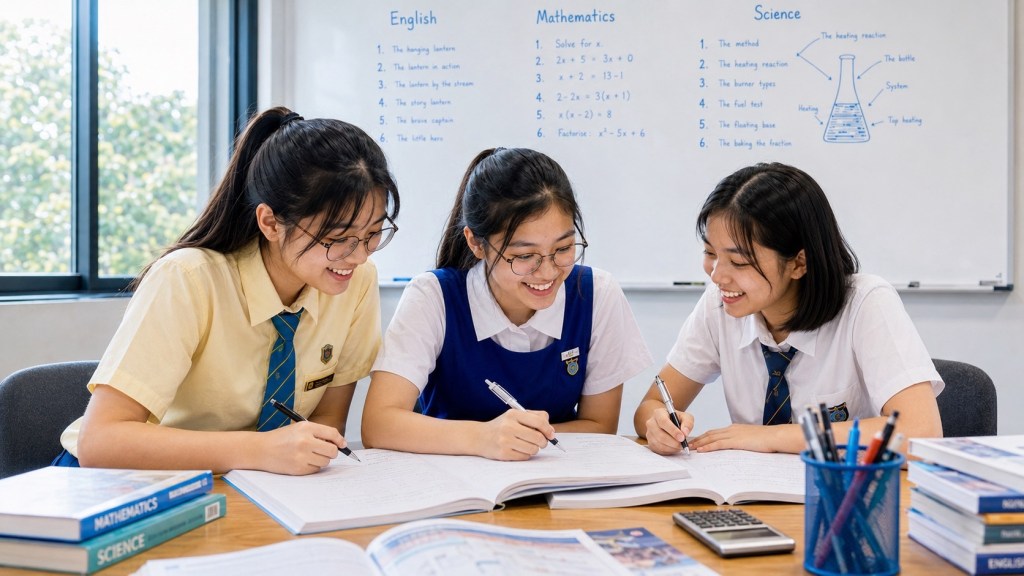
CHIJ St. Joseph’s Convent was established in 1938 and moved to Sengkang East Way in November 2000. The school’s official contact page gives its address as 62 Sengkang East Way. These answer two different questions: when the institution began, and where its later campus belongs. Someone researching the neighbourhood should keep both dates, rather than treating the arrival of a school building as the beginning of the whole school community.
The school was originally known as Paya Lebar Convent. Its history can be followed through people, places and purposes together. Start with the small rented premises, then consider how a growing institution could change its buildings while retaining its name and relationships. The chapters below connect that story with the wider IJ tradition, commemorative events and learning. Worked examples are original teaching exercises, clearly distinguished from school records; they help readers test a timeline and explain change without inventing pupils’ experiences.
eduKateSengkang • Neighbourhood history and learning
Choose your reading route
Read the historical record, follow the worked explanations, or begin with independent practice.
Route 1 · Chapters 1–2: Origins and earlier premises
A rented beginning and a school before a campus; The IJ inheritance and the different meanings of a founding date.
Route 2 · Chapters 3–4: IJ identity and purpose
Reopening, borrowed space and the meaning of continuity; Hillside Drive and changes in the work of schooling.
Route 3 · Chapters 5–6: The move and remembered places
The Sengkang move as a change of setting; Remembering an earlier home through a later event.
Route 4 · Chapters 7–8: Worked history investigation
Anniversaries, service and the wider school community; Traditions of participation and learning beyond a classroom.
Route 5 · Chapters 9–10: Independent practice and answers
A worked local-history account with evidence and interpretation; Build a small, useful SJC history investigation.
Full chapter index · Independent practice · Sources · Continue exploring
Contents
Chapters 1–2 · Origins and earlier premises
1. A rented beginning and a school before a campus
2. The IJ inheritance and the different meanings of a founding date
Chapters 3–4 · IJ identity and purpose
Chapters 5–6 · The move and remembered places
Chapters 7–8 · Worked history investigation
7. Anniversaries, service and the wider school community
8. Traditions of participation and learning beyond a classroom
Chapters 9–10 · Independent practice and answers
9. A worked local-history account with evidence and interpretation
CHAPTER 1 OF 10 • Origins and earlier premises
1. A rented beginning and a school before a campus
The school’s historical account identifies its first home as a rented house at Flower Road. It was then called Paya Lebar Convent, with 21 pupils cared for by an IJ nun and two teachers. This is an institutional origin in a domestic setting: the organisation of teaching preceded the later purpose-built campus that a Sengkang reader may recognise today.
A rented house makes the distinction between an institution and a property particularly clear. A school needs teaching, learners and some continuity of organisation; ownership of a large site is a different matter. Moving out of rented premises would change an address without automatically ending the school. Conversely, an old house could survive after a school left it, without continuing to function as that school. Keeping these possibilities separate helps explain why a history can follow one community through several buildings.
The small founding group also changes the questions worth asking. A modern campus photograph invites attention to architecture and facilities. An account of a small house invites questions about how space was shared, who provided instruction and how a recognised community developed. The surviving description supports the modest scale of the beginning. It does not supply a complete daily timetable, the dimensions of rooms or individual family circumstances, so those details should remain research questions rather than picturesque additions to the story.
Try a short interpretation exercise. Which sentence explains more: “The school started in an old house,” or “Teaching began in rented premises, so the school’s institutional identity did not depend on owning its first building”? The second sentence connects evidence to an explanation. It does not claim that renting caused later growth. This is a useful distinction when writing local history: a fact can reveal how an institution operated without proving every reason for its eventual development.
For a family history project, place the earliest school name beside the earliest location before adding later names. This prevents a reader from searching only for the present name and missing an earlier reference. A change of label can conceal continuity in a catalogue or a family album. The practical task is to ask whether two labels refer to the same developing institution, and then support that connection with the school’s own chronology.
CHAPTER 2 OF 10 • Origins and earlier premises
2. The IJ inheritance and the different meanings of a founding date
SJC’s official heritage page places its educational inheritance within a much longer story. It traces Nicolas Barré’s work educating poor children, especially girls, to France in 1662. It also describes Mother Mathilde and three IJ Sisters arriving in Singapore in February 1854 and establishing the first IJ school at Victoria Street. These dates concern the wider tradition and its Singapore presence, rather than the establishment of this particular school.
The distinction matters because organisations often belong to several historical scales at once. A local school can have its own founding year, participate in an older Singapore network and inherit ideas developed elsewhere. None of those scales cancels the others. A good caption therefore names the subject of an anniversary: the individual school, the Singapore IJ community or the wider religious tradition. The number alone is incomplete unless readers know which beginning it measures.
Here is a worked calculation using the two Singapore founding years. Subtracting 1854 from 1938 gives an interval of 84 years. That does not make SJC 84 years old when it began. It measures the time between the first Singapore IJ school and SJC’s establishment. The arithmetic is straightforward; choosing the meaning of the answer is the historical skill. A correct subtraction attached to the wrong institution still produces a misleading account.
The heritage page presents education for disadvantaged children as central to the tradition. That statement describes the institution’s understanding of its mission. It supplies a reason to investigate access, care and service alongside buildings and examinations. It does not, by itself, establish that every pupil in every period had the same circumstances or received the same experience. The richer question is how a stated educational purpose appeared in particular activities, decisions and relationships.
A useful changed-condition check is to imagine finding an anniversary badge with “165” but no school name. Would the number prove that the Sengkang school was founded 165 years earlier? No. First establish the event and the community being commemorated. Compare the badge with a dated programme or institutional notice. This approach allows a small object to contribute to history without asking it to answer a question its surviving information cannot resolve.
CHAPTER 3 OF 10 • IJ identity and purpose
3. Reopening, borrowed space and the meaning of continuity
The school records its postwar reopening in a borrowed bungalow off Upper Serangoon Road. Its chronology places the move to 11 Hillside Drive in 1945, initially into a four-classroom wooden building funded by the mission. The following year brought the name St. Joseph’s Convent. The school’s founder-and-patron page explains the choice through its religious account of St Joseph’s protection and Sister Theodora’s prayers.
These details reveal different kinds of continuity. Reopening concerns the restoration of teaching after interruption. Borrowed accommodation concerns the means of housing that teaching. Renaming concerns public identity and institutional meaning. Putting all three under the vague phrase “a new school opened” would hide the distinction between resuming an existing community and founding an entirely separate one. The sequence is more informative when each action retains its own verb.
The religious explanation should be presented as the school’s faith account. It shows how the community interpreted survival and chose to remember it. That is historically significant even though it is a different kind of statement from a dated address or the number of classrooms. A historian can explain what a belief meant to an institution without presenting that belief as a physically measurable cause of events. Respectful attribution preserves both the account and the reader’s ability to assess its nature.
Consider an original reconstruction exercise, rather than an imagined school diary. You have three labels: “teaching resumes,” “premises change,” and “name changes.” Arrange them using the chronology above, and write one sentence explaining what each label establishes. A strong answer treats resumption as continuity after interruption, relocation as a spatial change and renaming as a change of identity. It does not invent conversations between teachers or claim to know what every pupil felt.
If a later source supplies a precise reopening day, the year-level account could be refined. Until then, a year should remain a year. Adding a day and month for visual neatness would reduce accuracy. This is especially relevant to school timelines, where anniversary ceremonies may occur on chosen commemorative dates. The date on which a community celebrates an event need not be the exact date on which the original event happened.
CHAPTER 4 OF 10 • IJ identity and purpose
4. Hillside Drive and changes in the work of schooling
The official chronology records aided-school approval in 1949, the development into a fully secondary school by 1974, enrolment of 920 in 1986 and a first computer room in 1990. These milestones describe different dimensions of development: institutional status, the age range taught, scale and teaching resources. They should not be compressed into a single undifferentiated story of bigger buildings.
Changing from provision across primary and secondary stages to a secondary institution alters the educational task. Younger and older learners require different curriculum sequences, timetables and subject organisation. That is an explanation of the significance of the change, rather than a claim about the exact arrangements in every Hillside classroom. To reconstruct those arrangements in detail, a researcher would need period prospectuses, timetables or other contemporary records.
A classroom, a science laboratory and a computer room are also different categories of space. A specialist room can support activities that depend on particular equipment, while a general classroom can serve many subjects. Counting all rooms as interchangeable would therefore conceal something important about educational change. A room total, even if one were available, would not tell the complete story of what students could do in those rooms.
An original document-analysis case makes this concrete. Imagine a building inventory listing twelve general classrooms and one specialist room in one year, then eleven general classrooms and three specialist rooms later. The total rises from thirteen to fourteen, an increase of one room. Yet specialist provision rises by two rooms while general provision falls by one. The answer depends on the question. This invented inventory is not an account of SJC’s actual buildings; it shows why different kinds of educational space need separate categories.
Apply that lesson to the historical computer-room milestone. It establishes a documented change in provision, but it does not measure how often each class used computers or whether every subject used the room. A thoughtful history explains the new possibility and then identifies the evidence needed to measure actual use. In this way, facilities become part of the story of teaching rather than a list of objects assumed to produce identical outcomes for everyone.
CHAPTER 5 OF 10 • The move and remembered places
5. The Sengkang move as a change of setting
Relocation placed an established school within Sengkang’s neighbourhood landscape. The important historical relationship is between continuity of institution and change of setting. Pupils entering a campus in a developing residential town could belong to an organisation with roots elsewhere. That combination helps explain why neighbourhood histories should include institutions that moved into an area, as well as institutions first created there.
A location history asks where teaching took place. An institutional history asks how the school continued through those changes. A neighbourhood history adds a third question: how does this institution help explain the place around it? These questions overlap but require different evidence. An address establishes a location. A school chronology establishes a claimed sequence. To explain how relocation affected particular families, a writer would need testimony or records about those families, rather than assuming that every journey became shorter.
Here is a clearly invented travel comparison. Before a hypothetical school move, one pupil’s one-way journey is 35 minutes and another’s is 15 minutes. Afterwards, the corresponding journeys are 20 and 30 minutes. The first pupil saves 15 minutes; the second adds 15 minutes. The combined one-way total stays at 50 minutes. An unchanged total therefore conceals two opposite experiences. These figures illustrate how relocation can redistribute convenience; they are not measurements of SJC pupils’ travel.
Change the conditions so the second pupil’s later journey is 25 minutes. The new combined total is 45 minutes, a reduction of 5 minutes, but that pupil still travels 10 minutes longer than before. An overall improvement and an individual disadvantage can coexist. This is why an historical statement about a new location should not turn automatically into a claim that all members of a school community benefited in the same way.
For a Sengkang project, use the present address as a geographical anchor and the earlier locations as historical anchors. A paper map can show the sequence without entering school grounds or recreating an undocumented walking route. Label lines between places as “sequence of locations,” unless they represent a verified journey. A line on a diagram can communicate chronology perfectly well without pretending to be the exact route taken by pupils, staff or moving vehicles.
| Question | Useful record | What it establishes |
|---|---|---|
| When did the institution begin? | Official school chronology | The founding is distinct from later premises. |
| Where is the school now? | Official contact page | The current published address. |
| How did a former site remain meaningful? | The recorded commemorative walk | An event connected earlier and later premises. |
| What did an anniversary count? | A dated programme or institutional bulletin | The named community and its chosen historical beginning. |
| How did pupils experience change? | Relevant testimony or contemporary pupil records | Individual perspectives, with their own scope and limitations. |
CHAPTER 6 OF 10 • The move and remembered places
6. Remembering an earlier home through a later event
The school’s history describes a 2011 fundraising walkathon associated with the opening of its indoor sports hall. Past and present pupils and staff walked from the former Hillside Drive site to Sengkang East Way. This is a particularly revealing link between the school’s geography and its memory: an earlier location became part of an event at the later campus.
The connection makes the relocation story more than an arrow between two addresses. A school can leave a building yet continue to use that place as a reference point. In this case, the recorded walk linked generations as well as locations. The interpretation is that movement through space helped make institutional continuity visible. It does not require inventing speeches, personal recollections or the number of participants to explain why the choice of endpoints matters.
An event of this kind also gives an old site a new historical role. It may once have been a place of daily attendance; later it can become a place from which a commemorative journey begins. The physical location and its meaning are related but not identical. A reader who knows only the present campus can therefore understand why the former address remains relevant even after ordinary school activity has moved elsewhere.
For an original oral-history exercise, ask a willing former pupil to describe a routine associated with a school place, then ask what evidence could help locate that memory in time. A photograph, report card or dated programme might provide a useful anchor. Record the interview date and distinguish the speaker’s recollection from your own interpretation. This exercise is a proposed research method, not testimony from an unnamed SJC alumna. No personal memory is being supplied on anyone’s behalf.
A changed-condition question tests the interpretation. If you found only a photograph of people walking, with no caption or programme, could you identify the event and endpoints? No. Clothing and background features might suggest questions, but the stronger identification would come from a reliable caption or event record. The school’s documented description gives this particular walk its historical connection; the image alone would leave much more uncertain.
CHAPTER 7 OF 10 • Worked history investigation
7. Anniversaries, service and the wider school community
An IJ Sisters bulletin records SJC’s eightieth-anniversary dinner in the school hall on 17 October 2018. It also notes a 2017 book marking seventy-nine years of history. These are different commemorative forms: a gathering brings people together at a particular time, while a publication can carry selected memories to readers who were not present.
The bulletin also describes Chinese New Year activities with elderly people from the IJ Home and Lions’ Befrienders, competitions involving food and hampers, and origami dogs given to nearby residents. This record offers a specific connection between school life and people beyond the campus. It is an institutional report of activities, not an independent survey of what recipients thought or a measurement of lasting community impact.
That distinction helps explain service history properly. An activity record can establish that an organisation reported a particular form of participation. Evaluating its effect requires different evidence: what recipients valued, what needs were met, whether a relationship continued, and whose perspective has been preserved. A history can recognise the activity without assuming that its organisers’ aims provide a complete account of its outcomes.
The same bulletin places the wider IJ community’s 165-year Singapore commemoration in 2019, including a National Stadium celebration on 28 May and a forum on 9 March. The local school anniversary and the wider network anniversary therefore belong on related but separate lines of a timeline. Their different numbers are consistent because they count from different beginnings. The documents make better sense when the subject of each commemoration remains attached to its date.
For independent practice, calculate the local anniversary in the dinner year using the founding year at the start of this article. Then calculate the wider Singapore anniversary using the earlier IJ arrival year. The answers are 2018 − 1938 = 80 and 2019 − 1854 = 165. The one-year difference between the celebrations is not the main lesson. The crucial step is matching each later year to the appropriate institutional beginning before subtracting.
CHAPTER 8 OF 10 • Worked history investigation
8. Traditions of participation and learning beyond a classroom
The school’s Girl Guides page dates its unit’s beginning to 2003. It describes leadership, service and practical activities including first aid, camp craft and outdoor cooking. Its historical starting date belongs to that particular group, not to the school as a whole. This gives another example of histories nested within an institution: a school can be much older than one of its activities.
The practical significance of a co-curricular history lies in the forms of learning it introduces. Planning a shared task can involve allocating responsibilities, adapting to resources and taking account of others. A record that a group existed creates a starting point for investigating those experiences. It does not establish that every pupil joined the same group or acquired identical skills. Membership records, activity reports and first-person accounts would answer different parts of that larger question.
The school’s Humanities page describes inquiry and issue-based learning, field investigations and interdisciplinary work. Examples include a Civic District trail, learning at the Former Ford Factory and an Art–History trail at the National Gallery. These examples show how the school presents learning through places and questions. They are current published descriptions, rather than proof that every listed programme operated throughout the school’s earlier history.
There is a useful connection with the present article. Investigating a school’s own past also requires moving between subjects: reading institutional accounts, interpreting photographs, mapping locations and checking dates. The local topic gives those skills a common object. A map without chronology might confuse former and present premises; a chronology without attention to place might miss the significance of relocation. Bringing the two together produces a more complete explanation.
Try an original classroom task: choose one statement about a school building and one about a school activity. Explain what each reveals about education, then identify a question that neither can answer. A strong response might distinguish available space from participation and then ask how frequently a particular cohort used a facility. This is a proposed learning task for readers, not a description of an assignment currently required by SJC or of its assessment criteria.
CHAPTER 9 OF 10 • Independent practice and answers
9. A worked local-history account with evidence and interpretation
Suppose a student is asked, “How can a school remain the same institution after moving?” An effective answer should connect a specific event to a clear idea. It can begin with the documented relocation, explain the distinction between community and building, and use the later commemorative walk as evidence that an earlier site continued to matter. The argument is stronger than a sentence saying simply that the school has a long history.
Here is an original model interpretation: “The school’s identity extended across more than one campus. Its relocation changed the setting of school life, while the later walk connecting former and present premises turned that geographical sequence into a shared act of remembrance. The old address therefore remained part of the institution’s story after the move.” This paragraph explains the significance of the evidence; it does not claim that all former pupils understood the event identically.
Now examine the limits of the argument. A commemorative event supports an interpretation about how the institution presented continuity. It cannot establish how every participant remembered an earlier campus, nor can it show that everyday routines stayed unchanged after relocation. To investigate routines, a researcher might compare period timetables or school rules. To investigate memory, interviews might be appropriate. The next source should be chosen for the unresolved question, rather than because it repeats the most familiar milestone.
An alternative question changes the evidence needed. If the assignment asks whether a new campus improved learning, the relocation date and a commemorative walk are insufficient. Relevant evidence would concern teaching conditions and learning over time, with attention to changes in pupils, curriculum and assessment. A newer building may offer different possibilities, but the building’s age is not itself a measurement of educational effect. The same historical facts can therefore support one argument well and another only weakly.
For a self-check, underline the factual anchor in your paragraph and circle the words that express interpretation. Ask whether the connection between them is explained. If the argument depends on an assumed experience, name that assumption and seek evidence. This method keeps a local-history essay readable: readers can follow the account while seeing where the writer has moved from a documented event to an explanation of its meaning.
CHAPTER 10 OF 10 • Independent practice and answers
10. Build a small, useful SJC history investigation
Begin with a precise question that can be answered from a manageable set of records. “What changed when the school moved?” is more workable than trying to describe everything about the school. Divide the question into place, organisation and memory. The location sequence addresses the first part; records about educational provision address the second; anniversary publications and commemorations help with the third. The categories keep different kinds of change visible without requiring a claim about every aspect of school life.
For independent practice, imagine that a short display has room for three captions. Caption A gives only the present address. Caption B gives the founding and relocation as distinct events. Caption C says the school “began when it arrived in Sengkang.” Which caption best introduces institutional history, and why? B is strongest because it preserves a beginning before the present setting. A is useful for locating the school but does not explain its development. C merges two different events and loses the earlier institution.
Now change the display’s purpose. If it is an address directory rather than a history panel, A may be entirely adequate. The answer changes because the task changes. This is a valuable transfer check: historical completeness is not required in every practical notice, but a notice designed to explain origins must distinguish origin from relocation. Good communication selects evidence for its purpose while keeping every included statement accurate.
A second exercise concerns a proposed exhibit label: “A school activity began in a particular year, therefore the whole school began that year.” Explain the error without needing any additional dates. The answer is that a component and its parent institution can have different beginnings. This principle applies to a sports team, a Guides unit, a computer room and an anniversary publication. It helps a reader organise new information even when the specific milestone was not included in an earlier timeline.
Finally, write a short conclusion that answers your opening question in ordinary language. For example, explain that a change of premises can sit alongside continuity of institution, then name the records that led you to that interpretation. Keep a separate list of questions still unanswered, such as how a particular cohort experienced the move. A good investigation ends with a defensible explanation and a productive next question, rather than filling missing details with an imagined version of school life.
Frequently asked questions
Does a school’s present address tell us when it began?
An address locates a school at the time of the record. It does not normally establish the institution’s first year. For this history, use the chronology to understand beginnings and changes of premises, then use the official contact page to identify the present location. Comparing the purposes of those records prevents a common mistake: treating the date of a building, a move or a directory entry as the beginning of an older organisation. A place and an institution can have connected histories while keeping different timelines.
How should a reader understand the school’s Catholic identity?
The official mission page describes a Christ-centred community and an emphasis on truth, justice, freedom, love and the needs of disadvantaged people. It also presents the crest as a link among IJ pupils internationally. These statements help explain the institution’s own vocabulary of purpose and belonging. A historical account should attribute that perspective clearly and examine how it appears in particular records. Describing an institutional mission is different from claiming that every member experienced it identically or that a stated aim proves a particular outcome.
What is the best way to compare school anniversaries?
Write the name of the institution or community beside the anniversary number before doing any arithmetic. Then identify the beginning being counted and the year of commemoration. Different anniversaries can be correct at the same time because they refer to different historical scales. If the object or programme does not make its subject clear, investigate its context first. Subtraction can check whether a proposed interpretation is consistent, but arithmetic cannot identify an institution from an unexplained number by itself.
Can photographs replace written records in a school history?
Photographs contribute evidence about visible features, people and arrangements, but their interpretation benefits from captions, dates and information about their origin. A classroom image may reveal furniture while leaving the lesson, year or pupils’ experiences uncertain. A commemorative photograph may show an event without establishing its complete purpose. Use photographs alongside appropriate written records and identify what each actually contributes. The featured classroom photograph on this article illustrates eduKate’s learning theme; it should not be treated as a historical photograph of the named school.
Where should a reader continue after this introduction?
The linked official history and heritage pages provide the institutional account, while the IJ Sisters bulletin supplies a record of particular commemorations and activities. The sources panel distinguishes those materials from the older anniversary-publication link, which could not be reopened for this review. The onward links connect this school history with other Sengkang stories and the separate learning and parent guide. Choose the next source according to the question: origins, institutional purpose, a specific event or present contact information require different records.
Sources and reading notes
SJC official school history — Institutional retrospective. Distinguishes the founding, earlier premises, secondary-school development, facilities and commemorative walk; dates retain the precision supplied in the account.
SJC: founder and patron — Institutional heritage account reopened 22 October 2026. Distinguishes the wider tradition and first Singapore IJ school from SJC. Religious interpretations attributed as the school’s faith account.
SJC: crest and mission — Institutional statement reopened 22 October 2026; evidence of stated identity and purpose, rather than a measurement of every pupil’s experience.
IJ Sisters: schools and IJHCC events bulletin — Congregation’s own activity bulletin, four-page PDF reopened 22 October 2026. Page 2 records SJC’s anniversary and community activities; page 1 records the wider 2019 Singapore IJ commemoration. Organisational event reporting, not independent recipient evaluation.
SJC Girl Guides — Official activity page reopened 22 October 2026. Used for the unit’s stated historical beginning and examples of activities. No timetable, admission or participation guarantee reproduced.
SJC Humanities — Official programme description reopened 22 October 2026. Illustrates published approaches and examples, not an account of programmes throughout all earlier periods.
SJC official contact and address — Official contact page reopened 22 October 2026. The address is used as a current geographical anchor; other changing service details are not reproduced.
Earlier anniversary-publication link: availability note — Earlier institutional anniversary-publication link. The file was unavailable when checked on 22 October 2026; the accessible official history and heritage pages above provide the principal reading route.
CHIJ SJC: 80th-anniversary publication
CHIJ SJC: official contact page
Historical accounts describe particular times. Confirm current access and activities through official channels. The featured classroom photograph illustrates eduKate’s learning theme and does not depict the named artwork or school.
Continue exploring Sengkang
CHIJ SJC learning and parent guide
Soaring Vision Sculpture Sengkang: Elsie Yu’s 1992 Artwork and Its History
Compassvale Mosaic Murals: Sengkang’s Sea-Creature Art and Fishing Heritage
Pei Hwa Secondary School History: 2005 Beginnings and the Jalan Kayu Connection
