
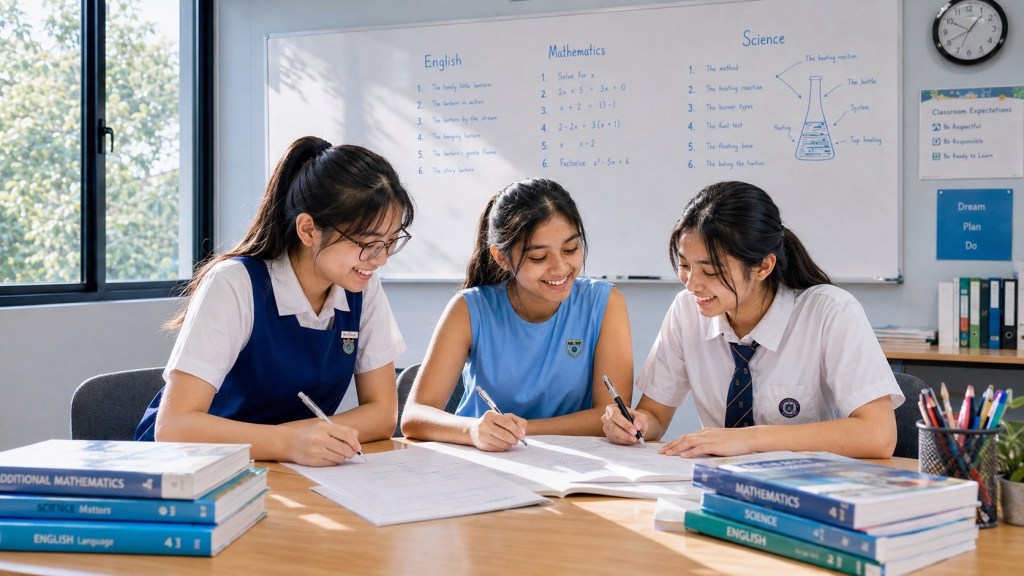
Did you know that Science revision can grow around one connected habit: explain what happens using an idea and the evidence? In Primary 3, that may begin with careful observation and familiar concepts. By PSLE, pupils must apply understanding to questions and investigations. At secondary level, the course may require more formal models, calculations and practical reasoning.
Start with a task the student has actually been taught. Ask what the evidence shows, which concept is relevant and how the two connect. Use feedback to repair the explanation, then test it on a changed situation. Science revision needs recall, but it also needs interpretation and application; a list of remembered keywords cannot show the whole learning profile.
The next useful step is to choose one question and separate observation from explanation. Keep the work matched to age, current topic and actual course. Formal Primary Science begins at Primary 3; for SEC, confirm whether the student takes G1 Science, a combined Science course or a separate science and check the examination-year SEAB syllabus.
Find your next learning step
eduKate Sengkang · Study methods that grow with the learner
Diagnose the task · Plan the transition · Check progress · Full contents
| Learning stage | Choose the relevant section |
|---|---|
| Before Primary 3 | Before Primary 3: preserve curiosity without inventing a syllabus |
| Primary 3–4 | Primary 3 and 4: make observations precise |
| Primary 5–6 / PSLE | Primary 5 and 6: follow the mechanism through the answer |
| Secondary 1–2 | Secondary 1 and 2: develop more formal representations |
| Secondary 3–4 / SEC | Secondary 3 and 4: match the actual Science course |
Contents: 10 practical sections
- Before Primary 3: preserve curiosity without inventing a syllabus
- Primary 3 and 4: make observations precise
- Primary 3 and 4: connect a concept to a particular situation
- Primary 5 and 6: follow the mechanism through the answer
- PSLE: practise deciding which evidence matters
- Secondary 1 and 2: develop more formal representations
- Secondary 3 and 4: match the actual Science course
- How should revision differ for Physics, Chemistry and Biology?
- A Science revision cycle with a clear result
- Questions about Science study progression
Primary 1 and 2 children can observe plants, materials, light and everyday changes. Ask what they noticed and allow them to describe it in their own words. Such conversations can build useful habits without being presented as formal Science examination preparation.
An adult might ask whether two leaves look the same and invite a description of visible differences. Avoid asking the child to infer an invisible mechanism from appearance alone. Curiosity can include uncertainty.
Follow age-appropriate school activities and adult guidance. The later formal subject should build on observation and language, not on a requirement that young children memorise upper-primary answers.
Help the pupil distinguish what was seen from what is being suggested. ‘The paper became wet’ describes an observation. ‘The paper absorbed water’ introduces an interpretation that should fit the task and evidence.
Ask for a relevant description rather than a long one. If the question compares a visible property, the pupil should identify that property. Adding unrelated facts can make the answer less focused.
Use vocabulary with meaning. A word such as waterproof is useful when the pupil understands the property being discussed and can use it accurately in context. Repeatedly writing the word without a suitable example does not check that connection.
Suppose a taught activity compares materials used to keep an object dry. Ask what happened, which property matters and what the result suggests for the stated purpose. Do not turn evidence about water into an unsupported claim about every material property.
A useful home conversation asks, ‘Which detail in the question helped you decide?’ It encourages the child to connect the answer to information rather than search for a familiar topic keyword.
Use current school examples and teacher feedback. The precise topic sequence varies, so this guide offers a learning method rather than a fixed national weekly teaching schedule.
An explanation should connect cause, process and relevant result where the task requires them. Ask what changes, what remains comparable and why the outcome follows. Keep the explanation within the information and taught concepts.
In an illustrative evaporation comparison, equal amounts of water may be placed in containers with different exposed surface areas under otherwise comparable conditions. The student needs to use the stated conditions and relevant concept, rather than mention every factor they remember about evaporation.
Do not apply a compulsory writing formula to every question. Some tasks ask for an observation, some for a reason, some for a conclusion and some for an improvement. The answer form should serve the task.
Use diagrams, observations and data from suitable taught material. Ask the pupil to identify what supports the answer and which possible claim goes beyond the evidence. This is a useful way to diagnose imprecise explanations.
After a correction, change the situation while retaining the important principle. Can the pupil explain the new case? If they repeat the previous answer word for word despite different conditions, return to the relationship.
Follow the current SEAB format for the pupil’s examination year and offering. Paper practice should reveal the next teaching action. Reserve time for corrections and fresh attempts before another paper replaces the old one.
Secondary Science can introduce more detailed terminology, diagrams and quantities. Learn what each representation means and how it connects to an observation or process. Do not assume that a labelled diagram is understood because it has been copied neatly.
Where a taught relationship involves quantities, explain the units and what the calculation represents. Where a graph is used, identify the axes and what the pattern supports before drawing a conclusion.
Keep practical learning supervised and aligned with school instruction. The student should understand the purpose of a procedure and the information it can produce. Reading a description and safely carrying out a task are different learning demands.
The SEC school-candidate directories distinguish subjects and combinations. G1 Science is not simply an abbreviated label for every secondary science option. G2 and G3 lists include combined Science combinations, and the G3 directory also lists separate Physics, Chemistry and Biology.
Confirm the exact title, code, level and examination year before selecting papers. A combined course and a separate science can differ in scope and assessed demands. Check the official document rather than use a generic collection of ‘SEC Science’ questions.
Read the actual assessment requirements, including practical components where applicable. Create tasks that test those actions. Do not assume that a task required in one course is automatically part of another.
In Physics, explain quantities, relationships and representations before substituting into formulas. Ask whether the units and magnitude make sense. A calculated number should answer a physical question.
In Chemistry, connect observable changes with the models and representations taught in the course. Track the entities involved carefully rather than switching unnoticed between a substance, particle or reaction description.
In Biology, connect structures, functions and processes and use evidence to explain the situation. These are general study priorities, not complete subject specifications. The actual syllabus determines the content and depth for the learner.
Choose one concept and one application. Recall the concept, inspect an example, attempt a related question and explain the link to the evidence. Use teacher feedback to repair the missing connection.
Return later with a new situation, diagram or dataset that requires the same idea. A correct fresh explanation is useful evidence of learning. If the learner still needs the original sentence in front of them, continue building independence.
In 3-pax tuition, ask whether each student is explaining their reasoning and receiving a suitable next task. Small-group attention is valuable when it identifies the real misconception rather than only supplies a correct phrase.
Should we memorise keywords? Learn important terminology with meaning and appropriate use. Then practise explanations and applications that require it.
Should all secondary students study separate sciences? Follow the school’s offered and confirmed subject combination, readiness and guidance. The subject catalogue is not a personal timetable.
What should we do first? Take one current question, state the evidence, select the relevant idea and explain the connection without unsupported additions.
Continue the effective-learning series
Primary 6 Science: explanations and revision
Scientific explanations: evidence and mechanisms
Official curriculum and examination routes
Official information checked on 10 October 2026. The home-study examples above are teaching illustrations, not additional examination requirements. Follow the student’s school sequence, actual subject offering and correct examination-year syllabus.
SEAB PSLE: current formats and candidate information
SEAB SEC school-candidate syllabus directory
Full Subject-Based Banding: Posting Groups and subject levels
Choose your next subject study route
Choose one subject and the stage you are learning at. Each guide gives a practical next task, then explains how the study routine develops.
English: how study methods change · Mathematics: how study methods change · Science: how study methods change · Mother Tongue: how study methods change
Connect earlier learning to your next subject
Choose a guide for the subject you are learning. Start with current school work, strengthen the missing connection and use the correct examination syllabus.
How Should Physics Learning Change from Primary Science to SEC?
How Should Chemistry Revision Change from Primary Science to SEC?
How Should Biology Revision Change from Primary Science to SEC?
How Do Primary and Lower-Secondary Maths Skills Prepare Students for A-Math?
