
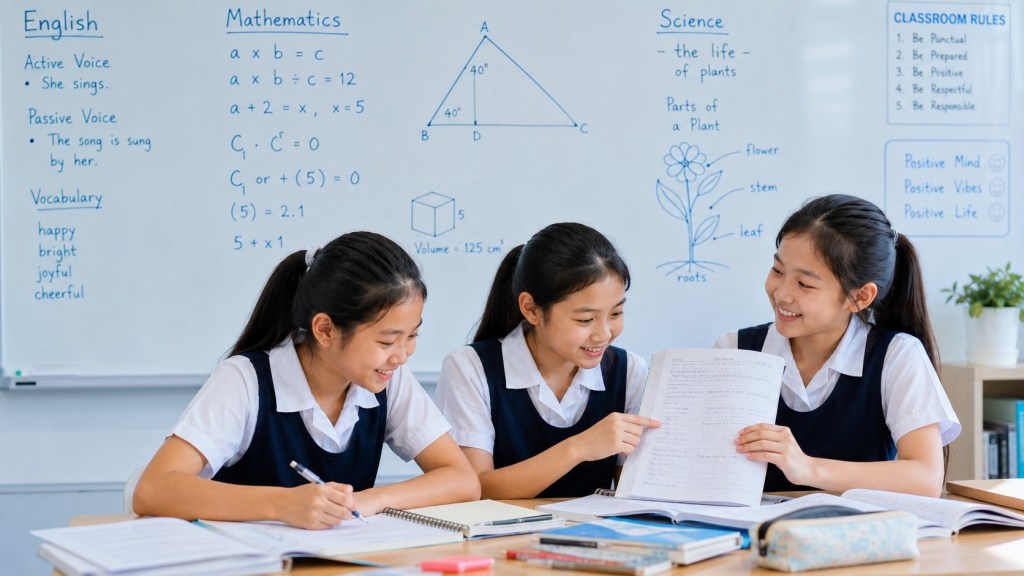
A Primary 6 pupil can know the chapter, recognise the concept and still lose the mark because the examination is asking for something more exact. The question may contain a familiar idea inside an unfamiliar setup. It may ask for two linked explanations, hide the relevant condition inside a diagram, require evidence from a graph or test whether the pupil can distinguish what is observed from what is merely possible.
PSLE Science therefore does not end with content revision. The final job is to turn knowledge into reliable performance under time, uncertainty and changing contexts.
This guide develops the examination-performance layer of the Primary 6 Science Learning Hub. It connects concept reconstruction, inquiry, evidence, explanation, error analysis and revision into one operating system. All examples and practice questions here are original eduKate teaching material rather than reproduced examination items.
Quick answer: what does a strong PSLE Science pupil do before writing?
Use the question as a compressed scientific world:
READ → RECONSTRUCT → IDENTIFY THE JOB → SELECT THE SCIENCE → USE THE EVIDENCE → EXPLAIN → CHECK.
This is an eduKate reasoning routine, not an official SEAB answer formula.
The 2026 PSLE Science examination assesses attainment in the 2023 Primary Science Syllabus. SEAB states two broad assessment objectives: Knowledge with Understanding and Application of Knowledge and Scientific Inquiry. Scientific inquiry includes making predictions and hypotheses, interpreting and analysing information, evaluating observations, information and methods, and communicating explanations and reasoning.
The 2026 examination is one written paper of 1 hour 45 minutes. Booklet A contains 30 multiple-choice questions for 60 marks. Booklet B contains 10–11 structured questions for 40 marks. Candidates answer all questions.
Official references: SEAB PSLE Formats Examined in 2026 · MOE 2023 Primary Science Syllabus.
The paper does not know what you meant
A pupil may think, “I knew that,” after losing a structured-question mark. That can be true. But an examination can assess only the answer that was produced, not the unwritten idea in the pupil’s head.
The performance problem may occur at several different points:
- the question was misread;
- the scientific system was reconstructed incorrectly;
- the wrong concept was selected;
- the right concept was selected but the causal chain was incomplete;
- the evidence was not used;
- the answer overclaimed;
- one command in a two-part question was missed;
- the pupil rushed, copied wrongly or changed a correct answer without a reason.
Good revision identifies which one happened.
Part I — Reconstruct the question before answering it
Many difficult PSLE Science questions are difficult because the familiar Science is disguised by a new surface.
A question may describe a plant under coloured filters, a toy moving through a multi-stage track, several organisms in a pond, an unfamiliar machine or an experiment with labelled containers. The pupil should not begin by searching memory for a matching worksheet.
Instead reconstruct:
- What objects or organisms are present?
- What condition differs?
- What remains the same?
- What changes or is measured?
- What pathway or interaction connects the parts?
- What evidence is given?
- What exactly is the question asking me to produce?
Example: the unfamiliar box
A diagram shows a sealed transparent chamber containing a plant, a sensor and a lamp. The lamp is switched on for twenty minutes and then switched off. Sensor readings rise while the lamp is on and fall after it is switched off.
Before naming any concept, reconstruct the timeline:
- same chamber and plant;
- condition changes at minute 20;
- sensor response changes across the two phases;
- the graph must be read separately before and after the switch;
- the sensor quantity must be identified from its label before explaining.
If the learner decides “photosynthesis question” before reading what the sensor measures, a plausible but wrong answer can follow.
Keywords are clues, not commands
Seeing the word rough does not automatically mean the answer is “friction”. Seeing leaf does not automatically mean photosynthesis. Seeing food web does not automatically mean “population decreases”.
A keyword suggests candidate Science. The evidence and question decide whether that Science belongs.
Use this test:
Keyword → possible concept → check the setup → check the command → keep or reject.
Part II — Know the command job
Two questions can use the same diagram but require different answers because the command changes.
State
Give the required fact, value, variable, observation or conclusion directly. Do not add a long mechanism unless needed.
Example: “State the changed variable.” Answer the property that was deliberately changed.
Describe
Tell what happens or what the data show. Focus on pattern, change or feature rather than mechanism.
Example: “As lamp distance increased from 10 cm to 40 cm, the number of bubbles produced in five minutes decreased.”
Explain
Give the scientific reason or mechanism linking a condition to the outcome.
Example: “With less light energy available, the measured photosynthesis-related bubble-production rate was lower under the stated conditions.”
Compare
Use the same basis for both cases. “A is taller than B” is a comparison. “A is tall and B has fewer leaves” compares different properties and may not answer the task.
Predict
State the likely outcome based on a pattern, concept or mechanism. A prediction should be justified when the question requires it.
Infer
Use observations and scientific knowledge to conclude something not directly stated.
Suggest
Provide a scientifically plausible response, method, reason or improvement consistent with the evidence and constraints. “Suggest” does not mean any imaginative answer is acceptable.
Evaluate
Judge the strength, fairness, validity or limitation of a method, conclusion or claim. Evaluation requires a reason, not merely “good” or “bad”.
Two commands mean two jobs
A pupil can lose half a structured-question mark allocation by completing only the first command.
Example: “State one observation from the graph and explain it.”
The answer needs:
- an observation from the graph;
- a scientific explanation for that observation.
If the pupil writes only the explanation, the data-reading job is missing. If the pupil writes only the observation, the mechanism is missing.
Underline or mentally separate the verbs before answering.
Part III — Build open-ended explanations as causal chains
A weak answer often contains the right noun but not the relationship.
Weak: “Because of friction.”
Stronger: “The rougher surface produces a greater frictional effect on the moving car, causing it to slow more quickly, so it travels a shorter distance before stopping.”
The second answer contains a chain:
condition → scientific interaction → immediate effect → asked-for outcome.
How many links?
Enough to make the reason visible, but not so many that the answer wanders into unrelated Science.
If a question asks why a plant under lower light produces fewer bubbles, a compact chain might be:
less light energy → lower photosynthesis rate under the stated conditions → fewer gas bubbles produced per unit time.
Adding root hairs, seed dispersal and food webs would not make the answer stronger.
Use the nouns from the question
Pronouns and vague words can hide scientific relationships.
Weak: “It gets less, so it slows down.”
Better: “The toy car experiences a greater frictional effect on Surface R, so the car slows down more quickly.”
Repeat the object name when necessary. Clarity matters more than avoiding repetition.
Evidence must enter the answer when the question asks for it
“Use the data to explain” requires evidence from the data.
Suppose the car travels 78 cm on Surface P and 31 cm on Surface R.
A complete answer could state:
“The car travelled only 31 cm on R compared with 78 cm on P. This shows that it was slowed more strongly on R; the greater frictional effect caused the car to stop over a shorter distance.”
The numerical evidence is doing a job inside the explanation.
Do not invent evidence
If a question gives only height measurements, do not claim that one plant photosynthesised faster unless the method supports that inference. If a food web shows feeding relationships but no population counts, do not state exact changes in population size.
Scientific confidence should match the evidence.
Part IV — Multiple-choice questions are reasoning tasks too
Booklet A has 30 multiple-choice questions worth 60 marks in the 2026 format. Multiple-choice does not mean superficial.
The options are candidate explanations. The pupil should test them against the reconstructed world.
A four-step MCQ routine
- Answer the question in your own words if possible.
- Read every option.
- Reject options that violate a condition, relationship or piece of evidence.
- Choose the option that survives the whole setup, not the one containing the most familiar keyword.
Distractor types
Common distractors can be created by predictable reasoning errors:
- True but irrelevant: scientifically true statement that does not answer the question.
- Reversed relationship: cause and effect swapped.
- Wrong object: correct concept applied to the wrong labelled part.
- Wrong condition: ignores a stated difference between setups.
- Absolute overclaim: uses “always”, “all” or “only” when evidence is limited.
- Observation-explanation swap: gives a mechanism where the question asks what was observed.
- Variable-value confusion: gives 10 cm rather than “distance from lamp”.
Learning these distractor families helps pupils inspect their reasoning instead of merely guessing more carefully.
Original MCQ workshop
Question 1 — Photosynthesis
Three identical aquatic plants receive the same water and carbon dioxide conditions. Plant A receives strong light, B moderate light and C very little light. A produces the most bubbles during the same five-minute period. Which conclusion is best supported?
A. Strong light always makes every plant grow tallest.
B. Under the tested conditions, greater light exposure was associated with greater bubble production.
C. Plant A absorbed the most mineral salts.
D. Plant C did not respire.
Answer: B. It stays within the measured evidence and does not introduce unsupported outcomes.
Question 2 — Force
The same toy car is released from the same ramp point onto Surfaces P and Q. It travels a shorter distance on Q. Which statement is most consistent with the evidence?
A. Q exerts a greater frictional effect on the moving car.
B. Q has more gravitational force.
C. The car has no kinetic energy on Q.
D. The car is heavier on Q.
Answer: A. The setup changes surface type while the car and release conditions are the same.
Question 3 — Evidence
A graph shows a plant’s height increasing over four weeks. Which claim cannot be concluded from the graph alone?
A. The measured plant became taller over the four weeks.
B. Height in Week 4 was greater than in Week 1.
C. The plant photosynthesised faster every week.
D. Growth occurred during the measured period.
Answer: C. Height data alone do not directly establish weekly photosynthesis rate.
Question 4 — Variables
A pupil tests how the amount a spring is stretched affects the distance a toy travels. Which is the measured variable?
A. Spring type.
B. Stretch distances of 2 cm, 4 cm and 6 cm.
C. Distance travelled by the toy.
D. Number of trials.
Answer: C. The stretched amount is the changed variable; the toy’s travel distance is the outcome.
Question 5 — Environment
In a food web, hawks eat rabbits and birds. Birds eat insects. If insect numbers decrease, which is the safest immediate conclusion?
A. All hawks must die.
B. Birds may have less insect food available.
C. Rabbits must decrease.
D. Producers stop photosynthesising.
Answer: B. It follows directly from the feeding relationship without overextending the effect.
Part V — Structured questions: reconstruct before writing
Booklet B contains 10–11 structured questions worth 40 marks in the 2026 format. A structured question may contain several parts that build on one another.
Do not treat each part as an isolated mini-question if earlier information remains relevant.
Carry forward the scientific world
If Part (a) establishes that Tube X contains carbon dioxide and Part (b) asks what happens when gas from X flows into a plant chamber, the earlier result may be part of the later reasoning.
But do not carry forward an answer that you know may be wrong without rechecking the original evidence. The diagram and data remain the source of truth.
Connected setups: trace before answering
When one container feeds another, trace the path with a finger or mentally:
A → tube → B → sensor → outlet.
Then ask what changes at each stage.
A surprising number of errors arise because pupils compare A and B as if they were independent when the output of A becomes the input of B.
Branching processes: identify the decision point
A process may split depending on a condition:
same starting system → Condition X → Outcome 1
same starting system → Condition Y → Outcome 2
Do not explain the two outcomes with different starting objects if the diagram shows the same object. The scientific difference begins at the branch condition.
Return-to-start questions
A quantity may return to its starting value after changing in between.
If temperature goes 25°C → 60°C → 25°C, the final value equals the start, but heating and cooling occurred. If a spring returns to its original length after a load is removed, deformation occurred before recovery.
Always examine the path through time, not merely initial and final states.
Part VI — Prediction without pretending certainty
A prediction should extend a scientific relationship appropriately.
If measured stopping distance decreases as surface roughness increases across three tested surfaces, a pupil may predict that another slightly rougher surface could produce a shorter stopping distance, provided the same relationship continues.
But a prediction far outside the tested range should be more cautious. The relationship may change, reach a limit or be affected by another condition.
Prediction language
Useful phrases include:
- “Based on the observed pattern…”
- “Under the same other conditions…”
- “It would be expected to…”
- “If the relationship continues…”
Do not weaken every answer with “maybe”. Use confidence appropriate to the evidence.
Part VII — How to evaluate explanations
A scientific explanation should pass four tests:
- Correct: Is the Science accurate at Primary 6 level?
- Relevant: Does it answer the command and specific setup?
- Complete: Are the necessary causal links visible?
- Bounded: Does it avoid unsupported extra claims?
Example
Question: A plant kept in dim light produced fewer bubbles than an otherwise comparable plant in brighter light. Explain.
Answer A: “Plants need light.” Correct but incomplete.
Answer B: “The plant in dim light received less light energy, so its photosynthesis-related bubble-production rate was lower under the tested conditions.” More complete and tied to the measured result.
Answer C: “The plant in dim light could not photosynthesise, stopped respiration, absorbed no water and would die.” Overclaims far beyond the evidence.
Part VIII — Time management without rushing the reasoning
The paper lasts 1 hour 45 minutes, but a useful timing plan depends on the individual learner and school practice. There is no official eduKate-required minute allocation.
The principle is:
Spend enough time to reconstruct accurately, but not so long on one question that the whole paper collapses.
Three time states
- Green: question is understood and progress is steady. Continue.
- Amber: reading is looping, two interpretations remain or the pupil is writing without confidence. Return to givens and command.
- Red: no productive progress after a reasonable attempt. Mark, move and return if time permits.
This state model is an eduKate teaching tool, not an examination instruction.
Being stuck is a state to manage
When a pupil freezes, saying “think harder” rarely helps. Use a recovery route:
- Stop generating new theories.
- Read the exact command.
- List what is directly given.
- Identify what changed and what was measured.
- State one observation.
- Ask which familiar scientific relationship could connect the condition to that observation.
- If still stuck, leave space and move on.
The goal is to restore a valid starting point.
Do not let one hard question become five lost easy questions
A difficult structured item can absorb disproportionate time. The pupil should distinguish persistence from unproductive fixation.
If the scientific world is not yet clear, a short return later can be better because another question may trigger the relevant concept or the learner may regain cognitive control.
Part IX — Checking answers scientifically
Checking is not rereading every word at the same speed. It is targeted verification.
The seven-point check
- Did I answer every command?
- Did I use the correct object or label?
- Did I preserve units and values?
- Did I confuse observation with explanation?
- Did my causal chain reach the asked-for outcome?
- Did I claim anything not supported by the evidence?
- If I changed an answer, what evidence justified the change?
Change an answer only for a reason
Pupils sometimes change correct answers during final checking because a second option “feels familiar”.
A productive change has evidence:
- “I misread the axis.”
- “The question asks for the measured variable, not the changed variable.”
- “I missed the word not.”
- “Option C contradicts the diagram.”
An unproductive change has only anxiety: “I don’t know, maybe B.”
Part X — Wrong answers are telemetry
A mark tells you that performance failed. Error analysis tells you what to repair.
Use a stable error taxonomy:
| Error type | What failed | Repair |
|---|---|---|
| Content | Concept/fact not known | Rebuild concept and test in multiple contexts |
| Retrieval | Known concept not recalled | Spaced retrieval and mixed recall |
| Reading | Condition, label, unit or command missed | Question reconstruction routine |
| Representation | Graph/table/diagram not translated correctly | Representation-switch practice |
| Variable | Changed, measured or controlled condition confused | Investigation mapping |
| Relationship | Cause/effect or system interaction wrong | Causal-chain reconstruction |
| Evidence | Claim stronger than data | Observation → inference → limit drills |
| Explanation | Right idea but missing causal link | Condition → mechanism → outcome |
| Execution | Miscalculation, copying, omission or rushed response | Targeted checking routine |
| Checking | Correct answer changed or error left despite visible clue | Evidence-based answer changes |
Do not call every wrong answer careless
“Careless” is not a useful diagnosis unless the pupil truly knew the correct procedure and failed to execute it.
If a child repeatedly reads “increase by” as “increase to”, that is a language-and-representation pattern. If the child repeatedly names the apparatus instead of the measured variable, that is an inquiry-concept error. If the child always omits the final causal link in explanations, that is an explanation architecture problem.
Name the failure so the next practice can target it.
The correction book should change future behaviour
A correction book is weak if it contains only copied correct answers.
For each significant error, record:
- Question job: What was the question asking?
- My first wrong step: Where did my reasoning leave the valid path?
- Correct scientific relationship: What should I have used?
- Repair rule: What will I check next time?
- Transfer question: Can I solve a different problem testing the same capability?
Example correction entry
Error: Wrote “10 cm” as the changed variable.
First wrong step: Confused one value with the property being changed.
Correct relationship: “Distance between lamp and plant” is the variable; 10 cm, 20 cm and 30 cm are values.
Repair rule: Ask, “What property do these values belong to?”
Transfer: In a spring test using 2 g, 4 g and 6 g loads, identify the variable and its values.
Reattempt the same paper or use a new one?
The choice depends on the learning goal.
Reattempt the same paper when:
- the pupil needs to verify that a repaired method can now be executed;
- the original question exposed a specific misunderstanding;
- enough time has passed that the learner cannot simply remember the answer;
- the task is to compare reasoning before and after correction.
Use a new paper when:
- the pupil can reproduce the old answer from memory but transfer is uncertain;
- you want to test whether the same skill survives a new surface context;
- timed whole-paper performance is the target;
- the old paper no longer provides diagnostic novelty.
A strong sequence is often correct → explain → delayed reattempt → new transfer question.
Open-book to closed-book without removing support too early
When a pupil is building a concept, open-book practice can reduce memory load and let attention stay on reasoning. But if support remains forever, retrieval may never become independent.
A gradual sequence:
- notes visible and teacher prompts allowed;
- notes visible but no prompts;
- short closed-book set immediately after study;
- delayed closed-book retrieval;
- mixed closed-book questions across topics;
- timed paper conditions.
Move forward when accuracy and reasoning are stable, not merely because a calendar says so.
Untimed to timed practice
Timing should be added after the learner can perform the reasoning accurately enough to benefit from pressure.
If a pupil is still misidentifying variables or cannot distinguish observation from inference, speeding up may automate the wrong method.
Useful progression:
- untimed reasoning with explanations;
- soft time targets for small sets;
- timed Booklet A or Booklet B sections;
- full-paper timing;
- post-paper diagnosis of where time was lost.
How to know when timed papers are appropriate
Look for these signs:
- most questions can be started without teacher prompting;
- the pupil can identify command type quickly;
- graph/table reading is accurate;
- open-ended answers usually contain the necessary causal links;
- variable identification is stable;
- wrong answers are no longer dominated by basic concept confusion.
Then timing becomes a performance variable rather than a substitute for learning.
Part XI — Mixed retrieval across the whole Primary Science course
PSLE does not announce the chapter before each question. Revision should therefore mix categories after foundational repair.
A mixed set can include:
- Diversity and classification;
- Cycles;
- Systems;
- Interactions;
- Energy;
- investigations and variables;
- graphs, tables and diagrams;
- open-ended explanation;
- method evaluation.
The pupil’s first task is to identify the scientific job, not to rely on a worksheet title.
Interleaving without confusion
Mixed practice is useful after concepts are sufficiently established. Mixing too early can overload a learner who has not yet built the individual models.
A practical sequence:
learn one relationship → practise it → vary the surface → mix with a nearby concept → mix across the course.
Retrieval should include relationships, not only definitions
Instead of asking only “What is friction?”, ask:
- How would greater friction affect a moving object’s stopping distance?
- What evidence would support that conclusion?
- How would you design a fair comparison?
- What graph pattern might you expect?
- How could the same concept appear in a shoe, tyre or toy-car context?
That is retrieval plus transfer.
Part XII — Original structured-question workshop
Case Study A: The spring launcher
A pupil compresses the same spring by 2 cm, 4 cm and 6 cm. A block is released from the spring onto the same smooth track. The average distances travelled are 35 cm, 68 cm and 96 cm respectively.
A1. State the changed variable.
Answer: Amount/distance the spring is compressed.
A2. State the measured variable.
Answer: Distance travelled by the block.
A3. Describe the relationship shown.
Answer: In the tested range, greater spring compression was associated with a greater average distance travelled by the block.
A4. Explain using energy and force ideas.
Answer: Compressing the spring further stores more potential energy. When released, the spring exerts an elastic spring force and more energy is converted into kinetic energy of the block, allowing it to travel farther under the same track conditions.
A5. Can the pupil conclude that doubling compression always doubles travel distance?
Answer: No. The measured values do not show an exact doubling relationship, and the conclusion should not be extended beyond the tested conditions without more evidence.
Case Study B: Plant and lamp
Two similar aquatic plants are placed in identical containers. Both receive the same water and carbon dioxide conditions. Lamp X is 15 cm from Plant X and Lamp Y is 45 cm from Plant Y. In five minutes, X produces 20 bubbles while Y produces 8.
B1. Give one observation.
Answer: Plant X produced 20 bubbles in five minutes while Plant Y produced 8.
B2. Explain the difference.
Answer: Plant X received greater light exposure because its lamp was closer, so more light energy was available for photosynthesis under the stated conditions, resulting in a higher measured bubble-production rate.
B3. Suggest one method limitation.
Answer: Bubble count may not measure exact gas volume because individual bubbles can differ in size.
B4. Why should lamp type remain the same?
Answer: Different lamps could differ in light output or heating, introducing another variable that could affect the measured outcome.
Case Study C: Food web
A habitat contains grass, grasshoppers, mice, birds and hawks. Grass is eaten by grasshoppers and mice. Grasshoppers are eaten by birds. Mice and birds are eaten by hawks. A drought reduces the amount of grass.
C1. State one producer.
Answer: Grass.
C2. Predict one possible effect on mice and explain.
Answer: Mouse numbers may decrease because less grass is available as food, reducing the food supply that supports the mice.
C3. Must hawk numbers decrease immediately?
Answer: Not necessarily. Hawks have more than one prey source in the stated food web, and population effects can take time and depend on other conditions.
C4. Why is “the ecosystem becomes unbalanced” a weak answer by itself?
Answer: It is vague and does not identify the specific changed resource, organism relationship or causal pathway required by the question.
Case Study D: Cooling cups
Equal volumes of hot water at 80°C are placed in Cups P and Q. After ten minutes, P is 55°C and Q is 63°C.
D1. Which cup lost more temperature over ten minutes?
Answer: Cup P. It decreased by 25°C, while Q decreased by 17°C.
D2. Why is “P ended at 55°C” not the same as “P cooled by 55°C”?
Answer: 55°C is the final temperature, while the decrease is the difference between initial and final temperatures: 80°C − 55°C = 25°C.
D3. Can we conclude from one trial that Cup Q is always the better insulator?
Answer: No. The result supports a difference in this tested comparison, but repeated trials and controlled conditions would strengthen the conclusion.
Part XIII — A mini-paper for independent transfer
MCQ 1
A plant is kept in light with water but no available carbon dioxide. Which P6 idea best explains why photosynthesis cannot proceed normally?
A. Carbon dioxide is a required input for photosynthesis.
B. Plants do not respire in light.
C. Water becomes oxygen without carbon dioxide.
D. Friction prevents energy conversion.
Answer: A.
MCQ 2
A moving toy car travels farther on Surface X than Surface Y under the same release conditions. Which statement is most likely?
A. X produces a smaller frictional effect on the car.
B. X produces greater gravitational force.
C. Y gives the car more potential energy.
D. The car has greater mass on X.
Answer: A.
MCQ 3
A graph rises and then returns to its starting value. Which statement is necessarily true?
A. Nothing changed.
B. The final value equals the initial value.
C. The quantity was constant throughout.
D. The experiment failed.
Answer: B.
MCQ 4
Which statement describes an inference rather than a direct observation?
A. The thermometer reads 42°C.
B. The leaf is green.
C. The object moved 15 cm.
D. The rough surface caused a greater frictional effect.
Answer: D.
Structured 1
A lamp is moved farther from an aquatic plant. Bubble count falls from 18 per minute to 10 per minute. State the observation and give one scientific explanation.
Answer: Observation: bubble count decreased from 18 to 10 per minute when the lamp was moved farther away. Explanation: the plant received less light exposure, so less light energy was available for photosynthesis under the stated conditions, resulting in a lower measured bubble-production rate.
Structured 2
A pupil repeats a toy-car experiment three times but uses a different release point each time. Why do the repeated trials not solve the main problem?
Answer: The release condition is inconsistent, so the car begins each trial under different conditions. Repeating a biased or inconsistent method reproduces the design problem instead of creating a fair comparison.
Structured 3
A food web shows a snake eating both frogs and mice. Frog numbers decrease. Explain why snake numbers do not have to decrease immediately.
Answer: Snakes also have mice as another food source in the stated food web, so reduced frog availability does not remove all available prey. Population change can also depend on time and other environmental conditions.
Structured 4
A spring returns to its original length after a load is removed. A pupil says, “The spring did not change.” Evaluate the statement.
Answer: The statement is incorrect. The spring changed length while the load was applied and later returned to its original length. Matching final and initial length does not mean no change occurred during the process.
Part XIV — Build a four-week revision cycle
This is a teaching suggestion, not an official programme.
Week 1 — Reconstruct and repair
- Diagnose a recent paper.
- Rebuild weak concepts.
- Practise question reconstruction without time pressure.
- Separate observations, inferences and explanations.
Week 2 — Inquiry and evidence
- Variables, fair tests and method evaluation.
- Graphs, tables and unfamiliar diagrams.
- Use data explicitly in answers.
- Practise one transfer question after every correction.
Week 3 — Mixed examination work
- Mixed MCQ and structured sets.
- Two-command questions.
- Recovery from unfamiliar setups.
- Soft time targets with accuracy protected.
Week 4 — Stabilise performance
- Timed sections or full paper as appropriate.
- Error-type analysis after each attempt.
- Short targeted repair instead of rereading whole chapters.
- Final transfer on new questions.
An eight-week runway if more time is available
Weeks 1–2: repair P3–P5 foundation gaps. Weeks 3–4: consolidate P6 content and system connections. Weeks 5–6: inquiry, evidence and mixed transfer. Weeks 7–8: timed execution, correction loops and stability.
The exact schedule should respond to the learner’s actual error pattern rather than follow a fixed calendar blindly.
Part XV — What parents can observe
Useful questions are concrete:
- Can the child tell you what the question is asking before answering it?
- Can the child identify what changed and what was measured?
- Can the child state an observation without immediately adding a theory?
- Can the child explain a result as a causal chain?
- Can the child use values from a table to support an answer?
- Can the child say when the evidence is insufficient?
- Can the child identify the first wrong step after a correction?
- Can the child solve a different question testing the same skill?
- Can the child recover after being stuck without losing the rest of the paper?
These are stronger indicators than “How many papers did you finish?”
What teachers can diagnose
Watch the route, not only the final mark.
- Does the pupil reconstruct before selecting a concept?
- Does a familiar keyword trigger premature answering?
- Are command verbs distinguished?
- Does the pupil preserve labels and units?
- Are open-ended answers missing the same causal link repeatedly?
- Does the learner overgeneralise from limited data?
- Are timed errors different from untimed errors?
- Does correction transfer to a new context?
The first repeated failure is usually a higher-value repair than another full paper.
Part XVI — When a pupil knows Science but still scores below expectation
Do not assume the solution is more content notes.
A pupil may have:
- knowledge without selection — many facts, wrong one chosen;
- selection without explanation — correct concept named, causal chain missing;
- explanation without evidence — plausible mechanism, no connection to given data;
- evidence without communication — values read correctly, relationship expressed unclearly;
- reasoning without timing — accurate work too slow for the whole paper;
- timing without checking — paper completed, avoidable mistakes remain;
- practice without diagnosis — many papers, same error repeated.
Each requires a different repair.
Part XVII — The PSLE Science correction loop
A useful complete loop is:
ATTEMPT → TYPE THE ERROR → FIND FIRST FAILURE → REPAIR → EXPLAIN → TRANSFER → RETEST → STABILISE.
This turns the paper from a score generator into a learning instrument.
Attempt
Work under the level of support appropriate to the current stage.
Type the error
Use content, retrieval, reading, representation, variable, relationship, evidence, explanation, execution or checking.
Find first failure
Locate the earliest point where the reasoning became invalid.
Repair
Teach only what is required to restore the route.
Explain
Have the pupil verbalise why the corrected reasoning works.
Transfer
Use a new surface context.
Retest
Check the capability again after a delay.
Stabilise
Mix it into wider paper conditions so the skill survives pressure.
Part XVIII — The final-week mistake: learning too many new tricks
Near the examination, stability matters. A pupil who has a reliable method should not be flooded with last-minute mnemonics, exotic shortcuts or advanced terminology that competes with established reasoning.
Use the final phase to:
- strengthen retrieval of known relationships;
- repair recurring errors with high mark impact;
- maintain sleep, pacing and paper routines;
- practise recovery from unfamiliar questions;
- keep explanations precise and evidence-linked;
- protect confidence through accurate diagnosis rather than vague reassurance.
The bridge beyond PSLE
The most valuable Primary 6 Science habits continue into Secondary Science:
- separate observation from inference;
- identify variables and controls;
- read data before explaining it;
- distinguish correlation from causation;
- use models with known limits;
- write causal explanations;
- revise from error patterns rather than from chapter anxiety.
PSLE is therefore both an examination and a useful point to consolidate scientific thinking before the next stage.
Continue the Primary 6 Science Learning Guide series
- Guide 1: Concepts, Systems, Interactions & Energy
- Guide 2: Investigations, Variables, Fair Tests & Method
- Guide 3: Data, Graphs, Diagrams & Evidence
Return to the Primary 6 Science Learning Hub, continue into the wider PSLE Science Learning Guide, or use the Primary 6 Science Tuition Sengkang diagnostic route.
The quiet return
A strong PSLE Science answer is not a performance of memorised certainty. It is a controlled return from an unfamiliar question to a scientific relationship the pupil actually understands.
Read the world. Find the job. Select the Science. Carry the evidence. Complete the chain. Check the claim. Then move forward.
