
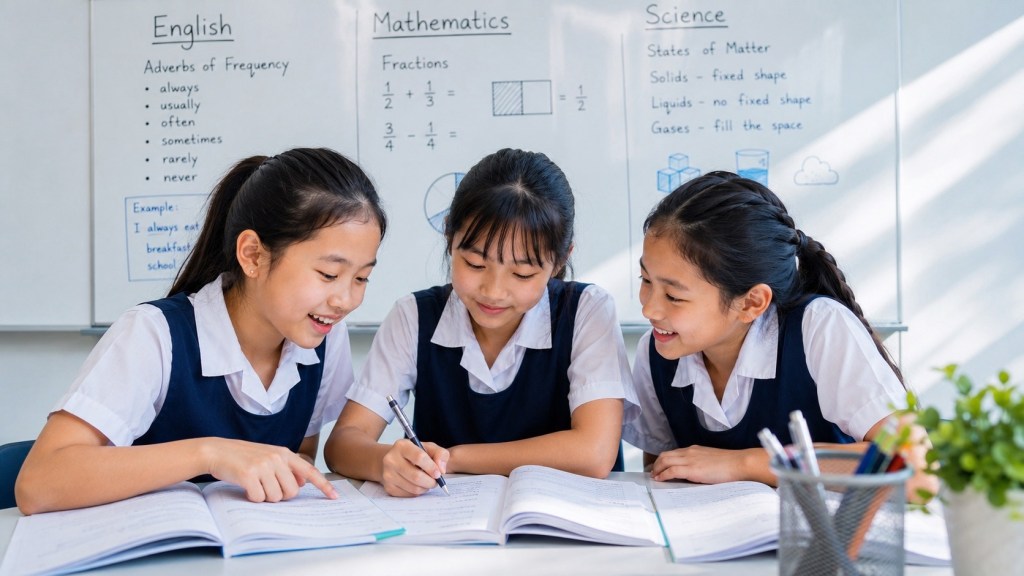
A Primary 6 pupil can remember that plants photosynthesise, friction opposes motion, food chains begin with producers and energy changes form—then still lose marks when all four ideas appear inside one unfamiliar question.
That happens because knowledge is not yet organised as a usable scientific model. The surface story changes, so the pupil searches for a familiar sentence. Stronger Science works the other way round: reconstruct the system first, then choose the concept that explains what changed.
This guide develops the concept-and-system layer of the Primary 6 Science Learning Hub. The examples and practice questions are original eduKate teaching material. They are not reproduced PSLE questions.
Quick answer: what does Primary 6 Science add?
Under Singapore’s 2023 Primary Science Syllabus, the P6 column includes four major areas: photosynthesis, energy conversion, interaction of forces, and interactions within the environment. PSLE Science from 2026 assesses attainment in the 2023 syllabus, so earlier Primary Science knowledge also remains part of the course.
Official references: MOE 2023 Primary Science Syllabus · SEAB PSLE Formats Examined in 2026.
The most useful summary is therefore not “learn four new chapters”. It is:
P6 Science = connect earlier systems + add new interactions + track energy + explain change from evidence.
The scientific system before the scientific sentence
Before answering, identify five things:
- Objects: What organisms, materials, devices or moving objects are present?
- Conditions: What light, water, temperature, surface, force, food or environmental conditions matter?
- Interactions: What acts on what? What flows, pulls, pushes, transfers or is consumed?
- Change: What becomes faster, slower, warmer, stretched, more abundant, less abundant, produced or depleted?
- Evidence: What was observed, measured, compared or given?
Only after that should the pupil write the explanation. This is an eduKate reasoning routine rather than an official marking formula.
Primary 6 is cumulative: the earlier Science is still inside the new Science
Photosynthesis depends on plant structures, water, gases and light. Energy conversion can appear in electrical systems, moving objects and heating. Force questions may use measurements and fair-test design. Environment questions can depend on classification, life cycles, food relationships and changes over time.
A pupil who stores each chapter in a separate mental box has to guess which box to open. A pupil who stores relationships can recognise the same Science under a different surface.
| Earlier idea | P6 connection |
|---|---|
| Plant parts and functions | Leaves, roots and transport become part of the conditions for photosynthesis and survival. |
| Respiratory and circulatory systems | Respiration connects food to released energy for life processes. |
| Water | Water becomes both a material condition and a limiting environmental factor. |
| Light and heat | Light is an energy input for photosynthesis; heat and light remain forms of energy in conversion chains. |
| Electrical system | Electrical energy can be traced to light, heat, sound or kinetic effects. |
| Magnets | Magnetic force sits beside gravitational, frictional and elastic spring forces as another force interaction. |
Part I — Photosynthesis: do not memorise the word, reconstruct the process
MOE’s P6 Standard learning outcomes place emphasis on the idea that living things need energy from respiration to carry out life processes, that the Sun is our primary source of light and heat energy, that plants and animals obtain energy in different ways, and that pupils investigate the requirements for photosynthesis: water, light energy and carbon dioxide, with sugar and oxygen produced.
The crucial distinction is between making food and releasing energy from food.
Photosynthesis and respiration are not the same job
Photosynthesis produces sugar using light energy, carbon dioxide and water. Respiration releases energy from food so living things can carry out life processes. A plant therefore does not “photosynthesise to get energy directly for every activity”. It produces sugar through photosynthesis, and energy is released from food through respiration.
This distinction helps pupils avoid a common error: saying plants do not respire because they photosynthesise. Plants are living things. They need respiration as well.
Plants and animals obtain energy differently
Plants can make sugar through photosynthesis when the required conditions are available. Animals cannot photosynthesise; they obtain food by feeding on plants or other animals. In both cases, living things need energy released from food for life processes.
That gives a useful chain:
Sun → light energy → photosynthesis in plants → sugar/food → respiration → energy for life processes.
For animals, the food link may pass through one or more organisms before respiration releases usable energy.
Do not replace conditions with slogans
A pupil may say “plants need sunlight” without checking whether the question is actually testing light, water or carbon dioxide. Another may say “a plant needs air” when the relevant gas is carbon dioxide.
Primary 6 questions often isolate one requirement. The correct answer should identify the manipulated condition and the relevant outcome, not list every requirement automatically.
Example: two identical plants under different light conditions
Plant A receives light. Plant B is kept in darkness. Both receive the same amount of water and are exposed to air. After a suitable period, evidence of sugar production is tested.
The scientific comparison is not “Plant A grows better because light is good for plants.” The tighter model is:
- Light energy differs between the two setups.
- Water and carbon dioxide are available to both.
- Photosynthesis requires light energy.
- Plant A can photosynthesise under the stated conditions; Plant B lacks that required input.
- The expected evidence should therefore differ in a way connected to sugar production.
Notice that the reasoning starts from the controlled comparison, not from a memorised paragraph.
Example: a leaf is partly covered
When part of a leaf is covered while the rest receives light, the important comparison is within the same leaf. The covered region and exposed region share many conditions, while light exposure differs. The strength of this design is that it helps isolate the effect of light on photosynthesis.
A pupil should still check what was measured. If the question asks about starch evidence, answer in terms of the test result and what it indicates; do not jump straight to unrelated claims about plant height or oxygen volume unless those were measured.
Photosynthesis misconception clinic
- Misconception: Plants get food from soil. Repair: Roots take in water and mineral salts; plants produce sugar through photosynthesis under the required conditions.
- Misconception: Plants only respire at night. Repair: Respiration is needed by living cells for life processes. Photosynthesis depends on light; respiration is a different process.
- Misconception: Oxygen is an input for photosynthesis. Repair: In the P6 photosynthesis model, carbon dioxide and water are used with light energy, and oxygen is produced.
- Misconception: More light always means proportionally more photosynthesis. Repair: Do not extend beyond the evidence. Other required conditions can limit the process.
- Misconception: If a plant does not grow, photosynthesis must have stopped completely. Repair: Growth is an outcome influenced by multiple processes and conditions. Use the evidence given.
Part II — Energy conversion: track forms, not labels
MOE’s P6 Standard learning outcomes include recognising that energy from most energy resources is derived in some way from the Sun, recognising forms such as kinetic, potential, light, electrical, sound and heat energy, and investigating conversion from one form to another.
The syllabus notes that specific terms such as chemical potential energy, gravitational potential energy and elastic potential energy are not required at this level. Pupils should therefore use the level-appropriate energy language expected by their school and syllabus.
The three-question energy routine
For any device or event, ask:
- What energy enters or is available at the start?
- What form appears next?
- What observable effect tells us the conversion occurred?
For example, a battery-powered toy car can be modelled as electrical energy in the circuit leading to kinetic energy of the moving car, with some energy also appearing as sound and heat. A lamp converts electrical energy into light and heat. A stretched spring can store potential energy that becomes kinetic energy when released.
Energy chains can have branches
Pupils often assume a conversion must be one-to-one. Real devices may produce multiple output forms. A speaker produces sound but can also warm slightly. A motor produces motion but may also produce sound and heat.
The question determines how much of the chain matters. If the task asks for the useful output, identify that. If it asks for energy changes, include the relevant forms supported by the setup.
Trace the Sun carefully
The Sun is a primary source of light and heat energy and is connected to many energy pathways. Plants capture light energy during photosynthesis. Animals obtain food energy through feeding relationships. Fuels can ultimately connect to past biological processes. Wind and water movement can also trace indirectly to solar heating of Earth’s surface and atmosphere, although the level of detail required depends on the syllabus and question.
The useful habit is not to force “Sun” into every answer. It is to understand that an energy chain can extend beyond the immediate device when the question asks for the larger source.
Example: torch
A torch has a battery, circuit and bulb. The observable result is light, and the bulb may also become warm. The appropriate chain can be described at Primary level as electrical energy → light energy + heat energy. If the question asks where the electrical energy came from, the battery is the immediate source in the device.
Example: falling object
An object held above the ground has potential energy. When released, it speeds up as it falls, so kinetic energy increases. The scientific explanation also involves gravitational force. This is a good example of two topic areas sharing the same event: energy conversion describes the changing energy forms, while forces describe the interaction that changes motion.
Energy conversion practice
Question 1. A wind-up toy is wound and then released. It moves and produces a clicking sound. State two energy forms observed after release.
Answer. Kinetic energy is associated with the toy’s motion, and sound energy is produced as it clicks. Heat may also be produced by friction, but include only what the question asks and what is reasonably supported.
Question 2. A solar garden light stores energy during the day and lights up at night. Why is it incorrect to say that the light “creates energy” at night?
Answer. The device converts energy from one form to another. Energy is not being created by the lamp; stored energy is converted into electrical and then light energy, with other outputs such as heat.
Part III — Forces: the interaction that changes motion or shape
MOE’s P6 Standard outcomes define a force as a push or a pull and include effects such as moving a stationary object, speeding up, slowing down or changing direction, stopping a moving object, and changing shape. The syllabus includes magnetic, gravitational, elastic spring and frictional forces.
It also states that objects have weight because gravitational force acts on them. Investigations include the effect of frictional force on motion and the effects of elastic spring force.
Force is not the same as motion
A moving object does not necessarily need a forward force continuously applied in the way pupils sometimes imagine. What matters is the pattern of forces acting and how motion changes. At Primary 6, the focus is on observable effects and appropriate force relationships rather than a full secondary-school treatment of net force.
A useful question is: What changed about the object’s motion or shape, and which interaction can account for that change?
Gravitational force and weight
Objects have weight because of gravitational force. When an object is released, gravitational force pulls it toward Earth. If the question shows an object supported on a table, the pupil should not conclude gravity has disappeared; the object still has weight.
Questions may compare identical objects in different circumstances. Unless the setup specifies a change affecting gravitational interaction, do not invent one.
Frictional force
Friction can slow motion and can differ with surface conditions. It is not simply “bad” or “wasted”. Walking, gripping and braking depend on friction. The scientific job is to identify how changing a surface or contact condition affects the outcome being measured.
MOE notes that the direction of frictional force for rolling objects such as wheels and balls is not required, and terms such as air resistance and water resistance are not required. This is a useful boundary: teach what the syllabus expects instead of importing unnecessary secondary-level detail.
Elastic spring force
A stretched or compressed spring can exert a force and change the motion of an attached or nearby object. Investigations often compare extension, compression, load or movement. Pupils should separate the amount of deformation from the resulting effect and identify what was actually measured.
Magnetic force returns
Magnets are introduced earlier but remain part of the force family. A magnet can exert a force without direct contact. This provides a useful contrast with friction, which depends on contact between surfaces.
Force investigation: the toy car ramp
A toy car rolls from the same starting point down a ramp onto different horizontal surfaces. The distance travelled on each surface is measured.
Before explaining, reconstruct the investigation:
- Changed condition: surface type.
- Measured outcome: distance travelled after the car reaches the horizontal surface.
- Important controls: same car, same ramp, same release point, same method of release and same distance-measurement method.
- Scientific relationship: different surfaces can produce different frictional effects on the moving car.
A weak answer says, “Rough surfaces have more friction.” A stronger answer connects the changed surface to the measured motion: the surface producing the greater frictional effect slows the car more, so it travels a shorter distance under otherwise comparable conditions.
Force misconception clinic
- Misconception: Heavy objects have no gravitational force when resting. Repair: Weight is due to gravitational force whether or not the object is moving.
- Misconception: Friction always makes objects move. Repair: Friction can oppose slipping and can slow motion; its role depends on the interaction.
- Misconception: A spring only exerts force when stretched. Repair: Elastic spring force can arise when a spring is stretched or compressed.
- Misconception: If two objects move the same distance, the same force must have acted. Repair: Motion depends on the whole setup and conditions. Use the evidence provided.
- Misconception: Motion itself is a force. Repair: Motion is a state/change being described; force is the push or pull interaction.
Part IV — Interactions within the environment: relationships, not a list of organisms
MOE’s P6 Standard outcomes include factors affecting survival—physical characteristics such as temperature, light and water; availability of food; and types of other organisms present. Pupils examine what happens when environments become unfavourable, understand energy pathways from the Sun through living things, and identify roles such as producers, consumers, predators and prey in food chains and food webs.
This is a systems topic. The question is rarely only “What is a producer?” It may ask what happens when one population changes, a resource decreases, an organism moves away, a habitat is altered or a physical condition becomes unfavourable.
Build the environment in layers
- Physical conditions: light, water, temperature and other environmental characteristics.
- Resources: food, shelter or access to necessary conditions.
- Organisms: producers, consumers, predators, prey and decomposers.
- Interactions: feeding, competition, dependence and environmental effects.
- Change over time: survival, reproduction, movement, decline or increase.
Food chains carry energy relationships
A food chain shows feeding relationships and an energy pathway from the Sun through living things. The arrow should be read according to the convention taught in school: from the food source to the organism obtaining energy from it.
A food web contains multiple connected food chains. Removing or reducing one organism can affect more than one pathway. This is why pupils should not predict change from a single pair without checking the whole web.
Producer, consumer, predator and prey are roles
The same organism can be both predator and prey in different relationships. A bird may eat an insect and be eaten by a larger predator. Labels therefore depend on the specific feeding relationship being examined.
Decomposers matter even when they are not the star of the diagram
Decomposers break down dead organisms and waste materials. Their role connects living systems to the cycling of materials. If a question includes dead matter or decomposition, do not ignore this route simply because the pictured food chain focuses on producers and consumers.
Environment case study: the school pond
A pond contains water plants, mosquito larvae, small fish, larger fish and decomposers. A period of heavy shade reduces light reaching the pond surface.
A careless answer might say, “All fish die because there is less light.” That leaps beyond the evidence. A better analysis asks:
- Which organisms directly depend on light for photosynthesis?
- How could reduced photosynthesis affect food availability or oxygen production?
- Which consumers depend on those producers or on organisms that depend on them?
- How long does the condition last?
- What evidence is actually given about population changes?
The key is to trace a plausible relationship while keeping certainty inside the question’s evidence.
Environment misconception clinic
- Misconception: Every animal in a food web is either predator or prey, never both. Repair: Roles depend on each feeding relationship.
- Misconception: Producers obtain energy from soil. Repair: Plants use light energy in photosynthesis to produce sugar under required conditions.
- Misconception: If one prey population increases, every predator must increase immediately. Repair: Population change depends on multiple factors and may involve time delays.
- Misconception: An unfavourable environment means every organism dies. Repair: Organisms may adapt and survive, move elsewhere or die, depending on the organism and conditions.
- Misconception: A food web tells us exact population sizes. Repair: A food web shows feeding relationships, not population counts unless data are provided separately.
Part V — The power comes from integration
PSLE questions can combine content because the world itself is connected. The strongest revision therefore includes mixed models.
Integrated example 1: plant under a lamp
A plant is placed under a lamp. The lamp is powered by a battery. The plant receives water and carbon dioxide. Over time, the battery becomes depleted.
Possible Science inside this single setup:
- Electrical energy in the circuit is converted to light and heat at the lamp.
- Light energy is a requirement for photosynthesis.
- The plant can produce sugar and oxygen when other required conditions are present.
- The plant still respires to release energy from food for life processes.
- If lamp distance or exposure time changes, an investigation may involve variable control and measurement.
One picture can therefore test energy, photosynthesis and inquiry without changing the underlying syllabus.
Integrated example 2: spring launcher and rough surface
A compressed spring launches a block across different surfaces.
- The spring stores potential energy.
- On release, energy is converted into kinetic energy of the block.
- Elastic spring force changes the block’s motion.
- Frictional force affects how quickly the block slows.
- Surface type can be the changed variable; distance travelled can be the measured outcome.
This is why memorising one sentence per force is not enough. The pupil must reconstruct the event.
Integrated example 3: food web after drought
A drought reduces available water. Some plants die, herbivore numbers later decrease, and a predator has fewer prey animals available.
- Water is a physical environmental factor affecting survival.
- Plants are producers and need water as a photosynthesis requirement.
- Reduced producer abundance can change food availability for consumers.
- Changes can propagate through a food web.
- Timing matters: not every population changes instantly.
The strongest answer follows the chain in the direction required by the question and stops when enough links have been supplied.
How many causal links are enough?
A Primary 6 explanation should be complete enough to show why the outcome follows, but not padded with unrelated facts.
Use this test:
Condition → process/interaction → immediate effect → asked-for outcome.
If the answer jumps from condition to outcome without showing the process, it may be incomplete. If it continues far beyond the requested outcome, it may become vulnerable to irrelevant or unsupported claims.
Example
Question: Why did the car travel a shorter distance on rough surface R than on smooth surface S?
Too short: “R has more friction.”
More complete: “The rougher surface produces a greater frictional effect on the moving car, causing it to slow down more quickly, so it travels a shorter distance before stopping.”
The answer connects condition, interaction, motion change and measured outcome.
Original mixed practice set
Question 1 — Photosynthesis
Two identical aquatic plants are placed in separate containers with equal amounts of water containing dissolved carbon dioxide. Plant X receives bright light; Plant Y receives very little light. Gas bubbles from the plants are counted for ten minutes. What is the changed variable?
Answer: The amount/intensity of light received by the plant, provided the setup genuinely changes that while keeping the other relevant conditions comparable.
Question 2 — Evidence
If Plant X produces more bubbles, can we conclude from bubble count alone that every bubble is oxygen?
Answer: Not unless the gas identity is established by the method or stated information. Bubble count is an observation; identifying the gas requires appropriate evidence.
Question 3 — Energy
A battery-powered fan produces moving air and sound. Name two energy forms present in the output.
Answer: Kinetic energy associated with motion and sound energy. Heat may also be produced, but do not list extra forms unless relevant.
Question 4 — Force
A spring is compressed further before launching the same toy car along the same track. What must a pupil be careful about before concluding that compression distance caused a longer travel distance?
Answer: Other relevant conditions should be kept comparable, including the same car, track, release method and measurement method. Otherwise another variable may explain the difference.
Question 5 — Environment
A food web shows grass eaten by rabbits and insects; insects are eaten by birds; rabbits and birds are eaten by hawks. If insect numbers decrease, can we immediately conclude hawk numbers must decrease?
Answer: No. Hawks also have rabbits as a food source in the stated web. A decrease in insects may affect birds, but the overall effect on hawks depends on the wider food availability and other conditions.
Question 6 — Integration
A plant grows beside a window. During several cloudy days, light levels are lower but water remains available. State the most direct P6 concept affected.
Answer: Photosynthesis, because light energy is a required condition. Any prediction about growth should still be made cautiously and in relation to the duration and other conditions.
Question 7 — Force and energy
A ball held above the floor is released. Name one force and one energy change involved.
Answer: Gravitational force acts on the ball. As it falls, potential energy is converted to kinetic energy.
Question 8 — Observation versus explanation
A graph shows that as surface roughness category increases, stopping distance decreases in the tested setup. Write an observation first, then an explanation.
Observation: The tested car travelled a shorter stopping distance on the rougher surfaces. Explanation: The rougher surfaces produced a greater frictional effect, causing the car to slow more quickly.
Question 9 — Food chain
In the chain grass → grasshopper → frog → snake, identify the producer and one predator-prey pair.
Answer: Grass is the producer. The frog is a predator of the grasshopper, and the grasshopper is its prey; alternatively, the snake is a predator of the frog.
Question 10 — Photosynthesis and energy pathway
Why can a rabbit’s energy ultimately be linked to the Sun when it eats grass?
Answer: Grass uses light energy from the Sun for photosynthesis to produce sugar. The rabbit obtains food by eating the grass, so the energy pathway can be traced back to the Sun.
Transfer test: change the surface, keep the Science
After solving a question, alter one surface detail and ask whether the same concept still applies.
- Change a toy car to a sliding block: does friction still matter?
- Change a potted plant to an aquatic plant: do photosynthesis requirements still matter?
- Change a forest food web to a pond food web: do producer-consumer relationships still matter?
- Change a torch to a buzzer: does energy conversion still matter?
If the pupil can recognise the relationship after the nouns change, the concept is becoming transferable.
A concept reconstruction notebook
Instead of copying notes, give each P6 concept one page with six boxes:
- Definition or core idea.
- Conditions.
- What changes.
- Evidence that would show it.
- Common wrong explanation.
- One unfamiliar example.
For friction, the unfamiliar example could be shoe grip rather than a toy car. For photosynthesis, it could be an aquatic plant rather than a leaf. For environmental interactions, it could be a mangrove rather than a pond.
Retrieval without losing relationships
Pure flashcard recall can help with terms, but Primary 6 requires relation recall. Ask questions such as:
- What three requirements are investigated for photosynthesis?
- How is photosynthesis different from respiration?
- How can one event involve both force and energy?
- What makes a producer different from a consumer?
- Why can a predator also be prey?
- What physical environmental factors can affect survival?
- How can a changed surface influence motion through friction?
- Which energy forms can appear when electrical energy is used in a device?
Then immediately ask for a new context. Retrieval becomes stronger when it is followed by reconstruction.
What parents can listen for
A child who understands the concept should be able to explain relationships with precise nouns and verbs.
- “Light energy is required for photosynthesis” is stronger than “plants like light”.
- “The rougher surface produces a greater frictional effect and the car slows more quickly” is stronger than “rough means slow”.
- “The organism has less food available” is stronger than “the ecosystem is unbalanced” when the question asks for a specific causal link.
- “Electrical energy is converted to light and heat energy” is stronger than “the bulb uses electricity”.
Ask, “What changed?” and “What caused that change?” before correcting vocabulary. This reveals the model underneath the sentence.
What teachers can diagnose
If a pupil gives the wrong answer, locate the first failure:
- Did the pupil identify the wrong object?
- Did the pupil miss a stated condition?
- Did the pupil choose the wrong interaction?
- Did the pupil confuse process with outcome?
- Did the pupil know the concept but overclaim beyond the evidence?
- Did the pupil use a memorised sentence that belongs to a different question job?
The correction should target that first failure, then retest with a new surface example.
Bridge to investigations
Concept knowledge becomes much more reliable when pupils can test it. If light matters for photosynthesis, how would you isolate light? If surface type affects motion through friction, what should be changed and what should be measured? If a claim about spring compression is made, what comparison would support it?
That is the next guide’s job.
Continue the Primary 6 Science Learning Guide series
- Guide 2: Investigations, Variables, Fair Tests & Method
- Guide 3: Data, Graphs, Diagrams & Evidence
- Guide 4: PSLE Questions, Explanations, Error Analysis & Revision
Return to the Primary 6 Science Learning Hub or the wider Primary Science Guide.
The quiet return
Primary 6 Science becomes less fragile when the pupil stops asking, “Which chapter is this?” and starts asking, “What system is here, what condition changed, what interaction follows, and what evidence shows the effect?”
Learn the concept. Rebuild the system. Change the surface. Make the Science survive.
