
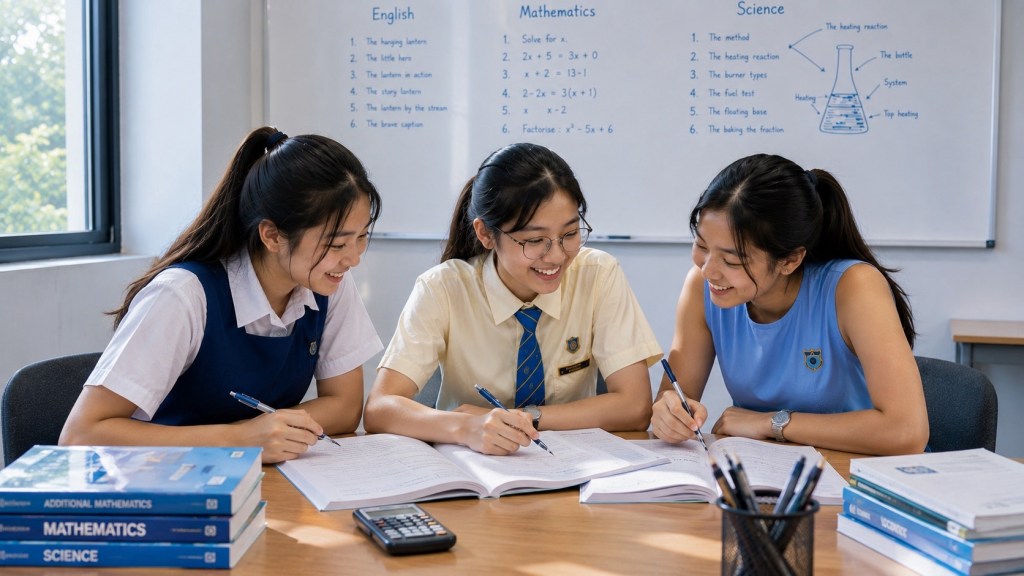
PG1 for Secondary Schools means Posting Group 1, one of the admission groupings used to facilitate entry into Secondary 1 under Singapore’s Full Subject-Based Banding system. PG1 is not a Mathematics subject level. It is an admission route that helps guide the learner’s starting subject profile.
For Secondary 1 Mathematics, the practical question after posting is not simply “My child is PG1 — what Mathematics do they take?” The useful question is: what level of Mathematics is the learner actually taking? A PG1 learner may begin Mathematics at G1, may be eligible for a more demanding level under the applicable criteria, or may later adjust subject level as school evidence and readiness change.
This guide explains what Posting Group 1 means for Secondary 1 Mathematics, why PG1 is not the same as G1 Mathematics, what parents should check after posting, and how to support the actual mathematical learner rather than the admission label.
The Short Answer: What Is PG1?
PG1 stands for Posting Group 1. Posting Groups are used to facilitate Secondary 1 admission. Under Full Subject-Based Banding, students can take subjects at G1, G2 or G3 according to their strengths, interests, needs and the school’s subject-level arrangements.
The simplest way to keep the terms straight is:
- PG1: Secondary 1 admission route.
- G1 Mathematics: Mathematics at General 1.
- G2 Mathematics: Mathematics at General 2.
- G3 Mathematics: Mathematics at General 3.
- Student profile: the learner’s actual combination of subject levels.
Once the learner enters school, the actual Mathematics level tells us far more about what should be taught than the Posting Group alone.
PG1 Is Not G1 Mathematics
This distinction is essential.
Posting Group 1 describes admission. G1 Mathematics describes an individual subject level. A PG1 learner may start Mathematics at G1, but PG1 itself is not a Mathematics syllabus.
Full Subject-Based Banding separates these ideas so that a learner’s strength in one subject can be recognised independently of the overall posting route.
A more useful description than “PG1 student” is therefore: “The learner entered through PG1 and is currently taking Mathematics at G1,” or whatever the actual subject-level combination is.
There Is No Separate “PG1 Mathematics” Syllabus
Mathematics is organised by G1, G2 and G3 subject levels. PG1 is not a fourth level.
For parents, the first Mathematics question after Secondary 1 posting should be:
What Mathematics level is my child actually taking?
That answer determines which syllabus demand, school materials, assessments and support should guide the learner.
What Mathematics Can Look Like for a PG1 Learner
Mathematics at G1
The learner builds fundamental mathematical knowledge and skills with strong emphasis on meaningful application, confidence and real-world use.
Read: What is G1 for Secondary Schools | Sec 1 Mathematics.
Mathematics at a More Demanding Level
Students entering through Posting Groups 1 and 2 may be eligible to take Mathematics and selected other subjects at a more demanding level when the applicable criteria are met. Parents should always check the learner’s actual Secondary 1 subject offer and the current cohort rules.
If Mathematics is a relative strength, the teaching should respond to that strength rather than assume the Posting Group sets a permanent ceiling.
The Secondary 1 Mathematics Transition Still Matters
Whatever the Posting Group, Secondary 1 Mathematics introduces a new symbolic environment. Students encounter more algebra, negative numbers, relationships, graphs, formal geometry and multi-step reasoning.
- letters stand for quantities;
- operations must be interpreted structurally;
- equations represent relationships;
- diagrams contain mathematical constraints;
- graphs represent change and connection;
- data requires interpretation;
- answers should be checked against context.
A PG1 learner who struggles does not necessarily need “more practice” in the broad sense. The learner needs the exact first weak link identified.
Three Common PG1 Mathematics Profiles
Profile 1 — Foundation Repair
The learner has gaps in number facts, fractions, ratio, percentage, units or multi-step problem-solving. These gaps interfere with Secondary 1 algebra and application.
The correct response is targeted repair. Repeating whole years of primary material wastes time and can damage confidence.
Profile 2 — Mathematics Is a Relative Strength
The learner entered through PG1 because of the overall posting profile, but Mathematics may be stronger than the other subjects. This learner may already be taking Mathematics at a more demanding level or may later become ready for one.
The teaching should match the actual Mathematics level and evidence, not the admission shorthand.
Profile 3 — Rapid Secondary-School Growth
Some learners improve quickly after the transition. Better maturity, better routines, stronger teaching and a clearer sense of purpose can change mathematical performance significantly within a year.
Full Subject-Based Banding is designed so that the programme can respond when the evidence changes.
How to Read a PG1 Learner’s Mathematics Work
Posting Group tells us almost nothing about the exact reason a Mathematics answer is wrong. The working tells us much more.
- Did the learner understand the question?
- Was the correct quantity identified?
- Was a suitable representation chosen?
- Were arithmetic facts available quickly enough?
- Were negative signs handled correctly?
- Were units kept visible?
- Did the learner know why each step was valid?
- Was the final answer checked?
These questions turn “weak at Maths” into something teachable.
Our First-Principles Method: Teach the Mathematical Learner
1. Confirm the actual Mathematics level
We first establish whether the learner is taking Mathematics at G1, G2 or G3. PG1 alone is not enough information.
2. Diagnose the first weak link
We trace errors to their earliest cause: number facts, fractions, representation, notation, operation, algebraic meaning, geometry property or checking.
3. Fence the target skill
Using our Fencing Method, surrounding complexity is reduced so the learner can see and practise the target idea successfully.
4. Connect procedure to meaning
We do not want a learner who can copy a method only when the worksheet looks familiar. We connect the procedure to the quantity, relationship or property that justifies it.
5. Retrieve after delay
Important skills return later. If the learner can use them after time has passed, the mathematics is becoming accessible from memory rather than dependent on immediate imitation.
6. Transfer into new contexts
The same mathematical structure appears in a different question form. This teaches the learner to recognise relationships rather than memorise layouts.
7. Adjust challenge based on evidence
When the learner is secure, complexity increases. When the learner is overloaded, we isolate whether the problem is prerequisite knowledge, subject level, workload or inefficient process.
What Progress Looks Like for a PG1 Mathematics Learner
- starts questions with less hesitation;
- shows working more clearly;
- makes fewer repeated arithmetic errors;
- handles negative signs more reliably;
- uses algebraic symbols with less confusion;
- keeps units and labels visible;
- recognises unreasonable answers;
- can explain a method in words;
- needs less prompting to choose a strategy;
- shows readiness for greater complexity when appropriate.
PG1 and the 2027 SEC
Posting Groups are not SEC subject levels. From 2027, students sit the Singapore-Cambridge Secondary Education Certificate in subjects at G1, G2 or G3.
A learner who entered secondary school through PG1 therefore does not sit a “PG1 Mathematics” examination. The learner sits Mathematics at the actual subject level being taken.
- PG1 describes admission.
- G1/G2/G3 describe subject levels.
- SEC records the subject and level actually sat.
Parents should use the current SEAB SEC overview and MOE Full SBB guidance for the learner’s cohort.
Frequently Asked Questions
What does PG1 mean?
PG1 means Posting Group 1, an admission grouping used to facilitate Secondary 1 posting under Full Subject-Based Banding.
Is PG1 the same as G1 Mathematics?
No. PG1 is an admission grouping. G1 Mathematics is a subject level.
Does a PG1 learner have to take Mathematics at G1?
Not necessarily. Students in Posting Groups 1 and 2 may be eligible to take selected subjects, including Mathematics, at a more demanding level when the relevant criteria are met. Check the actual school offer for the learner’s cohort.
Can the Mathematics level change later?
Subject levels can be reviewed according to school guidance, learner progress, strengths and needs.
What should I tell a Mathematics tutor?
Tell the tutor the learner’s actual Mathematics subject level, recent school topics, recent assessment work and repeated error patterns. PG1 alone is not enough to plan precise support.
Helpful Reading
- What is G1 for Secondary Schools | Sec 1 Mathematics
- Secondary G1, G2 and G3 Mathematics: Algebra, Problem Solving and the Secondary Reset
- Secondary 1 Mathematics: Why the Primary 6 to Algebra Transition Feels Hard
- MOE Full Subject-Based Banding
- SEAB Singapore-Cambridge Secondary Education Certificate
PG1 and Secondary 1 Mathematics: Teach the Level, Not the Label
PG1 tells us how the learner entered Secondary 1. It does not tell us everything about the learner’s Mathematics and does not impose a permanent ceiling.
The useful sequence is simple: confirm the actual Mathematics level, diagnose the first weak link, rebuild meaning, stabilise reliable working, transfer the skill into new problems and increase the challenge when the evidence supports it.
At eduKate Sengkang, we teach the mathematical learner in front of us rather than the admission shorthand.
Contact eduKate Sengkang if you want help interpreting your child’s Secondary 1 Mathematics profile and identifying the next useful step.
