
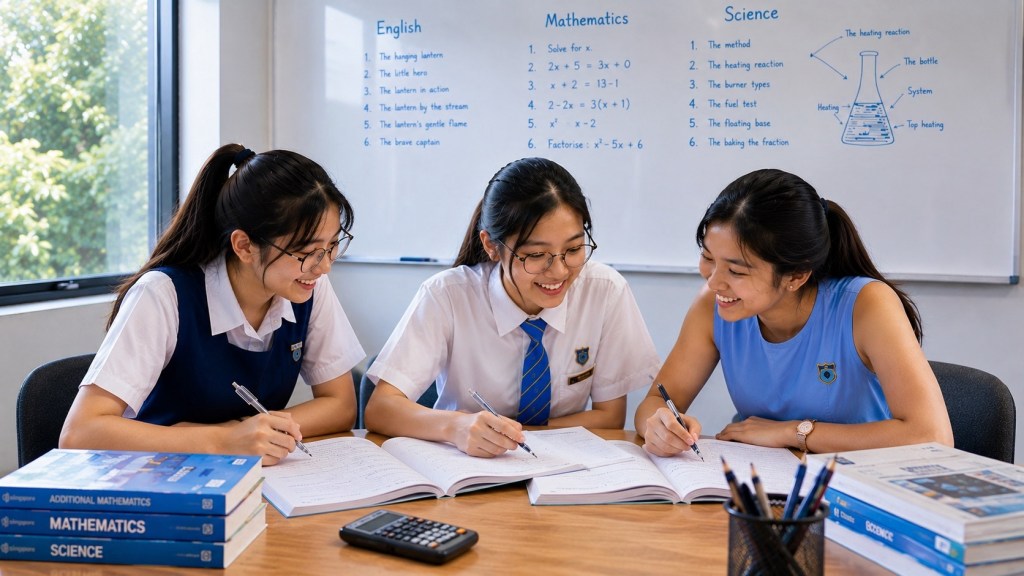
G3 for Secondary Schools is the most demanding of the three General subject levels used under Singapore’s Full Subject-Based Banding system. For a Secondary 1 learner taking Science at G3, the label describes the level of scientific thinking, content and application expected in that subject. It does not define the learner’s intelligence, future potential or level in every other subject.
Secondary 1 G3 Science is a transition from learning science mainly as a collection of primary-school topics into learning science as a way of explaining the natural and physical world. Students must observe carefully, use evidence, distinguish variables, read tables and graphs, connect cause and effect, explain mechanisms, evaluate claims and communicate conclusions precisely.
This guide explains what Secondary 1 G3 Science means, how lower-secondary Science differs from the later SEC Science combinations, how G3 differs from G1 and G2, why G3 Science is not the same as Posting Group 3, and how parents can recognise genuine scientific progress rather than simple worksheet familiarity.
The Short Answer: What Is G3 Science?
G3 means General 3. Under Full Subject-Based Banding, G1, G2 and G3 are levels for individual subjects. A learner may therefore take Science at G3 while taking another subject at G2 or another appropriate level.
- G3 Science is a subject level.
- It is not the same as Posting Group 3.
- It does not mean the learner is automatically strong in every branch of Science.
- It does not remove the need for experimental skill, careful reading or mathematical accuracy.
- It should be judged by what the learner can explain, test, infer and apply.
The useful question is not “Is my child a G3 student?” It is: what scientific ideas can my child understand, explain with evidence and transfer into a new situation?
Lower Secondary G2 and G3 Science: A Common Foundation
MOE’s lower-secondary Science curriculum for G2 and G3 is designed around a shared scientific foundation. At Secondary 1 and Secondary 2, students build core ideas and the Practices of Science before upper-secondary subject combinations become more specialised.
This matters because a Secondary 1 learner should not be treated as if they are already studying a full upper-secondary Physics, Chemistry or Biology course. The lower-secondary job is broader: learn how scientific knowledge is built, how evidence is collected, how models explain phenomena and how conclusions should be limited by the quality of the evidence.
Read the wider transition guide: From PSLE to Secondary Science G1, G2 and G3: A Parent Guide.
Why Secondary 1 Science Feels Different From Primary Science
Primary Science gives students an important base of observations, concepts and applications. Secondary 1 raises the level of explanation.
- Students meet more specialised scientific vocabulary.
- Diagrams carry more information.
- Experiments require clearer control of variables.
- Graphs and tables become more central.
- Explanations need mechanisms rather than one-word causes.
- Claims must be tied to evidence.
- Measurements must include units and sensible precision.
- Students need to distinguish observation from inference.
The student is no longer only asked what happened. Increasingly, the student is asked why it happened, how we know, what evidence supports the explanation and what would make the conclusion stronger or weaker.
The Core G3 Science Capabilities
1. Observation Before Explanation
Science begins by separating what was actually observed from what was inferred. “The solution turned blue” is an observation. “A certain substance is present” may be an inference based on that observation and a known test.
Students who mix observation and inference too early often write conclusions that are stronger than the evidence allows.
2. Variables and Fair Tests
A scientific investigation becomes meaningful only when the learner can identify what is changed, what is measured and what should be kept controlled.
- Independent variable: what is deliberately changed.
- Dependent variable: what is measured or observed.
- Controlled variables: what must be kept sufficiently constant for the comparison to be fair.
At G3, students should move beyond memorising these labels and understand why poor variable control weakens a conclusion.
3. Evidence and Inference
Science questions often require students to move from evidence to explanation. The learner needs to know how far the evidence allows the conclusion to go.
A useful structure is:
- state the evidence;
- identify the relevant scientific principle;
- connect the evidence to the principle;
- state the conclusion at an appropriate level of certainty.
This protects against answers that sound scientific but are not actually supported.
4. Models
Science uses models because many important processes cannot be observed directly. Particle models, systems diagrams, force diagrams and biological representations simplify reality so relationships become easier to reason about.
A strong G3 learner understands both what a model explains and what it leaves out. Models are useful representations, not perfect copies of reality.
5. Measurement and Data
Measurements are not just numbers. They have units, limitations and uncertainty. Students should learn to choose suitable instruments, record values sensibly and interpret patterns rather than merely copy data into a table.
- record units consistently;
- identify anomalous values cautiously;
- describe trends without exaggeration;
- distinguish correlation from proven causation;
- avoid inventing precision beyond the measuring instrument;
- compare repeated readings where appropriate.
Scientific Vocabulary: Precision Matters
Science has everyday words that acquire specialised meanings. Students who rely on conversational meaning can lose marks even when they understand the broad idea.
Examples include words such as force, work, energy, solution, organism, medium, concentration, diffusion, variable and accuracy. The learner must use each word according to its scientific meaning.
Vocabulary learning therefore needs more than definitions. Students should connect the word to diagrams, examples, non-examples, measurements and explanations.
Science Is a Reading Subject Too
Many G3 Science errors begin with language rather than science. A learner may know the concept but misread a command word, skip a condition or answer a different question.
- State: give the required fact or result.
- Describe: report what is shown or observed.
- Explain: connect cause, principle and effect.
- Compare: identify similarities and differences using a common basis.
- Suggest: propose a scientifically reasonable answer supported by the context.
- Calculate: use the relevant relationship, working and units.
Students should learn to translate each command into a response job before writing.
Science Is a Mathematics Subject Too
Scientific reasoning often depends on Mathematics: ratios, graphs, averages, rates, percentage change, units, scale and proportional relationships. A learner can therefore appear weak in Science when the real bottleneck is mathematical representation.
Strong teaching makes that dependency visible. If a student cannot interpret a graph gradient, compare rates or convert units reliably, we repair the mathematical link rather than simply assign more Science questions.
A G3 Science Answering Runtime
- Decode: what exactly is the question asking?
- Locate: what information, diagram or data matters?
- Recall: which scientific principle applies?
- Connect: how does the principle explain the evidence?
- Write: answer at the right depth.
- Check: did you answer the command word, include units and avoid unsupported claims?
The purpose is not to make answers formulaic. It is to make reasoning visible enough that the learner can control it under pressure.
How G3 Science Differs From G1 and G2
All three subject levels develop scientific literacy. The difference lies in the level of complexity, abstraction, independence and precision expected.
- G1 Science: builds foundational scientific understanding and practical application.
- G2 Science: increases depth, evidence use, explanation and quantitative reasoning.
- G3 Science: increases abstraction, precision, model use, experimental reasoning and transfer further.
The learner should be challenged at a level where scientific understanding can still grow reliably.
Read the existing guides: What is G1 for Secondary Schools | Sec 1 Science and What is G2 for Secondary Schools | Sec 1 Science.
G3 Science Is Not Posting Group 3
Posting Group 3 is used to facilitate Secondary 1 admission. G3 Science is a Science subject level. The two often occur together, but they are not synonyms.
Full Subject-Based Banding allows students to have mixed subject-level profiles. The educational question should therefore focus on the learner’s actual Science level and performance rather than the posting shorthand.
The Upper-Secondary SEC Science Endpoint
At upper secondary, G3 Science under the 2027 SEC is offered through paired Science combinations. SEAB lists K326 Science (Physics, Chemistry), K327 Science (Physics, Biology) and K328 Science (Chemistry, Biology) for G3 school candidates.
This is a future endpoint, not a reason to force a Secondary 1 learner into premature specialisation. Lower-secondary Science should build the scientific habits that later make Physics, Chemistry and Biology intelligible: evidence, measurement, models, explanation, data and careful experimental thinking.
Use the official SEAB 2027 G3 syllabus listing whenever examination-year details matter.
Three Secondary 1 G3 Science Pathways
Repair Hidden Foundations
A high-performing learner may still have one weak foundation: graph reading, units, proportional reasoning, experimental variables, scientific vocabulary or explanation structure. Intelligence can hide these gaps temporarily.
Repairing them early prevents later Physics, Chemistry or Biology topics from becoming unnecessarily difficult.
Stabilise Scientific Reasoning
This learner knows the content but answers inconsistently. The student may forget units, overstate conclusions, describe when asked to explain, or ignore data that contradicts the expected answer.
The job is to make scientific reasoning repeatable.
Extend Through Depth
This learner is secure and needs challenge. Extension should include richer data, unfamiliar experiments, competing explanations, model limitations, quantitative reasoning and transfer across contexts.
Depth should arrive before volume.
Our First-Principles Method for G3 Science
1. Diagnose the first divergence
We trace the learner’s answer back to the earliest point where the reasoning stops matching the evidence. The final wrong statement may begin with a misread variable, unit, graph or command word.
2. Fence the target skill
Using our Fencing Method, surrounding complexity is reduced temporarily so the learner can master one scientific relationship or reasoning move before applying it in a larger context.
3. Make evidence visible
Students identify which observation, measurement or pattern supports each claim. This prevents science answers from becoming memorised paragraphs detached from the question.
4. Explain mechanisms
We move beyond naming a cause. The learner explains the process connecting cause to effect.
5. Retrieve after delay
Scientific vocabulary, concepts and experimental ideas return after time has passed. Retrieval reveals whether the learner can access them independently.
6. Transfer into unfamiliar contexts
The same principle appears in a different experiment, organism, material or physical situation. This is how science becomes transferable knowledge rather than chapter memory.
7. Calibrate conclusions
Students learn to say only what the evidence supports. A strong scientific answer is precise about certainty and limitation.
What Progress Looks Like
- distinguishes observation from inference;
- identifies variables correctly;
- reads tables and graphs more accurately;
- uses scientific vocabulary precisely;
- explains mechanisms instead of naming keywords;
- uses units consistently;
- connects evidence to conclusion;
- recognises limitations in an experiment;
- transfers concepts into unfamiliar contexts;
- checks whether the answer matches the command word.
Frequently Asked Questions
What does G3 Science mean?
It means Science is being taken at General 3, the most demanding of the three General subject levels under Full Subject-Based Banding.
Is G3 Science the same as PG3?
No. PG3 is an admission grouping. G3 Science is an individual subject level.
Does Secondary 1 G3 Science mean my child is already specialising in Physics, Chemistry or Biology?
No. Lower-secondary Science builds a broad scientific foundation. Upper-secondary Science later becomes more specialised through subject combinations and pathways.
What are the 2027 G3 SEC Science codes?
SEAB lists K326 for Science (Physics, Chemistry), K327 for Science (Physics, Biology) and K328 for Science (Chemistry, Biology).
How do I know whether Science tuition is helping?
Look for better evidence use, clearer experimental reasoning, more accurate graphs and units, stronger explanations, fewer memorised-but-misapplied phrases and greater independence with unfamiliar questions.
Helpful Reading
- What is G1 for Secondary Schools | Sec 1 Science
- What is G2 for Secondary Schools | Sec 1 Science
- From PSLE to Secondary Science G1, G2 and G3: A Parent Guide
- How to Write a Science Lab Report
- SEAB 2027 G3 Syllabuses for School Candidates
Secondary 1 G3 Science: Evidence Before Confidence
G3 Science becomes powerful when the learner can connect evidence, model, mechanism and conclusion. Knowing many facts helps, but the deeper skill is using those facts to explain a new situation without inventing more certainty than the evidence allows.
At eduKate Sengkang, we diagnose the first divergence, fence the target skill, make evidence visible, retrieve after delay and transfer scientific ideas into unfamiliar contexts. The goal is not merely to remember Science. It is to think scientifically.
Contact eduKate Sengkang if you want help reading your child’s Secondary 1 G3 Science work and identifying the next useful step.
