
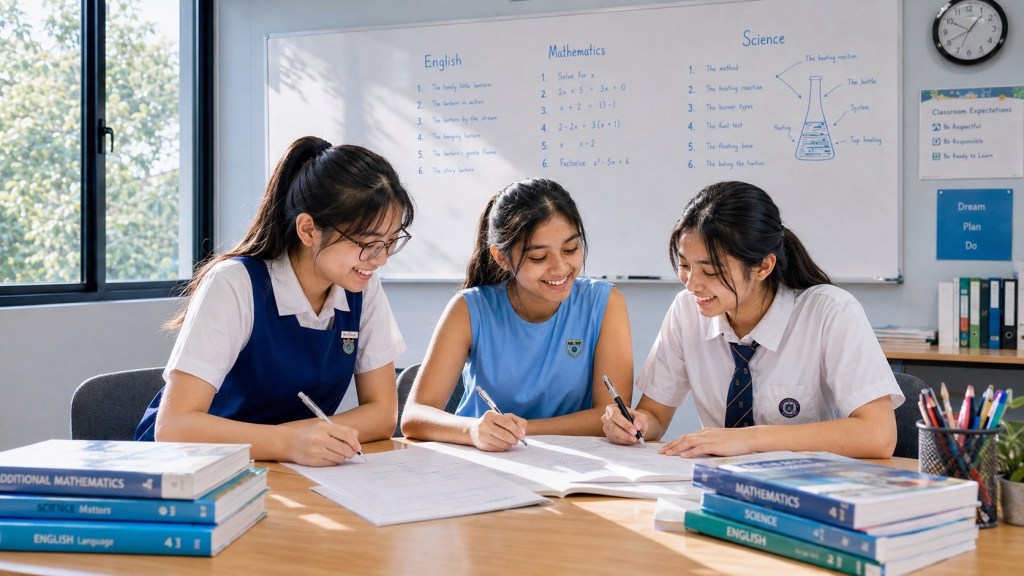
G2 for Secondary Schools is a subject level under Singapore’s Full Subject-Based Banding system. For a Secondary 1 learner taking Science at G2, the label describes the degree of scientific depth, abstraction and independence expected in that subject. It is not a stream, not a permanent identity and not a judgment about the learner’s ability in every other subject.
Secondary 1 G2 Science is a substantial transition from PSLE Science. Students meet more abstract models, more formal practical work, denser scientific vocabulary, more quantitative relationships, and a stronger expectation that they can interpret evidence without being told exactly which chapter to use.
This guide explains what Secondary 1 G2 Science means, how the G2/G3 lower-secondary Science framework is organised, how G2 differs from G1 and G3, why G2 Science is not the same as Posting Group 2, and how the later 2027 SEC G2 Science combinations fit the pathway.
The Short Answer: What Is G2 Science?
G2 means General 2. Under Full Subject-Based Banding, G1, G2 and G3 are individual subject levels. A learner can therefore take Science at G2 while taking Mathematics, English or another subject at a different level.
- G2 Science is a subject level.
- Posting Group 2 is an admission grouping.
- The learner may have a mixed subject-level profile.
- Lower-secondary Science builds a foundation before later specialisation.
- School evidence and readiness should guide future subject-level decisions.
The G2/G3 Lower Secondary Science Framework
MOE’s G2/G3 Lower Secondary Science syllabus is organised around broad ideas including Scientific Endeavour, Diversity, Models, Interactions and Systems. The framework gives students a coherent way to connect scientific knowledge rather than treating each chapter as a separate island.
Across the lower-secondary years, students encounter areas such as matter, separation, light, cells, forces, heat, chemical changes, ecosystems, electrical systems and human biological systems within that broader framework.
The exact school sequence can differ. Parents should therefore use the learner’s actual school scheme of work together with the official MOE G2/G3 Lower Secondary Science syllabus.
Why Secondary 1 G2 Science Feels Different
Primary Science often gives students familiar contexts and clear topic boundaries. Secondary 1 begins to blur those boundaries.
- models become more abstract;
- scientific terms have tighter definitions;
- measurements and units matter more;
- graphs and tables carry more of the reasoning;
- experiments require more precise control of variables;
- questions mix knowledge and interpretation;
- students need stronger independent correction routines.
Read the transition guide: From PSLE to Secondary Science G1, G2 and G3: A Parent Guide.
The Core G2 Science Capabilities
1. Scientific Models
Students increasingly reason through models: particle models, cell models, force representations, ray diagrams, circuit representations and system diagrams.
A useful learner should be able to answer:
- What does this model represent?
- What relationship does it make visible?
- What prediction does the model allow?
- What limitation does the model have?
2. Experimental Reasoning
Students need more than memorised language about “fair tests”. They must understand why a variable matters and whether the method can support the claimed conclusion.
- identify the investigative question;
- distinguish independent and dependent variables;
- identify important controlled conditions;
- choose relevant measurements;
- recognise sources of error;
- judge whether the evidence supports the conclusion.
3. Representation Translation
The same scientific idea may appear as prose, diagram, graph, table, equation or experimental result. G2 learners need to move between these representations.
- describe a graph in words;
- draw a process from a paragraph;
- turn a data table into a trend statement;
- connect a diagram to an underlying model;
- interpret units before using numbers.
4. Mechanism-Based Explanation
A strong Science answer does not merely state that something happens. It explains why.
A useful structure is:
- identify the relevant scientific idea;
- describe the mechanism or relationship;
- connect it to the evidence in the question;
- state the resulting effect precisely.
5. Quantitative Discipline
Secondary Science increasingly uses numerical relationships. Students need to know what a number represents before manipulating it.
- identify the physical quantity;
- track units;
- read graph scales;
- substitute carefully;
- interpret the result in scientific terms.
How G2 Science Differs From G1 and G3
The subject levels share scientific inquiry and literacy, but the degree of abstraction and depth differs.
- G1 Science: contextualised scientific literacy and practical application.
- G2 Science: stronger model use, disciplinary concepts, quantitative relationships and evidence-based reasoning.
- G3 Science: greater depth, abstraction, specialisation and disciplinary precision.
The correct level is the one in which challenge produces learning rather than chronic confusion.
G2 Science Is Not the Same as Posting Group 2
PG2 is used for Secondary 1 admission. G2 Science is a Science subject level. A learner entering through PG2 may take Science at G2, but the two terms are not interchangeable.
Likewise, a learner entering through another Posting Group may take Science at G2 where the applicable criteria and school arrangements support it.
- Posting Group describes entry.
- G2 describes subject level.
- School work describes actual performance.
- Progress informs the next learning decision.
Three Secondary 1 G2 Science Pathways
Repair
The learner may have a weak model, incomplete Primary foundation, poor graph reading, weak scientific vocabulary or confusion about experimental variables. New Secondary Science makes the old weakness visible.
The teaching job is to locate the first conceptual or process failure rather than repeat whole chapters indiscriminately.
Stabilisation
The learner understands lessons but performance varies. The causes may include incomplete explanations, unit errors, weak retrieval, careless graph reading or failure to connect evidence to a conclusion.
The job is to make scientific routines reliable.
Extension
A secure G2 learner should be challenged through deeper model reasoning, unfamiliar evidence, better experimental critique and stronger quantitative connections rather than simply receiving more worksheets.
Our First-Principles Method for G2 Science
1. Find the first divergence
We trace the learner’s reasoning to the first point where the scientific model, evidence or interpretation stops matching the question.
2. Fence the target concept
Using our Fencing Method, surrounding complexity is reduced so one scientific relationship can be understood clearly before it is returned to a mixed problem.
3. Connect words, diagrams and data
Students translate the same idea across several representations. This makes knowledge more flexible and less dependent on one memorised format.
4. Retrieve after delay
Models, vocabulary and processes return later. Retrieval exposes whether the learner can access the idea independently.
5. Interleave topics
Mixed Science questions force the learner to decide which model or concept applies. This is closer to real assessment and real scientific thinking.
6. Verify the conclusion
The learner checks whether the data actually supports the explanation, whether the units are correct and whether another interpretation fits the evidence better.
What Progress Looks Like
- uses scientific terms more precisely;
- identifies the relevant model before answering;
- reads graphs and units more carefully;
- explains mechanisms rather than repeating keywords;
- identifies variables for an investigation;
- recognises weaknesses in an experimental design;
- connects evidence to conclusions;
- moves between words, diagrams and tables;
- retrieves older ideas in mixed questions;
- needs less teacher prompting to identify the scientific job.
G2 Science and the 2027 SEC Endpoint
Secondary 1 G2 Science is part of the lower-secondary foundation. Later, the 2027 G2 SEC Science offerings are organised as combined disciplinary pairs: Science (Physics, Chemistry) K223, Science (Physics, Biology) K224, and Science (Chemistry, Biology) K225.
The lower-secondary years should therefore build the broad scientific habits that support later specialisation: models, evidence, measurement, practical reasoning, quantitative discipline and explanation.
Parents can use the current SEAB 2027 G2 syllabus listing for the official SEC offerings.
Frequently Asked Questions
What does G2 Science mean?
It means Science is being taken at General 2, one of the individual subject levels under Full Subject-Based Banding.
Is G2 Science the same as PG2?
No. PG2 is an admission grouping. G2 Science is a subject level.
What are the 2027 SEC G2 Science codes?
SEAB lists K223 for Science (Physics, Chemistry), K224 for Science (Physics, Biology), and K225 for Science (Chemistry, Biology).
Does a Secondary 1 learner already choose those SEC Science pairs?
Secondary 1 belongs to the lower-secondary foundation stage. The exact later subject options, timing and school arrangements should be checked with the learner’s school. The lower-secondary curriculum builds breadth before later specialisation.
What is the biggest transition from PSLE Science?
For many learners, the biggest shift is from recognising chapter-specific answer patterns toward reasoning with models, experiments, measurements, data and mixed-topic evidence.
Helpful Reading
- From PSLE to Secondary Science G1, G2 and G3: A Parent Guide
- Advanced Science Tutorials | How to Study Science Effectively
- AI for Science Study: Verification, Privacy and Academic Integrity
- SEAB 2027 G2 Syllabuses for School Candidates
Secondary 1 G2 Science: Learn the Model Behind the Answer
G2 Science becomes much easier to control when the learner understands the model, evidence and relationship behind the final sentence. Memorised keywords can help with recall, but scientific independence requires more: observe, represent, explain, test and revise.
At eduKate Sengkang, the educational Science estate uses a first-principles approach: diagnose the first divergence, expose the model, connect representations, retrieve after delay and test explanations against evidence. The aim is scientific control that travels into unfamiliar questions.
