
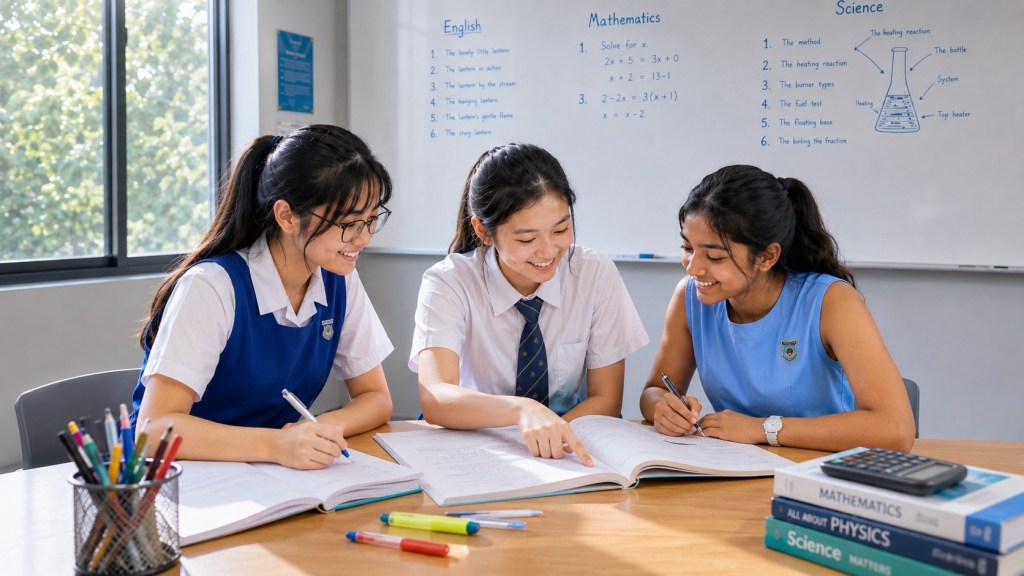
G1 for Secondary Schools is one of the three subject levels used under Singapore’s Full Subject-Based Banding system. For a Secondary 1 learner taking Science at G1, the label describes the level of Science learning and assessment. It does not define the learner’s intelligence, potential, overall school identity or level in every other subject.
Secondary 1 G1 Science is a transition from Primary Science into a more structured scientific system. Students continue to learn from real-world situations, but they are expected to measure more carefully, use scientific vocabulary more precisely, interpret diagrams and data, understand models, carry out practical reasoning and connect evidence to explanations.
This guide explains what Secondary 1 G1 Science means, how it differs from G2 and G3 Science, why G1 Science is not the same as Posting Group 1, what the lower-secondary curriculum is trying to build, and how the later 2027 SEC G1 Science pathway fits the picture.
The Short Answer: What Is G1 Science?
G1 means General 1. Under Full Subject-Based Banding, G1, G2 and G3 are levels for individual subjects. A student can therefore take Science at G1 while taking English, Mathematics or another subject at a different level.
- G1 Science is a subject level.
- It is not the same thing as Posting Group 1.
- It is not a permanent identity.
- It does not determine the level of every other subject.
- It can be reviewed as the learner’s readiness, progress and needs develop.
What G1 Lower Secondary Science Is Trying to Build
The official G1 Lower Secondary Science curriculum is designed around scientific literacy, practical understanding and meaningful contexts. It includes laboratory measurement and procedures and contextual modules such as machines, environment, body and health.
The important shift from Primary Science is not simply “more content”. The student increasingly needs to:
- measure accurately;
- read scales and units;
- follow laboratory procedures;
- distinguish observation from inference;
- interpret tables, diagrams and simple graphs;
- use evidence to support a conclusion;
- connect scientific ideas to everyday situations;
- explain cause and effect clearly.
Parents can use the official MOE G1 Lower Secondary Science syllabus for the curriculum framework.
Why Secondary 1 Science Feels Different After PSLE
Primary Science builds important habits of observation, explanation and evidence. Secondary Science keeps those foundations but increases the resolution.
- Scientific vocabulary becomes denser.
- Models are used to explain things that cannot be seen directly.
- Measurements and units matter more.
- Practical procedures become more formal.
- Students work with more representations.
- Questions increasingly mix ideas rather than announcing one chapter.
- The learner is expected to correct and organise work more independently.
Read the transition overview: From PSLE to Secondary Science G1, G2 and G3: A Parent Guide.
The Core G1 Science Capabilities
1. Measurement
Scientific measurement is not just reading a number. The learner must understand the quantity being measured, the instrument, the unit, the scale and the degree of precision the situation supports.
- identify the correct measuring instrument;
- read a scale carefully;
- record appropriate units;
- repeat measurements when useful;
- recognise obviously unreasonable values;
- distinguish measurement from interpretation.
2. Observation and Inference
An observation is what was detected or measured. An inference is an explanation based on evidence. Students often lose marks because they blur the two.
A strong learner can say, “The temperature increased by 6°C” as an observation, then separately explain what that change suggests about the process.
3. Scientific Models
A model is a simplified representation used to explain or predict. Models can be diagrams, physical representations or conceptual pictures.
The learner should ask:
- What does this model represent?
- What relationship does it show?
- What does it leave out?
- What prediction can be made from it?
4. Practical Reasoning
Practical Science should not become a recipe-following exercise. The student should understand the purpose of the method.
- What is being investigated?
- What is changed?
- What is measured?
- What conditions should be kept stable?
- What result would support the idea?
- What source of error could weaken the conclusion?
5. Scientific Explanation
A strong explanation links evidence to a mechanism. It does not simply repeat the question.
A useful structure is:
- state what happens;
- identify the relevant scientific idea;
- explain the mechanism;
- connect the mechanism back to the observed result.
G1 Science Is Not “Easy Science”
G1 is a less demanding subject level than G2 or G3, but it still requires genuine scientific thinking. Students must observe, measure, interpret, explain, communicate and apply.
Weak study reduces Science to memorising answers. Strong study builds a reusable process:
- identify the scientific idea;
- read the evidence;
- choose the relevant model;
- explain the mechanism;
- check whether the conclusion matches the evidence.
How G1 Science Differs From G2 and G3 Science
The subject levels differ in depth, abstraction, representation and expected independence.
- G1 Science: contextualised scientific literacy, practical competence and dependable explanation.
- G2 Science: greater abstraction, model use, quantitative work and scientific reasoning.
- G3 Science: deeper disciplinary understanding, more complex models, stronger quantitative reasoning and greater transfer.
The labels describe subject demand. They should not be turned into rankings of children.
G1 Science Is Not the Same as Posting Group 1
PG1 describes the learner’s Secondary 1 admission route. G1 Science describes the level at which Science is taken.
A learner entering through PG1 may take Science at G1, but Full Subject-Based Banding allows selected subjects to be taken at more demanding levels where the relevant criteria and school arrangements support it.
- Posting Group tells us about entry.
- Subject level tells us about current Science demand.
- Actual school work tells us what the learner understands.
- Progress tells us what should happen next.
Three Secondary 1 G1 Science Pathways
Repair
The learner may have weak Primary foundations in matter, energy, forces, systems, experimental variables, graph reading or explanation. Secondary Science makes these gaps more visible.
The job is to identify the exact missing concept or scientific process and repair it while keeping the learner connected to current school work.
Stabilisation
The learner understands the lesson but performance varies. The cause may be vocabulary, unit errors, weak graph reading, incomplete explanations or poor retrieval after a delay.
The job is to make good scientific routines repeatable.
Extension
A secure G1 learner should not be held in endless repetition. Extension can deepen explanation, model use, graph interpretation, practical reasoning and unfamiliar application.
Where sustained school evidence supports it, parents can discuss whether a more demanding Science level is appropriate.
Our First-Principles Science Method
1. Diagnose the first weak link
“Weak in Science” is too broad. The real problem may be vocabulary, a model misconception, practical reasoning, graph interpretation, a unit error or an incomplete explanation.
2. Fence the target skill
Using our Fencing Method, unrelated complexity is temporarily reduced so the target scientific idea can be understood cleanly before it is returned to more complex contexts.
3. Translate between representations
Students move between words, diagrams, tables, graphs and models. Translation builds deeper understanding because the learner cannot survive by memorising one familiar picture.
4. Retrieve after delay
Important vocabulary, concepts and models return after time has passed. Retrieval exposes whether the knowledge is genuinely available.
5. Interleave concepts
Mixed questions force the learner to decide which scientific idea is relevant instead of applying the chapter named at the top of the worksheet.
6. Check evidence against explanation
The learner asks whether the conclusion is actually supported by the observation, measurement or data given.
What Progress Looks Like
- uses scientific vocabulary more accurately;
- reads units and scales carefully;
- separates observation from inference;
- explains mechanisms rather than copying keywords;
- interprets tables and graphs with less prompting;
- recognises what a model represents;
- identifies variables in an investigation;
- connects evidence to conclusions;
- retrieves older concepts when a new question requires them;
- becomes more independent in correcting mistakes.
G1 Science and the 2027 SEC
For 2027 school candidates, SEAB lists G1 Science as K123. The SEC records the subject and the level at which it is taken; Posting Group is not the examination level.
A Secondary 1 learner is not yet sitting the final SEC examination, but the endpoint is useful because it shows why lower-secondary habits matter. Measurement, evidence, explanation, practical reasoning and scientific literacy are not temporary classroom techniques. They are the foundation of later Science performance.
Frequently Asked Questions
What does G1 Science mean?
It means Science is being taken at General 1, one of the three subject levels under Full Subject-Based Banding.
What is the 2027 SEC code for G1 Science?
SEAB lists G1 Science as K123 for 2027 school candidates.
Is G1 Science the same as PG1?
No. PG1 is an admission grouping. G1 Science is a subject level.
Can a learner move to a more demanding Science level?
Subject levels can be reviewed according to school guidance, progress and readiness. The decision should be based on sustained evidence rather than status.
What is the biggest Secondary 1 Science transition?
For many learners, the biggest shift is moving from chapter-specific recall toward model-based explanation, measurement, representation and evidence-based reasoning.
Helpful Reading
- From PSLE to Secondary Science G1, G2 and G3: A Parent Guide
- Advanced Science Tutorials | How to Study Science Effectively
- Advanced Science Tutorials | Science Homework Help for Parents
- SEAB 2027 G1 Syllabuses for School Candidates
Secondary 1 G1 Science: Build Scientific Control
G1 Science is a learning level, not a verdict. The learner’s job is to become increasingly capable of observing carefully, measuring accurately, using models, interpreting evidence and explaining what happens without constant rescue.
At eduKate Sengkang, the educational Science estate follows a first-principles approach: diagnose the first weak link, make the model visible, retrieve after delay, connect representations and use evidence to test explanations. The subject level tells us where the work begins. It does not decide where the learner must end.
