
Secondary Mathematics hints can either restart thinking or replace it. Parents searching for how to help with E-Math homework, what hint to give a stuck student, Mathematics scaffolding or tuition in Sengkang often face a difficult balance: too little support can leave the learner frozen, while too much support produces a correct answer that does not belong to the student.
The best hint is the smallest prompt that makes productive thinking possible again. It should target the exact stuck point: reading, representation, method selection, algebra, recall or working organisation. Once the student restarts, the support should fade quickly.
At eduKate Sengkang, this Advanced Mathematics Tutorials article owns hint-and-scaffold control. It complements the broader “I Don’t Know How to Start” owner and the Parent Homework Support guide.
Quick answer: what makes a good Mathematics hint?
A good hint identifies the next useful decision without supplying the full method or answer, and it disappears as soon as the student can continue independently.
- Ask the student to reread the final question.
- Ask what is known and unknown.
- Ask what type of mathematical object is present.
- Suggest a representation rather than a formula when appropriate.
- Point to the last secure line.
- Remind the student of a related simpler example.
- Reveal one missing fact only if retrieval is the bottleneck.
- After success, use a fresh question with less help.
The hint ladder: from lightest to strongest
Hint 1: attention cue
“Read the last sentence again.” No mathematical content is added.
Hint 2: structural question
“What are you trying to find?” or “What relationship do you see?”
Hint 3: representation cue
“Would a diagram or equation make this clearer?”
Hint 4: method-family cue
“This is a rate relationship.” The student still chooses the exact operation.
Hint 5: partial step
The tutor provides one intermediate relation, then returns control to the learner.
Hint 6: worked micro-example
A simpler analogous example is shown, not the original question itself.
Why immediate rescue is dangerous
If the student learns that pausing for ten seconds triggers a full explanation, productive struggle disappears. The learner becomes skilled at waiting rather than generating.
Support should therefore be contingent on evidence of a genuine stuck state, not simple discomfort.
How to tell what kind of hint is needed
- Cannot restate the problem: reading/interpretation hint.
- Understands story but cannot represent it: representation hint.
- Has representation but no method: method-family hint.
- Knows method but forgets a fact: retrieval hint.
- Has correct route but execution fails: algebra/calculation hint.
- Has error late in solution: return-to-last-secure-line hint.
Hints in Secondary 1
Lower-secondary students often need language and representation prompts while adjusting to algebra. A number line, labelled variable or simple balance question can be more useful than giving the equation directly.
Hints in Secondary 2
Secondary 2 students increasingly need method-discrimination prompts: expand or factorise, equation or graph, direct or inverse proportion. Contrast questions can reduce overdependence on tutor cues.
Hints in Secondary 3
Upper-secondary students may need help locating which dependency is failing: algebra, trigonometric side identification, graph interpretation or calculator execution.
Hints in Secondary 4
Final-year support should become more minimal. The tutor should imitate exam conditions by delaying intervention and using post-attempt diagnosis instead of live rescue for every problem.
The fade: support must shrink
- Full prompt
- Short prompt
- Question only
- Wait time
- Independent attempt
If the learner succeeds only at the same support level every week, tuition is creating assisted performance rather than independence.
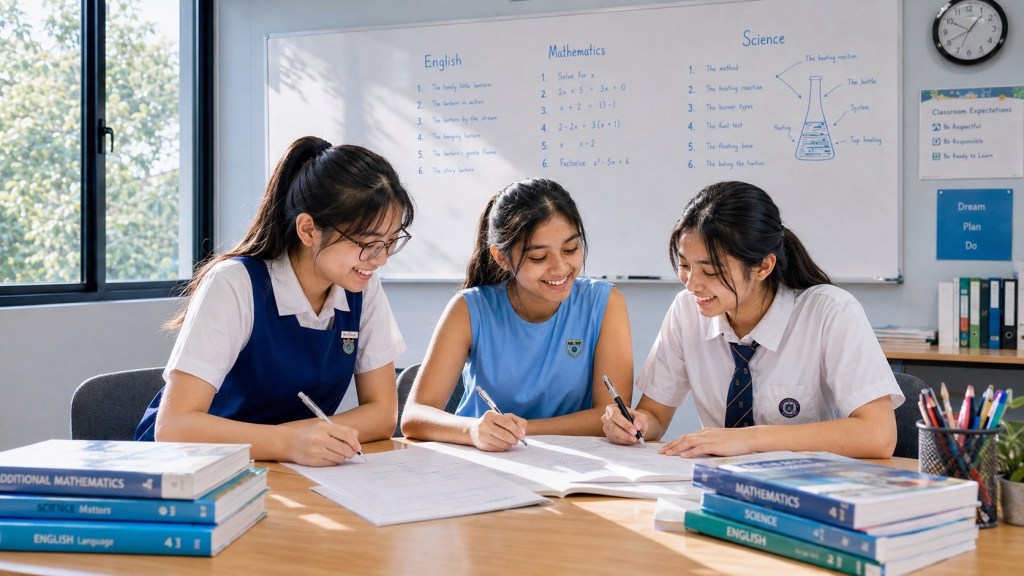
A three-student tutorial makes hint calibration visible
One student may need an attention cue while another needs a method-family prompt. A third may need no hint at all. In a small group, the tutor can vary support without changing the whole class pace.
How parents can use hints at home
- Wait before helping.
- Ask one question at a time.
- Avoid naming the operation immediately.
- Do not complete the next line for the child.
- After the child resumes, stop prompting.
- Use a fresh problem later to check whether the hint became learning.
Frequently asked questions
How long should a student struggle before getting a hint?
There is no universal timer. Look for productive activity: rereading, drawing, testing ideas. If the learner is cycling randomly or completely frozen, a light prompt is justified.
Are hints bad for strong students?
No. Strong learners also need occasional prompts, but the support should usually be lighter and focus on representation or strategy rather than content.
How do I know the hint worked?
The student should be able to continue beyond the hinted step and later solve a similar question with less or no support.
Where this hints guide sits in the Mathematics estate
Use the Worked Examples guide when more structured modelling is needed and the 3-Student Secondary Mathematics Tutorial guide for the broader small-group teaching mechanism.
Hint design should change by Secondary level
Secondary 1: support meaning before speed
Secondary 1 students often need prompts that reconnect symbols to quantities. A useful hint may ask what x represents, what equality means or where a negative number sits on a number line. Giving the next algebraic step too early can hide the real conceptual gap.
Secondary 2: prompt discrimination
Secondary 2 hints should increasingly ask students to distinguish between neighbouring methods: expand or factorise, equation or graph, direct or inverse proportion. The tutor’s question should help the student classify, not simply name the answer.
Secondary 3: identify the blocked dependency
At Secondary 3, a stuck problem may be caused by algebra, diagram reading, trigonometric side identification or calculator execution. The hint should target that dependency instead of reteaching the whole question.
Secondary 4: simulate exam independence
Final-year tutoring should use delayed support. Students attempt substantial sections without rescue, then the tutor analyses the stuck point afterwards. This protects the transition from assisted tuition performance to exam performance.
The hint-efficiency diagnostic
- Student restarts after an attention cue: support need is light.
- Student needs a representation cue: structure is not yet visible.
- Student needs the method family named: classification is weak.
- Student needs a partial step: prerequisite or sequencing is unstable.
- Student still cannot continue after a strong hint: concept repair may be required.
How to know support has faded successfully
The student begins the same question family with fewer prompts, can tolerate a longer pause before asking for help, and solves a fresh parallel problem independently. A good tuition system should show this trend over time rather than maintaining a fixed amount of tutor intervention.
A three-student hint protocol
In a three-student lesson, the tutor can wait differently for each learner. One student may receive only a question, another a diagram cue, and another a brief worked micro-example. The group stays on one mathematical theme while the support dose remains individual.
Cross-link: from hints to full independence
Use Worked Examples when modelling is still justified. Move toward Self-Explanation and Mixed-Topic Method Selection as support fades.
Continue through the Mathematics Learning Hub for routes by concept and level, the Complete Mathematics Index for the wider estate, or Mathematics Tutor Sengkang when the question is specifically about tutoring support.
