
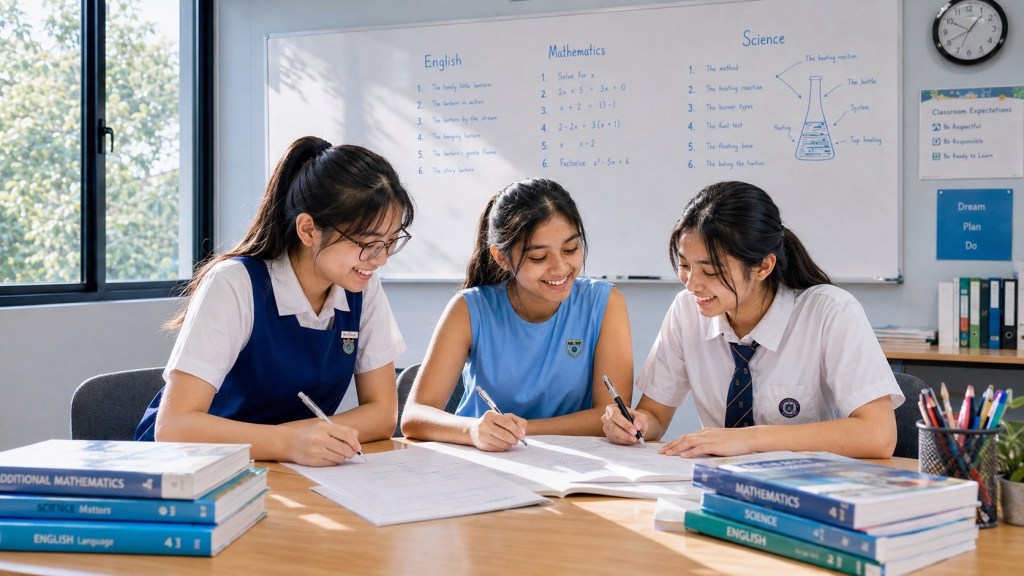
“I know this topic, but I don’t know how to start.” This is one of the most important Mathematics sentences a parent can hear. Searches for how to solve Mathematics word problems, how to start hard maths questions, problem-solving strategies, PSLE Mathematics help and Secondary Mathematics problem solving all point toward the same hidden skill: method selection.
A student can know multiplication facts, fractions, algebra, formulas and model drawing yet still freeze when a question arrives in an unfamiliar form. The missing knowledge is not always another formula. It is often a starting routine that turns a large problem into something the learner can inspect.
For Sengkang and nearby Punggol families, this matters from Primary 3 through PSLE and Secondary G1, G2 and G3 Mathematics. Tuition can add value when it makes the first decision visible: what is known, what is unknown, which relationship matters and what representation will make that relationship easier to see.
Problem-solving research and high-traffic Mathematics resources repeatedly emphasise representation, linking to prior learning, self-questioning and choosing operations from meaning rather than from surface keywords. The principle is simple: before a learner can calculate, the learner needs a route into the problem.
Quick answer: what should a student do when they do not know how to start?
Do not search for a formula first. Build the problem first.
- Read the final question and state exactly what must be found.
- List or mark the quantities that are known.
- Identify the relationship between those quantities.
- Choose a representation: bar model, diagram, table, number line, equation or labelled sketch.
- Ask which earlier topic or problem has the same underlying structure.
- Take one justified mathematical step.
- Check whether that step made the target closer or clearer.
Why students freeze
Freezing is often treated as a confidence problem, but the cause can be technical. The question may contain too much information, use unfamiliar wording or hide the operation behind a relationship the student has not yet represented.
A learner who has only practised blocked worksheets can also become dependent on chapter cues. If the heading says ‘Percentage’, the method is obvious. In a mixed paper, the learner must identify the percentage structure independently.
This is why a child can say, truthfully, ‘I know how to do it once I see the solution.’ Execution is available; selection is not.
The first move is not calculation
Students often believe good mathematicians calculate quickly. In difficult questions, strong solvers frequently spend more time before the first calculation.
They inspect the target, organise the data and choose a useful representation. The first mathematical act may be drawing, relabelling, estimating or rewriting.
This pre-calculation work reduces random trial-and-error.
Read the target before the story
In long word problems, reading from the beginning can overload working memory because the learner does not yet know which details matter.
One useful strategy is to read the final question early. If the problem asks for the number of remaining items, total cost, percentage change or unknown length, that target gives the earlier information a purpose.
Then reread the full problem and mark only information connected to that target.
Representation is the bridge
Representation converts language into structure. In Primary Mathematics, a bar model may reveal part-whole, comparison or ratio relationships. In Secondary Mathematics, an equation may compress the same relationship more efficiently.
Tables are useful when values change systematically. Number lines help with signed numbers, fractions and elapsed time. Diagrams support geometry. Graphs reveal relationships between variables.
The question is not ‘Which representation is correct?’ but ‘Which representation exposes the relationship most clearly?’
Do not teach keyword hunting
Keywords such as altogether, left, more, increase and per can be clues, but they are not reliable operation selectors.
The same word can appear in problems that require different operations. A student who memorises ‘more means add’ will eventually meet a comparison problem where addition is wrong.
Teach the relationship: total, difference, equal groups, rate, proportion, change or comparison.
Link to prior learning
When a new problem feels unfamiliar, ask what earlier problem shares its mathematical skeleton. The surface story may be new while the structure is old.
A taxi-fare problem may be a linear relationship. A recipe problem may be ratio. A discount problem may be percentage of a whole. A shaded-shape problem may be area subtraction.
This is transfer: using existing Mathematics in a new context.
One justified step is enough to restart
Students sometimes believe they must see the whole solution before writing anything. This creates paralysis.
Instead, require one justified step. Label the diagram. Find one unit. Write one equation. Convert one measurement. Calculate one intermediate quantity.
That step produces new information and often reveals the next move.
The plan-monitor-evaluate cycle
Good problem solving includes metacognition: planning, monitoring and evaluating.
Plan means choosing a route. Monitor means asking whether the route still makes sense. Evaluate means checking the result and the strategy after the problem is complete.
A learner who monitors can abandon an unproductive route before wasting half the paper.
What parents can ask instead of giving the first step
- What is the question asking for?
- What do you know already?
- What relationship do you see?
- Can you draw it?
- Can you make a table?
- What would one unit represent?
- Which earlier topic feels similar?
- What is one step you can justify?
- How will you know if the answer is reasonable?
These prompts preserve ownership. Telling the learner which formula to use may solve today’s question while weakening tomorrow’s independence.
Primary Mathematics examples
In Primary 2 and Primary 3, the first move may be identifying whether the situation is part-whole, comparison, multiplication or division. In Primary 4 and Primary 5, the learner may need to distinguish fraction, decimal, percentage or ratio structures.
By Primary 6, the strongest students can switch representations. A ratio problem might begin as units, move into a bar model and end with a percentage.
The aim is not to memorise every heuristic name. It is to build a flexible starting system.
Secondary Mathematics examples
In Secondary 1 and Secondary 2, unfamiliarity often comes from symbolic compression. A word problem must be translated into algebra before the familiar solving method becomes available.
In Secondary 3 and Secondary 4, students may need to combine algebra, graphs, geometry, trigonometry or statistics. The first move is therefore often classification: what mathematical relationship is present?
For G1, G2 and G3 learners, the level of abstraction differs, but the starting discipline is shared.
Why worked examples must fade
Worked examples are powerful when the learner is genuinely new to a method. They show structure without forcing unproductive search.
But the support must be removed. If a worked example remains beside every practice item, the student can copy surface moves rather than retrieve a route.
A useful sequence is full example, partial example, prompted attempt, independent attempt, delayed attempt and varied attempt.
Common signs that method selection is the real problem
- The student solves correctly after receiving the first hint.
- The student performs well by chapter but poorly in mixed revision.
- The student says the answer looks obvious after seeing the solution.
- The student uses several random formulas before finding one that works.
- The student can calculate accurately but leaves unfamiliar questions blank.
- The student draws a model only after being told to draw one.
- The student cannot explain why a chosen operation applies.
- The student starts every question immediately without planning and later crosses out large sections.
A five-minute starting drill
Use four mixed questions. The student is not allowed to solve them fully.
For each question, require only the target, the relevant known information, the relationship, the proposed representation and the first justified step.
This isolates method selection from calculation. It is an efficient way to train the part of problem solving that many worksheets accidentally skip.
How tuition in Sengkang can help
A small-group tutor can watch the moment before the first line of working. That moment is diagnostically valuable. Does the learner reread? Draw? Guess an operation? Search memory for a matching worksheet?
At eduKate Sengkang, the three-student format allows the tutor to compare starting strategies while keeping each learner’s working visible. One student may need representation, another prerequisite repair and another simply needs a routine for slowing down before calculating.
Use the Mathematics Hub for the complete Mathematics estate, including Primary, PSLE, Secondary G1/G2/G3 and Additional Mathematics.
Frequently asked questions
Should students memorise heuristics?
Useful heuristics can be named, but the student must understand the relationship that makes each heuristic appropriate. Memorising names without selection logic does not solve unfamiliar problems.
What if my child refuses to draw?
A drawing is not always necessary. Ask whether another representation such as a table, equation or number line would make the relationship clearer.
How do I know whether the problem is knowledge or strategy?
Give a simpler question with the same mathematical structure. If the child still cannot execute, the prerequisite may be missing. If the child can execute once the structure is identified, method selection is the bigger issue.
Does this work for PSLE and Secondary Mathematics?
Yes. The representation changes with level, but the sequence of target, knowns, relationship, representation and first justified step remains useful.
Continue the Advanced Mathematics Tutorials route
For Primary learners, pair this with Primary 5 Mathematics: Ratio, Percentage, Fractions, Decimals and Multi-Step Problems and How to Survive PSLE Mathematics.
For Secondary learners, continue to Secondary G1, G2 and G3 Mathematics: Algebra, Problem Solving and the Secondary Reset.
